· 15 min read
Tournament Format Generator: How to Pick the Right Format
Learn how a tournament format generator builds pairings, applies handicap allowances and chooses a golf format by field size and time, with worked examples.
The date is locked, the signup sheet has a firm headcount, and the course has given up a block of hours on a Saturday. What's missing is the format name, and everything downstream waits on it: how many groups go out, how many matches the bracket needs, what percentage of each Course Handicap players receive, and whether the low-handicap member who loses in round one has anything left to play for.
A tournament format generator doesn't answer those questions. It executes them. The director picks the format and the handicap rules, the generator turns those settings into pairings, tee times and standings, and any mistake in the settings gets reproduced faithfully across the whole field. Fairness is decided at setup, not at generation.
Pick a Format by Field Size and Time Available
Start with three facts: how many players, how many days, and how much of each day the course is willing to give. Those three numbers eliminate most formats before preference enters the conversation.
| Field size | Time available | Format to start with | Matches or groups to check |
|---|---|---|---|
| Foursome, one round | One day | Stroke play or scramble | 1 group, no bracket |
| 8 players, one round | One day | Single elimination match play | 7 matches over 3 rounds |
| 8 players, one round | Several days | Round robin match play | 28 matches (8 x 7 / 2), usually spread over several days |
| 16 players, one round | One day | Single elimination match play | 15 matches over 4 rounds |
| 12 players, one round | One day | Single elimination with byes | 11 matches over 4 rounds, 4 first-round byes |
| 4 players, weekly league | Several weeks | Round robin with flights | 6 matches per 4-player cycle |
| 40 players, one round | One day | Stroke play split into flights | 10 groups of 4 in 2 flights of 5 groups |
How to Read the Count Column
The last column is a check, not a prediction. For a fixed format, a correct schedule always produces the same number of matches, so the director counts the generator's output and compares. Single elimination is the easy case: the match total is one fewer than the field, because every match removes exactly one player and only the champion survives.
That check only works for formats with a fixed structure. A scramble has groups rather than matches, and a multi-cycle league keeps adding matches as cycles repeat, so the count to verify is per cycle.
The Questions That Decide Between Two Good Options
Eight players fit both formats in the table, and the tiebreaker isn't math. Three preference questions settle it:
- Matches per player: a round robin gives everyone the same number of matches regardless of results, while a bracket gives the first-round losers one match and the champion three.
- What happens to early losers: if players who lose should keep playing, the round robin or a flighted structure keeps them in the event.
- Length of the day: a 28-match round robin is a multi-day schedule for most clubs, so a single Saturday points to single elimination.
Practical rule: when the field is small and the day is short, choose the format that finishes, not the format that's fairest on paper.
Group size and session length drive format choice in every sport, not just golf. Organizers planning mixed-activity days can compare bubble soccer and Kin Ball to see how participant counts and available time push teams toward rotation formats rather than knockout brackets. The same logic applies to a golf outing: a foursome needs one group and no bracket at all.
Team Formats and Which Players They Suit
One question sorts most team events: does every player need their own ball in play, or does the team only need one good shot?
| Team format | How the score counts | Suits |
|---|---|---|
| Best ball | Each player plays their own ball; the best score on each hole counts | Mixed skill levels, players who want their own ball in play |
| Scramble | Everyone plays from the best shot; the team plays one ball | Mixed skill levels, social outings, faster pace |
| Alternate shot | Partners take turns hitting one ball | Experienced pairs in competitive events |
| Shamble | Everyone tees off, the team picks the best drive, then each plays their own ball | Casual outings where players want the best drive and their own finish |
| Aggregate | Team scores on each hole add together | Events where the team total is the prize |
Each row converts into a question the director can answer from the signup list. How wide is the handicap spread? A field running from scratch to 30 punishes aggregate scoring, because one bad hole from the highest handicap sinks the team, while a scramble absorbs it. Are the players competitive or social? Alternate shot asks partners to accept each other's misses, which social groups rarely enjoy.
Pace matters too. A scramble moves quickly because the group plays from one lie, and a shamble sits between the two: everyone gets a real round going after the drive, so it plays slower than a scramble but faster than four separate balls with no shared advantage. Familiarity is the last filter. Partners who've played together handle alternate shot; strangers drawn from a signup sheet don't.
Wide handicap spread plus social players favors scramble or shamble. Experienced pairs in a competitive event suit alternate shot or best ball.
Team formats also change the handicap math, so the allowance has to be set for the specific team format before any standings get generated. A director who picks scramble first and thinks about handicaps later usually discovers the settings were still configured for individual net play. Formats worth a longer look are laid out in this rundown of golf play formats. When the field is large, team standings can be split by flight so a mixed-skill field still competes on comparable terms.
Handicap Allowances Each Format Requires
The allowance table is the reference a director copies into the settings, and it isn't one universal percentage. Under the USGA's handicap allowance guidance, the recommended allowance is 95% for individual stroke play, 85% for four-ball, 90% for four-ball Par/Bogey, 100% for individual match play, 90% for four-ball match play, and 50% of the combined team handicap for foursomes.
| Format | USGA allowance |
|---|---|
| Individual stroke play | 95% |
| Four-ball | 85% |
| Four-ball Par/Bogey | 90% |
| Individual match play | 100% |
| Four-ball match play | 90% |
| Foursomes | 50% of combined team handicap |
Course Handicap comes from the World Handicap System as revised in 2024, and play itself follows the 2023 Rules of Golf. The allowance is a separate step applied afterward.
Where the Rounding Happens
Apply the allowance to each player's unrounded Course Handicap as the final step in producing the Playing Handicap, and round only once at the end. Rounding early and then multiplying produces a different number, and the difference shows up on the scorecard as a stroke someone shouldn't have received.
Two checks with the same starting value:
- Individual stroke play: a Course Handicap of 18.6 at 95% gives 17.67, which rounds to 18.
- Four-ball: 18.6 x 0.85 = 15.81, which rounds to 16.
Same player, same course, two strokes apart, purely because the format changed.
Match Play Normalizes the Matchup
Match play doesn't hand out full Playing Handicaps. The generator sets the lowest Playing Handicap in the match to zero and gives every opponent the difference from that baseline. A player with a Playing Handicap of 10 facing a player with 14 means the second player receives 4 strokes and the first receives none. Stroke play works the other way: players generally receive their full Playing Handicap after the allowance.
The Settings Worth Storing Explicitly
Three parameters cause most of the quiet errors. The stroke-index allocation for the competition determines which holes receive strokes, and mixed formats may need separate allocations for men and women. Whether handicaps come from each player or from combined team values changes the arithmetic entirely. And the rounding policy has to be written down rather than assumed.
Changing format without changing these settings, say from individual net stroke play to four-ball, creates equity errors nobody sees until the prizes are handed out.
The mechanics of net scoring, stroke allocation and where strokes land on a card are worked through in this guide to handicap scoring in golf.
How a Format Generator Turns Settings Into Pairings
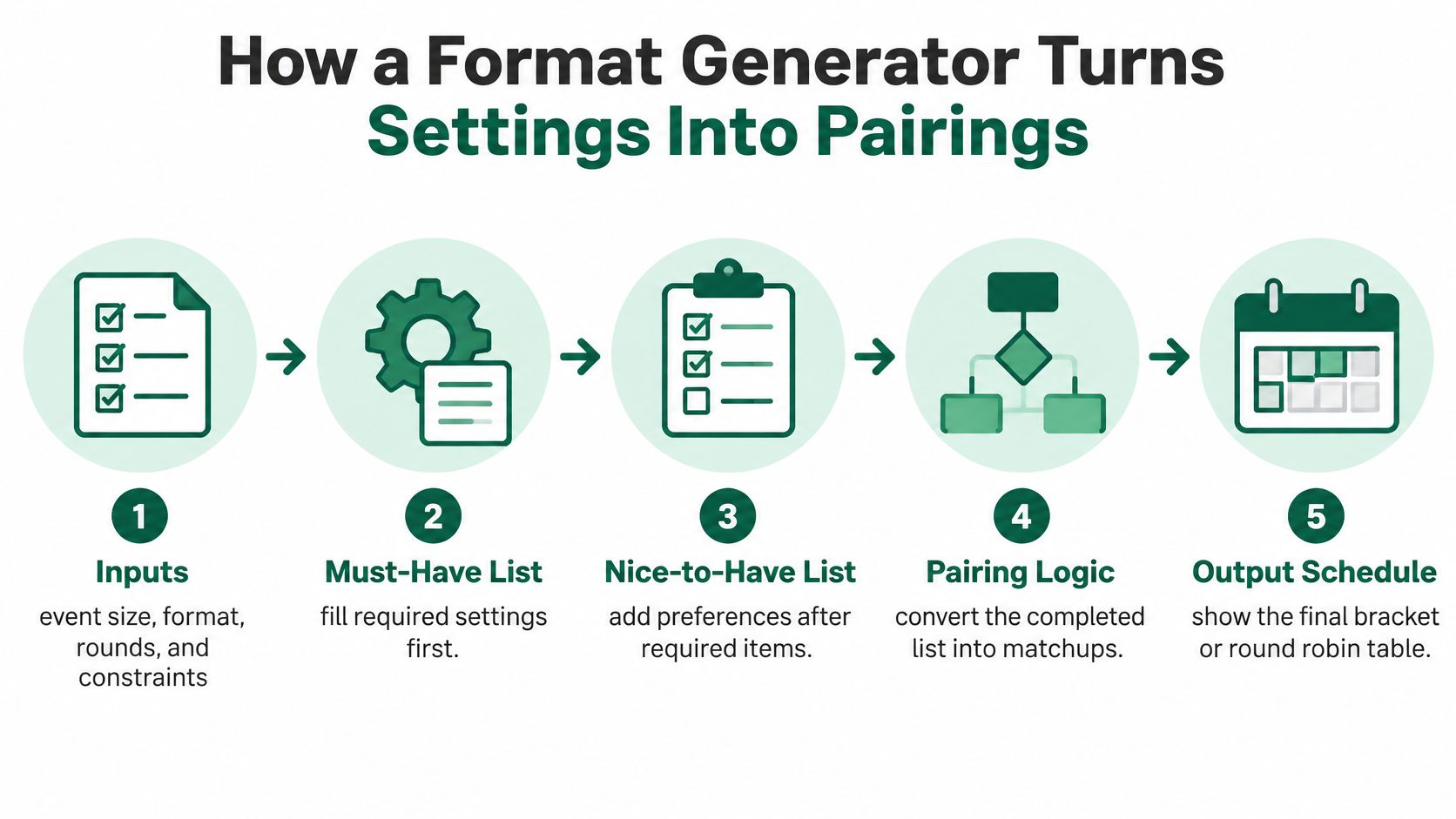
A seating planner with a must-have list and a nice-to-have list fills the first list completely before touching the second. Family members who can't sit together get separated first; the preference for a window seat gets satisfied afterward, if it can be. A pairing generator works in that order, and the reason it works is that the two lists carry very different weights.
Inputs and Outputs
The inputs are the settings already decided: event type, team composition, handicap allowance, rounding policy, stroke-index table, and whether handicaps are calculated per player or from combined team values, plus field size, number of rounds and any restrictions the director wants enforced. The outputs are groups, pairings, tee times or starting holes, and explicitly recorded byes.
The Method in Plain Steps
The USGA's committee guidance on pairing procedures describes pairing as a graph problem drawn from Swiss-system tournament research: participants become nodes, feasible pairings become edges, and rule priorities are encoded as edge weights, with maximum-weight matching selecting the best simultaneous set of pairings. Translated into director language:
- Every player is a point. Every allowed pairing is a line between two points.
- Each rule adds or subtracts weight on that line. A hard violation, such as scheduling a player twice in one round or repeating an opponent the format forbids, carries a very large penalty.
- Soft preferences carry smaller penalties: spreading byes evenly, keeping players from the same group apart, preserving score-based tiers, respecting team or tee-time capacity.
- For each round, the generator selects the set of pairings with the highest total weight, then moves to the next round with the results so far as new inputs.
This is why sequential assignment struggles. Filling round one greedily, pairing the first name with the second and so on, can leave the last two players with no legal pairing at all, and the only fix is to unwind earlier choices. Weighted matching considers the whole round at once, which is what makes it usable for round robins, brackets, Ryder Cup-style sessions and multi-round events where constraints compete.
What the Director Should Be Able to See
The selected constraints should be visible per round, and the pairing history should be retained so a director can explain why two members met twice or why one player sat out. Opaque randomization can't be defended at the awards dinner.
Live scoring on the day depends on the venue's network holding up as much as on the pairings, and the equipment side is worth understanding before a shotgun start; this overview of Premier Broadband networking hardware shows the kind of rack and enclosure hardware that keeps connectivity organized in a clubhouse or maintenance building.
Checks That Catch Bad Pairings and Byes
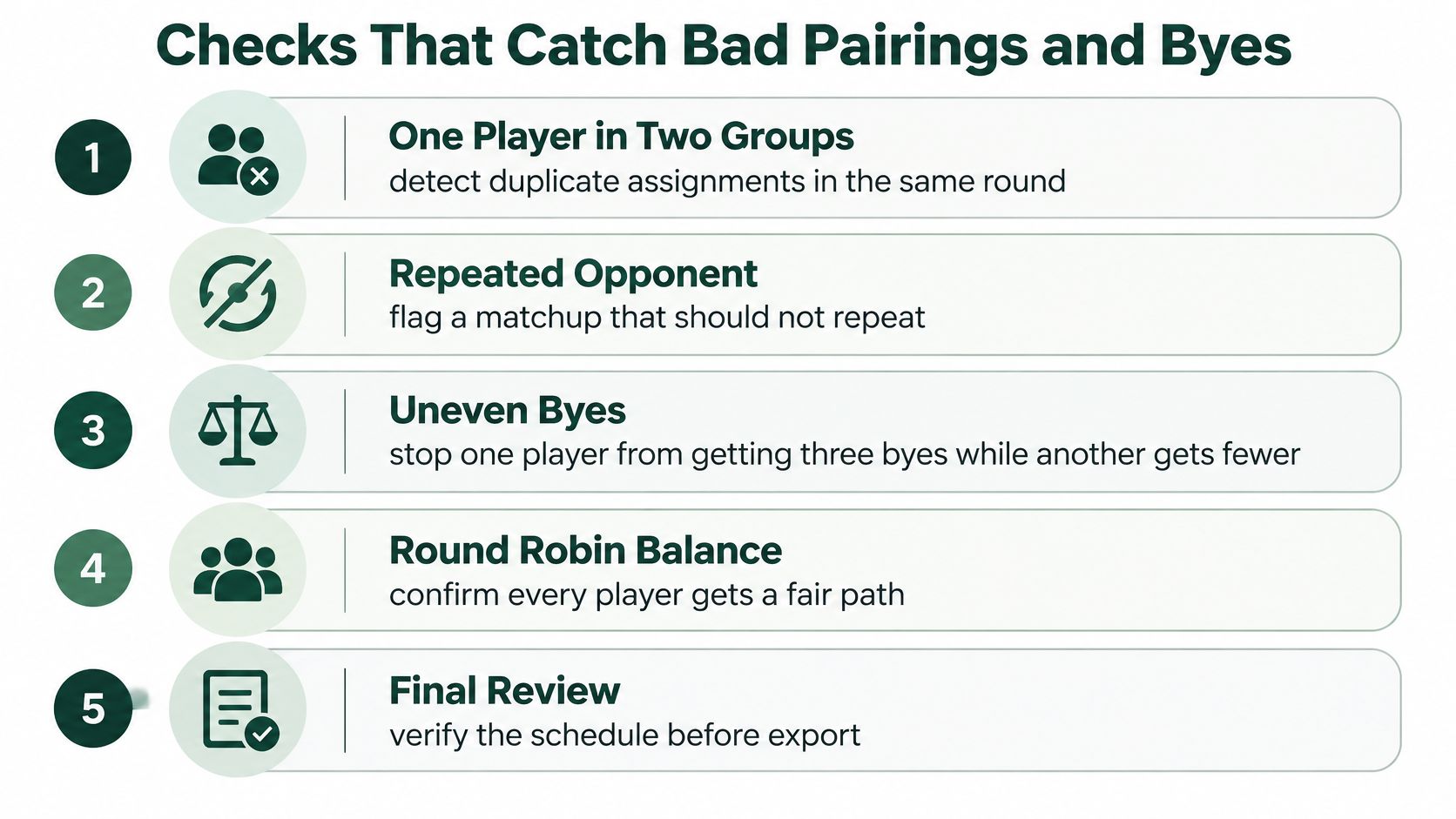
The failures are recognizable. One player appears in two groups on the same tee sheet. A round robin that shouldn't repeat opponents pairs the same two members in consecutive rounds. One player collects three byes while another never sits out, and the standings reward the player who played more golf. None of these are generator bugs. They're settings gaps, and they're all catchable before publication.
Seven Checks Before Publishing
- One appearance per round. Every eligible player appears exactly once in each round, and no name shows up twice.
- Full coverage. Every required match or group in the format is present, counted against the fixed total for that structure.
- Byes recorded and spread. Byes are written into the schedule rather than left as gaps, and they're distributed evenly across the field.
- Repeats only where the format wants them. Later cycles of a round robin repeat opponents by design; a first cycle shouldn't.
- Separation rules honored. Players who must be kept apart, such as partners from the same club in a member-guest draw, aren't in the same group.
- Tee-time capacity respected. Count intervals, not groups: five groups of four at ten-minute spacing span forty minutes from the first tee time to the last, and the tee sheet has to hold that window.
- Flights and tiers match the event rules. Each player's allowance was applied for the format being played, and flight boundaries follow the stated handicap or score criteria.
A schedule that passes all seven checks can still be unpopular. A schedule that fails one of them is unfair, and that's a different problem.
Building Groups by Hand or by Tool
Both routes are legitimate. Organisers build each week's groups themselves or let Live Tourney assign them, with tee times or shotgun starting holes. Hand-building makes sense when the field carries specific pairing requests, sponsors placed with guests, or a captain's discretion the director wants to exercise. Tool assignment makes sense when the field is large and the constraints are rule-based rather than personal.
Either way, the output gets checked against the list above. In a match play league, the matchups for every round are generated automatically, which shifts the director's job from drawing pairings to verifying them. Check round one before any player sees the schedule, because a first-round error propagates through every later round. Bracket structures and round sequencing are covered in this piece on the match play schedule.
Worked Examples for Three Common Events
These are illustrative fields, not real events. The arithmetic is the point: a director should be able to repeat each calculation with a different headcount and get a schedule that adds up.
A Charity Outing With 12 Players
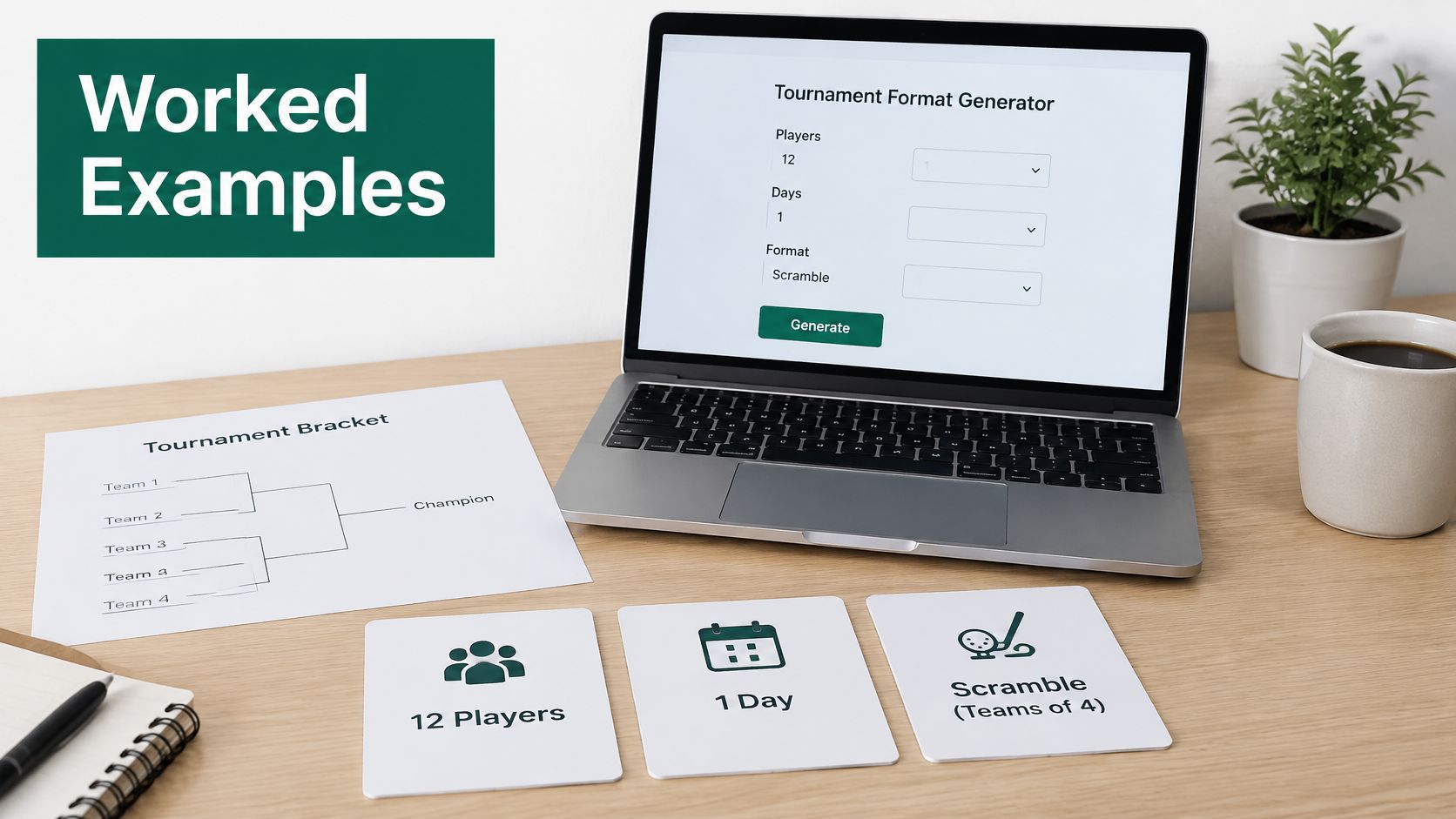
Twelve players, one day, scramble in teams of four. Divide first: 12 / 4 = 3 teams of 4, which means 3 groups on the course. With a shotgun start from three holes, all three groups tee off simultaneously, so there's no tee-time spacing to calculate and no interval window to reserve. The whole outing occupies three starting holes and finishes when the slowest group finishes.
The format choice does the logistical work here. Three groups on a shotgun is a small footprint the course can absorb around regular play, which is usually the constraint a charity organizer is negotiating against.
A Club Round Robin With 6 Members
Six members, one month, match play round robin. Each player meets 5 opponents, and every match involves two players, so the total is 6 x 5 / 2 = 15 matches. An even field divides cleanly: 5 rounds of 3 matches, and 5 x 3 = 15 confirms it. There are no byes, because every round can pair all six players.
That clean division is worth checking before promising a schedule length. An odd entry count changes the structure immediately, adding a sitting player each round and stretching the number of rounds needed to complete the cycle.
A 40-Player Stroke Play Day
Forty players, one round, individual stroke play in two flights. The groups come first: 40 / 4 = 10 groups of 4. Split those into two flights of 5 groups, which puts 20 players in each flight. Apply each player's allowance for individual stroke play before drawing the flights, so the tier boundaries reflect Playing Handicaps rather than raw indexes.
Then check the tee sheet against the spacing set for a five-group flight. If the window isn't there, the fix is a second tee or a shotgun, not a shorter interval that squeezes groups into each other on the first fairway.
Outings that bring guests in from out of town add an arrival layer on top of all this, and transfer timing has to work backward from a fixed start. This look at Unique Private Transportation on Cancun transfers shows how pickup windows get planned around an immovable departure or start time, which is the same discipline a shotgun start demands from a director coordinating hotel shuttles.
The Edge Case That Breaks Schedules
One player withdraws from the 40-player day. Now 39 players make 9 groups of 4 and one group of 3, since 9 x 4 = 36 and 36 + 3 = 39. The generator has to handle a three-ball without breaking the pairing rules or dropping a name, and the flight counts need rechecking, because a flight that was 20 players may now be 19. Late withdrawals are normal. A schedule that can't absorb one gets rebuilt by hand on the morning of the event.
Confirm the Format Before You Build the Schedule
The decision isn't which button generates the pairings. It's whether to build the schedule now or spend ten minutes confirming the settings first. Building first feels faster and costs more, because a format change after publication means re-issuing tee times and re-explaining handicaps to the field.
The order that avoids that:
- Write down the field size, the days available and the team size.
- Pick the starting format from the field-size table.
- If the event uses teams, choose the team format, then set the handicap allowance for that format from the allowance table.
- Confirm the bye and repeat rules fit the schedule length, especially for odd fields and multi-cycle leagues.
- Run the generator with a real roster and check round one against the checklist before anyone sees it.
Live Tourney supports five event types: single round tournaments, multi-round tournaments, match play brackets, round robins and Ryder Cups. A match play league runs as a round robin with flights, a generated schedule, 9 or 18 hole matches, bye weeks, and points per hole or per match, which covers most weekly club structures without custom setup.
It's web based, so players score in their phone browser from a link or QR code, with no app to download, and players receive email and text messages. The feature overview lists what's configurable, the walkthrough shows setup end to end, plans and prices cover the Single Event and annual options, and league formats detail recurring play. There's a 10-day free trial, which is enough time to run one real roster through the checks above.
Settle the format and the allowance first. Then build the schedule.
Live Tourney generates brackets, round robins, Ryder Cup sessions and single or multi-round tournaments, assigns groups with tee times or shotgun starting holes, and applies the 2024 USGA Rules of Handicapping so the allowance matches the format entered at setup. Directors who want to test their own field size and format against the checks in this article can start the 10-day free trial and review round one before publishing. Visit Live Tourney to set up an event with a real roster and see the pairings it produces.