
Sep 3, 2026
2 man golf tournament formats, golf tournament formats, two-man golf games, golf tournament scoring, golf event planning
Explore the best 2 man golf tournament formats for your next event. This 2026 guide covers team pairings, scoring styles, and tips for a successful day on the

You've got the pairings ready, the tee sheet is filling, and every team has two players. That part is easy. The format decides what happens next: whether players rely on one standout partner, make decisions together on every shot, manage a serious head-to-head match, or struggle to understand how the score should be entered.
The best 2 man golf tournament formats match the field, not just the organizer's preferences. This guide compares the rules, hole-by-hole scoring, handicap considerations, pace, player experience, competitive difficulty, and practical Live Tourney setup decisions for eight formats. It also explains what tends to work, what creates confusion, and which scoring workflow should be configured before tournament day.
For broad accessibility, start with best ball or scramble. For more strategy without making the event overly severe, consider Chapman or shamble. For serious competition, alternate shot or match play creates more pressure. For novelty and consistency challenges, aggregate or worst-ball scoring changes how every player approaches the round. The right choice depends on who's playing, how much explanation the event can support, and whether you want the leaderboard to reward one great score or two dependable ones.
1. Best Ball Four Ball
Best ball, also called four-ball or better ball, is usually the safest starting point for a two-player tournament. Each golfer plays an individual ball from tee to hole, and the team records the lower score for each hole. In match play, that lower score is compared with the opposing team's lower score. In stroke play, the team builds its round from the best score on every hole, as explained in this best ball and four-ball format guide.
A simple example makes the scoring clear. If one partner scores 4 and the other scores 5 on a hole, the team posts 4. If the partners score 6 and 6, the team posts 6. Both players still matter because either one can supply the counting score.

Why organizers choose it
Best ball handles mixed abilities better than alternate shot because each player controls their own ball. A developing golfer can contribute with a good hole without having every miss carry directly into the team's next shot. A stronger golfer can also provide the counting score when the partner has trouble.
The format works for club events, corporate outings, and member tournaments because the rules are familiar and the scoring workflow is clean. For net four-ball stroke play, the USGA handicap guidance uses an 85% allowance, with the lower net score becoming the team's score for the hole, as specified in the USGA four-ball stroke play guidance.
Configure the scoring system to show both individual scores and the selected team score. Publish whether the event is gross or net, define handicap treatment before registration closes, and label the leaderboard Best Ball, Four-Ball, or Better Ball consistently. For a Ryder Cup-style competition, the format's team scoring background is also useful context in this Ryder Cup format and scoring guide.
2. Scramble
A two-person scramble is built for participation. Both golfers tee off, the pair selects the preferred shot, and both players continue from that location. The process repeats until the ball is holed, and the team records one score for the hole. The PGA's explanation of best ball versus scramble highlights a rule organizers should state clearly: the selected ball must remain in the same cut of grass, so a ball in the rough can't be moved onto the fairway because that position is better.
Suppose the partners hit drives into the fairway and rough. They select the fairway ball, both hit from there, then choose the stronger second shot. If the team reaches the green and holes out in 4, the team score is 4, regardless of which player made the final stroke.
The accessible choice
Scramble is especially effective for charity events, corporate outings, pro-ams, twilight events, and small club competitions. Two-person scrambles are operationally simpler than larger-team versions because the organizer only tracks one selected ball for two players at each stage. Industry format guidance describes the two-person version as low to medium complexity with low resource requirements, which makes it practical when staff and volunteers are limited, as outlined in this two-person scramble format guide.
The trade-off is that a strong player can influence nearly every decision and shot. That can be enjoyable for a casual field, but it can also reduce the role of a less experienced partner. Handicap rules vary by competition, so don't assume that a standard allowance applies. State the allowance, placement restrictions, and whether the team must use a minimum number of drives from each player.
Use a digital scorecard that records the team score without forcing players to enter unnecessary individual details. If you want more visibility into participation, collect each player's score separately while displaying the single team total on the leaderboard. That gives staff an audit trail without making the round feel administrative.
3. Alternate Shot Foursomes
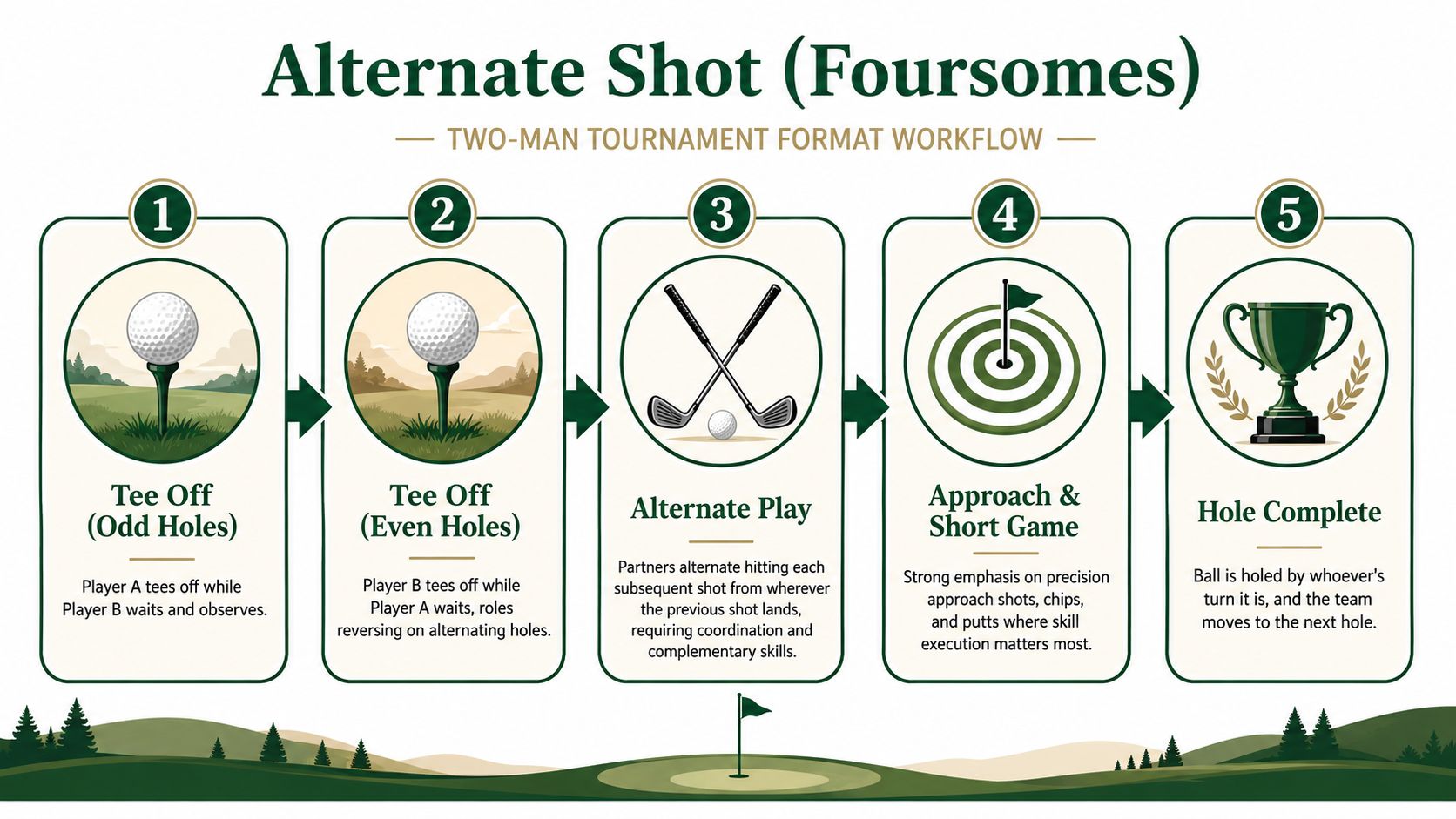
Alternate shot, known as foursomes, asks partners to share one ball and alternate strokes until the hole is complete. One player tees off on one group of holes and the other starts the remaining holes, commonly using odd and even hole assignments. The team's score is the total number of strokes taken with that shared ball.
For example, Player A drives, Player B hits the second shot, Player A plays the third, and so on. If the ball is holed in 5, the team posts 5. The players don't each produce a separate score, so a poor shot affects the team's next decision immediately.
The format for serious partnership golf
Foursomes has been part of the Rules of Golf for more than a century and remains a core format in elite team events such as the Ryder Cup and Solheim Cup. Its modern return to PGA Tour team competition came in 2017, when the Zurich Classic adopted alternating rounds of four-ball and foursomes, according to the history of foursomes.
The format rewards planning, emotional control, tee-shot order, and complementary skills. Partners must decide who handles particular situations well, but they can't choose the safer player's ball after every shot. That makes foursomes more demanding than a scramble or best ball, especially for pairs with a wide handicap spread.
Practical rule: Publish the tee-shot order on the scorecard and explain that the order continues through the hole. Confusion about who plays next creates avoidable penalties and delays.
Foursomes can be played as stroke play or match play. It generally uses fewer total balls and creates a strong competitive identity, but casual players may find the format frustrating if they aren't prepared for the shared-ball pressure. Explain the sequence before the first tee, provide a sample hole, and configure the leaderboard to accept one team score per hole. Greensomes is a related alternative, and its differences are covered in this greensomes golf format guide.
4. Chapman System Pinehurst
The Chapman System, also called Pinehurst, starts like a scramble but becomes alternate shot. Both players tee off, then each plays the other partner's tee shot. After those second shots, the pair chooses one ball and plays that ball to completion, with the player whose second shot wasn't selected taking the next stroke.
Consider a hole where Player A's drive is selected, but Player B's second shot from that location is better. Player A then plays the next shot, and the partners alternate from there. If they finish in 5, the team records 5.
Why Chapman creates better decisions
Chapman gives both partners a meaningful role before the team commits to one ball. The opening drives matter, the exchanged second shots matter, and the ball-selection decision can determine the rest of the hole. It's more strategic than a standard scramble without placing every shot under the same shared-ball pressure as traditional foursomes.
The format can accommodate moderate skill differences because each player contributes early. It also creates natural conversation between partners, especially when they must choose between a better lie, a better angle, or a ball that suits the next player's strengths.
The cost is explanation. Casual golfers often understand “pick the best drive” but lose track when the second shots are exchanged. Put the sequence on the scorecard in plain language:
Tee shots: Both partners hit.
Second shots: Each player hits the other player's tee shot.
Selection: The team chooses one ball.
Finish: The player who didn't hit the selected second shot plays next, then partners alternate.
A digital scoring setup should display one team score for each hole, while the event briefing should explain the selection rule before play. The format is a strong choice when a regular scramble feels too easy but alternate shot feels too severe.
5. Texas Scramble Modified Scramble
Texas Scramble keeps the familiar opening of a scramble, then adds another decision. Both players tee off, the team selects the better drive, and both players hit second shots from that selected location. The pair then chooses the better second-shot position and continues the scramble process until the ball is holed.
If the team selects Player A's drive and Player B's second shot finishes closer to the green, the team plays the next shots from Player B's position. A final score of 4 is recorded if the pair holes out in four strokes from the selected sequence.
A useful middle ground
This variation preserves the social energy of a scramble while creating more opportunities for each golfer to contribute. It's more demanding than a standard scramble because the team must evaluate two shots from the same drive, not just select one ball and repeat the process. That makes club selection and risk management more visible.
Texas Scramble is a practical option when your field wants teamwork but your committee worries that a regular scramble will produce an overly relaxed competition. It also gives a stronger golfer less control over every decision because the partner's second shot can become the selected position.
The format needs a precise rules sheet. State whether the team must use both players' drives, how many drives each player must contribute, where the second shots are played, and whether the same placement restrictions apply at every stage. Don't rely on a generic “Texas Scramble” label because local variations are common.
Keep the scoring workflow simple. Staff should enter one gross or net team score per hole, while marshals or volunteers monitor the placement rules. A short briefing at the first tee should explain that the second-shot selection is part of the format, not an optional variation.
6. Better Ball Match Play
Better ball match play uses the same low-score principle as four-ball, but the competition is decided hole by hole rather than by a cumulative stroke total. Each player plays their own ball, each team identifies its lower score on the hole, and the team with the lower better-ball score wins that hole. A tied hole is halved.
Suppose Team A posts 4 and 5, while Team B posts 4 and 6. Both teams have a better ball of 4, so the hole is tied. If Team A posts 3 and 5 and Team B posts 4 and 4, Team A wins because 3 beats 4.
Where match play changes the experience
Match play creates momentum that a stroke-play leaderboard can't reproduce. Players track whether they're up or down, decide when to attack, and may concede a hole once the result is clear under the competition rules. A team can be behind early and still recover, while a strong stretch can close a match before every hole is completed.
This format suits club championships, bracketed events, and team competitions where head-to-head tension matters more than comparing every team against one total field. It also works across different schedules, including shorter matches, provided the committee publishes the match length and tiebreaking procedure.
Handicaps can be used for net match play, but the committee must explain how strokes are allocated and how the software reflects them. Configure the event as match play rather than forcing a stroke-play leaderboard to imitate match status. The system should show each match's holes won, holes lost, and holes remaining.
Pairing and scheduling matter as much as scoring. Build the bracket before the event, assign tee times with enough flexibility for matches that finish at different points, and provide players with a clear match identifier. Live Tourney supports tournament formats including match play and paired competition, which can help organizers keep the scoring workflow aligned with the event structure.
7. Worst Ball Aggregate Scoring
Worst ball reverses the usual best-ball instinct. Both golfers play their own ball, but the team records the higher score on each hole. If one partner makes 4 and the other makes 6, the team posts 6. If both make 5, the team posts 5.
That scoring rule turns a normal two-person round into a consistency test. A player can't rely on a partner's par to erase a difficult hole. Each golfer must limit mistakes, recover sensibly, and avoid the blow-up score that becomes the team's number.
Use novelty deliberately
Worst ball is memorable because players immediately understand the pressure once they see the first few scores. It can fit a charity event, themed competition, side game, or club day that needs something different from standard best ball. It's less suitable when participants expect a conventional championship structure or may become discouraged by high team scores.
Decide whether the event will use gross or net scoring. If net scoring is allowed, document how strokes are applied before the round. Don't hide the format behind a leaderboard label such as “Team Score.” Call it Worst Ball so players understand why a higher individual score may be appearing as the team result.
A sample on the scorecard prevents disputes:
Player scores: 4 and 6.
Team score: 6.
Scoring principle: The higher score counts.
Keep the pace in mind. Players may spend more time replaying a poor hole mentally because it affects the team directly. A concise rules briefing, visible hole-by-hole team scoring, and a clear maximum-score policy, if the committee chooses to use one, can keep the event moving. Don't introduce a maximum without publishing it in advance.
8. Two-Man Shamble
A two-man shamble combines a scramble start with best-ball scoring after the drive. Both golfers tee off, the team selects the better drive, and then each player plays their own ball from that selected position through the rest of the hole. The lower finishing score becomes the team score.
For example, the team selects Player B's drive. Player A plays from that position and scores 5, while Player B scores 4. The team records 4 for the hole. Unlike a scramble, the partners don't keep selecting a single ball after every shot.
The balance between access and competition
Shamble works well for mixed-ability teams because both players receive the benefit of the better drive, but each must still complete the hole independently. The format gives players a shared strategic decision off the tee, followed by individual shotmaking and recovery choices. It's easier to manage than alternate shot and more competitive than a standard scramble.
The main operational risk is the transition. Players who hear “scramble” may assume that every shot is shared, while players familiar with best ball may forget that the opening drive is selected. Put the rule directly on the scorecard and repeat it at the first tee.
Use one team score per hole on the primary leaderboard, with individual hole scores stored if your system supports them. Make the event label explicit, such as Two-Man Shamble Gross or Two-Man Shamble Net. The shamble format guide from Live Tourney can help organizers explain the format in player-facing language.
A shamble is often the right compromise when the field includes social golfers and stronger players, but the committee still wants decisions and individual performance to matter. It creates enough variety to feel like an event without requiring a long rules lecture.
8 Two-Man Golf Formats Compared
Format | 🔄 Implementation Complexity | Resource Requirements | ⚡ Speed/Efficiency | ⭐ Expected Outcomes | 📊 Ideal Use Cases / 💡 Key Advantages |
|---|---|---|---|---|---|
Best Ball (Four Ball) | Low, simple scoring per hole | Minimal, scorecards or app | ⚡ High, fast play, both balls played | ⭐⭐⭐⭐, steady team scoring; balances skills | 📊 Club champs, corporate outings, 💡 Inclusive, easy to run; flexible handicaps |
Scramble | Low–Moderate, clear but different shot rules | Low, tee markers, volunteers for pacing | ⚡ Very high, fastest team format | ⭐⭐⭐⭐, very low team scores; high engagement | 📊 Charity events, Pro-ams, 💡 Great for mixed abilities and spectator excitement |
Alternate Shot (Foursomes) | High, alternating shots and tee order rules | Moderate, clear rule enforcement, informed players | ⚡ Low, slower due to alternating play | ⭐⭐⭐⭐, high-quality, skill-revealing outcomes | 📊 Match play, elite events (Ryder Cup), 💡 Tests partnership, strategy; best for skilled pairs |
Chapman System (Pinehurst) | Moderate, hybrid rules need explanation | Moderate, scoring clarity and markers recommended | ⚡ Moderate, slower than best ball, faster than foursomes | ⭐⭐⭐⭐, balanced outcomes showcasing varied skills | 📊 Club tournaments, member-guest, 💡 Strategic, fair contribution from both players; require pre-event instructions |
Texas Scramble (Modified Scramble) | Moderate, added second-shot rule to manage | Low–Moderate, similar to scramble with extra tracking | ⚡ High, slightly slower than standard scramble | ⭐⭐⭐, more skill separation than scramble | 📊 Charity or corporate when more challenge is desired, 💡 Keeps scramble pace but increases competitiveness |
Better Ball (Match Play) | Moderate, matchplay logistics and brackets | Moderate, bracket management and scoring platform | ⚡ Variable, matches may finish early or extend | ⭐⭐⭐⭐, dramatic, momentum-driven results | 📊 Match play divisions, club championships, 💡 Exciting for spectators; needs clear advancement rules |
Worst Ball (Aggregate Scoring) | Low, simple reverse scoring but unfamiliar | Minimal, standard scoring with handicap adjustments | ⚡ Moderate, psychological impact can slow play | ⭐⭐, novel outcomes; can produce high scores | 📊 Novelty or charity divisions, 💡 Use net scoring for fairness; market as fun/novel event |
Two‑Man Shamble | Moderate, transition from team tee to individual play | Moderate, markers, clear format cards helpful | ⚡ Moderate, faster than foursomes, slower than scramble | ⭐⭐⭐, balanced: scramble excitement + individual challenge | 📊 Corporate/club alternative days, 💡 "Best of both worlds"; good for mixed-ability fields |
Turn the Format Into a Smooth Event
The format decision should start with the player experience. Choose best ball when you want familiar rules, individual play, and a forgiving structure for mixed abilities. Choose scramble when participation, teamwork, and pace matter most. Choose Chapman or shamble when you want players to make decisions without imposing the full pressure of shared-ball play.
For a more serious field, alternate shot tests partnership and consistency, while better-ball match play creates direct competition and a clear sense of momentum. Use worst ball for novelty, not by accident. Aggregate scoring can also create a demanding consistency challenge because both players' scores count, but define the exact calculation and handicap treatment before registration opens.
Before tournament day, confirm these decisions in writing:
Player ability: Decide whether the field is mostly social, mixed handicap, or competitive.
Pace target: Identify whether the event needs a quick rotation or can support more explanation and decision-making.
Scoring basis: Publish gross or net scoring, and state the handicap allowance or calculation.
Tee-shot order: This is essential for alternate shot and should be clear for any format with required drive usage.
Ball selection: Explain whether the team selects a drive, a second shot, or every shot, and define placement restrictions.
Tiebreakers: Specify the procedure before play, particularly for stroke-play leaderboards and match-play brackets.
Flights: Decide whether teams compete in one field or separate by handicap, division, or player category.
Side games: Configure closest-to-the-pin, skins, or other extras separately so they don't interfere with the primary team score.
Leaderboard labels: Use recognizable names such as Best Ball, Four-Ball, Scramble, Chapman, Shamble, or Foursomes.
Scoring software should reflect the rules instead of making staff translate them manually. A platform such as Live Tourney can help organizers configure pairings, scoring formats, live leaderboards, reports, and player communications through a browser-based workflow. Its back-office tools include roster uploads, report building for scorecards and tee sheets, dynamic emails, side games, and payout calculations. It also supports single- and multi-round events, match play, Ryder Cup formats, and round robin competition.
The operational details matter just as much as the format. Use the flawless outdoor event tips as a broader reminder to plan signage, player flow, staff responsibilities, and communication alongside the golf rules. A well-run scramble can feel professional, while a poorly explained best ball can feel chaotic.
A familiar format isn't automatically the best choice. Clarity and preparation determine the player experience. Select the scoring model that fits your field, explain the decisions players must make, test the leaderboard before the first tee time, and give staff a simple process for resolving questions during play.
Live Tourney helps organizers run two-player tournaments with pairings, format-specific scoring, real-time leaderboards, reports, and player communications from one browser-based workflow. Visit Live Tourney to configure your next best ball, scramble, shamble, foursomes, or match-play event without requiring players to download an app.





