Sep 29, 2026
match play schedule, golf tournament, match play bracket, golf scheduling, live scoring
Learn how to create a match play schedule with real examples, step-by-step pairing, and tools to handle byes, tee times, and ties.

You've got a full field, the first tee is reserved, and players are already asking when they'll play. Then one match runs long, a finalist's opponent is still on the course, and the carefully prepared tee sheet starts to unravel. That's the point where a match play schedule proves whether it was designed for real golf or only for a bracket on paper.
A good schedule protects competitive fairness, keeps the course moving, and gives players clear information before they arrive. The bracket matters, but so do byes, extra holes, tee-time spacing, result entry, and the way staff communicate changes. Here's how to build a schedule that works on the ground.
The Match Play Scheduling Challenge
Match play creates a different operating problem from stroke play. In stroke play, the organizer mainly needs to place players on the course and collect completed scores. In match play, every result changes the next pairing, and the finish time of one match can affect several later matches.
A typical trouble spot appears in the first knockout round. One match ends early because a player wins comfortably, while another reaches the final green all square and continues beyond regulation. If both winners are scheduled for the next round at nearly the same time, the early finisher waits, the other player rushes, or the committee moves the entire schedule. None of those outcomes feels professional.
The excitement comes from the same uncertainty that creates the administrative pressure. A player can be several holes down and still change the match with one strong stretch. A match can finish before the 18th hole, or it can require extra holes. The schedule must allow those outcomes without treating them as disruptions.

Where schedules usually fail
Organizers often build the draw first and think about course capacity later. That reverses the practical order. Before publishing times, establish how many matches the course can absorb, which holes will be used, how quickly groups can start, and what happens when a match goes beyond 18 holes.
The most common pressure points are:
Unbalanced byes: Some players receive an easier route while others must play immediately.
Compressed rest: A winner finishes one match and is expected to start the next before recovering or even eating.
No extra-hole allowance: One extended match pushes every later tee time.
Unclear result reporting: Staff don't know whether a match is complete, which delays the next pairing.
Late communication: Players learn about schedule changes through informal messages rather than one reliable channel.
Build around the player experience
A strong schedule makes the next action obvious. Players should know their opponent, starting hole, expected time, reporting location, and the procedure for a tied match. Staff should be able to update a result once and have the next pairing reflect it without rewriting several sheets.
The best match play events feel spontaneous to spectators but controlled behind the scenes. That balance comes from planning for the variables instead of pretending they won't occur.
Understanding Standard Match Play Brackets
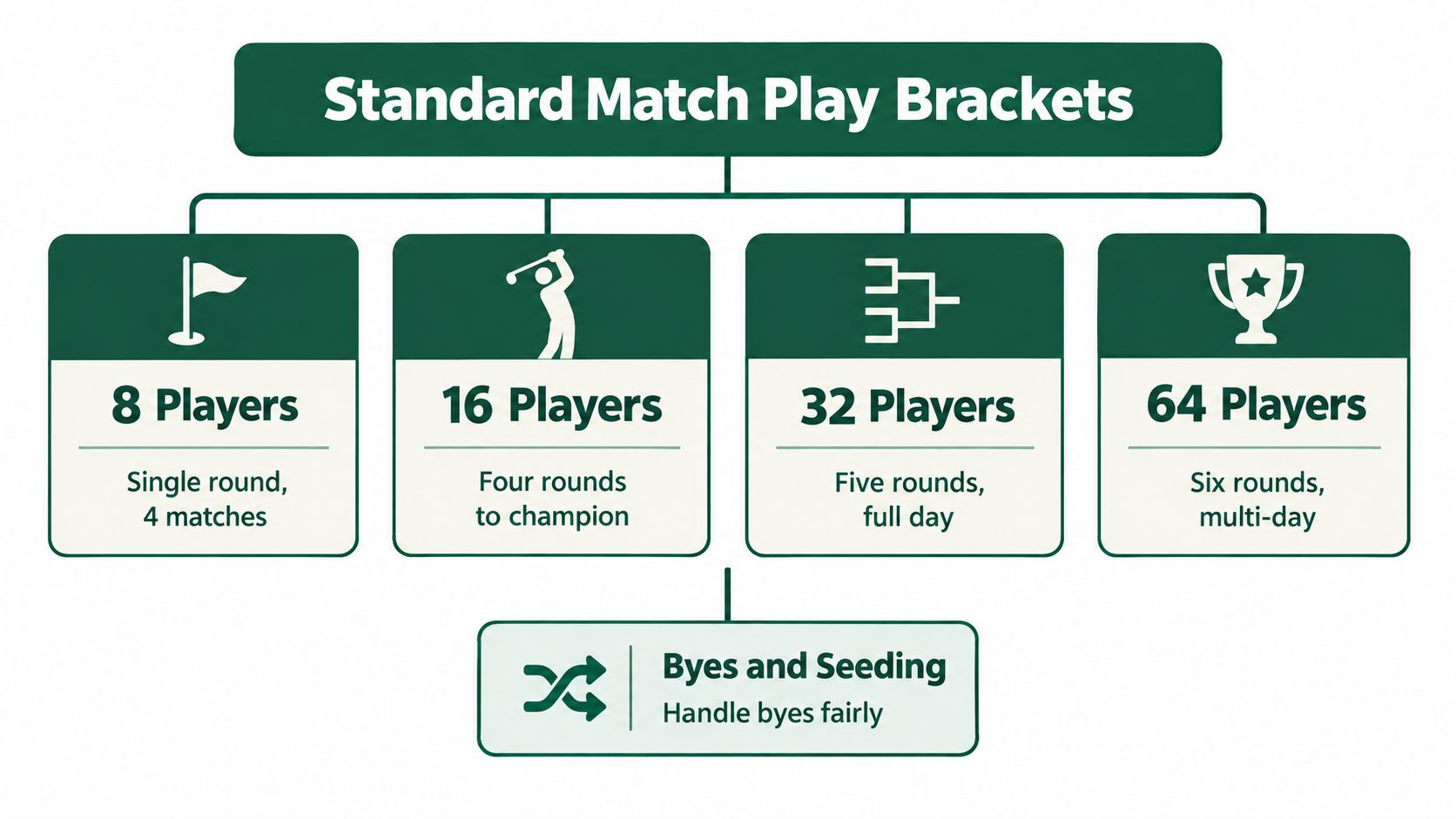
Start with a draw that gives every player a transparent path to the final. USGA guidance on match play flights and draw sizes recommends standard fields of 8, 16, 32, or 64 players. These sizes produce clean elimination structures and make the number of matches in each round easy to calculate.
An 8-player bracket begins with four matches. A 16-player bracket begins with eight, a 32-player bracket with 16, and a 64-player bracket with 32. Each winning round halves the field until one player remains. The clean structure helps staff prepare scorecards, tee sheets, noticeboards, and digital result pages without custom exceptions for every round.
Seed before you schedule
If qualifying determines the field, use those results to create a repeatable seeding process. The USGA's recommended General Numerical Draw is designed for situations where flights are determined by qualifying. It gives the committee a consistent way to place competitors and reduces the distortion that can come from a completely blind draw.
A practical workflow looks like this:
Confirm the field size. Move the entries into the nearest approved bracket only after you know who is eligible and available.
Rank the qualifiers. Use the published qualifying method, including any stated playoff procedure for ties.
Place the seeds. Distribute high and low seeds through the bracket so strong qualifiers aren't unnecessarily grouped in the opening match.
Audit the path. Check that a player can't meet an expected high seed earlier than the published structure permits.
Publish the complete draw. Show match numbers, player names, seeds when relevant, and the next-round relationship.
For staff who need a repeatable digital workflow, this guide to creating a tournament bracket provides a useful reference for mapping rounds and advancing winners.
Handle an imperfect field fairly
A field that doesn't fill the bracket needs byes, not improvised pairings. USGA guidance recommends using byes only to complete the bracket. If there's one bye, assign it to the No. 1 position, then place additional byes in order. With multiple flights, fill as many flights as possible before assigning byes to the last flight.
That rule matters because an unbalanced distribution can create unequal routes to the final. Don't place all byes on one side merely because it makes the printed bracket look tidy. Record each bye clearly and tell players whether the opponent advances automatically or whether the player has a scheduled practice window.
The draw is finished only when the competitive route and the operational route both make sense. A technically valid bracket can still produce poor player experiences if its byes, rest periods, and reporting requirements aren't clear.
Choosing the Right Match Play Format
A player who travels for an event and loses once may leave after a single competitive match. A knockout championship creates that pressure clearly: each match advances one winner and eliminates one player, making the schedule relatively simple once the field is set. The trade-off is limited participation for early losers.
Round robin gives players several scheduled opponents, which suits leagues, compact groups, and events where guaranteed playing opportunities matter more than a fast finish. It also creates more work. Staff must record multiple results, calculate standings, check tiebreakers, and prevent the order of matches from giving one player extra rest or preparation time. Use a practical round-robin schedule guide to map pairings before assigning tee times.
Compare formats by purpose
Format | Best fit | Main strength | Main scheduling risk |
|---|---|---|---|
Single elimination | Championship events | Clear winner and intense matches | Early exit for losing players |
Round robin | Leagues and compact groups | More guaranteed competition | More pairings and standings work |
Team match play | Club or representative events | Shared identity and varied matchups | Coordinating players, points, and waves |
Group stage into knockout | Larger participation events | Combines guaranteed play with a final bracket | Requires two scheduling systems |
Team formats add player coordination, scoring, and wave planning. The Ryder Cup is the best-known global example in professional golf. According to the Ryder Cup format history, it developed from a 2-day event with 12 total points in 1927 into the modern 3-day, 28-match format used since 1979. The current structure has 8 team matches on Friday, 8 on Saturday, and 12 singles matches on Sunday, with 24 players competing across 28 points.
The format shows how different match types can fit one competitive rhythm. Friday and Saturday use foursomes and four-ball, while Sunday puts the full field into singles. Matches cover 18 holes, and a team needs 14.5 points to win the Cup, as documented in the same Ryder Cup format reference.
Match type changes the tee sheet
A two-player individual match is easier to place than a team match involving four players and caddies. Team events may need shared starting areas, coordinated waves, and a points board that staff can update quickly. Round robin can suit self-scheduled windows, while a championship bracket usually works better with fixed times because every winner feeds a known next round.
Digital scheduling tools can reduce manual errors when the format includes changing opponents, live results, or several groups. They should show each player's next match, reporting deadline, and available start window, rather than treating the schedule as a static bracket.
Choose the format before promising tee times. If participation matters most, protect repeat play. If prestige and a clear finish matter most, use knockout play. If the event needs both, run groups first and move qualified players into a final bracket after standings are settled.
Assigning Tee Times and Managing Course Flow
Once the bracket is stable, execution starts with a tee sheet that staff can run and players can understand. Set the sequence of starts, define who waits for a result, and build recovery time into the route from one match to the next.
Use this operating sequence:
Map the starting points. Confirm whether matches use the first tee, tenth tee, or additional holes. Check the walking route between starting points and the places where groups may converge.
Set the waves. Send confirmed matches first, then hold later pairings until winners are known. Give each waiting player a clear reporting location and deadline.
Control the intervals. A short gap can improve flow, but only when the opening holes and starter team can maintain it. If the first groups bunch up, later matches inherit the delay.
Build recovery buffers. A long match may finish close to the next round. Allow time for result entry, food, recovery, and travel between tees before assigning the winner another start.
Publish one current schedule. Use disciplined tee-sheet management so staff and players see the same opponent, time, starting point, and reporting instruction.
The USGA Mid-Amateur hosting manual gives a practical reference point. Its 64-player USGA match-play championship follows stroke-play qualifying with six rounds of match play, and its early match-play rounds use 10-minute intervals. Treat that interval as a starting reference, not a rule. Walking distances, pace expectations, starting configuration, and the location of the scoring desk determine whether the cadence works at your venue.

Use digital coordination where it helps
A paper bracket still helps at the starter's desk, but it becomes unreliable when multiple people record winners and move matches at the same time. A digital system can connect pairings, result entry, tee times, and player notifications, reducing the risk that a player follows an outdated printout. Live Tourney supports match play, round robin, live schedules, and tee-sheet administration through a browser-based workflow, allowing organizers to update published information without requiring players to download an app.
Use self-scheduling for a casual league or a round robin with flexible windows. Fixed times suit compressed tournament days because staff can control reporting and release matches in order. If flexibility is permitted, state the deadline, the approved starting window, and the person responsible for confirming the result.
Keep the course visually organized
Players move with more confidence when staff have a readable list, match identifiers, and a clear process for late arrivals or incomplete results. Keep the next reporting instruction visible at the scoring desk and near each starting area. For staff or volunteer uniforms, Caddie Uniform's hat styling tips offers practical guidance for keeping the course team recognizable without distracting from play.
Use group-based waves only when the assigned starting areas and transition routes support them. A second tee can reduce waiting, but it can also create confusion if players must cross paths or report results to different desks. Before releasing a wave, confirm the starter, scoring contact, player list, and next-round instruction. That small check keeps operational changes from becoming player-facing problems.
Common Match Play Scheduling Mistakes
A full tee sheet isn't automatically an efficient tee sheet. The common assumption is that tighter spacing means more matches finished, but compression only helps when players, holes, starters, and scoring staff can maintain the same rhythm.
Treat byes as a fairness issue
An unbalanced bye distribution can give one player a materially different route through the event. The remedy is simple, but it must happen before publication. Apply the approved draw order, place byes consistently, and review both sides of the bracket rather than checking only that the total number looks correct.
Don't hide a bye in a vague note such as “advance as needed.” Name the player who advances and identify the next scheduled match. That prevents a player from arriving at the tee expecting an opponent who was never assigned.
Reserve time for extra holes
Match play is decided by holes, not total strokes. A side wins once it leads by more holes than remain, while tied holes are halved rather than added to a stroke total. The SGA match play guidance explains that tied matches may continue hole by hole until a winner is found, subject to the committee's stated procedure.
That contingency belongs in the schedule, not in a footnote. Hold a buffer before the next round, identify which holes can be used for an extension, and tell players where to go if regulation ends all square. If you don't reserve that time, one extra-hole match can delay players who have already completed their round and create confusion at the next starting point.
Announce playoff procedures early
A tie for the final qualifying place or a group-stage position needs a published resolution method. Some events use an immediate sudden-death playoff. Others use criteria such as head-to-head results, points, or a coin toss in group formats. The committee should choose the method before competition begins.
USGA guidance also recommends telling competitors in advance if a tie for the last place will be settled by a hole-by-hole playoff. That announcement should include the time and location, not merely the phrase “playoff if necessary.”

Avoid relying on after-the-fact fixes
Other recurring errors include:
Skipping a rest check: A winner shouldn't be placed in the next round without checking when the match finished.
Using one rigid interval everywhere: Early rounds and later rounds may need different spacing because the number of active matches changes.
Updating only the public board: If the starter's sheet and digital page disagree, players receive conflicting instructions.
Leaving rules implicit: Players need the concession, extra-hole, result-reporting, and late-arrival procedures before the first tee shot.
A schedule becomes resilient when the committee plans for ordinary variance. Match play rarely follows the neatest possible path, so the operating plan should assume that at least one match will finish early, another will run late, and someone will ask where to report the result.
Finalizing Your Match Play Schedule
A final review should test the schedule from three perspectives: the committee, the player, and the course. The committee needs a reliable way to advance winners. The player needs one clear answer about where and when to play. The course needs enough separation to keep groups moving without creating unsafe or frustrating queues.
Before publication, check the following:
Bracket integrity: Every player appears once, every pairing is correct, and every bye follows the published method.
Round progression: Each winner has a defined next match, with no impossible overlap.
Course capacity: Starting holes, waves, and intervals match the actual operating limits of the course.
Contingencies: Extra-hole locations, playoff procedures, weather responses, and late-result handling are written down.
Communication: Players know where to find the current schedule and who can answer questions.
Result control: Staff can record a completed match once and advance the correct player.
Use the USGA match play rules framework when checking round completion. Match play is conducted hole by hole, and the stipulated round ends only when all players in the match have completed the final hole of that round. For a 36-hole match, the first round ends when players complete the 18th hole of that stipulated round.
Keep the published version clean. A player shouldn't need to interpret a spreadsheet or compare several screenshots to find a starting time. Put the draw, tee sheet, reporting instructions, and live updates in one predictable location, then brief the starter and scoring desk on the same information.
The strongest match play schedule isn't the one with the most aggressive timing. It's the one that preserves fairness when matches finish differently, keeps staff aligned, and lets players focus on beating the opponent in front of them.
Live Tourney gives golf organizers tools for match-play brackets, round-robin pairings, byes, live schedules, and tee-sheet coordination in one web-based workflow. Visit Live Tourney to see how you can publish a clearer match play schedule and manage results as the event progresses.