Aug 16, 2026
pinehurst 2 scorecard, pinehurst no 2, pinehurst yardages, pinehurst slope and rating, golf scorecard reference
Complete Pinehurst 2 scorecard with yardages by tee, par, slope, rating, stroke index, and printable layout. Plan your round with tee strategy tips.

The Pinehurst No. 2 scorecard isn't one fixed set of numbers, and that's the first detail most visitors miss. The course can appear as a 5,321-yard Red-tee layout or a 7,588-yard U.S. Open setup, while everyday and championship cards can also differ in par, ratings, and hole yardages. Pinehurst's official scorecard lists the current U.S. Open tees at 7,588 yards and par 70, while the PGA Tour's 2024 championship table lists 7,550 yards, a difference created by the setup and publication context rather than an error.
That variability matters more than a single headline yardage. Restoration, firm conditions, tee placement, and the location of the pin often decide whether a hole feels manageable or severe. A useful scorecard tells you not only how far to play, but also which shots are sensible from your tee and which mistakes leave no comfortable recovery.
What the Pinehurst 2 Scorecard Actually Shows
Treat the Pinehurst 2 scorecard as a matrix, not a static card. Each tee set changes the total yardage, par, rating, slope, and often the practical angle into a green. BlueGolf's detailed Pinehurst No. 2 scorecard makes that structure clear by displaying several tee sets and tee-specific rating information rather than one universal figure.
Before comparing numbers, learn the four terms that do the most work:
Term | Meaning on a Scorecard | Why It Matters at Pinehurst No. 2 |
|---|---|---|
Par | The score assigned to each hole and the course total | Pinehurst can play as everyday par 72 or a championship par 70 |
Stroke index | The handicap ranking of each hole | It helps allocate strokes in matches and handicapped events |
Course rating | The expected score for a scratch golfer from a specific tee | It gives more context than yardage alone when posting scores |
Slope | A measure of relative difficulty for golfers who aren't scratch players | It helps show how sharply difficulty rises for higher-handicap players |
The practical reading order is simple. First, find the tee color and yardage. Then check par and the hole-by-hole stroke index. Finally, use rating and slope to compare how demanding that tee is for different player abilities. A shorter tee can still create difficult approach shots if it leaves awkward angles into the crowned greens.
Why published cards can differ
Authoritative sources may show slightly different championship yardages. Pinehurst's restoration tour notes list a 2024 U.S. Open scorecard yardage of 7,548, while the PGA Tour's 2024 hole-by-hole overview lists 7,550 yards. The official current scorecard lists the U.S. Open tees at 7,588 yards, so the card you see depends on the event setup, tee markers, and publication date.
Practical rule: Use the scorecard in front of you for today's round. Use published cards to understand the range of configurations, not to assume every Pinehurst round uses identical numbers.
Tee Sets by Yardage, Par, Rating, and Slope
Pinehurst No. 2 has no single scorecard yardage. The tee matrix runs from the Red tees at 5,321 yards to the U.S. Open setup at 7,588, with restoration, firm surfaces, and daily tee markers changing the test. The Pinehurst No. 2 course page identifies the principal tee configurations, while BlueGolf's scorecard grid shows how ratings and slopes may be listed by tee and gender.
Tee | Yardage | Par | Rating | Slope |
|---|---|---|---|---|
U.S. Open | 7,588 | 70 | 76.5 | 138 |
Blue | 6,961 | 72 | 73.7 | 133 |
White | 6,307 | 72 | 70.7 | 126 |
Green | 5,771 | 72 | 68.0 | 123 |
Red | 5,321 | Not stated in the verified data | Women's and men's ratings shown on the scorecard grid | Women's and men's slopes shown on the scorecard grid |
The U.S. Open card combines championship length with par 70. Its 7,588 yards are spread across only 70 strokes of par, creating a demanding setup rather than a routine course played from farther back.
The Blue, White, and Green tees reduce both yardage and the published difficulty indicators. Blue remains a serious test at 6,961 yards. White at 6,307 and Green at 5,771 shorten approaches while preserving the course's defining demands, especially firm lies, runoff areas, and crowned greens. Red at 5,321 yards suits players who need shorter approaches and a better chance of reaching usable landing areas.
Tee-day decisions matter more than the printed maximum. A few yards can change the angle into a green, the club needed over a hazard, or whether a missed approach leaves a manageable recovery.
For posting scores, compare more than gross score against par. Course rating describes expected difficulty for a scratch golfer, while slope reflects how sharply that difficulty changes for players with other abilities. This course rating explanation from Live Tourney helps clarify how to read those figures for handicapping and event setup.
Front Nine Hole by Hole
The Pinehurst No. 2 scorecard is a moving target, not one fixed list of hole lengths. The front nine measures 3,534 yards in one championship routing, while the PGA Tour's 2024 championship table lists 3,728 yards. For everyday play, the Blue tee configuration gives a useful reference for a strong visitor round, but tee placement, firmness, and pin location can change the decisions more than the printed yardage suggests.
Hole | Par | Yardage | Stroke Index | Note |
|---|---|---|---|---|
1 | 4 | 402 yards | 5 | Start with a controlled tee ball. The best approach finishes below the hole, where the putting surface gives you room to manage speed. |
2 | 4 | 468 yards | 1 | Favor the side that opens the widest entry to the green. A shorter approach from the wrong angle can leave a worse chance than a longer one from the correct line. |
3 | 4 | 387 yards | 13 | The crowned green punishes a flag chase. Center green is often the proper target, particularly when the hole is cut near a shoulder or runoff. |
4 | 4 | 529 yards | 3 | Position controls the hole. Maximum distance helps only if it leaves an approach angle that can hold the green. |
5 | 5 | 563 yards | 7 | The uphill par 5 can play longer than the card appears. Use a complete yardage, then commit to the carry required for the raised or exposed landing area. |
6 | 3 | 228 yards | 11 | This is a commitment hole. Choose a conservative target, accept a two-putt opportunity, and avoid turning a difficult tee shot into a short-sided recovery. |
7 | 4 | 401 yards | 9 | Keep the drive in play and preserve an approach angle. A heroic line rarely compensates for a poor lie or a blocked entry. |
8 | 5 | 528 yards | 15 | Plan the layup around the next shot's angle, not only its remaining distance. A useful position can matter more than getting as close as possible. |
9 | 3 | 190 yards | 17 | The front-nine finish tests distance control. Choose the safe miss before selecting the flag, because a short-sided recovery can turn a reasonable hole into a dropped shot. |
The yardages and stroke indexes above represent the Blue configuration. They should not be treated as permanent hole specifications. Pinehurst publishes multiple tee setups, and championship routing can shift both length and par presentation. Use the tee matrix above for the complete figures for each set, then confirm the day's card before deciding on clubs.
The numbers are only half the instruction. Pinehurst's restored design places unusual emphasis on crowned, turtleback greens. A shot can land safely and still release away if it finishes on the wrong quadrant. The correct target is often wider than the flag, especially when the pin sits near a shoulder or falloff.
How to play the first six
The opener should establish rhythm rather than start a distance contest. A drive that misses modestly can leave an approach carrying a difficult shoulder, so favor the line that preserves a full view and a manageable angle.
The fifth's uphill visual can distort club selection. Trust the complete yardage and make the carry you have chosen. A tentative swing often leaves the ball short of the usable section, where the next recovery is harder than the original approach.
The sixth is the clearest warning that Pinehurst is not a collection of ordinary resort holes. The PGA Tour's championship table lists it as a 228-yard par 3 in the 2024 U.S. Open setup. Firm surfaces and a demanding pin can make that number play even more severely. Pinehurst's restoration notes provide the restoration context behind the course's playing surfaces and strategic character.
Back Nine Hole by Hole
The back nine is where Pinehurst No. 2 exposes a poor tee choice or a loose approach plan. In one championship routing, the inward nine measures 3,785 yards, compared with 3,534 yards on the outward nine. The sequence includes a 621-yard 10th, 460-yard 11th, 444-yard 12th, and 531-yard 16th, so the scorecard's total distance does not show how quickly the demands accumulate. The Global Golfer's course overview records that distribution and the closing stretch's heavier yardage.
Hole | Par | Yardage | Stroke Index | Note |
|---|---|---|---|---|
10 | 5 | 621 yards in the referenced championship routing | Not published in the available source | Plan for three shots unless your drive, lie, and conditions clearly create a sensible opportunity to advance farther. |
11 | 4 | 460 yards in the referenced championship routing | Not published in the available source | A strong drive helps, but the approach still needs a controlled landing area rather than a flag-first target. |
12 | 4 | 444 yards in the referenced championship routing | Not published in the available source | Favor the angle that keeps the green open. A conservative target is often better than a short-sided recovery. |
13 | 4 | Championship yardage varies by tee and setup | Not published in the available source | After the long opening run, reset your tempo and choose a line that leaves room around the green. |
14 | 4 | Championship yardage varies by tee and setup | Not published in the available source | Identify the useful miss before selecting the target. The contours matter as much as the flag location. |
15 | 3 | 197 yards in the 2024 U.S. Open setup | Not published in the available source | Commit to reliable distance control. A pin-seeking swing is a poor trade when the surrounding falloffs are in play. |
16 | 5 | 531 yards in the referenced championship routing | Not published in the available source | Choose the safest aggressive line. Position for the next shot instead of forcing the longest possible advance. |
17 | 3 | 207 yards in the 2024 U.S. Open setup | Not published in the available source | Select the club and trajectory that hold the intended section of the green, then accept the wider target. |
18 | 4 | Championship yardage varies by tee and setup | Not published in the available source | The closing turtleback green rewards an approach that controls rollout. Chasing the flag can turn a sound shot into a difficult recovery. |
The available championship figures show why the back nine plays differently from a standard resort loop. No. 15 measured 197 yards and No. 17 207 yards in the 2024 U.S. Open setup. The long par-5s then place a premium on position, especially when firm conditions make the next bounce unpredictable.
The detailed yardage grid should be treated as a configuration guide, not a permanent promise. Pinehurst can change tee markers, hole locations, and playing conditions, so the card handed to you on the day remains the working document. If a hole's championship number is unavailable for your setup, use the listed tee distance and confirm the target with the starter or caddie rather than filling the gap with an assumed yardage.
The back nine is longer, but its bigger test is decision quality under fatigue.
For tournament staff, that sequence affects scoring operations as well as strategy. Long par-4s and par-5s can extend approach and recovery time, while the closing hole can produce late swings. A live scorecard should record each hole separately, including par, tee, and player score, instead of relying only on the final total.
Everyday Par 72 vs U.S. Open Par 70
Pinehurst No. 2 does not have one fixed scoring identity. Everyday play uses par-72 configurations, while the 2024 U.S. Open card used par 70. The PGA Tour's 2024 table shows a balanced 35 on the front nine and 35 on the back nine, with the championship course measuring 7,550 yards.

The par change reflects setup decisions, not a cosmetic edit to the card. Championship routing can turn holes that support a par-72 rhythm into tougher par-4 or par-3 assignments, while tee markers may add or remove substantial distance. The PGA Tour table lists the four championship par 3s as No. 6 at 228 yards, No. 9 at 184, No. 15 at 197, and No. 17 at 207.
Yardage matters, but restoration and firmness often decide how that yardage plays. Pinehurst's restored sandy areas, open approaches, and contoured green complexes reward controlled landings. On firm surfaces, an approach can release into a collection area instead of stopping, while a pin near a crown narrows the margin for error.
A modern benchmark for difficulty
Data Golf recorded the 2024 U.S. Open scoring average at 72.78, or 2.78 over par, on the championship setup. That figure captures the combined effect of firm surfaces, demanding targets, and tournament pin positions against elite players.
Bryson DeChambeau won that championship at 6-under, as documented in the USGA's 2024 U.S. Open results. The practical lesson for visitors is direct: the longest card is not automatically the hardest day. A shorter tee can create the worse test when it leaves a poor angle, sends an approach toward a firm green, or exposes an ambitious pin. Configuration, firmness, and the tee selected that morning can matter more than the headline yardage.
How to Choose the Right Tees
Choose tees by the quality of your next shot, not by pride attached to the tee box. Pinehurst's crowned greens punish players who arrive with too much club, too little control, or an approach angle that removes the safe side. A tee that leaves you repeatedly hitting long irons or fairway woods into narrow landing zones can turn a memorable round into damage control.
The official matrix gives clear reference points:
U.S. Open tees, 7,588 yards: Reserve this for elite competitive players or a deliberate championship challenge. The 76.5 rating and 138 slope confirm that it's a severe setup, not a normal visitor choice. USGA course-handicap guidance can help tournament organizers translate that difficulty into playing handicaps.
Blue tees, 6,961 yards: A strong fit for low-handicap recreational players and competitive groups with reliable length and approach control. You'll still face meaningful distance without reproducing the full championship burden.
White tees, 6,307 yards: The sensible default for many capable recreational golfers. The 70.7 rating and 126 slope show a clear step down from Blue while preserving Pinehurst's strategic demands.
Green tees, 5,771 yards: Appropriate when carrying long approaches is limiting your ability to reach the correct green sections. The 68.0 rating and 123 slope make this a practical choice for players who want the design challenge without excessive length.
Red tees, 5,321 yards: A legitimate playing option for golfers who need shorter approach distances. BlueGolf presents Red as a separate scorecard configuration with tee-specific rating and slope information, not as an afterthought.
Match the tee to your miss
Handicap alone doesn't settle the decision. A player who hits a consistent fade may need to account for how that shape approaches the green's falloff, while a draw player may prefer a different side of the fairway. The right tee is the one that gives your normal shot shape enough room to finish in a playable quadrant.
For men and women, use the tee ratings available on the card rather than assuming one gender-neutral difficulty number. Competitive organizers should also avoid placing every flight on the same tee for administrative convenience. Balanced competition depends on comparable approach demands, not identical color choices.
A useful test is your expected approach club. If you're frequently hitting a club that cannot hold the green's intended section, move forward. That isn't conceding the course. It's choosing a configuration that lets you use Pinehurst's strategy instead of merely surviving its length.
Printable, Digital, and Live Scored Scorecards
A paper scorecard remains practical for a casual round. Mark the tee color, confirm par and stroke index, then record the score immediately after each hole. At Pinehurst, add a note beside any hole where the safest green section differs from the flag. That detail helps when a similar pin or wind appears later.
For organized play, a printed card has clear limits. It cannot update tee assignments, calculate totals, or show spectators the competition as scores come in. Players may use the wrong tee information, while staff must collect and re-enter results. A digital scorecard lets players submit hole-by-hole scores from their phones, while organizers manage pairings, formats, and leaderboards in one place.
Use Case | Paper / PDF | Digital Live Scorecard |
|---|---|---|
Casual personal round | Simple and familiar | Useful when tracking a group remotely |
Tee assignments | Must be written or printed correctly | Can be distributed with player information |
Hole-by-hole entry | Manual | Entered from a phone during play |
Live leaderboard | Not available | Updates as scores are submitted |
Event formats | Requires manual calculation | Can support configured scoring formats |
Printable materials | Easy to print | Can generate event materials from stored data |
Live Tourney's digital golf scorecard workflow shows how organizers can run this process without app downloads or third-party software. A configured course card becomes a player-link scoring experience, with live leaderboards and customizable materials including scorecards, tee sheets, cart signs, and bag tags.

Configuration matters more than the delivery method at Pinehurst. Before publishing, staff should verify the tee set, par, and event format. That check is especially important when a tournament uses a championship-style setup instead of the everyday par-72 card. The scorecard workflow should keep those choices visible and consistent from registration through final scoring.
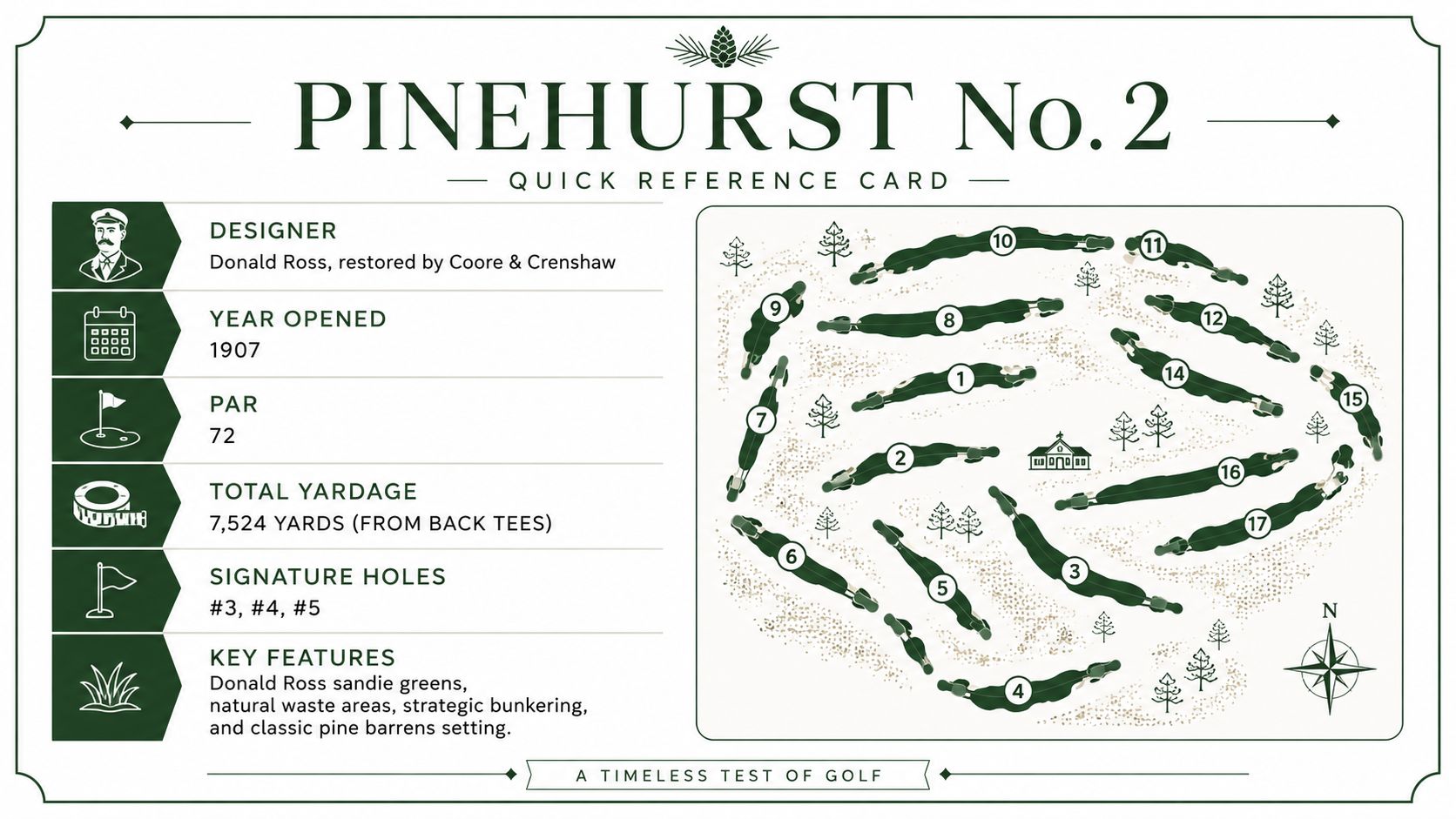
Pinehurst 2 Quick Reference Card
Use this card to set expectations before play. Pinehurst No. 2 is not one fixed scorecard. Restoration, firmness, and the tee selected that day can change how the same hole plays.
Item | Pinehurst No. 2 reference |
|---|---|
Course | Pinehurst No. 2 |
Designer and restoration | Donald Ross, restored by Coore and Crenshaw |
Everyday par | 72 |
U.S. Open par | 70 |
Yardage range in the verified tee matrix | 5,321 to 7,588 yards |
Verified slope range | 123 to 138 |
Verified rating range | 68.0 to 76.5 |
Par 3s on the championship card | Four |
Par 4s and par 5s | The remaining holes on the par-70 card |
Core playing features | Crowned turtleback greens, sandy waste areas, firm strategic approaches |
Conditions to prepare for | Firm, fast Sandhills-style playing surfaces, with Bermuda greens in summer |
The yardage span runs from the Red tees through the U.S. Open configuration, covering the Green, White, and Blue sets as well. The verified rating and slope span runs from the Green configuration at 68.0 and 123 to the U.S. Open configuration at 76.5 and 138, based on Pinehurst official documentation and BlueGolf.
Treat the card as a decision tool, not a static yardage list. Choose tees that leave realistic approaches, identify the safer green quadrant before selecting a club, and allow for firm bounces that can turn a modest miss into a difficult recovery.
If you are organizing a Pinehurst round, league, or tournament, Live Tourney can convert the selected No. 2 configuration into app-free live scoring with leaderboards, custom formats, and printable event materials. Set up the card to match the chosen tees, players, and competition format.