
Oct 17, 2026
ladies golf tournament formats, women golf tournaments, golf tournament formats, ladies golf events, golf scoring formats
Compare 8 ladies golf tournament formats, including team sizes, handicaps, scoring examples, setup tips, and live scoring options.

A ladies' club day can bring together first-time players, low-handicap regulars, and golfers who just want an enjoyable round with friends. The format decides whether everyone stays involved, how quickly play moves, and whether the event feels like a relaxed outing or a serious competition. Choosing the rules after you've already made the pairings often creates avoidable confusion.
A successful ladies golf event starts by choosing the format that fits the field, pace of play, skill range, and competitive goals. The eight options below range from quick team play to handicap-adjusted head-to-head competition, with practical guidance on scoring and setup.
For organizers, the work doesn't end at the rules sheet. Live Tourney can help manage registrations, pairings, live leaderboards, side games, and payouts across different event formats, so players and staff can focus on the day.
1. Scramble for Social Team Play
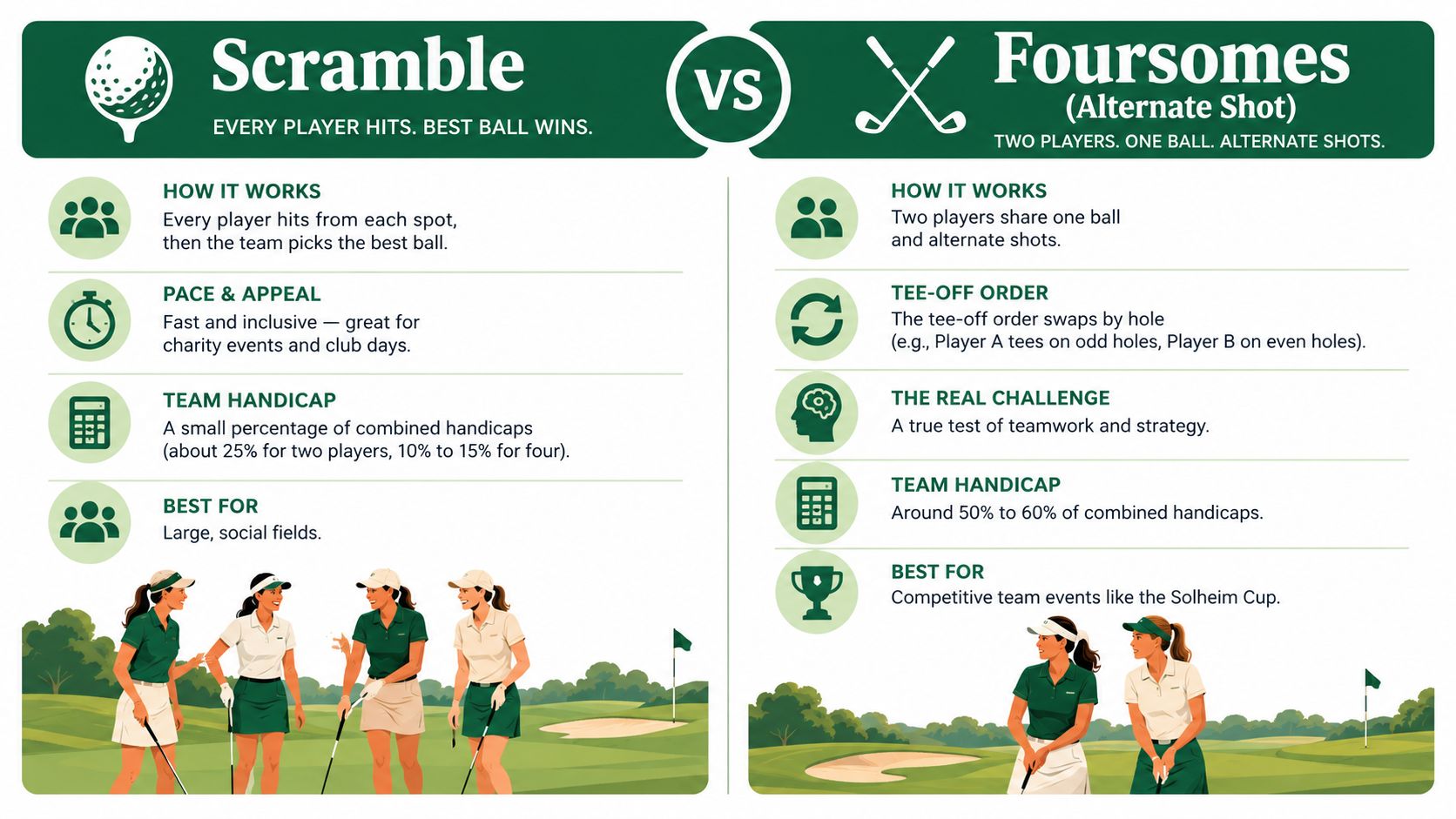
A scramble is often the easiest format to explain and the least intimidating for a mixed-ability group. Each player hits a tee shot, the team chooses one ball, and everyone plays the next shot from that spot. The team repeats the process until the ball is holed, then records one score for the hole.
Teams can have two or four players. Four-person teams suit charity outings, corporate events, and club days where social play and pace matter. A two-person scramble gives each golfer more influence over the team's result and can work well for partner events. The USGA recommends a four-person team handicap based on 25% of the lowest handicap, 20% of the second-lowest, 15% of the third-lowest, and 10% of the highest. Apply the resulting team handicap to the gross team score, and publish the calculation before registration so players know how net results will be determined. (USGA scramble handicap guidance)
Practical rule: Set the required number of tee shots from each player before the round. Without that rule, one or two strong drivers can dominate the team's contribution.
A shotgun start can help groups begin and finish in a shared event window, but it doesn't replace pace-of-play guidance. Explain how to mark the selected ball and where teammates may place their next shots under the event rules. Live scoring can show team standings during play, while a clear scorecard keeps the group aligned hole by hole.
For a fuller explanation of team setup and scoring, see this guide to running a golf scramble.
2. Stableford for Points-Based Competition
Stableford changes the question from “How many strokes did you take?” to “How many points did you earn?” Players receive points according to their score relative to par on each hole, with handicap strokes applied according to the event's chosen rules. The player with the most points wins.
That scoring approach can keep a round competitive after a difficult hole. A player doesn't need to spend the rest of the day recovering from one high score in the same way they might in cumulative stroke play. Stableford can suit a ladies' club competition, a league day, or a social event where players have different levels of experience.
Make the points easy to follow
Tell players whether they're playing gross or net Stableford before they tee off. If the event is net, explain how handicap strokes are assigned by hole, using the course's stroke index. Put a points reference on the scorecard or cart signs, and give groups a consistent way to record points so the scorer isn't left to interpret unclear marks at the end.
A practical example: if a player's handicap gives her a stroke on a particular hole, calculate her hole result after that allowance before assigning the event's Stableford points. Don't rely on each group to make its own assumptions about the points scale or handicap treatment. If you want to limit the influence of an unusually high hole, define a cap in the rules before play.
A hole-by-hole points report can also help players follow the competition and confirm results. For an accessible explanation of the scoring method, share this guide to Stableford scoring in golf.

3. Foursomes for Partnership Strategy
Foursomes, also called alternate shot, puts two players on one ball. Partners alternate shots until the ball is holed, and they also alternate who tees off on odd- and even-numbered holes. The player who hits the tee shot doesn't hit the next shot as well. Each partner's decisions affect the other's next position, making communication and shot planning central to the format.
This is a demanding choice for a casual field, but a rewarding one for players who enjoy team strategy. Foursomes is part of the Solheim Cup, the international competition between the United States and Europe. In its standard structure, foursomes is played alongside four-ball and singles, a combination that gives teams a mix of shared-ball and individual-ball contests. (Solheim Cup format and history)
Match the partners and explain the allowance
For a handicap foursomes event, the USGA recommends a team handicap equal to 50% of the partners' combined Course Handicaps. In match play, the higher-handicapped team receives 50% of the difference between the teams' combined Course Handicaps, while the lower-handicapped team plays from scratch. (USGA foursomes handicap guidance)
Pairing players with complementary strengths can make the format more enjoyable, but don't assume a long hitter and a strong putter will automatically feel comfortable together. Give partners time to discuss shot choices, publish the tee order, and explain how to handle errors or questions about the playing order. A simple team sheet can prevent uncertainty about who tees off next.
Foursomes can work for a club team match or a member-guest event where players have chosen to take on a more collaborative challenge. For a broad social field, a scramble or four-ball usually gives each person more freedom to play her own ball.

4. Four-Ball for Two-Player Teams
Four-ball, often called better ball, gives each partner an individual ball on every hole. The team records the lower of the two scores for that hole. It's a useful middle ground: partners compete together, but neither has to depend on the other to strike the next shot.
Organizers must state whether the event is four-ball match play or four-ball stroke play. In match play, teams compare their better score on each hole, and the side with the lower score wins that hole. In stroke play, the better score from each pair counts toward the team's total across the round. Those versions feel different to players, so “four-ball” alone isn't a complete rules description.
The USGA recommends a 90% handicap allowance for four-ball match play. First establish each player's unrounded Course Handicap. The lowest player uses that value as the baseline and plays from scratch; the other players receive 90% of the difference between their Course Handicap and the lowest player's. Round the resulting allowances to determine Playing Handicaps. (USGA four-ball handicap allowances)
The format rewards both steady scoring and a partner willing to take a calculated risk. If one player makes a difficult hole, the other may still post the score the team needs.
For a two-day partner event, four-ball on one day and foursomes on another can offer a strong contrast, but only if players receive clear instructions for both formats. Use the course's stroke index to allocate handicap strokes, and make the live leaderboard show the score that counts for the team on each hole. That prevents players from mistaking an individual score for the team result.

5. Chapman for a Blended Team Format
Chapman, also known as Pinehurst, gives partners more individual involvement than foursomes while retaining an alternate-shot finish. Both players tee off, then each plays the other partner's ball for the second shot. The team chooses one of those balls and alternates shots from there until the hole is complete.
That sequence is the part players are most likely to forget. Explain the swap before the round, and make sure each player can identify her own ball. A short printed diagram or a demonstration on the first tee can prevent the group from accidentally continuing with the wrong ball or using the wrong player for the next shot.
Chapman suits two-person club, resort, and charity events where organizers want a format that feels more strategic than a scramble without requiring alternate shot from the tee onward. It gives each player a tee shot and a second shot before the team commits to one ball. That creates a decision point: the team has to consider both the quality of the position and which partner will play the next shot.
Handicap treatment depends on the competition rules, so don't borrow an allowance from a different format without checking that it fits the event. Publish the allowance and explain how the team's net score will be calculated. Pairings and tee times should clearly identify each team, and scorecards should include the Chapman sequence.
A charity outing might use Chapman for a two-person flight alongside a four-person scramble flight. That gives partner teams a more involved challenge while preserving a familiar team format for larger groups. The trade-off is extra explanation at registration and on the tee, so this format works best when players receive the rules in advance.
6. Match Play Singles for Head-to-Head Drama
A player loses a hole badly, then wins the next and brings the match level. That recovery is the appeal of singles match play: each golfer faces one opponent, and each hole produces a win, loss, or halve. The match ends when a player leads by more holes than remain.
Choose this format for competitive individual events where a head-to-head result matters more than a total score. Each pairing consists of two opponents, with no partner to share decisions or shots. Women's championship golf offers a longstanding setting for this competition, documented in the USGA history of the Women's Amateur.
Build the bracket around the playing schedule
Seed the bracket through qualifying or use a draw under published event rules. For a mixed-ability field, consider flights or handicap matches. Publish the handicap allowance and identify where strokes apply before play starts; players need to compare the correct net scores on each hole.
Explain concessions and how tied matches will be resolved. A conceded putt, hole, or match stands, so players should make their intentions clear.
Give players a reporting example: a 3&2 result means the winner finished three holes ahead with two remaining. Both opponents should confirm the result, then report the winner's name and “3&2” to the designated scoring desk.
Allow room for matches that require extra holes, and publish where that play will begin. Keep the bracket visible and update it promptly. For social outings, elimination can leave players without another match, so decide beforehand whether to offer consolation play.
7. Net Stroke Play with Handicap Flights
Set the flight boundaries before registration closes so players know how they will be grouped. Net stroke play suits competitive individual events where golfers want a full-round result and can record every hole. Each player's gross total is adjusted by the applicable handicap strokes, with prizes awarded within published flights.
Choose flights when a broad handicap range makes a single net competition less appealing. Club championships, member-member events with individual awards, and league competitions can all use this approach. Players may share a starting group, but each golfer returns an individual score rather than a team total.
Separate the results, not the experience. Gross and net awards can recognize different strengths while keeping the full field part of the same event.
Publish the handicap basis, applicable allowance, flight cutoffs, and tie-breaking method before play. Confirm each participant's tees and course information when calculating the handicap used for scoring. A Handicap Index alone does not establish the strokes received for that round. For background, share the WHS handicap system explanation.
Keep score submission simple: record the gross hole scores, then apply the published handicap adjustment to determine the net total. Make clear who checks that calculation. Avoid moving players between flights unless the event's published policy allows it.
Stroke-play qualifying establishes rankings in the USGA Women's Amateur championship history; here, the practical purpose is to determine final individual standings within handicap groups.
Use leaderboard filters for flight and overall results, and label gross and net standings clearly so players follow the correct competition.
8. Skins Game for a Side Competition
A skins game makes each hole a separate contest. The player or team with the lowest score on a hole wins the skin. If players tie for the low score, the skin carries over under the event's rules, making the next hole worth more.
Skins can sit alongside a primary format, such as net stroke play, or serve as the main competition for a group that wants hole-by-hole stakes. It works particularly well as an optional side game during a ladies' club day or member-guest event. The important distinction is that the skins result doesn't replace the main event score unless the organizer explicitly says it does.
Before play, decide whether the game is individual or team-based, whether handicaps apply, and what happens when a hole is tied. Set any carryover limit and explain how the final result will be determined if ties continue. If prizes are involved, keep the terms clear and check local regulations. Don't assume every participant wants to join a wagering-style side game; make participation optional and communicate the rules before registration or play.
A live side-game tracker can show which holes have been won and where carryovers stand. That keeps players from relying on memory and helps the scorer resolve questions promptly. A payout calculator can make distributions clearer, but organizers should confirm the rules and amounts before the event rather than making adjustments after the round.
For a plain-language overview of the format, use this guide to skins game rules in golf.
Comparison of 8 Ladies Golf Tournament Formats
Golf Format | 🔄 Implementation Complexity | ⚡ Pace & Resource Requirements | 📊 Expected Outcome | ⭐ Key Advantages | 💡 Ideal Use Cases |
|---|---|---|---|---|---|
Scramble (Two- or Four-Person) | Low; select the best shot each turn and set team handicap rules | Fast; supports large fields and shotgun starts | One team score; reduced handicap allowance is common | Inclusive, social, and forgiving of mixed skill levels | Charity outings, corporate events, and club days |
Stableford Scoring | Moderate; apply handicap strokes and award points by hole | Similar to a standard round; requires a points guide or scorecard | Highest points total wins; a poor hole has limited impact | Keeps players engaged and encourages positive play | Club competitions and mixed-ability social events |
Foursomes (Alternate Shot) | Moderate; partners alternate shots and tee-off order by hole | Often slower; requires coordination and clear turn tracking | One team score per hole; partnership and consistency matter | Tests teamwork, strategy, and course management | Competitive team matches, including Solheim Cup-style events |
Four-Ball (Better Ball) | Moderate; each player plays their own ball, with the better score counting | Slower than a scramble; requires individual score tracking | Team result is based on the better score on each hole | Keeps both players involved and allows strategic risk-taking | Club partner events and team match play |
Chapman (Pinehurst) | Moderate to high; explain the second-shot swap and alternate-shot finish | Moderate pace; clear ball identification helps avoid confusion | One team score per hole after selecting a ball | Balances individual play, teamwork, and recovery from a poor tee shot | Two-person club, resort, or charity events |
Match Play (Singles) | Moderate; track holes won, lost, or halved, plus handicap strokes if used | Scheduling can be demanding for large brackets | Head-to-head winner; matches may end before 18 holes | Dramatic, easy to follow, and forgiving of an isolated bad hole | Knockout brackets, club championships, and team singles |
Net Stroke Play with Handicap Flights | Moderate; requires accurate handicaps and flight assignments | Standard round pace; needs handicap data and separate leaderboards or prizes | Lowest net score wins within each flight | Familiar and equitable across different skill levels | Club championships, leagues, and large individual events |
Skins Game | Low to moderate; establish tie, carryover, and value rules | Minimal setup; requires transparent tracking of skins and carryovers | A hole's skin goes to its lowest scorer; ties commonly carry over | Adds excitement and keeps players engaged throughout the round | Side competitions at club days, outings, and league events |
Build an Event Players Will Remember
The best ladies golf tournament format isn't automatically the most competitive one. It's the format that fits the event's purpose, the players' experience, and the time available. A scramble can reduce pressure for newer golfers, but it won't guarantee that every player's choices shape the team score. Four-ball offers more individual involvement, while foursomes asks partners to coordinate every shot.
Skill spread should guide the handicap and prize structure. Net stroke play with flights can give players a fairer contest against golfers of similar ability, while handicap-adjusted team formats can combine different skill levels without ignoring scoring differences. Match play and skins add head-to-head stakes, but they need clear rules for ties, concessions, carryovers, and reporting results. In every format, publish the scoring method and handicap treatment before pairings are final.
Participation logistics matter too. A format that requires a pre-formed team may leave solo registrants uncertain about whether they can join. Offer a partner-matching option where practical, explain how pairings will be made, and prepare a plan for late cancellations or uneven team sizes. Shorter rounds, flexible team structures, and clear instructions can make an event easier to enter without removing competitive options for experienced players.
For a multi-format event, make the transition between formats explicit. The Solheim Cup demonstrates how foursomes, four-ball, and singles can fit into one competition, with match-play scoring giving teams a shared result to follow. A club or charity event can adapt that idea on a smaller scale, provided players know which ball to play and which score counts in each session.
Event operations should support the format rather than complicate it. Live Tourney can manage registrations, roster uploads, pairings, scoring, leaderboards, side games, payouts, and reports without requiring players to download an app. For organizers planning a golf outing around a wider visitor schedule, a winery event schedule for visitors can provide a practical example of how event timing and guest activities can be presented together.
Choose the simplest format that delivers the experience you want, then communicate it early. A clear rules sheet, fair handicap method, and reliable way to follow results do more for player confidence than adding complexity for its own sake. When the structure fits the field, players can spend less time asking what counts and more time enjoying the competition.
Use Live Tourney to manage registrations, pairings, live scoring, leaderboards, side games, and payouts for ladies' tournaments with different formats. Visit Live Tourney to see how its app-free scoring and event management tools can help your next golf event run smoothly.





