· 18 min read
What a Regional Golf Tournament Is and How It Runs
A regional golf tournament brings players from a wide area together. Learn who enters, how formats and handicaps work, and how events are run.

A regional golf tournament is a competition open to players from a defined geographic area, usually organized by a club, association, or event group, with entrants from several clubs rather than one membership. Running one well means fixing the format, handicap allowances, eligibility rules, and scoring workflow before a single entry opens. At the upper end of destination golf, the stakes for strong event operations are unmistakable: the 2025 ONEflight Myrtle Beach Classic generated $15.8 million in economic impact for the Myrtle Beach area, up from $15.4 million the previous year, according to the Myrtle Beach Area Convention and Visitors Bureau.
Even on a smaller district or state scale, a multi-club field behaves differently from a Saturday club game. Entrants travel from outside the host membership, follow one published rulebook, and rely on clear communication long before they reach the first tee. Good administration also plans for event-day realities that many committees overlook, including physical access for older or disabled participants and reliable backup scoring when mobile connections fail.
Why a Regional Tournament Is Different from a Club Event
Consider what happens when a county golf association schedules a two-day championship at a private host facility. Entrants arrive from a dozen neighboring clubs, none of which control the tee sheet, local rulings, or entry policy. Because no single club owns the field, the organizing committee has to act as an independent administrator for everyone who tees it up.
How Regional Events Sit Between Club and Tour Play
A club event draws from one facility's membership and relies on familiar pro shop staff, informal locker-room announcements, and house rules every member already knows. A professional tour event sits at the opposite end, bringing touring pros under a national or international tour's staff, rulebook, and broadcast infrastructure. A regional golf tournament occupies the middle ground, combining amateur or mixed-ability fields from a defined state, province, county, or district under a written set of conditions that every entrant must accept equally.
Typical examples include state amateur championships, district team qualifiers, multi-club league finals, and regional charity opens. When players travel across counties, the event's reach extends far beyond greens fees. A University of Florida economic-impact study of the 2005 THE PLAYERS Championship in northeast Florida estimated that nearly 45% of the tournament's 71,700 attendees and participants, or approximately 32,261 people, came from outside the seven-county study area, generating an estimated $95.8 million in total output and supporting roughly 1,398 full- and part-time jobs.
Nonlocal traffic changes logistics on the ground. Visiting players can't walk into the pro shop on Wednesday to ask about tee markers or weather policies, so every rule and deadline must be published in advance. Larger visiting crowds, overnight equipment staging, and overflow parking also push host clubs beyond routine staffing; committees managing sprawling venues often coordinate traffic control and find guards for regional sites to keep parking lots, sponsor tents, and clubhouse perimeters secure.
Three Checks to Confirm an Event Is Regional
Organizers unsure whether an upcoming competition needs full regional administration can run three quick checks:
- Multi-club field: Entrants hold memberships or handicaps across several clubs rather than a single host roster.
- Defined catchment area: Eligibility follows a stated geographic boundary such as a county, metro district, province, or state.
- Published entry process: Registration runs through open entry dates, written eligibility standards, and formal confirmation rather than an internal club sign-up sheet.
If an event fails all three checks, it's usually a club tournament with invited guests, and the simpler administration of a house event is enough.
Tournament Formats Compared at a Glance
| Format | How it is played | Who usually enters | How the winner is decided |
|---|---|---|---|
| Single round stroke play | One round on one course in one day | Individuals or teams | Lowest gross or net total |
| Multi-round stroke play | Two or more rounds, often on consecutive days | Individuals | Lowest total across all rounds |
| Stableford | Points awarded for each hole against par | Individuals | Highest points total |
| Match play bracket | Head-to-head matches with losers eliminated | Individuals | Last player left after the bracket is complete |
| Round robin | Each player meets every other player in the group | Individuals or teams | Most match wins or points |
| Ryder Cup style team match | Two teams compete across a set of matches | Two teams with selected sides | Team with the most points |
| Team best ball, scramble, alternate shot, shamble or aggregate | Teams of two, three or four players | Teams of two to four | Team score under the named format |
Choosing the Right Format for the Field
Single round stroke play works best for a one-day regional open with a large field because every group plays one uninterrupted loop and finishes with a clear gross or net score. Multi-round stroke play suits a two-day district championship or season finale where the committee wants consistency over several days to separate the top contenders. Stableford keeps pace moving in mixed-handicap fields, since a player who can't score points on a blow-up hole picks up and moves to the next tee.
Match play brackets generate head-to-head tension, yet they demand tight scheduling because every tie must play extra holes until one player advances. When a committee runs a multi-club league or wants every entrant guaranteed multiple rounds regardless of early losses, a round robin solves that problem by matching every player or side against the rest of its flight. Ryder Cup style team matches fit inter-club or inter-district rivalries where captains pair selected rosters across singles and partner sessions.
For charity opens, sponsor days, and mixed-skill regional gatherings, team formats (best ball, scramble, alternate shot, shamble, or aggregate for teams of two, three, or four) keep high-handicap golfers engaged alongside scratch players. Organizers comparing how each option shapes pace and pairings can review standard golf tournament play formats before finalizing the schedule. Committees hosting sponsor foursomes alongside competitive flights also benefit from reviewing practical corporate golf tips from PSW Events to align team play with hospitality schedules.
Practical rule: Lock in the competition format before opening registration. Entry categories, handicap allowances, tee-time spacing, and tie-break rules all flow directly from how the winner is decided.
Who Enters and How Players Qualify
Regional competitions routinely blend serious amateur contenders with community golfers, sponsors, and spectators. The University of Minnesota's analysis of the 2010 3M Championship illustrates that dual appeal: the event drew an estimated 65,294 individual attendees, with residents accounting for 71% of attendance, while also involving 716 amateur golfers in its associated amateur competition and producing an estimated $18.7 million in total economic impact and 192 regional jobs.
Typical Entrant Groups in a Multi-Club Field
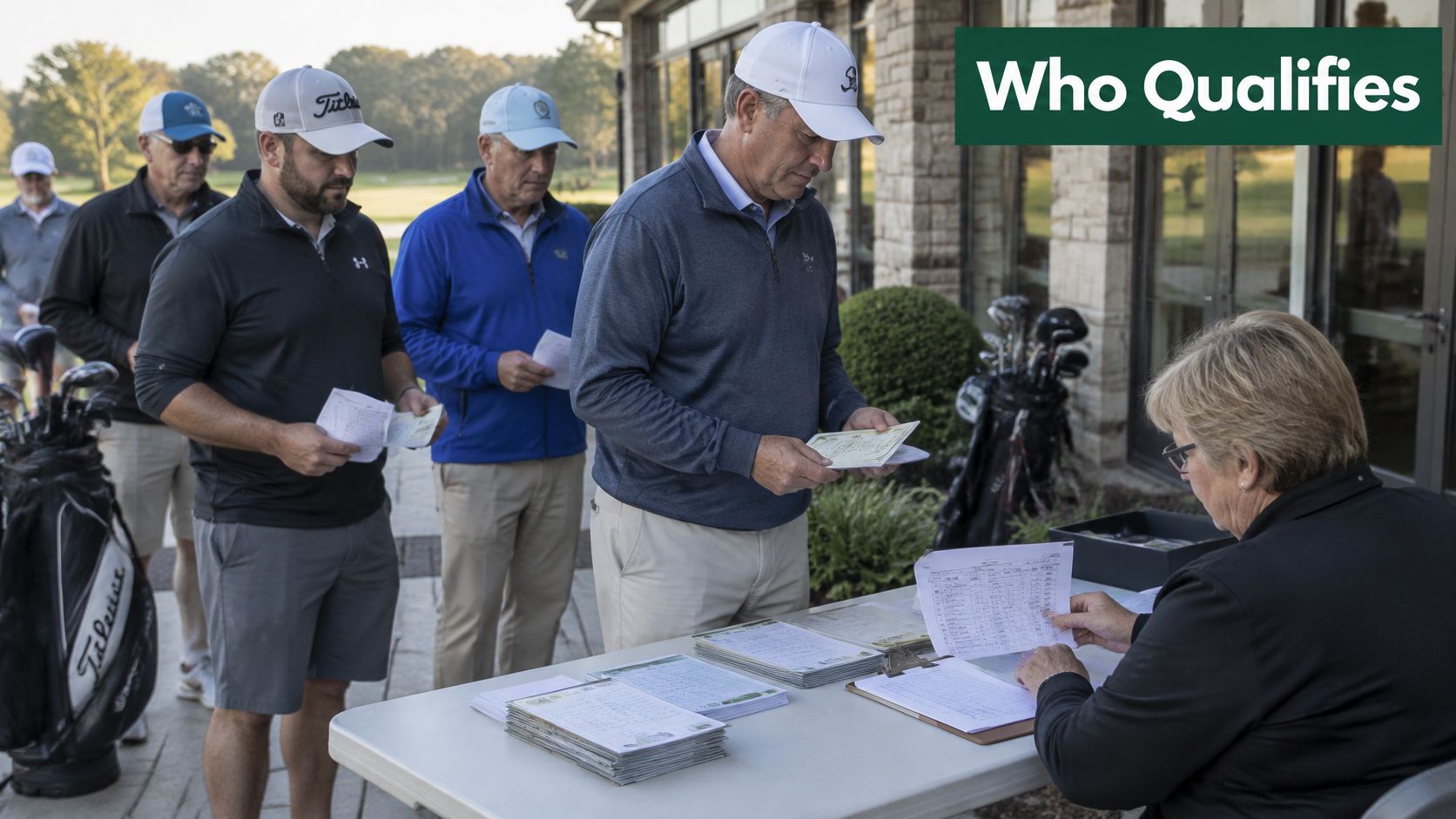
Most regional fields pull from five distinct groups. Members and handicap holders from the host facility and neighboring clubs form the core roster, often joined by competitive amateurs who earn spots through association points lists or open qualifying rounds.
Committees also carve out places for invited guests and sponsor players, age-based divisions for juniors and seniors, and four-person corporate or charity teams. Because some entrants carry a verified USGA Handicap Index (or a Golf Canada card in cross-border or Canadian events) while others don't hold an official index at all, the committee must decide in advance how playing handicaps apply to every category.
A Four-Step Qualification and Waitlist Path
When demand outpaces available tee times, a published qualification path prevents disputes over who makes the field. Suppose a district association plans a 96-player championship and receives 120 paid applications:
- Open entry window: Registration opens on a stated date with a clear closing deadline, posted entry fee, and refund cutoff so every eligible golfer has the same window to apply.
- Qualifying round or ranking check: Because entries exceed the 96-player limit, the committee runs a pre-published 18-hole qualifier or sorts applicants by current association ranking and handicap index.
- Cut to the set field: The top 96 qualifiers or highest-ranked exempt entrants lock in starting places, while the remaining 24 applicants move onto an official alternate list rather than being dropped without notice.
- Ordered alternate call-ins: If a player withdraws, the committee calls alternates strictly in published order, such as ranking or qualifying score, and sets a firm confirmation deadline (for example, four hours before tee times lock) before moving to the next name.
Before registration goes live, four decisions belong in writing inside the competition terms: exact eligibility standards for each division, the maximum field size, the alternate call-in order, and whether non-index players receive a capped handicap, a fixed index, or gross-only entry. Putting those answers on the entry page lets players verify their own status without flooding the pro shop phone line.
Handicap Allowances and Scoring Setup
| Format | Recommended allowance | Note |
|---|---|---|
| Individual stroke play | 95% | Applies to each player's Course Handicap |
| Individual Stableford | 95% | Same figure as individual stroke play |
| Individual Par/Bogey | 95% | Same figure as individual stroke play |
| Individual Maximum Score | 95% | Same figure as individual stroke play |
| Four-ball stroke play | 85% | Applied to each player's Course Handicap |
| Four-ball match play | 90% | Applied to the difference in Course Handicap between the two players |
Applying the right allowance keeps net divisions fair across different formats. Under the 2024 World Handicap System revision, the USGA Rules of Handicapping recommend a 95% handicap allowance for individual stroke play, individual Stableford, individual Par/Bogey, and individual Maximum Score competitions, while setting 85% for four-ball stroke play. Organizers should pick the percentage that matches the announced format and publish it directly in the competition terms so players know what strokes to expect before arriving.
Team match play deserves extra attention because the mechanics changed under the 2024 revision. According to the USGA 2024 WHS Reference for Clubs, the 90% allowance in four-ball match play applies to the difference in Course Handicap between players rather than separately to each player's full Course Handicap. The same reference also notes that committees can adjust the recommended allowance in individual stroke play based on the size and makeup of the field, which is helpful when an event runs very small flights or wide skill gaps. Organizers who want a deeper breakdown of Course Handicap versus Playing Handicap math can consult a guide to how handicap scoring works in golf.
Worked Examples Under the 2024 Revision
Checking the math on two sample matchups makes the difference between formats easy to verify before printing cards:
- Individual stroke play example: Suppose a player holds a Course Handicap of 20 from the championship tees. Multiplying 20 by 95% produces exactly 19 strokes for their Playing Handicap.
- Four-ball match play example: Suppose one competitor plays off a Course Handicap of 12 and another plays off 18. The difference between the two Course Handicaps is 6 strokes (18 minus 12). Applying the 90% allowance to that difference gives 5.4 strokes, which rounds to 5 strokes awarded to the higher-handicap player.
Pre-Tee Checks for the Scoring Desk
Even experienced committees catch errors when they audit handicap setup the evening before play. Scorers should work through four final verifications before printing the first card:
- Handicap revision date: Confirm every entrant's index reflects the exact revision date named in the terms, not a stale number typed during registration weeks earlier.
- Mixed tees and par differences: Check that players competing from different tee sets have Course Handicaps adjusted for differing Course Ratings, Slope Ratings, and pars under USGA Rule 6.2b.
- Allowance spot-check: Manually calculate three sample scorecards from different flights to confirm software or spreadsheets match the 95%, 85%, or 90% difference formula.
- Flight boundaries: Verify that every player sits in the proper gross or net division before tee times go public, preventing mid-round re-flighting disputes.
Committee Roles and Staffing on Event Day
Clear rules only hold up when everyone on site knows who makes decisions and who executes operations. Before the terms go out to players, the tournament committee owns three core duties: drafting and publishing the Terms of the Competition, deciding whether Local Rules apply, and certifying final results. Its committee chair acts as the final decision point on formal disputes and the single escalation contact for rules questions.
Alongside the chair, a rules official, typically a qualified club professional or association representative, handles on-course rulings strictly according to the Rules of Golf and the published Local Rules. Separating governance from day-of logistics keeps the committee free to settle disputes without stalling check-in lines or tee times.
Six Day-of Operational Roles
Every operational station should belong to a named lead rather than a vague pool of volunteers:
- Registration desk: Checks in entrants, verifies eligibility and handicaps against the official roster, distributes player packets, and holds private accessibility requests.
- Starter: Calls groups to the first tee, announces essential Local Rules, sends pairings off on schedule, and logs actual start times against the pace policy.
- Course marshals: Monitor group spacing on the course, answer basic directional questions, keep cart traffic moving, and radio rules questions or slow-play warnings to the rules official.
- Scoring lead: Manages live digital scoring and the staffed paper backup station, audits returned cards for signatures and marker errors, and flags ties to the committee.
- Prize and payout lead: Verifies net, gross, and side-game winners with the committee chair before any podium announcement or gift-certificate distribution begins.
- Host club contact: Coordinates facility logistics that sit outside competition rules, including parking flow, clubhouse access, food service timing, and course maintenance schedules.
One person must hold final authority on scoring questions. When two volunteers give two different answers on the ninth green, the committee loses credibility with the entire field.
Give every station a one-page role sheet showing the staff member's name, shift hours, radio channel or phone number, and direct reporting line. Hold a brief volunteer huddle 30 minutes before the first tee time to walk through the Local Rules, the pace policy checkpoints, and the exact escalation path if a player challenges a ruling. That short briefing prevents inconsistent advice once groups spread across all 18 holes.
Writing Terms and Pace Rules Before Play Starts
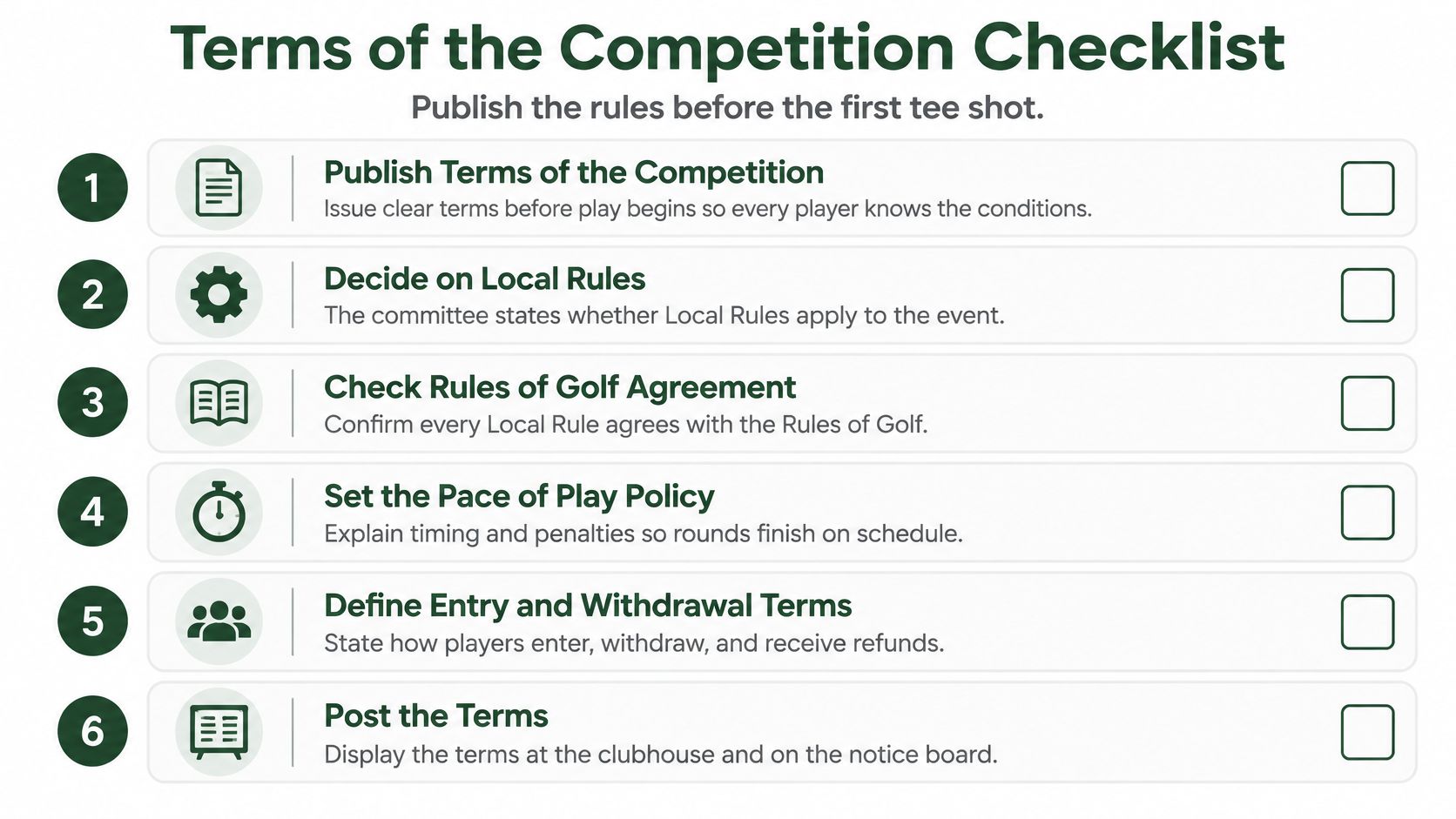
Informal rules create arguments in multi-club golf. Under the USGA Committee Procedures for Rule 5, the committee should publish clear Terms of the Competition before play begins, covering who may enter, how players enter, the competition schedule, the format, and the procedure for deciding ties. The committee is also responsible for deciding whether Local Rules apply and making sure every Local Rule stays consistent with the 2023 Rules of Golf.
What the Published Terms Must Cover
An organizer can audit a draft set of terms against these core items before posting it online and at the clubhouse:
- Eligibility and entry mechanics: State exact residency, club, age, or handicap limits, plus the entry deadline, fee, and withdrawal refund policy so no applicant guesses whether they qualify.
- Schedule and tee assignments: List practice-round availability, registration hours, starting times or shotgun start windows, and weather-delay cutoffs so traveling players can book lodging and transport reliably.
- Format and tie-breaking procedure: Define the exact scoring format and how ties will be broken, such as a sudden-death playoff for first place and a scorecard count-back for lesser spots, because deciding tie-breaks after cards come in invites protests.
- Course-specific Local Rules: Spell out how the committee treats out-of-bounds boundaries, cart paths, penalty areas, drop zones, and ground under repair so visiting golfers aren't penalized for unfamiliar course markings.
Setting an Enforceable Pace of Play Policy
Slow play is the fastest way to derail a regional schedule, especially in afternoon waves or two-day events. Under USGA Rules of Golf Rule 5, players must not unreasonably delay play while playing a hole or between holes, and a committee may adopt a Pace of Play Policy as a Local Rule. That policy can establish maximum times for finishing the entire round, completing an individual hole or group of holes, and playing a stroke, while specifying exact penalties for failing to comply.
The operational takeaway is straightforward: write the timing checkpoints and penalty ladder into the Terms of the Competition and hand them out before the first tee shot. Enforcing a pace policy works only when groups know their target checkpoint times on hole 1 rather than hearing about slow-play penalties for the first time on hole 14.
Course Details to Confirm Before Publishing
Before locking the PDF and emailing the field, verify four operational items with the host head professional and superintendent:
- Tee markers and yardages: Confirm which tee sets each division will play and verify the official scorecard yardage and slope ratings.
- Hole locations and practice areas: Lock in pin-sheet distribution and confirm when the driving range and putting green open relative to the first tee time.
- Cart and caddie policies: Clarify whether carts are mandatory, optional, or restricted to paths, and state whether players may bring caddies or use push carts.
- Severe weather plan: Document the horn signals for suspension of play, designated course shelters, and how players return to the clubhouse safely.
Running Event Day from Pairings to Results
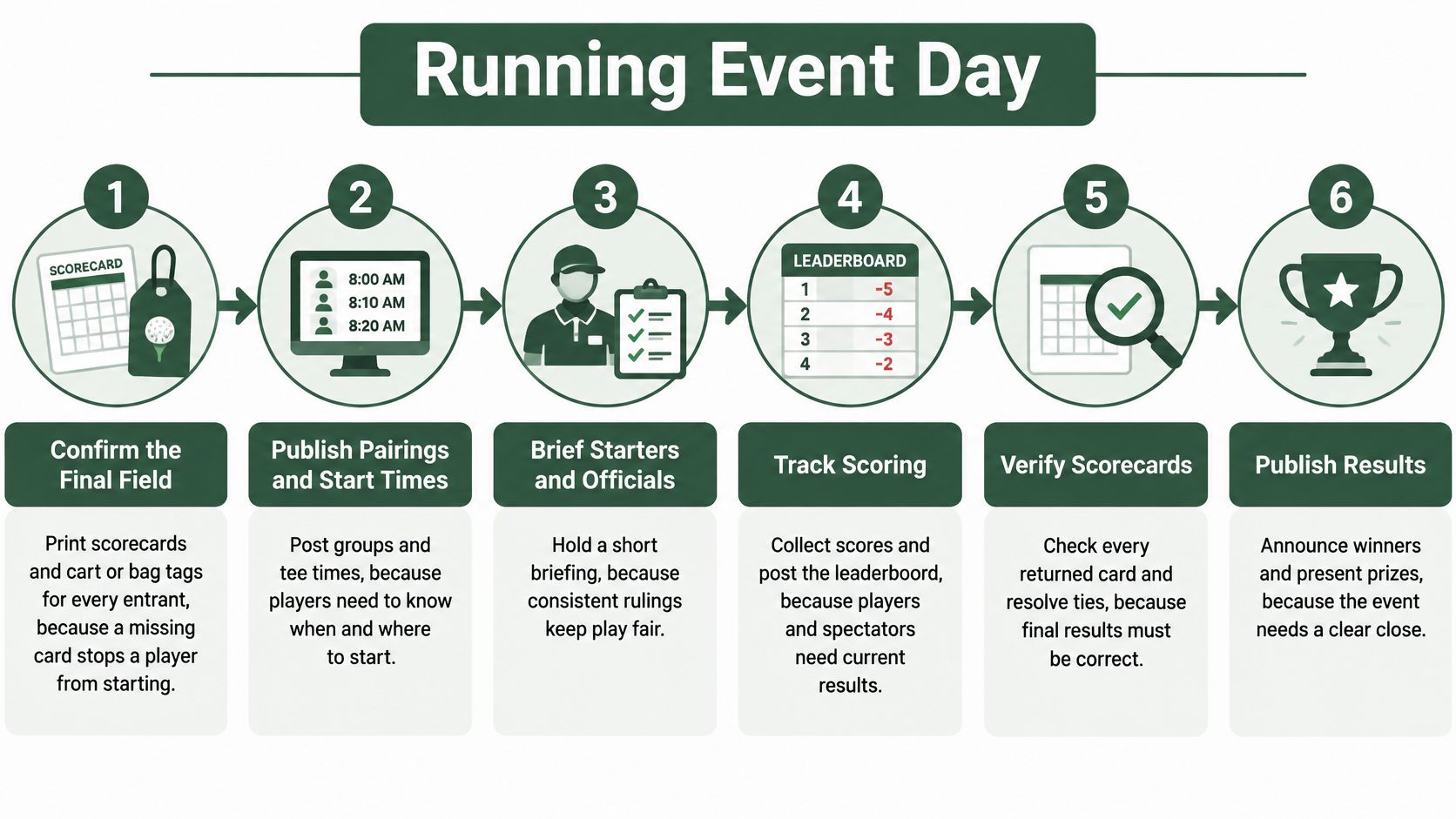
Even a carefully planned competition unravels if morning check-in stalls or scorecards back up behind the 18th green. A disciplined event-day workflow moves groups from arrival through final prize certification in predictable stages.
Seven Steps from Morning Check-In to Final Payouts
- Confirm the final field and print materials: Finalize late withdrawals and alternate additions, then print scorecards and cart or bag tags for every player, because a single missing scorecard delays a group right before its tee time.
- Check in players and verify handicaps: Confirm attendance at registration and double-check each player's Playing Handicap against the allowance published in the terms, since an unverified stroke allocation is one of the most frequent sources of post-round disputes.
- Build pairings and start times: Organizers build each event's groups themselves or let Live Tourney assign them, using tee times or shotgun starting holes so every pairing can finish within the pace policy. For complex multi-flight fields, mapping start intervals with a guide to building a golf tournament schedule helps prevent early bottlenecks on short par-4 holes.
- Brief players before the opening tee shot: Have the starter review key Local Rules, out-of-bounds areas, and pace checkpoints with each group so players hear the rules before hitting their first shot.
- Collect scores through live and paper channels: Gather hole-by-hole scores via a phone browser link or QR code while keeping paper scorecards available for any golfer who prefers them, ensuring every entrant has a reliable way to report.
- Update standings and side games continuously: Feed incoming scores into gross, net, and side-game leaderboards in real time so scoring staff can spot unusual entries and verify leaders against official cards as groups finish.
- Certify results before making announcements: Have the scoring lead and committee chair review every returned scorecard, resolve ties, and confirm payouts before calling winners forward, because correcting an announced prize list after the fact is painful for everyone involved.
Accessibility and Hybrid Backup Scoring
Most regional planning guides focus heavily on tee sheets and payouts while overlooking golfers and spectators with disabilities, older attendees, families, and people without reliable smartphones. Across larger events, accessibility is now tracked as a concrete operational standard: the 2025 Dow Championship impact report documented ADA-accessible event structures equipped with ramps, elevators, or scooters.
At the same time, committees often face pressure to cut printed paper for sustainability reasons. Environmental reporting from the 2025 World Amateur Team Championship impact report shows why organizers should weigh real impact rather than cutting paper blindly: the championship estimated a baseline footprint of 3,801.15 tonnes of CO2e and avoided at least 727 tonnes (about 16% of potential emissions) through targeted actions, highlighting that travel and venue operations drive far more impact than a small stack of backup scorecards. Dropping paper completely can exclude players dealing with weak course cell signal, older devices, low digital confidence, or visual impairments.
Hybrid scoring rule: Run live phone-browser scoring for speed and real-time leaderboards, and back it up with a clearly marked, staffed paper scoring station on every tournament day.
Small and midsize committees can operationalize accessibility on a modest budget by checking six practical touchpoints:
- Accessible parking and shuttle routes: Reserve level parking close to registration and map smooth cart or shuttle paths between the lot, the clubhouse, and the first tee.
- Restroom and viewing access: Verify accessible restrooms on both nines and identify flat, shaded viewing spots near the first tee, ninth green, and 18th green.
- Quiet areas: Set aside a calm indoor or shaded tented space where older attendees, families, or players experiencing sensory overload can rest away from clubhouse noise.
- Captioned or written announcements: Post tee-time shifts, weather delays, and final results in writing on notice boards and via text or email rather than relying solely on loudspeaker announcements.
- Low-friction registration intake: Add one optional question on the registration form asking whether any event-day assistance is needed, without asking participants to disclose personal medical details.
- Named accessibility contact: Assign one identifiable staff member on event day to coordinate mobility requests, backup score entry, and emergency assistance.
Confirm Your Format Before Entries Open
A golfer from a visiting club pays for a four-ball stroke-play event at a stated handicap allowance. A week later the host wants a match-play bracket and a new tie-break, just before the tee sheet prints. That switch does not stay inside one clubhouse. It breaks the terms every participating club already shared with its members.
Organizers sometimes wait to see the field before they pick an allowance or a tie-break. In a single-club event that delay is annoying. In a regional event it changes who was eligible to enter, which tees they were promised, and how net scores will be compared across clubs.
Treat the entry form like a contract. Publish the competition before anyone can pay.
Confirm these items in writing, then open registration:
- Format, including how winners and ties are decided
- The handicap allowance that applies, and which divisions or players without an index may enter
- Local Rules and pace checkpoints, written into the Terms of the Competition
- Where players turn in scores if cell coverage drops, and who staffs the paper backup
Phone scoring follows the signal on the course. Weak coverage on even a few holes can stall a live leaderboard for a multi-club field. Decide the backup before entries open: a marked station, a named committee member, and a card path players can find without hunting for a volunteer.
Running a multi-club regional golf tournament gets simpler when registration, pairings, handicap calculations, printed scorecards, and live leaderboards stay connected in one place. Live Tourney helps golf professionals, club staff, and association committees manage single-round, multi-round, match play, round robin, and Ryder Cup formats with browser-based scoring and a 10-day free trial. Visit Live Tourney to explore plans and test how the platform fits an upcoming regional schedule.