
Aug 31, 2026
bad golf handicap, golf handicap average, golf handicap index, improve golf handicap, golf scoring
Discover what is a bad golf handicap, how averages compare by gender and skill level, and practical steps to lower your index and play better rounds.

A bad golf handicap is generally anything significantly above 14.2 for men and 28.7 for women, but the answer depends on who you're comparing yourself with and what kind of golfer you want to be. A number that looks rough to a league player can be perfectly normal for a beginner, so the question is less “What's bad?” and more “Bad compared with whom?”
If you've ever looked at your index and felt stuck, you're not alone. Golfers tend to treat handicap like a grade, when it's really a measuring tool. The better question is whether your number reflects where you are right now, or whether it's being judged against the wrong benchmark.
Defining a Bad Golf Handicap in Real Terms
What makes a golf handicap “bad” for you? The answer depends on your experience, playing goals, and the golfers around you. A 25-handicap may be difficult to accept in a competitive club game, yet it can show steady progress for a weekend player who started only a couple of seasons ago. The USGA's September 2024 averages, 14.2 for men and 28.7 for women, offer a clearer reference point than a vague rule of thumb. An index well above those figures is higher than the typical registered golfer in that U.S. sample, but it is not automatically bad for every player. USGA average Handicap Index data
Relative to your peer group, not the entire game
The World Handicap System exists to make matches fairer, not to label golfers as good or bad. Its 54.0 ceiling also shows that the system includes everyone from a brand-new player to a seasoned golfer. A beginner, casual player, and tournament regular need different standards for judging progress. The useful question remains, “Bad compared with whom?” USGA World Handicap System statistics
Use your peer group and goals as the first filter:
Single-digit handicaps usually indicate advanced control and repeatable scoring.
Mid-teens handicaps often describe capable recreational players.
Above 30 commonly indicates that the player is still learning fundamentals or has wide score swings.
Handicap Range | Skill Level | Typical Profile |
|---|---|---|
0 to 9 | Advanced | Regular competitor, dependable ball striking |
10 to 19 | Solid recreational | Plays often, scores are usually manageable |
20 to 29 | Developing | Can post good holes, still fights blow-up numbers |
30 and above | Newer or struggling | Building fundamentals and course awareness |
Practical rule: A handicap is “bad” only when you measure it against the wrong player group.
Your target matters more than a universal label. Someone trying to compete in net events may want a different index than a golfer whose main aim is to beat friends on Saturday. A personal baseline helps too. Compare your current number with your earlier results, then ask whether your scoring is becoming more predictable.
Small off-course habits can support that process. Tracking rounds consistently makes changes easier to spot, and marking practice equipment can prevent mix-ups. Some players choose to shop for golf ball decal stickers so their practice balls are easy to identify.
For a plain-language explanation of the term, Live Tourney's guide to what a handicap in golf means provides a useful companion read.
How the Handicap Index Is Actually Calculated
A golf handicap isn't your average score, and that's where a lot of confusion starts. The USGA defines a Handicap Index as a portable measure of demonstrated ability, built from score differentials that account for course and tee difficulty. The key idea is that the system looks at the player's better rounds, not every round in the same way. Under the USGA method, the best 8 of the most recent 20 score differentials are averaged, and a Handicap Index can be established with as few as 3 18-hole scores. USGA Rules of Handicapping PDF
Why the number reflects potential, not your average day
The calculation starts with a score differential, which adjusts your round for the course you played. In plain English, it answers a fair question. How did this score stack up against that course's difficulty? Once those differentials are in the system, your index becomes a snapshot of demonstrated potential, not a summary of every rough day you've ever had. Posting every acceptable round matters because it keeps that snapshot honest.
A useful way to read the number is to think in ranges. A player with a 15.0 index on a course rated 72.0 with a slope of 130 would usually expect a casual round somewhere around the high 80s to low 90s, depending on the day. That's not a promise, it's a realistic range based on how handicaps are meant to work. The point is to measure fair competition, not to predict every score with exact precision. Live Tourney on golf handicaps calculation
Keep posting the rounds that count. The index gets sharper when the scoring record reflects real golf, not just the rounds that felt good.
The 2024 revision of the World Handicap System in the United States also changed how 9-hole scores are handled. The USGA says each 9-hole score is converted into an 18-hole Score Differential and added to the record right away, with the revised resources taking effect on January 16, 2024. That matters for weekend players, because partial rounds can now help build a more complete scoring record sooner. USGA 2024 revision details
The other piece people miss is adjustment. The USGA says an exceptional score is one that is 7.0 strokes or better than the Handicap Index at the time the round is played, and another adjustment can apply when the 8-of-20 calculation is 3.0 or more strokes above the Low Handicap Index from the previous 365 days. That's the system's built-in way of keeping outliers from warping the record. USGA FAQ on Handicap Index calculation
For golfers who want the mechanics laid out with score differentials and posting logic, Live Tourney also has a practical breakdown on how to calculate golf handicaps.
Handicap Ranges by Player Type and Skill Level
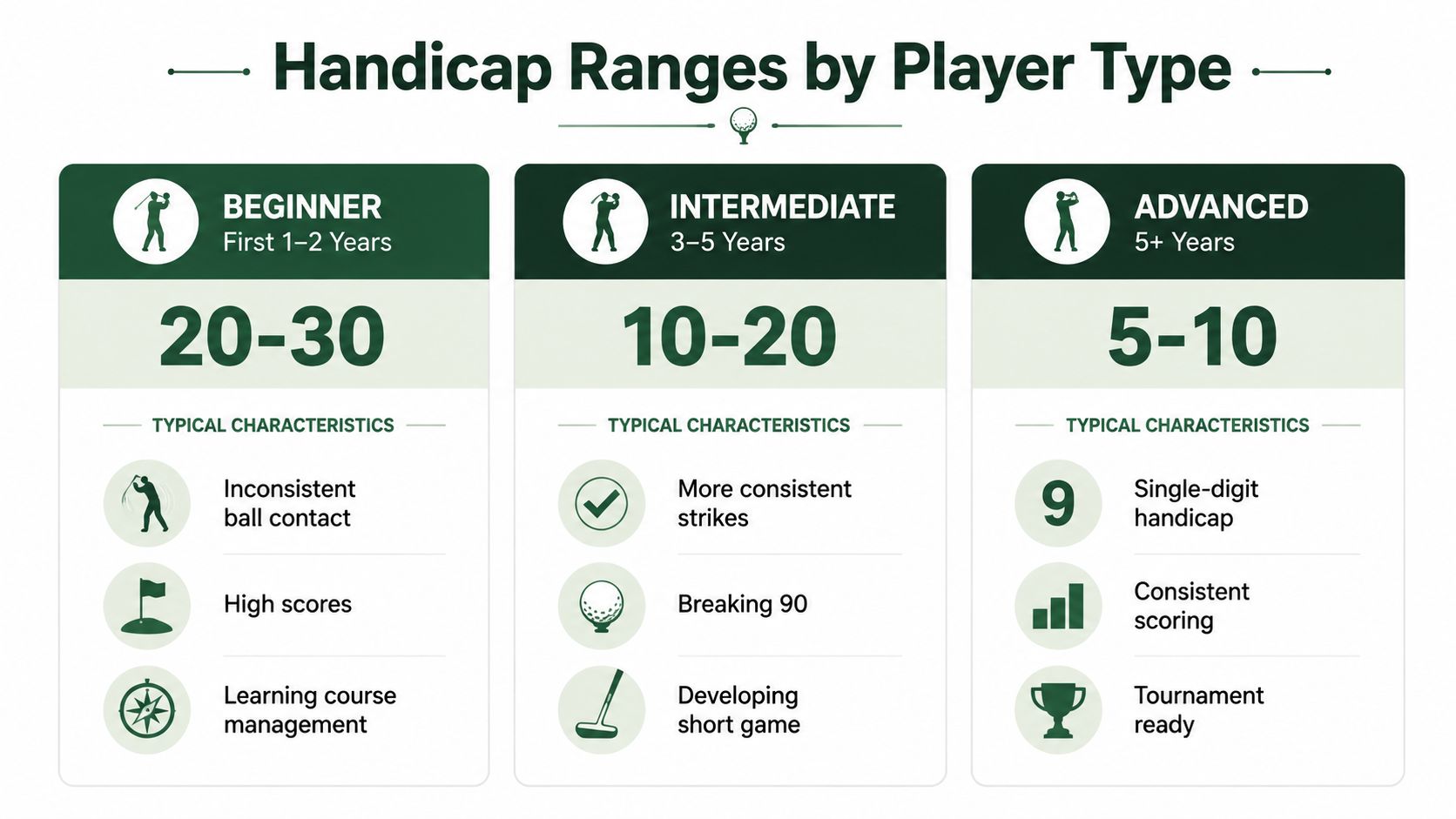
What counts as a bad golf handicap depends on who holds it, how often they play, and what they are trying to achieve. A beginner learning consistent contact should not judge the number by the standard of a golfer who plays weekly competitions. Comparing both with one cutoff turns a useful measure into an unfair verdict.
Three golfer types, three different standards
During the first one to two years, beginners often sit in the 30 to 54 range. That reflects a learning phase, not a lack of potential. Casual weekend golfers who play once or twice a month often fall around 15 to 25, while competitive amateurs and regular practisers commonly sit between 0 and 12. Each range describes a different scoring environment, so the same number can mean progress for one player and underperformance for another.
The USGA average noted earlier also gives gender context. Its September 2024 data reported an average Handicap Index of 28.7 for women, so a woman with a 22 is below that average in the cited U.S. data set. A handicap that feels disappointing among low-handicap club players may still compare well with recreational golfers overall. The number needs a reference group before it can answer whether it is “bad.”
Player Type | Typical Handicap Range | What It Usually Means |
|---|---|---|
Beginner | 30 to 54 | Learning contact, pace, and basic course management |
Casual weekend player | 15 to 25 | Some steady scoring, with strokes still lost in clusters |
Competitive amateur | 0 to 12 | More repeatable strikes and narrower scoring windows |
A 28-handicap beginner may be building a sound foundation. For a competitive club player, the same number could point to a slump or time away from practice. Course difficulty and personal goals matter too. Trying to break 100 calls for a different benchmark than trying to qualify for a tournament.
Live Tourney's handicap calculator applies the World Handicap System rules to posted scores and score differentials, giving players a practical way to check how their records translate into an index.
Useful lens: A handicap is a context number. Without context, it becomes a judgment instead of a guide for improvement.
Factors That Make a Handicap Feel Worse Than It Is
I've seen plenty of golfers beat themselves up over a number that was never telling the full story. A 55-year-old who plays a demanding home course twice a month is not in the same situation as a 25-year-old with daily range access and more chances to post scores. Their numbers can look similar, but their paths to improvement are completely different.
Real-world variables that distort the picture
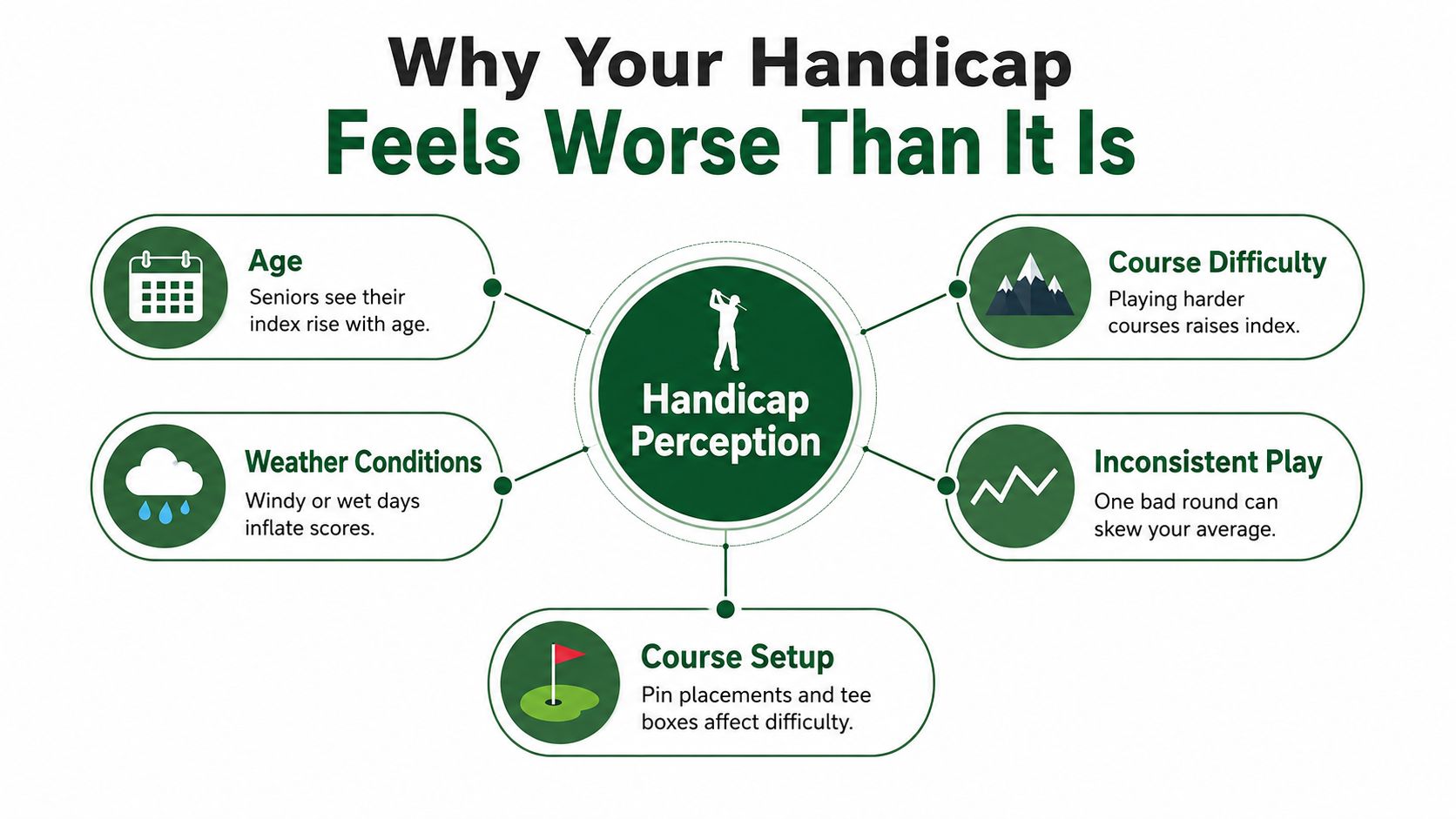
Age is one reason the index can drift. Older players often see their number rise even when the swing hasn't changed much, because recovery, flexibility, and consistency aren't the same as they were ten years ago. Younger players can improve quickly, but if they don't post often, their index can lag behind what they're capable of right now. That gap makes the handicap feel worse than it is.
Course difficulty matters too. A score posted on a tight, punishing home course doesn't carry the same meaning as the same score on a wide-open layout. Wind, wet conditions, fast greens, and awkward tee setups all change how hard a round feels. The number in the app doesn't always capture how much grinding went into it.
Age: Older golfers can carry a higher index without any loss of commitment.
Course difficulty: Harder setups make the same score more valuable.
Frequency of play: Infrequent golfers usually have less stable records.
Round-to-round volatility: One ugly card can make the number feel bigger than it is.
You should judge your handicap against your own routine, your own tees, and your own home course, not against somebody else's highlight reel.
The most common mistake is treating the index like a verdict. It's really a moving summary of how you've played across different conditions. If your game changes because your schedule changes, that doesn't mean you suddenly became a worse golfer. It means the number is responding to the golf you're able to play.
Practical Steps to Lower Your Golf Handicap
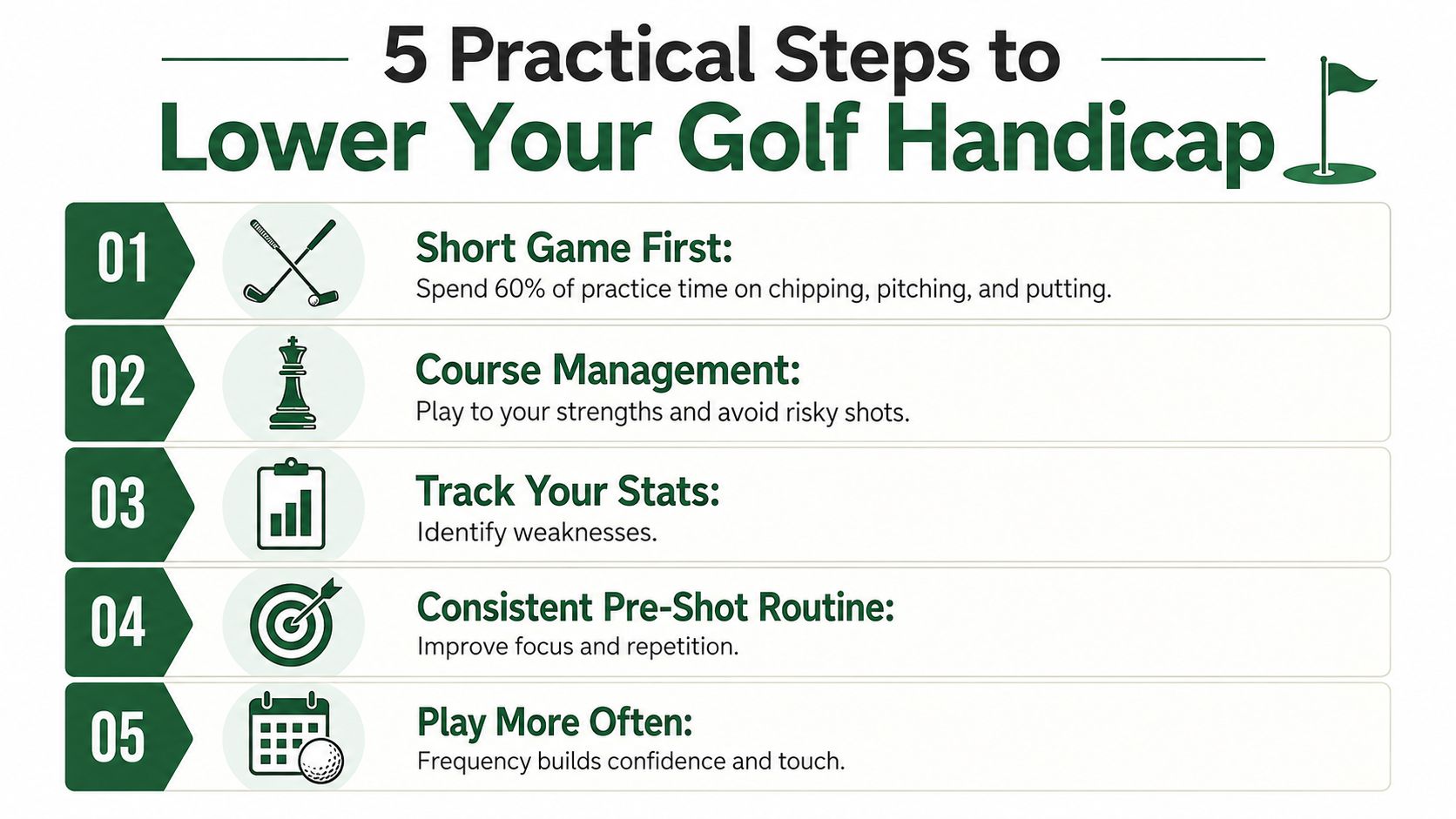
The fastest way to move the number is to stop chasing a perfect swing and start cutting the strokes that show up most often. For most weekend players, that means the short game first. Chipping, pitching, and putting save more strokes than another bucket spent fighting the driver. When the ball is already on the ground or close to the green, you're working with simpler motions and fewer ways to create a blow-up hole.
Build a lower number with fewer mistakes
Course management comes next. Play to your miss, avoid the hero shot from trouble, and aim for the fat side of the green when the flag is tucked near trouble. A lot of handicap damage comes from one aggressive decision that turns a playable hole into a double or worse. Good players don't force every shot, they choose the next shot that keeps the score alive.
Score posting discipline matters just as much. If you leave acceptable rounds out of your record, the index can stay inflated and stop reflecting real progress. Equipment checks also help more than people expect. Worn grooves can cost spin, and the wrong shaft flex can make timing harder, which adds strokes over time.
Short game first: Put more practice time into chipping, pitching, and putting than into full swings.
Play smarter targets: Choose shots that reduce big numbers, not just shots that look athletic.
Post every acceptable round: A handicap only improves when the record is complete.
Check the clubs: Small gear problems can make solid swings produce poor results.
Stay consistent: Repeated habits beat occasional intensity.
A realistic goal is steady progress over a season, not a magical overnight fix. If you stay honest about your rounds and keep the ball in play more often, the handicap will usually follow the work. That's the part many players overlook. The number doesn't lower itself, it responds to the habits behind it.
Common Misconceptions About High Handicaps
A high handicap is not a sign that you don't belong on the course. Net scoring exists for a reason, and it lets golfers of very different levels compete in the same event without pretending they're playing the same game. If a tournament uses handicaps properly, a player with a higher index can absolutely be in the mix.
The other myth is that a high handicap means someone isn't athletic. That just doesn't fit golf. Plenty of strong, coordinated athletes still post high numbers because golf asks for a specific skill set, repetition, and patience under pressure. Athleticism helps, but it doesn't replace swing pattern, distance control, or short-game touch.
Sandbagging gets thrown around too quickly. An inflated index is more often the result of infrequent posting or uneven play than deliberate manipulation. If you want a deeper look at that subject, Live Tourney has a straightforward explainer on sandbagging in golf.
A high handicap also doesn't mean you need expensive lessons or shiny new clubs before you can improve. Better posting habits, smarter targets, and regular play usually move the number faster than buying more gear. A high index is a starting line, not a verdict. Every scratch golfer began with a first score that looked nothing like a scratch round.
If you're organizing tournaments, leagues, or outings and want handicap-based scoring to feel simpler for everyone involved, Live Tourney gives golf groups a straightforward way to manage live scoring and tournament setups. It fits well with handicap-driven events because the scoring flow is built for real rounds, real players, and real-time updates. Visit Live Tourney to see how it can support your next event from setup to final leaderboard.





