Jul 1, 2026
senior golf tournament, golf event management, live golf scoring, tournament software, golf course operator
Plan and run a successful senior golf tournament with this step-by-step guide. Covers formats, modern registration, live scoring, and player experience tips.

You're probably staring at the same pile every tournament director knows too well. A signup sheet with handwritten notes in the margins. A few unpaid spots you're trying to hold. A couple of players who want to join but don't have a full team. A scorecard template from last year that nobody loved then, either.
That's usually where a local senior golf tournament starts. Not with strategy. With cleanup.
The good news is that senior events are worth the effort when they're run well. They build repeat play, fill quieter dates, bring in dependable groups, and create the kind of club atmosphere that keeps players coming back. Senior golf also carries real commercial weight at the top end of the game. The PGA Tour Champions, born as the Senior PGA Tour in 1980, has grown into a major force with over $51 million in annual prize money, which tells you plenty about the staying power of the category according to this history of the tour's growth and prize money.
At the club and local level, the formula is different, but the principle is the same. Senior players notice details. They care about pace, clarity, fair competition, accessible logistics, and whether the day feels organized instead of improvised.
Your Blueprint for a Flawless Senior Event

A messy senior golf tournament usually fails before the first tee time. It fails when registration lives in email threads, pairings are built by hand, and the staff has no clean process for changes. Tournament day only exposes the weak spots.
Senior players don't need flashy production. They need a day that feels smooth. Check-in should be fast. Tee assignments should be obvious. Scoring should be simple. Awards should happen without a twenty-minute delay while someone rechecks math in the golf shop.
Start with the player's day, not your admin sheet
Most organizers plan backward from forms and spreadsheets. That's the wrong starting point. Plan the day from the player's perspective.
Ask these questions first:
Arrival: Can players park, check in, and get to carts without confusion?
Format clarity: Does every player understand how scoring works before they reach the first tee?
Comfort: Are tees, timing, and on-course instructions realistic for your senior field?
Visibility: Can players follow the event as it happens, or do they disappear into a black box until lunch?
If you build around those four points, the rest gets easier.
Practical rule: If a player has to ask the same operational question more than once, your process is the problem, not the player.
Treat senior events like a product, not a date on the calendar
That mindset changes everything. A strong senior golf tournament isn't just “another event.” It's a repeatable offering with its own audience, standards, and operational rhythm. That means tighter registration, cleaner communication, better pace management, and less dependence on one staff member who “knows how we usually do it.”
If you run recurring leagues or are building a stronger pipeline of senior play, this guide on senior golf leagues and recurring event operations is useful background.
The rest of the work comes down to five decisions. Pick the right format. Make registration painless. Set the course up for the players you have. Keep the event visible while it's happening. Finish with fast payouts and clean follow-up.
Defining Your Tournament Format and Rules
The fastest way to frustrate a senior field is to choose a format that looks good on paper but plays poorly in practice. Some events should be competitive. Others should be social first. Most local senior tournaments need a balance of both.
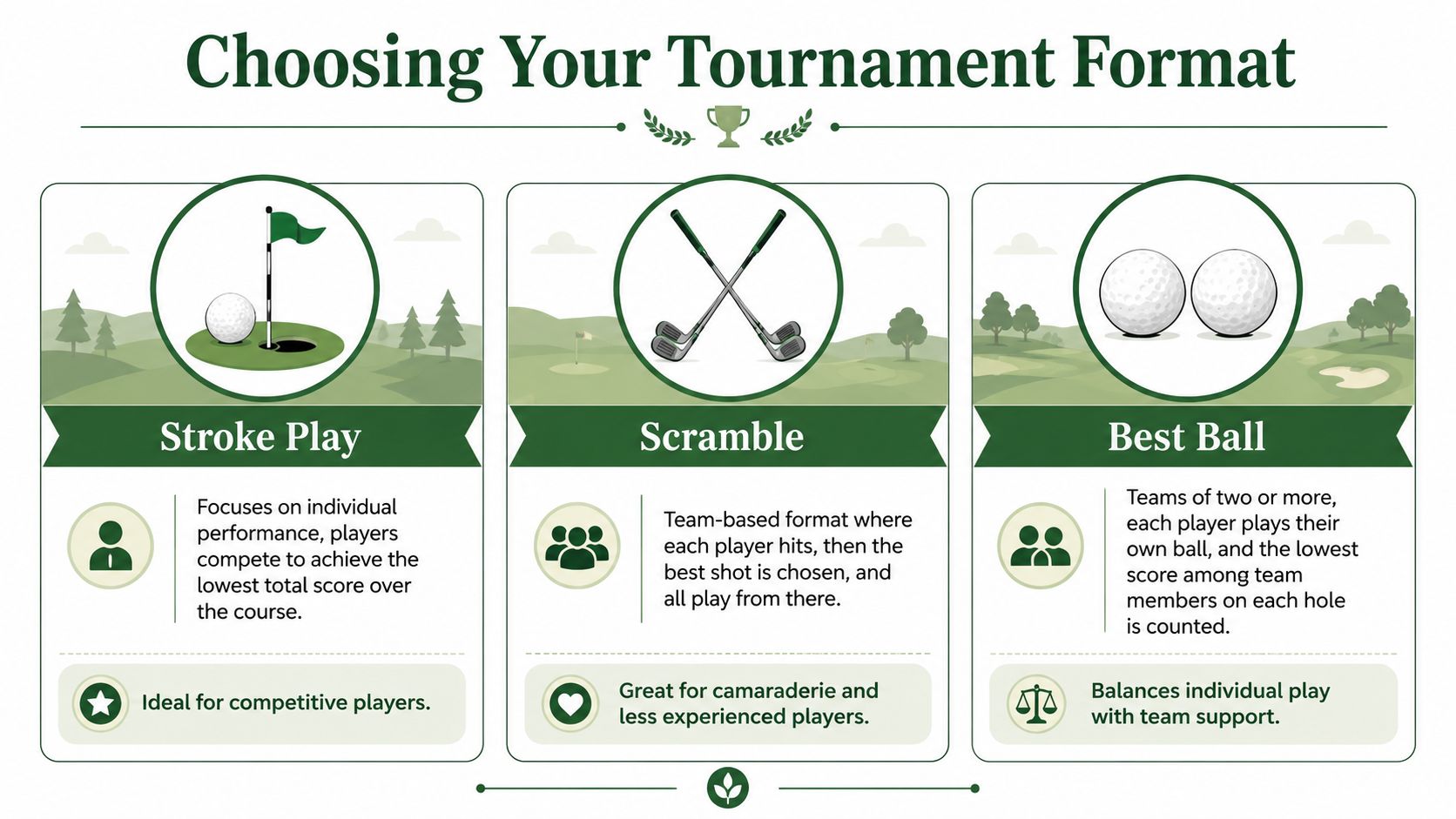
Pick the format that fits the field
Use the field, not your preference, as the deciding factor.
Format | Best use | Main strength | Main risk |
|---|---|---|---|
Stroke play | Competitive club seniors | Clear individual result | Slow pace if the field is uneven |
Scramble | Social, mixed-skill events | High fun factor and easy entry | Team assembly gets messy fast |
Best ball | Pairs or stable regular groups | Keeps individual integrity | Can confuse players if rules aren't explained well |
Stroke play works when your players want a true tournament feel. It's the cleanest format to administer and the easiest to explain. It also exposes every pace-of-play problem you have.
Scramble is usually the safest choice for fundraising, mixed-ability groups, and club events where participation matters more than crowning the strongest single player. The trade-off is administrative. Scrambles create more registration exceptions than any other format.
Best ball sits in the middle. Better players still get to play their own ball, but the team element softens a bad hole and keeps people engaged.
Set age rules that feel fair
The professional standard is clear. PGA Tour Champions is reserved for male professionals age 50 and older, and that age threshold defines the category according to ESPN's overview of the circuit rules and schedule.
Local events don't need to be that rigid in structure, but they do need to be fair. The smartest move is usually to create age flights rather than forcing everyone into one broad senior division. Common examples include 55 to 64, 65 to 74, and 75+, which creates more balanced competition without overcomplicating the event.
A senior field isn't one demographic. It's several different competitive realities sharing the same tee sheet.
Decide handicap treatment early
Nothing creates post-round arguments faster than vague handicap rules. Publish them before registration opens. Don't leave “we'll sort that out later” for the golf shop.
Three workable models tend to hold up:
Gross only for stronger competitive fields.
Gross and net divisions for broader club participation.
Reduced team handicap allowances for scrambles and best ball events.
The key is consistency. If you're running net competition, lock your handicap source and your allowance method before the first signup. If you need a clean primer for setting those rules, this article on handicap scoring in golf is worth keeping handy.
Borrow standards from elite events, then simplify
You don't need tour-level complexity to learn from tour-level structure. Strong senior events use strict eligibility, clear scoring methods, and published competition conditions. For example, the Senior Open Presented by Rolex uses 72-hole stroke play over four consecutive days with a field capped at 144 competitors, and entrants must be age 50 with a World Handicap System index of 0.4 or lower under the championship qualification document for the Senior Open Presented by Rolex.
That level of specificity tells you something important. Good events remove ambiguity.
For local play, that means one rules sheet. One format summary. One sentence on ties. One sentence on handicap treatment. One sentence on who's eligible. If a rule needs a speech in the staging area, it wasn't written well enough.
Streamlining Registration and Marketing
Registration is where older tournament workflows break down fastest. Paper forms, emailed rosters, checks dropped at the shop, and manually patched teams might feel familiar, but they create errors you'll still be fixing the night before the event.

The biggest trap is thinking manual registration feels more personal for senior players. It usually doesn't. What players seek is clarity. They want to know if they're in, what they owe, who they're playing with, and what happens next.
Build one clean path to register
Your event should have a single registration path. Not a flyer plus a phone number plus a PDF plus “call the shop if you want to bring a guest.” One path.
A good registration flow handles these cases without staff intervention:
Full teams: A captain enters the whole group and pays.
Singles: An individual joins and gets paired later.
Partial teams: Two or three players reserve spots without forcing staff to manually rebuild the field.
Sponsor entries: Included players can be assigned cleanly and updated without side spreadsheets.
That last point is often underestimated. Many organizers struggle with partial team entries in scramble formats, and that operational gap keeps forcing manual upgrades and workarounds, as noted in this piece on charity golf tournament ideas that also reveals the workflow pain.
Stop collecting information twice
A common failure point is duplicate entry. Staff takes a registration, then retypes names into pairings, then retypes names again for cart signs or scorecards. Every duplicate touch adds another chance to misspell a name, lose a payment note, or put the wrong player in the wrong group.
Use a workflow where player data feeds everything downstream:
Registration input | Should automatically support |
|---|---|
Player name and contact | Confirmation and event updates |
Team status | Pairings and cart setup |
Division or flight | Leaderboards and prize categories |
Payment status | Check-in and financial reconciliation |
That's not about convenience. It's about reducing admin failure.
Market the event like a club invitation, not a blast email
Senior golfers respond to direct, useful messaging. Skip the hype. Lead with date, format, eligibility, entry details, and what makes the day enjoyable. If the event includes lunch, a shootout, tee gifts, or an awards reception, say so plainly.
A few reliable channels tend to outperform generic promotion:
Member email with one clear call to action
Printed notice in the golf shop for regular senior play days
Starter and pro shop staff mentioning the event in person
Club newsletter and women's groups if spouses or mixed teams are involved
For clubs that want sharper ideas on packaging and promoting tournament offerings, GolfRep for private club marketing has useful examples that are more practical than the usual generic social media advice.
The best tournament marketing answer isn't louder promotion. It's removing every small reason a player might delay signing up.
Make payment part of registration, not a separate chore
If payment sits outside the signup process, collections become a staff problem. Some players will pay later. Some will forget. Some will assume their partner covered it. Then you're chasing balances instead of finalizing the event.
Tie payment to registration whenever possible. If you need exceptions for member billing, sponsorship bundles, or club accounting, define them upfront. Don't improvise them one by one.
The cleanest senior golf tournament registration systems don't feel “high tech.” They feel organized. That's the standard to aim for.
Optimizing Course Setup and Pace of Play
Tournament operations live or die on the first hour of the day. If parking is awkward, carts are staged poorly, and players start with uncertainty, the round never fully recovers. Senior events need a setup that respects energy, mobility, and rhythm.
Set the course for the field you actually invited
Too many organizers choose tees based on pride instead of pace. Senior players don't need a course setup that proves anything. They need one that produces a fair, enjoyable round and keeps the field moving.
A simple setup checklist helps:
Tee selection: Use forward or senior tees when that fits the field. That improves pace and keeps approach shots reasonable.
Cart staging: Stage carts in score order or starting order. Don't make players hunt for names.
Registration location: Put check-in close to parking and the clubhouse whenever possible.
Printed instructions: One sheet at check-in beats ten verbal explanations at the first tee.
If you're forcing older players into long carries, slow walks between check-in and staging, or confusing tee assignments, you're creating avoidable stress.
Pace problems are usually setup problems
Players get blamed for slow rounds, but most delays begin with poor event design. Wide ability gaps inside the same group, unclear format instructions, too many side contests, and difficult tee placements all drag the round.
These fixes usually work better than lecturing players about pace:
Group by realistic playing speed. Don't mix your fastest twosome with a group that needs more time on every green.
Keep hole contests selective. Closest-to-the-pin and long drive are fine. Too many extras create backups.
Use visible on-course signage. Direct players to contest holes, restrooms, scoring reminders, and turn stations.
Brief starters properly. The starter should explain one or two essential items, not deliver a rules seminar.
Accessibility isn't optional
Senior events reward small operational decisions. Is there seating near registration? Is water easy to find? Are restrooms easy to identify? Can players understand where to go without asking three times?
Those details affect mood more than most tournament directors realize.
If players feel looked after before they tee off, they're more forgiving of the small things that always happen during a round.
Match your round structure to your audience
Not every senior event should be a full competitive grind. Some should be lighter. Some should finish with a social lunch. Others may need a shorter awards turnaround because players won't want to wait around while results are built manually.
Look at formal senior competition for contrast. The European Senior Golf Association mandates 54 holes of gross stroke play over three consecutive days with no handicap allowance in its championship format, according to the ESGA tournament statutes. That structure works for serious championship play. Most local fields need a simpler version of discipline, not the full weight of it.
A good senior golf tournament setup feels calm. Calm doesn't happen by accident. It comes from fewer decisions on the day and more decisions made correctly beforehand.
Engaging Players with Live Scoring and Leaderboards
Manual scoring kills momentum. It turns an active competition into a delayed report. For a senior golf tournament, that's a missed opportunity because players want to know where they stand while the round still matters.

The strongest modern upgrade you can make is app-free live scoring. Not because it sounds modern, but because it removes delay without adding friction.
Why live scoring works better for senior events than you'd expect
A lot of organizers assume senior players won't use live scoring. That's usually based on the wrong mental model. They imagine a download, login, training session, and support line. Of course that won't work well.
What does work is a simple link that opens on any phone.
That matters because real-time scoring is one of the most overlooked gaps in amateur senior golf. This matters enough that it's worth saying plainly. A critical underserved angle in senior golf is the lack of real-time scoring for amateur events, and app-free solutions have shown a 40% increase in live scoring participation, according to this discussion of the engagement gap around senior golf event coverage.
Make visibility part of the competition
Live scoring changes behavior in useful ways. Players pay attention. Groups understand that every hole matters. Staff can spot missing scores before the round ends instead of rebuilding cards after lunch.
Use leaderboards in two places:
On players' phones through a simple mobile link
In the clubhouse or grill room on a visible display during and after the round
That second piece is underrated. A visible leaderboard gives the event a center of gravity. Players finish, look up, and immediately feel part of something live rather than waiting for a sheet to be taped to the wall.
For organizers evaluating systems and scoring workflows, this guide to golf tournament scoring software is a solid reference point.
Keep the scoring process simple
The mistake isn't using live scoring. The mistake is overengineering it.
A workable scoring setup usually follows this pattern:
Moment | Best practice |
|---|---|
Before play | Give each group one scoring link and one backup instruction |
During round | Let one player enter scores, with another player confirming |
After round | Staff reviews exceptions only, not every full card by hand |
That structure reduces disputes and avoids a second full scoring process in the clubhouse.
Players don't need more technology. They need less friction.
Don't wait for a big event to act like a big event
Major championships understand the value of live information. The spectator experience around senior majors now assumes real-time access, visible schedules, and clear digital support. Your local tournament doesn't need television coverage to borrow the same principle. It just needs a cleaner system than a paper board and a delay.
Once players experience a senior golf tournament with active leaderboard movement, they don't want to go back to dead time and mystery. That's why live scoring isn't a bonus anymore. It's part of running a modern event that feels current.
Managing Prizes and Post-Event Reporting
The finish shapes the memory. You can run a smooth round and still lose the room if payouts are confusing, awards drag on, or nobody hears from the club afterward. Good tournament directors close hard.
Build a prize structure players can understand
Complicated prize tables create mistrust. Keep the structure visible before the round and easy to explain after it.
A practical senior event prize mix often includes:
Flight prizes: Gross, net, or both depending on the field
Team awards: Best ball or scramble placements
Skill contests: Closest-to-the-pin and long drive when they fit the format
Participation touches: Tee gifts, raffle items, or sponsor-backed extras
The key isn't having more prizes. It's having prizes that match the event. A social scramble doesn't need the same payout logic as a competitive individual stroke play event.
Automate the math, then verify the edge cases
Manual payout calculation is where late-stage errors creep in. Ties, handicaps, skin allocations, and divided flights can turn a simple prize table into an avoidable mess.
Use a process that handles the repeatable math automatically, then review only the exceptions. Staff should spend post-round time confirming unusual results, not rebuilding the whole board with a calculator.
That also gives you a faster awards window. In senior events, that matters. Players are usually happy to stay for lunch and prizes if the ceremony moves. They're less happy when the room stalls because results are still being sorted.
Turn the wrap-up into retention
Most clubs stop at “thanks for playing.” That wastes the easiest community-building moment you have.
Send a concise post-event follow-up that includes:
Results and winners
A short thank-you to players, staff, and sponsors
Photos or a recap if you have them
The next event date or a note about future senior play
A brief survey or reply request
This is how events become traditions. The Senior PGA Championship, first established in 1937, predates the official senior tour by more than 40 years, which shows how much prestige and staying power a senior event can build over time, as outlined in the history of the Senior PGA Championship.
Legacy starts with repeatability. Repeatability starts with a professional finish.
Use awards and merchandise wisely
Not every senior field wants another generic towel. If you're giving gifts or winner items, make them specific to the event and the audience. Better one useful piece than a bag of forgettable filler.
For ideas that go beyond the usual logo leftovers, this roundup of unique custom event merchandise is a practical place to look.
The best post-event report does two jobs at once. It closes the current tournament and quietly recruits the next one.
A well-run senior golf tournament doesn't end at the final putt. It ends when every player knows the result, understands the prizes, and feels like signing up again would be easy.
If you want to run a senior golf tournament without paper chaos, delayed scoring, and manual cleanup, Live Tourney is built for exactly that. It helps courses and organizers handle registration, payments, pairings, live scoring, leaderboards, reports, and player communication in one app-free system that works on any device.