
Jul 29, 2026
PGA Winter Series, winter golf tournaments, golf tournament management, live scoring software, club professional events
Learn what the PGA Winter Series is, its history and format, who can play, and how golf courses and organizers can run modern winter tournaments with ease.
If you've ever been the head pro staring at a quiet winter tee sheet and thinking the season's momentum has gone flat, you're already in the right headspace for the PGA Winter Series. In club golf, winter is often where the sharp players stay sharp, the staff tests logistics, and organizers decide whether an event feels like a real competition or just a cold-weather outing.
The phrase gets used in more than one way, which is where confusion can arise. Sometimes it means the PGA of America's Winter Championships for professionals, sometimes it refers to the broader winter stretch in PGA Tour coverage, and sometimes it just means any well-run winter tournament series at a club or association level. The useful part is that all of these versions point to the same underlying idea, a compact competitive window built for limited daylight, tighter scheduling, and players who still want meaningful golf when the weather turns.
What the PGA Winter Series Is
A winter series gives golf a working season when the weather and daylight make everything harder to schedule. It is a structured block of competition that keeps players active when many clubs are juggling limited tee sheets, colder conditions, and a need for rounds that finish on time.
For a club pro, league director, or event organizer, the point is practical. You still need pairings, scoring, tee times, and a prize structure, but you also need a format that fits shorter days and a field that can get through the round without a scramble at the end. That is why the PGA Winter Series works well as a template even for an event that is not part of an official PGA calendar.
Two different meanings show up online
One meaning is the PGA of America's Winter Championships, a long-running competition for PGA professionals. The other meaning is the PGA Tour's winter stretch, which sits inside the season schedule and points chase rather than a club-professional series. The confusion is common because many results pages list only dates, fields, or event titles, not the practical question of who can enter and what kind of golf is being played, as noted in the PGA tournaments winter page on event listings (PGA Tournaments winter championships).
That is why it helps to treat the winter series as both a real tradition and a reusable blueprint. The tradition belongs to PGA professionals and the Tour calendar. The blueprint belongs to anyone running golf in the off-season.
A club version of the same idea is easy to picture. The players may not be touring pros, but the event still needs the same bones, clear entry rules, a pace that matches winter light, and a format that tells every competitor what kind of round they are signing up for.
Practical rule: If your players need to ask whether the event is for pros, amateurs, or everyone with a handicap index, the event identity is not clear enough yet.
Origins and Evolution of the Winter Championships
The Winter Championships started in 1954 at the former PGA National Golf Club in Dunedin, Florida, as a practical answer to a familiar problem. Winter left many northern clubs quiet, and PGA of America wanted a place where professionals could keep competing instead of sitting idle. That origin still explains the series better than any polished tagline does.
The early setup centered on the Stroke Play Championship and the Quarter Century Championship. The point was straightforward, keep the membership active, keep professionals connected, and give teaching pros and club professionals a competitive outlet when their home courses were not carrying full schedules. The original championship rules were built around that purpose, with entry limited to PGA of America members except A-3, or Tour Player, members (PGA of America press release).
From seasonal solution to sought-after circuit
Over time, the Winter Championships moved from a small seasonal opportunity to a draw that many players wanted to reach. In the PGA story cited here, nearly all six events had waiting lists, and more than 700 players had competed the previous year for about $375,000 in purses (PGA story). That kind of demand changes how the series functions. It is no longer just a winter filler, it is a competitive window with its own standing.
That growth also explains why the format has lasted. A winter series that began as a way to create more starts for working professionals still answers the same basic need today. Club pros want matches that matter. Teachers want to measure their game against peers. The field keeps returning because well-run winter golf gives players a clear reason to stay sharp when the regular club calendar slows down.
Format, Schedule, and What a Typical Event Looks Like
A good way to understand the Winter Series is to look at a real event instead of a generic description. A FSGA Winter Series stop at PGA National Resort & Spa, Estates Course shows how these tournaments are built in practice. The event details outline 36 holes of gross stroke play, FSGA Adult Members age 25+, a Florida GHIN 10.0 handicap limit, and an entry fee of $200, which keeps the event firmly in the serious competitive lane without turning it into a full-scale production.
The course setup changes by division, and that is what keeps the event from feeling one-size-fits-all. In the event details, the Mid-Amateur division played 6,707 yards with a 72.6/138 rating and slope, the Senior division played 6,282 yards at 70.5/133, and the Super-Senior division played 5,976 yards at 69.1/124. The point is fairness across age groups. Each division gets a yardage that matches how that group plays the course, instead of just shortening everything and calling it even.
What a leaderboard looks like
The scoring pattern makes the format easy to picture. Brian Bassett won with a 145 total, posting 73 and 72, while Mark Allen finished one stroke back at 146 and the fourth-place finisher came in at 152. That is classic winter-series scoring. The event rewards consistency over two rounds, but it still leaves room for pressure and a small swing in the standings.
The leaderboard also shows why this format works for club golfers and competitive regulars alike. A player can survive one average round and still stay in the hunt, but there is no hiding from a second day that goes sideways. That balance is part of the appeal, and it is the same kind of structure used across many minor league golf tours that want to keep fields competitive without making them unwieldy.
A winter event works best when the setup does the sorting for you. Separate tee markers, a gross format, and a clear handicap ceiling protect competitive integrity better than a long rules memo ever will.
For organizers, this is the template to study. Keep the field rules narrow enough to avoid confusion, then set the divisions and yardages so each group feels the course was built with its game in mind.
Eligibility, Field Sizes, and Competitive Pathways
Eligibility is where winter events either feel legitimate or feel improvised. PGA professional events naturally hinge on membership status, while amateur winter series stops usually rely on age bands, handicap ceilings, or association membership. That's why organizers need to decide who the event is for before they decide anything else.
PGA-sanctioned winter structures also show how to manage a field without letting it sprawl. The PGA TOUR's newer two-series model says Challenger Series events will run with approximately 144 players over 72 holes, while Championship Series events are limited to about 120 players with a 36-hole cut to the top 65 and ties (PGA TOUR structure announcement). Those benchmarks aren't the same as a club event, but they show the logic behind winter scheduling, field management, pace, and competitive filtration.
Why the structure matters beyond the entry list
The practical upside of winter competition is bigger than the trophy itself. Players are chasing early momentum, better status, and a clearer path into the next stretch of the season. PGA Tour coverage also shows winter events feeding season-long ranking pathways such as FedExCup and “Swing 5” opportunities, which is why winter results can matter even when they look like standalone stops on a schedule (PGA Tour signature events).
That same logic applies at the club level. A winter series can become a qualifier, a roster-builder, or a confidence event for members who play into summer formats later on. A league director who understands that will build better stakes into the event without overcomplicating the day.
If you're trying to model a local series on something more organized, the broader conversation around competition depth in minor league golf tours is a useful parallel, because the same questions keep coming up, who gets in, what the cut means, and how the result carries forward.
How to Watch, Attend, and Follow Winter Series Results
Winter golf feels different as a spectator experience because it usually runs on a tighter footprint. Fewer moving parts, fewer distractions, and more visible scoring activity make it easier to follow a round without standing in one spot all day. That's true whether you're watching a pro field or a club association event.
On site, the basics matter most. You want clear tee sheet timing, easy access to starting times, and a live scoring setup that spectators can find without hunting through three menus. Association websites and social channels usually become the main distribution points once play begins, especially for results, pairings, and final standings.
What fans actually notice
The best winter events feel organized before the first tee shot. Players know where to check in, spectators know where to stand, and results appear quickly enough that people can follow the flow of the round. When that happens, the event feels more like a tournament and less like a cold-weather scramble.
If the leaderboard is easy to find, the event feels bigger than the field size.
That's why winter coverage often lives or dies on clarity. Summer marquee events get attention by default. Winter events have to earn it with clean communication, accessible scoring, and a pace that keeps people engaged from start to finish.
Running Your Own Winter Tournament From Scratch
A winter tournament is easiest to run when you treat it like a small production, not a loose golf day. Start with the format, because the format determines your staffing, scoring, and pace of play. Then set the budget for greens fees, prizes, and software, because those three pieces usually decide whether the event can happen cleanly or gets patched together at the last minute.
The first planning decision is the simplest one. Pick stroke play, match play, scramble, or a Ryder Cup-style team event, then match the format to your audience and available daylight. If the field wants a serious individual test, keep it to stroke play. If the event is built for member energy and social momentum, team formats can carry the day.
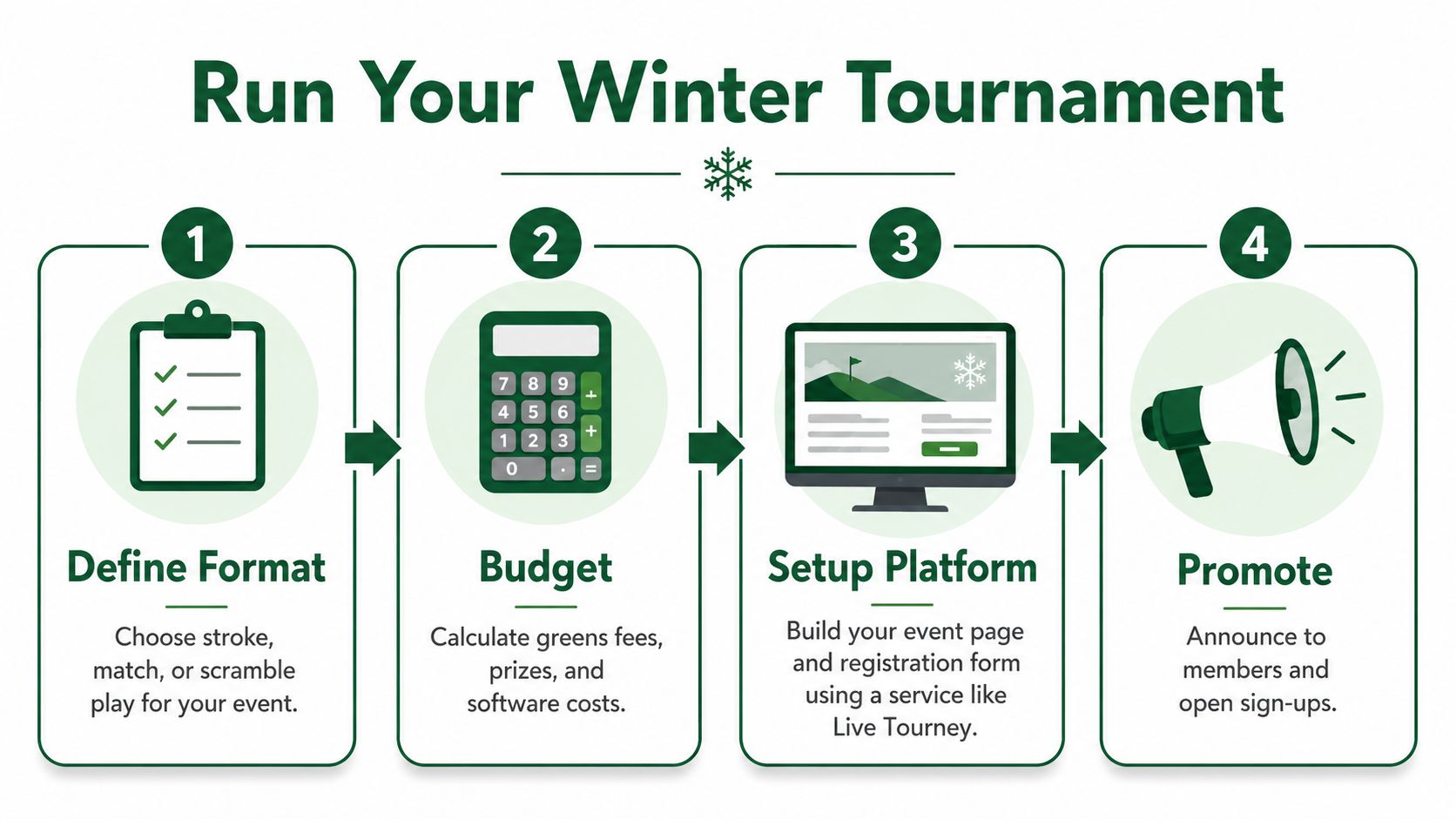
The setup checklist that keeps staff sane
Define Format. Choose stroke, match, or scramble play for your event.
Budget. Calculate greens fees, prizes, and software costs.
Setup Platform. Build your event page and registration form using a service like Live Tourney.
Promote. Announce to members and open sign-ups.
That sequence sounds basic, but it solves most of the operational pain. Once the format and budget are set, registration becomes easier to explain, pairings become easier to publish, and payout math stops becoming a scramble on the final day.
The best time to choose a scoring platform is before the field is full. Waiting until the last minute usually means rebuilding pairings in spreadsheets, double-checking names manually, and sending too many correction emails. A better model is to build the registration flow first, then lock in scoring and pairings so staff can spend tournament week managing the event instead of repairing it.
For a fuller organizer's framework, the practical steps in this golf tournament planning guide are a helpful companion to the winter-series approach.
Why Modern Scoring Software Changes the Winter Event
A winter event can look simple from the outside. Players sign in, scores get posted, and prizes get handed out. Inside the clubhouse, though, the critical work happens in the back office, where paper scorecards, spreadsheet pairings, and older tournament tools can slow everything down the moment a correction is needed. Modern web-based systems handle registration, live scoring, reports, and payouts in one place, so staff are not juggling separate tools while the event is already underway.
That shift matters because winter golf leaves little room for rework. If check-in starts running behind, or a pairing changes after the field is set, every manual handoff adds another chance for a mistake. Modern scoring software reduces that friction by keeping the event data in one shared system instead of spreading it across paper, email, and spreadsheets.
Live Tourney's published track record is one reason organizers have started looking at software differently. The platform says it has powered 10,000+ events, recorded 1M+ holes scored, driven a 40% increase in live scoring participation, and delivered 3x faster event setup. Those figures matter because winter events do not have much margin for delay, especially when daylight is limited and staff are handling check-in, pace of play, and final results at the same time.
For a closer look at how live scoring works in practice, see this guide to real-time golf tournament scoring.
What matters most for winter formats
The most useful features are the ones that cut repeated work. A customizable report builder can handle tee sheets, cart signs, and bag tags without forcing staff to rebuild the same information in different places. Dynamic emails reduce reminder calls by sending updates automatically. A payouts calculator makes the final results feel organized and official instead of patched together at the end. Support for formats like match play, round robin, and team events also gives organizers room to match the competition to the season.
Winter golf used to depend on whoever was willing to do extra manual labor after the round. Modern software changes that routine. A staff can set up the event once, then let the scoring platform manage the repetitive parts while the committee pays attention to course conditions, pace, and player experience.
Accessibility helps too. A web-based scoring flow that does not require an app is easier for members and guests who only need to enter scores and check the leaderboard. It keeps the event moving without asking everyone to learn a new system on the spot.
Putting It All Together for Organizers and Players
The PGA Winter Series is more than a tournament name. It's a proven winter rhythm built for players who still want competition and for organizers who need a reliable format when the calendar gets tight. The origin story from 1954, the modern demand around waiting lists and field depth, and the practical tournament models all point to the same lesson, winter golf works when the structure is clear and the operation is tight.
For organizers, the winning formula is straightforward. Choose a format that fits the field, set a budget you can manage, and use scoring tools that keep the event professional from registration to payout. For players, that usually means a better experience and a leaderboard that feels worth chasing.
If you're planning a winter event, Live Tourney gives you the live scoring, registration, and tournament management tools to run it cleanly on any device. It's built for courses and organizers who want the event to feel polished without adding back-office stress. Visit the site, see how it fits your winter schedule, and turn your next tournament into a smoother show from first signup to final payout.





