· 17 min read
How to Run a Charity Golf Outing That Raises Real Money
Learn how to run a charity golf outing that actually raises money. Practical steps for budgeting, sponsorships, registration, scoring, and follow-up.

The committee has a date in mind, a course that looks promising, and a list of people who said they're “probably in.” Then someone asks the question that matters most: how much will the outing raise after every bill is paid?
That question should shape the event before the first invitation goes out. Charity golf already operates at substantial scale. Philanthropy News Digest, citing National Golf Foundation research, reports an estimated 140,000 charitable golf events, involving more than 15 million participants and raising almost $3 billion annually in the United States.
The difference between a pleasant golf day and a worthwhile fundraiser is financial design. You need a net-proceeds target, a venue that fits the economics, sponsors with specific deliverables, and event-day giving mechanics that are planned as carefully as the tee sheet.
Start With the Fundraising Goal, Not the Golf
Treat the outing as a fundraising project that happens to use a golf course. If you start with the course, you'll usually build a price around the venue's demands. If you start with net proceeds, you can decide whether the venue, menu, prizes, and player experience deserve their place in the plan.
Write the target as a net number:
Net proceeds = total revenue minus total event costs.
Revenue should include player registrations, sponsorships, mulligans, contests, raffles, auctions, merchandise, meal-only tickets, and any post-event gifts directly connected to the outing. Costs should include the course agreement, green fees, carts, catering, beverages, insurance, permits, software, signage, prizes, payment processing, and volunteer supplies. The average community-based charity outing raises roughly $10,000, while some national charity events raise several hundred thousand dollars, according to the National Golf Foundation research cited by Philanthropy News Digest. That range makes one point clear: your committee needs its own financial model rather than a borrowed promise.
Three questions before you choose the date
Ask these questions before signing anything:
- Can the venue absorb the field? Confirm available player capacity, shotgun-start requirements, banquet capacity, cart inventory, and practice-area access.
- What sponsorship revenue is realistic? A first-time event with no sponsor history needs a conservative forecast. Don't count verbal interest as committed income.
- Can the committee execute the plan? Sponsorship sales, registration, check-in, contests, auction management, scoring, photography, and follow-up all need owners.
If your organization also runs direct mail campaigns, coordinate the golf appeal with those communications. A direct-mail audience can become a sponsor prospect list, a player pool, or a post-event donor audience, but only if the messages and data are planned together.
A practical target example
Suppose the committee wants $25,000 in net proceeds from a 144-player outing. The target isn't a registration goal. It's the amount left after costs.
| Line Item | Amount | Notes |
|---|---|---|
| Net-proceeds target | $25,000 | Amount the charity keeps |
| Estimated event costs | $30,000 | Course, food, carts, prizes, insurance, software, and supplies |
| Required total revenue | $55,000 | Target plus costs |
| Player registrations | $28,800 | Illustrative pricing model, not a guaranteed result |
| Sponsorships | $20,000 | Cash commitments secured before event promotion |
| Add-ons and auction | $6,200 | Mulligans, contests, raffles, auction, and other giving |
| Total revenue | $55,000 | Covers costs and target |
| Expected net proceeds | $25,000 | The score that determines whether the event worked |
Use the golf tournament fundraising ideas resource to pressure-test add-ons before you finalize the plan. The key decision is simple: if the forecast doesn't reach the net target, change the economics now. Don't wait until the banquet to discover that a full field still produced a disappointing result.
Run the 70 percent test
Before you approve the date, rerun the model with only 70 percent of the field sold. That test forces the committee to separate committed revenue from hopeful revenue, and it shows whether sponsorships are carrying the event or whether player fees are doing too much of the work. If the outing still clears its costs and returns something meaningful to the charity at 70 percent, the plan is sound. If it doesn't, fix the pricing, the sponsor goal or the cost base now.
Build a Realistic 6 to 9 Month Timeline
A charity outing scheduled for early fall can fail before promotion begins if the course is still unconfirmed in spring. Set the event date and secure the venue first, then build every fundraising and operations deadline around that commitment. Planning references commonly place course booking and core project setup in a 9 to 6 month window. The MOMENTIVE Software's charity golf tournament planning guidance also recommends booking the venue at least 6 months in advance.
The venue controls capacity, available dates, food and beverage rules, cart access, staffing, and much of the cost structure. A late contract leaves less time to sell sponsorships, fill teams, and adjust the revenue plan if the projected net proceeds fall short. Ask for nonprofit-friendly terms before signing, because an early agreement usually gives the committee more room to negotiate.
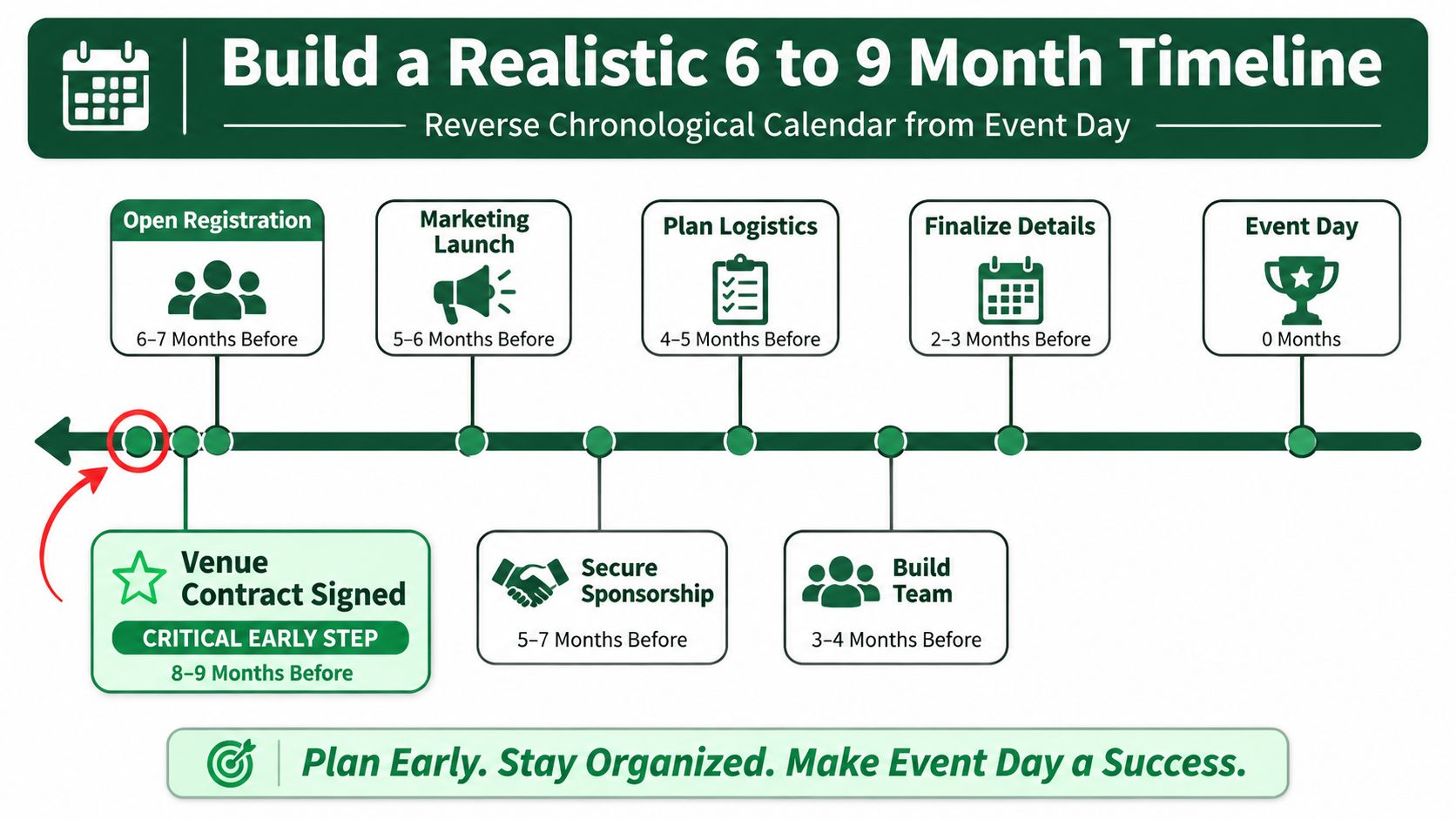
Reverse-planning calendar
Nine to six months out: Select the date, inspect the course, negotiate terms, and sign the venue contract. Build the first budget from the net-proceeds target backward. Form the committee, assign one person to sponsorship sales, choose the format, and list every sponsor asset you can sell.
Six to four months out: Set the title, presenting, hole, contest, food, beverage, and in-kind sponsorship packages. Prepare the one-page sponsor sheet, beneficiary language, registration copy, and payment process. Begin sponsor outreach immediately.
Four to three months out: Open registration, publish the mission story, confirm the player limit, and start public promotion. Keep making sponsor calls instead of assuming registration traffic will sell packages. Recruit volunteers while the available pool is still broad.
Three to two months out: Approve sponsor artwork, review player and foursome data, and order only the gifts and prizes the budget can support. Secure auction items, then verify insurance requirements, liquor permits, and raffle licenses. These administrative deadlines can determine what the event may legally sell or serve.
Final month: Reconcile registrations, assign starting holes or foursomes, publish the schedule, train volunteers, confirm catering counts, and prepare signage. Send players practical details, including arrival instructions and contest rules, rather than promotional reminders alone.
Final two weeks: Run a logistics sprint. Print station cards, test scoring, verify sponsor placements, prepare check-in materials, and create a contact sheet for the course, committee, vendors, and volunteer lead. Freeze changes unless they improve safety, compliance, or net proceeds.
Practical rule: Decide early on anything that affects capacity, sponsor inventory, or cost. Leave decoration decisions until later.
Budget and Pricing Built Backward From Net Proceeds
A budget becomes useful when it answers a decision. Start with the net-proceeds target, add the costs required to deliver the outing, and then decide how registrations, sponsorships, and add-ons will cover that requirement.
For a 144-player event, separate costs into fixed, variable, and contingent lines. The venue agreement may include booking fees, green fees, carts, catering, snacks, beverages, and staffing. Add insurance, permits, registration or scoring software, signage, awards, prizes, payment fees, and volunteer supplies. The planning guidance from MOMENTIVE specifically warns organizers to understand the venue's cost structure and negotiate nonprofit-friendly terms rather than assuming a generic per-golfer price.
The three revenue buckets
Entries create the attendance base but rarely carry the whole fundraising burden. Price individual golfers, foursomes, corporate teams, and banquet-only guests separately so you can fill the field without forcing every participant into the same package.
Sponsorships should cover a meaningful share of the required revenue before the event is promoted publicly. Cash sponsors protect margin. In-kind sponsors can cover printing, food, beverages, prizes, or photography, but assign each contribution a documented value so the budget doesn't overstate its benefit.
Add-ons include mulligans, contests, raffles, auctions, string, merchandise, and direct donations. Give each one a forecast before registration opens. If the budget needs more revenue, you can then decide whether to adjust entry pricing, sell another sponsorship, or improve the add-on plan.
| Category | Line Item | Sample Amount | Notes |
|---|---|---|---|
| Revenue | Player registrations | $28,800 | Illustrative total for the field |
| Revenue | Cash sponsorships | $20,000 | Secure commitments before public launch |
| Revenue | Add-ons and auction | $6,200 | Assign targets by activity |
| Cost | Course, green fees, and carts | $18,000 | Confirm the complete venue structure |
| Cost | Food and beverages | $7,000 | Include banquet and on-course service |
| Cost | Insurance and permits | $1,000 | Verify requirements with the venue and jurisdiction |
| Cost | Software and payment costs | $1,000 | Include registration and scoring tools |
| Cost | Prizes, gifts, and signage | $3,000 | Use sponsorships to offset variable costs |
| Total | Event costs | $30,000 | Review for scope creep |
| Result | Net proceeds | $25,000 | Revenue minus costs |
These amounts are a planning illustration, not a market benchmark. A break-even check is more valuable than a polished spreadsheet: required revenue equals costs plus the net target. If projected revenue falls short, don't hide the gap by cutting safety or hospitality first. Reprice the entry, add a sponsor package, reduce low-value extras, or strengthen the giving mechanics.
Keep one master sheet with committed, forecast, paid, and actual columns. Review it monthly, then weekly during the final stretch. A prize added casually, a catering guarantee changed late, or an untracked processing fee can reduce the amount the charity keeps.
Sponsorships That Deliver
Sponsors pay for a defined business and mission opportunity, not a logo scattered across the course. A workable package connects the sponsor to a specific audience, benefit, and proof of delivery. Build every tier backward from the net-proceeds target. If a package takes staff time or event budget, account for that cost before counting its cash as fundraising.
Use a short ladder that prospects can understand without a meeting. The ranges below are planning placeholders tied to the $25,000 net-proceeds example, not universal market prices. Adjust them to your audience, venue, and sponsor history.
| Tier | Cash Range | Key Benefits | Target Count |
|---|---|---|---|
| Title | $10,000 | Naming rights, top billing, opening remarks, major signage, program placement, and dedicated social mentions | 1 |
| Presenting | $5,000 | Prominent signage, branded carts or banquet area, speaking recognition, program ad, and mission tie-in | 1 |
| Hole | $1,000 | Tee-box sign, contest or hospitality activation, program listing, and event-day recognition | 4 |
| Contributing | $500 | Program listing, website recognition, and shared sponsor signage | 6 |
Sell deliverables, not adjectives
Replace “great visibility” with details your team can prove:
- Brand placement: Identify the sign location, size, installation date, and whether the sponsor receives a photo.
- Audience context: Share the expected player and guest profile from your registration records. Do not promise a number you have not earned.
- Mission connection: Name the beneficiary line item, program, or service the sponsorship supports.
- Content package: Specify the number and type of pre-event, event-day, and post-event mentions.
Sell hole sponsorships in batches of four when possible. Coordinated signs create a stronger presence, while the package gives a local business a clear decision instead of asking it to choose one isolated location.
Cash-plus-in-kind packages protect proceeds when the contribution covers a cost you would otherwise pay. Printing, food, beverages, prizes, and photography can fit, but unused products add work without improving the result. Assign one owner to the pipeline, set a 90-day sell-through goal, and require 50% of expected sponsorship revenue to be committed before public promotion. These are operating rules for the example plan, not external benchmarks.
A sponsor renewal starts with delivery. Photograph every placement, record every mention, and send the evidence while the event is still fresh.
Give each prospect one leave-behind, a one-page sponsor sheet. For package ideas, review this guide to golf outing sponsorship ideas, then remove anything your team cannot fulfill consistently.
Keep sponsor recognition compliant
In the U.S., the IRS treats a sponsor payment as a qualified sponsorship payment when the charity only acknowledges the sponsor. An acknowledgment can show the sponsor's name, logo, product lines, address, phone number and website on banners, programs and tee signs. Once the recognition turns into advertising, such as price information, comparisons, endorsements or calls to buy, or the sponsor receives other substantial benefits, part or all of the payment can be treated differently and may create taxable advertising income. Keep the sign copy to acknowledgment, list any benefits the sponsor receives (such as playing spots and meals) on the invoice, and check the details with your accountant.
Registration, Format, and Digital Scoring
Registration should be frictionless because every extra question or paper form creates another reason for a prospect to postpone. Open digital registration 90 days before the event through an online registration page that takes payment, such as a Live Tourney registration portal or a checkout on your own website. Collect player names, contact details, handicap information if relevant, dietary needs, foursome requests, sponsor connections, waivers, and add-on purchases in one flow.
Use a four-player team price of $500 to $900 and a single-golfer price of $125 to $225 as the stated planning ranges for this event model. (MOMENTIVE Software's registration and pricing guidance) Offer a banquet or food-and-beverage-only ticket for guests who want to attend the mission presentation, auction, and awards without playing.
Six touches that reduce event-day questions
Plan player communication as a sequence, not a pile of reminders:
- Save the date: Establish the cause, date, venue, and registration link.
- Early registration message: Give foursomes a reason to commit while spots are available.
- Two-week reminder: Confirm logistics and highlight remaining add-ons.
- Week-of message: Send pairings, arrival instructions, parking, and check-in details.
- Day-before weather call: State what will happen if conditions change and who makes the decision.
- Post-event thank-you: Share results, photos, and a short survey while the experience is fresh.
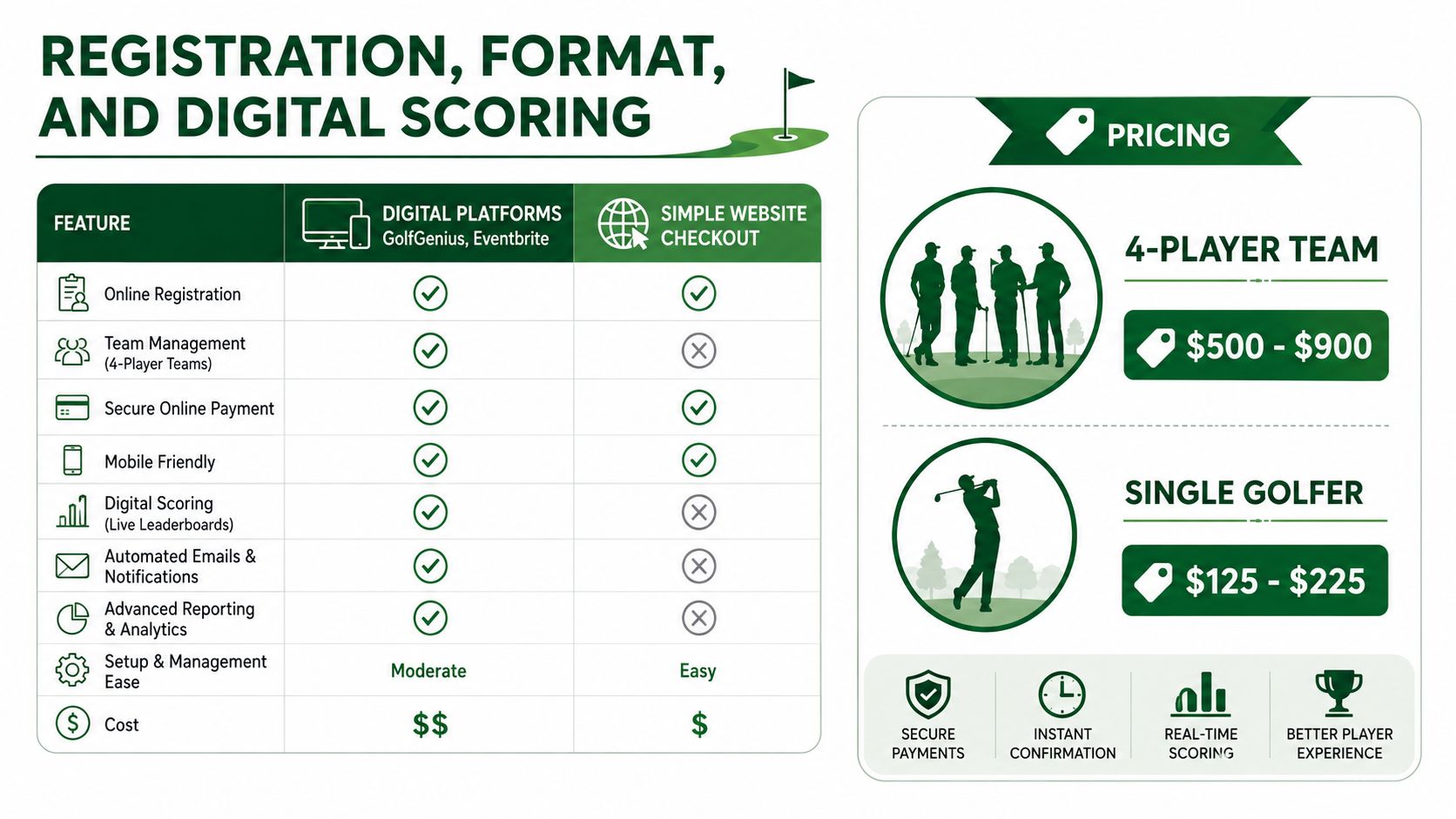
Choose the format for the field
A scramble is usually the right choice for a mixed charity field. Every player contributes shots, casual golfers can participate, and the rules are easy to explain. The format is also faster, with industry guidance describing scramble play as keeping rounds under five hours in the intended event model. (MOMENTIVE Software's charity golf tournament guide)
For a field that expects serious competition, choose best ball. Players play their own balls, and the team uses the best score on each hole. A Ryder Cup-style format can be engaging, but use it only when a captain has managed the format before. Match structure, pairings, scoring, and schedule complexity can consume volunteer time that would be better spent on donors.
For readers who want a plain explanation of scramble rules, 2ndShotMVP's scramble guide is a useful reference for player communications.
Enable digital scoring from the beginning. A tool such as a golf tournament scoring app can keep pairings, leaderboards, side games, and results in one workflow. Live Tourney is one option that provides app-free scoring through a phone link, registration management, leaderboards, and tournament materials such as scorecards and tee sheets.
Event-Day Revenue Add-Ons and Contests
The add-ons aren't decorations around the fundraiser. They are financial levers that give players more ways to contribute after they've already paid to attend. Put a revenue target beside every activity before registration opens, then track actual sales separately.
Sell mulligans in bundles, with a clear cap so the format remains credible. The event plan can offer two mulligans per player, but explain when they may be used and whether they apply to drives, putts, or both. String can be sold by the foot as a measured way to move a ball closer to the hole. Keep the rule simple, and have a volunteer cut or record usage.
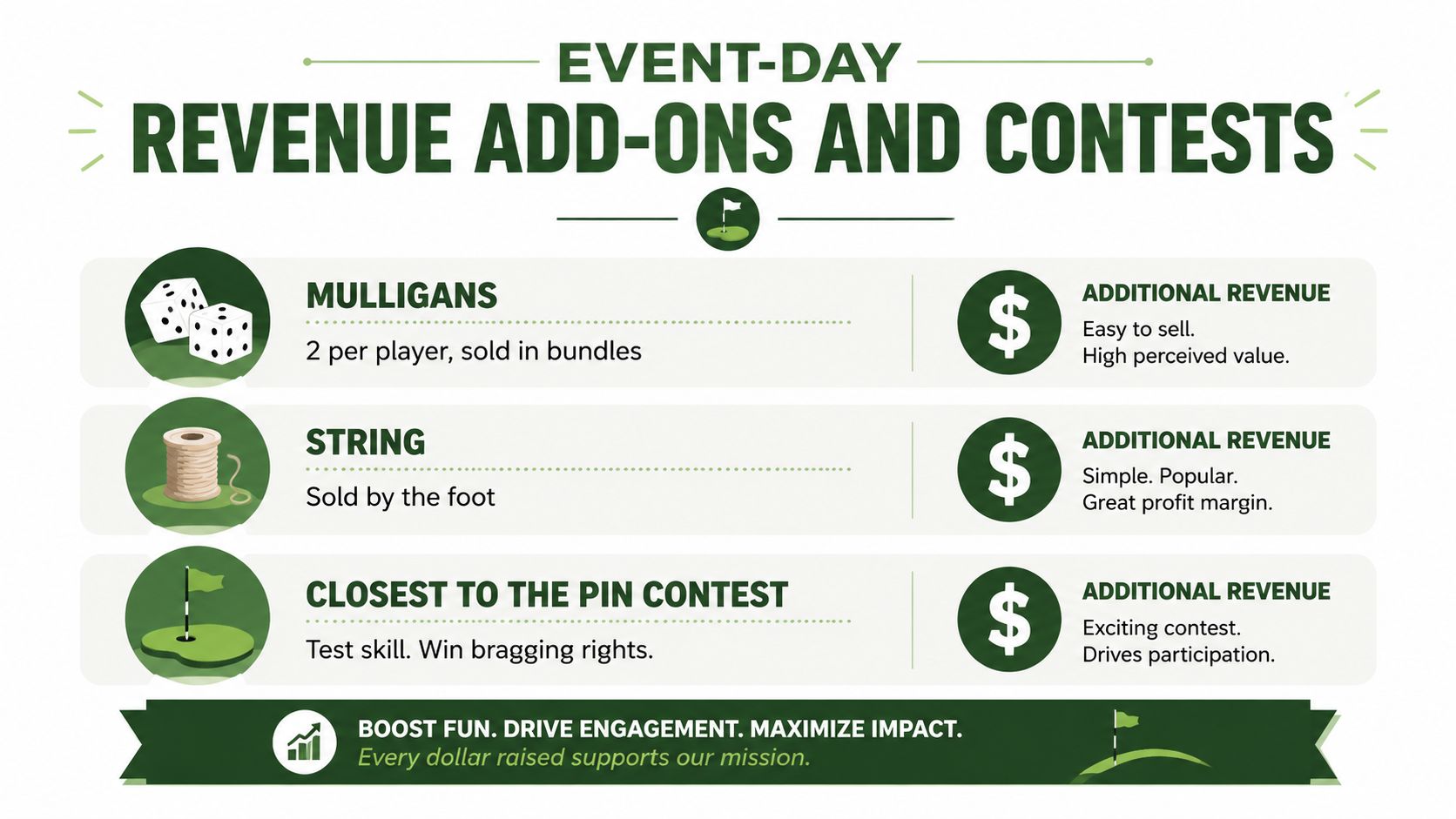
Give each activity a job
A 50/50 raffle creates a straightforward cash appeal, but hold the drawing at the banquet so the full field is present. Raffle tickets and auction bids should be available digitally and at the registration area, with fixed-price packages visible before players leave for the course.
Use closest-to-the-pin and longest-drive contests as both paid participation opportunities and sponsor inventory. Each contest hole needs a named volunteer, measuring tape where appropriate, a rules card, and a payout or prize sheet. A silent auction can run during play, while a live auction or paddle appeal belongs in the banquet program when attention is concentrated.
If players can't understand the offer in a few seconds, they won't buy it from a moving beverage cart.
Keep every sale in its own line. Compare gross income, direct cost, volunteer burden, and sponsor value after the event. A contest that looks impressive on a flyer but produces little margin should be redesigned or removed. A modest mulligan bundle or well-presented raffle can be more valuable than an expensive activation that slows play.
On-Site Logistics, Volunteers, and Live Leaderboards
The event day should feel obvious to the guest. Carts are staged, check-in has a queue plan, volunteers know where to stand, the opening remarks start on time, and players understand how to buy add-ons and enter scores without hunting for a staff member.
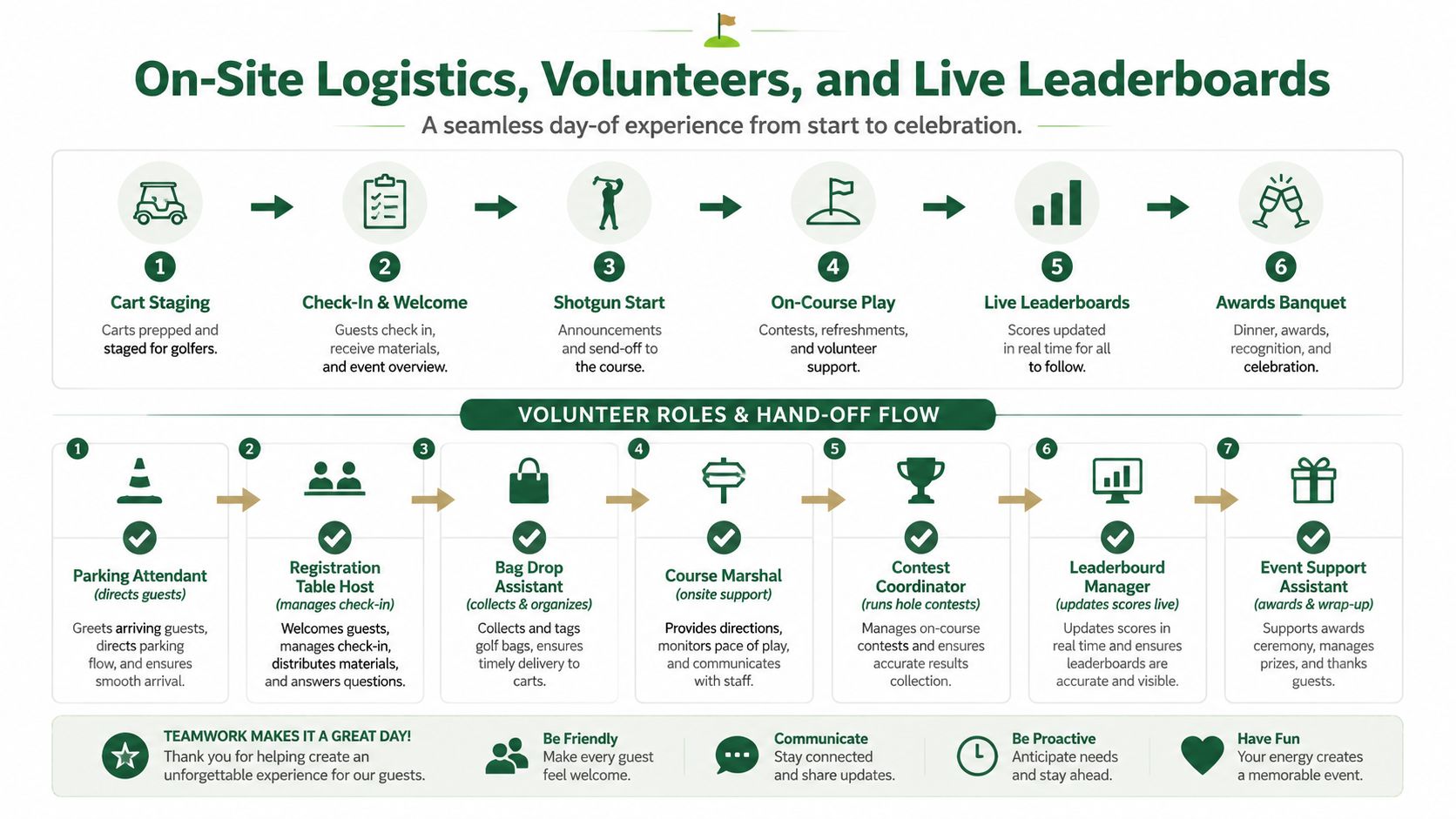
Design the hand-offs
Create a day-of map from cart staging to the awards banquet. Give every volunteer a printed card showing the station, start time, duties, hand-off point, and cell number for the volunteer lead.
- Parking attendant: Directs guests, identifies accessible parking, and sends players toward registration.
- Registration desk host: Handles waivers, cart assignments, team questions, and check-in.
- Hole-in-one witness: Verifies the shot, records the player, and protects the prize rules.
- Contest tent captain: Manages mulligans, string, contest entries, measuring, and payout records.
- Beverage cart driver: Delivers refreshments and points players toward digital giving or auction information.
- Scoring runner: Resolves missing or suspicious scores and communicates with the leaderboard manager.
- Photographer: Captures players, sponsors, volunteers, contest moments, and mission-related interactions.
- Float runner: Moves auction materials, signage, supplies, and urgent messages where they're needed.
Use a 30-minute check-in window in the event schedule. The desk should process waivers, confirm cart assignments, sell contest wristbands or fixed-price add-ons, and give players a quick explanation of the live leaderboard. Pre-assign starting holes and foursomes so staff aren't rebuilding the field while the course is waiting.
Staff check-in with at least three volunteers per shift: one greets players and verifies the roster, one handles payments and add-ons, and one answers questions and directs players to carts. Keep the donation table and sponsor displays visible, but don't let them block the registration queue.
Protect the pace
Set a clear target of 4 hours 30 minutes for 18 holes and tell players what it is during the rules briefing. Put a marshal checkpoint at the turn and step in, politely but directly, when a group falls behind that pace. Slow play affects the kitchen schedule, the scoring queue, sponsor activations, and how many players stay for the reception. Keep the scoring table staffed during play so corrections happen while groups are still on the course.
Digital scoring reduces the committee's dependence on paper scorecards. Volunteers can verify hole scores, help players who have trouble accessing the link, and post photos instead of hand-tallying cards after the round. The leaderboard also gives the banquet a live thread, especially when side games and skins are displayed clearly.
Make the follow-up part of operations
Sponsor recognition doesn't end when the last group leaves. Send sponsor recap packets within 72 hours, including the placements delivered, registered teams, dollars raised, and a photo set from the day. The packet should show exactly what the sponsor funded and make renewal feel like a continuation rather than a new sales pitch.
Email attendees with a thank-you, a one-page impact report, and a tax receipt that separates the deductible portion from the value of meals, greens fees, carts, and other benefits. For U.S. payments over $75 that are partly contributions and partly payment for goods or services, IRS disclosure rules require a written statement identifying the deductible portion as the amount paid minus fair market value, along with a good-faith estimate of that value. (Redswing's summary of charity tournament entry-fee disclosure rules)
Tax handling varies by jurisdiction. In Canada, the Canada Revenue Agency says tokens of appreciation and door prizes exceeding the lesser of $75 or 10% of the registration fee are treated as an advantage and must be subtracted from the donation receipt. (Canada Revenue Agency guidance for golf tournaments) Tag every registrant in the CRM by role, foursome, and sponsor connection. Send next year's save-the-date 30 days before the general public, invite strong attendees into the next planning committee, and ask each sponsor within two weeks whether it wants to renew, upgrade, or step down. The follow-up isn't a courtesy. It starts next year's revenue pipeline.
Running a Charity Outing in Live Tourney
In Live Tourney, players sign up on a registration page and pay online through Stripe, with price tiers for single golfers, foursomes and sponsor packages that include playing spots, plus add-ons such as mulligans or a skins entry. Registrations land on one roster, so pairings, cart signs, scorecards and tee sheets are built from the same data. On event day, players score from a link or QR code with no app to download, the live leaderboard runs on phones and the clubhouse TV, and skins and payouts are calculated from the same scores. Email and text messages handle the pre-event touches. See setting up online registration and the features page.
Live Tourney can help organizers manage registration, player rosters, digital scoring, live leaderboards, side games, payouts, and event-day materials from one web-based system. If you want to replace paper scorecards and reduce the manual work around your next charity outing, visit Live Tourney and review how the platform fits your event workflow.