May 14, 2026
money ball golf, golf tournament games, golf side games, tournament scoring, live tourney
Learn how to run a money ball golf tournament. This guide covers rules, scoring variations, payouts, and step-by-step setup using modern tournament software.

If you're staring at another charity scramble, member-guest, or corporate outing and thinking, "We need something fresh, but I don't want a scoring mess," money ball golf is one of the best answers. It adds tension without requiring players to learn an entirely new game, and it gives every hole a reason to matter.
The catch is that money ball looks simple on a rules sheet and gets messy fast once carts leave the clubhouse. Rotation gets missed. Teams forget who carries the money ball. Someone enters the wrong score. Side pots turn into post-round math. The format works best when the game itself feels high-energy and the administration feels invisible.
What is Money Ball Golf and Why Players Love It
A standard scramble can go flat by the middle of the round. Players are still having a good day, but the competitive pulse drops because everyone starts to feel like each hole blends into the next. Money ball golf fixes that by giving every hole a designated pressure player.
In the most common version, you have a four-person team and one golfer is the money ball player on each hole. That role rotates in order: A on Hole 1, B on Hole 2, C on Hole 3, D on Hole 4, then back to A. A common scoring method combines the money ball player's score with the scramble score of the other three teammates. If the money ball player makes 5 and the other three produce a scramble 4, the team score is 9, as described by Golf Compendium's money ball format overview.

Why the format lands with players
The appeal is immediate. Every golfer knows they'll eventually be the one whose score carries extra weight, so weaker players stay engaged and stronger players can't hide inside the team result.
That shift changes the mood of the day in a good way:
Every hole has a focal point. One player becomes the storyline.
Every player matters. Nobody can coast through the round waiting for the scramble to save them.
Teams talk strategy. Order, risk tolerance, and hole management suddenly matter.
The format suits outings well. It feels competitive without becoming overly complicated.
Practical rule: If you can explain the scoring in under a minute at check-in, players will embrace it. If they need a printed appendix, you've overbuilt the game.
Money ball also works because it layers neatly on top of formats golfers already understand. You don't need to reinvent pairings, tee sheets, or pace-of-play policies. You're just adding a rotating pressure component to the round.
If you're comparing side-game options for your next event, this broader list of tournament golf game ideas helps put money ball in context. In my experience, money ball stands out because it creates drama on every hole instead of saving all the excitement for the final leaderboard.
Why directors like it
From an operator's perspective, the best formats do two things. They create energy for players and they don't create chaos for staff. Money ball does the first naturally. The second depends on how clearly you define the rules before the first tee shot.
Core Rules and Common Variations
Money ball succeeds when you lock down the house rules early. Most event problems don't come from the concept. They come from organizers mixing two or three versions of the game and assuming players will sort it out on the course.
The two scoring models that matter
The first decision is how the non-money players contribute to the team score.
Option one is the version most groups recognize. The money ball player's individual score is added to the scramble score created by the other three players. This is easy to explain and usually moves quickly because teams already know how to play a scramble.
Option two is more individual. The money ball player's score is added to the best individual score from the other three players. If the money ball player makes 5 and the best non-money-ball score is also 5, the team score is 10. This version rewards cleaner individual play and usually feels more exacting.
Rotation and assignment choices
The default rotation is sequential. That matters because predictable order reduces disputes and keeps scorecards clean. Write the rotation on the cart sign, include it in the rules email, and print it on any physical scorecard if you're using one.
Some groups like to flex the assignment late in the round. That can add strategy, but only if your field is competitive and your rules are explicit. For charity and mixed-skill events, fixed rotation is cleaner.
The best house rules aren't the cleverest ones. They're the ones every team can follow without calling the shop on Hole 6.
What happens when the money ball is lost
This is the decision that most often gets ignored until it's too late.
One common higher-stakes version uses a lost money ball rule. If the designated player's ball is lost, only that player is eliminated and the team continues as a threesome. A second loss can eliminate the entire team. That creates real tension, but it can also turn a casual outing into a survival exercise if the course has heavy trouble.
The softer version applies a scoring penalty instead of disqualification. In some variants, a lost ball brings penalty strokes and the score is doubled as the team total for that hole. That keeps everyone in the game and is usually the better fit for fundraisers, corporate groups, and mixed-ability fields.
Money Ball Rule Variations
Rule Category | Option A (Standard) | Option B (Higher Stakes) | Best For |
|---|---|---|---|
Team scoring | Money ball score + scramble score of the other three | Money ball score + best individual score from the other three | Standard for outings, higher-stakes for competitive fields |
Rotation | Fixed sequential order through the round | Flex assignment late in the round if announced in advance | Fixed for simplicity, flex for advanced competitions |
Lost money ball | Penalty-based scoring so teams stay alive | Player elimination, with team elimination after another loss | Penalty model for charity events, elimination for serious side games |
What usually works best
For most public events, the cleanest build is fixed rotation, scramble support from the other three players, and a penalty-based lost-ball rule. That combination preserves the fun part of money ball without producing awkward rulings or dead teams halfway through the round.
If your players are experienced and specifically want more risk, the elimination version can be memorable. Just don't surprise them with it. In money ball golf, the quality of the day often comes down to whether the rules feel consistent rather than harsh.
Setting Up Your Money Ball Game in Minutes
The hardest part of money ball isn't the golf. It's the administration if you try to run it manually.
I've seen organizers use spreadsheets, paper side sheets, and text threads to track the rotation and scoring. That works right up until one team forgets whose hole it was, another team writes down a scramble score instead of the money ball score, and someone in the shop has to reconstruct the round after lunch.
A 2025 Golf Software Survey covering over 500 US courses reported that 62% of head pros want "plug-and-play" formats for side games like Money Ball, and that manual entry on older platforms can lead to side-pot error rates as high as 25%. That's exactly why this format needs a digital setup before players arrive.

Build the game before check-in opens
The smoothest events treat money ball as a configured side game, not a manual add-on. That means setting the logic once, then letting the system handle the repetitive work.
A clean setup usually follows this sequence:
Load the teams first. Make sure your four-player rosters are final before assigning rotation.
Set the money ball order. Sequential assignment is best for most fields because everyone can verify it at a glance.
Choose one scoring model. Don't combine scramble support and best-ball support in the same event.
Define the lost-ball treatment. Penalty or elimination. Pick one and write it clearly.
Create the side-game payout. Keep it simple enough that players understand what they're playing for.
For the staff, the goal is repeatability. For players, the goal is clarity.
Why app-free scoring matters here
Money ball asks players to do more than enter a standard team number. They need to keep track of a designated player and a second scoring component on every hole. Any extra friction hurts adoption.
That's why app-free workflows are so useful. If players can open a browser link and score immediately, you remove the usual stall points: app downloads, login confusion, forgotten passwords, and mixed device compatibility. A practical example of that approach is covered in these digital golf scorecard best practices.
If a side game needs staff intervention on every third hole, it isn't a side game. It's a second tournament layered on top of the first.
What not to do
A few setup habits cause most of the trouble:
Don't assign rotation verbally only. Players will forget by the back nine.
Don't leave penalty handling for later. That's how disputes start.
Don't rely on one volunteer to calculate side scores by hand. The round will finish before the side game does.
Don't hide the payout logic. Players are much better scorers when they know exactly what counts.
When money ball is set up properly, it feels simple to the field even though the logic underneath is more complex than a basic scramble. That's the benchmark you want.
Managing Scoring and Live Leaderboards
Tournament day should feel easy for the field and quiet for the golf staff. If your money ball process requires teams to ask the scoring table for help every few holes, the format isn't ready.
The cleanest workflow is to have each team submit only what the game needs on each hole. In most money ball setups, that's the designated player's score and the supporting team score from the other three players. Once those two inputs are in, the system can do the arithmetic and post the result automatically.
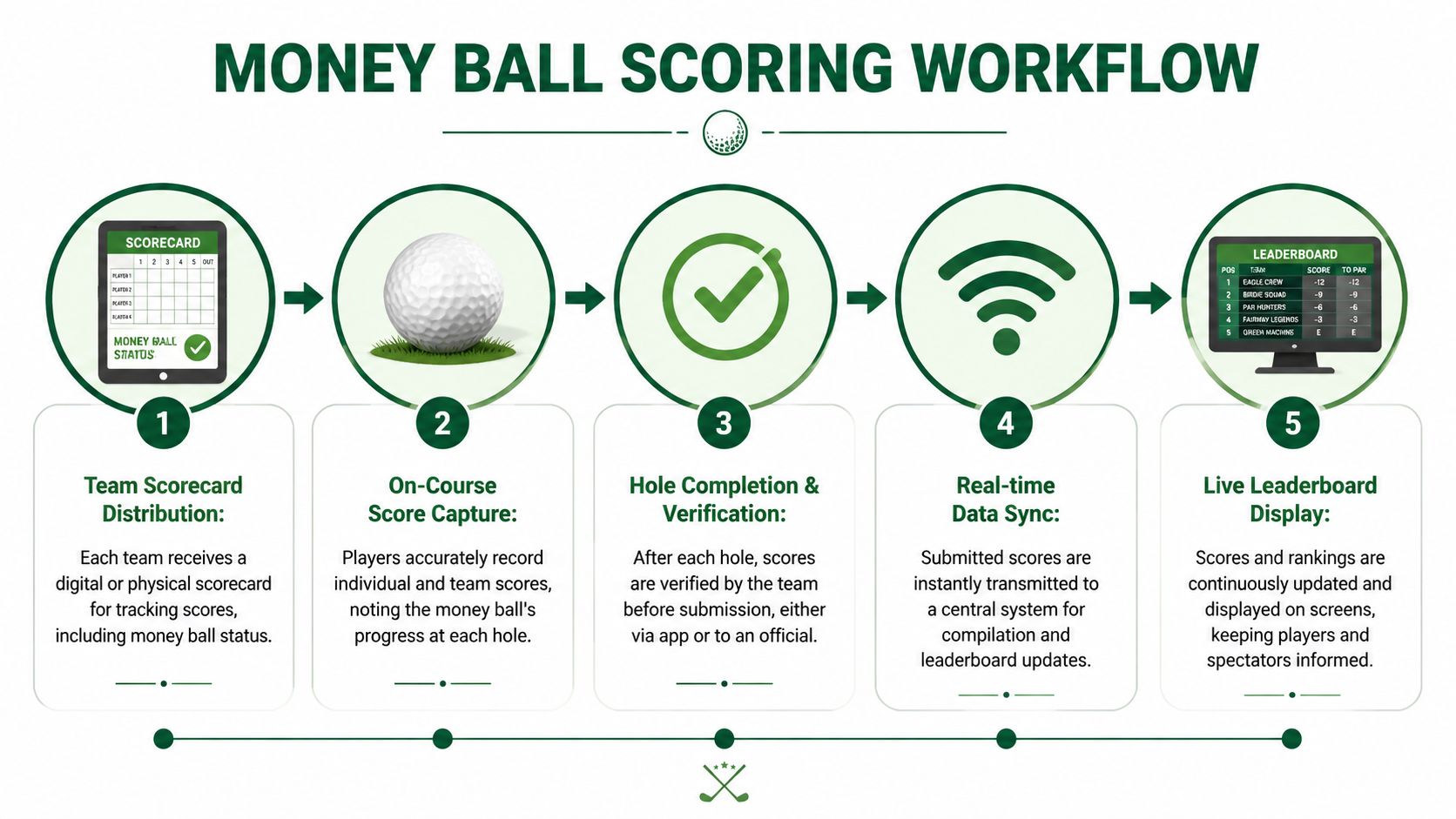
The on-course scoring rhythm
Good scoring routines are repetitive by design. Every team should follow the same pattern on every hole.
A practical rhythm looks like this:
Confirm the money ball player on the tee. That avoids the most common mistake before it happens.
Record both required scores after the hole. Don't wait three holes and trust memory.
Verify before submitting. One player reads the numbers, another player confirms them.
Submit and move on. No handwritten recalculation needed.
Money ball has two failure points instead of one. Teams can get the golf score right and still enter the wrong player's role. That's why verification should happen while everyone is standing at the green, not in the cart on the way to the next tee.
Why live leaderboards help this format more than most
Money ball creates momentum swings. A team can look steady for several holes, then lose ground when the designated player has a rough hole. The live board makes those swings visible, which keeps the format interesting for the entire field.
When scores post in real time, players can see where the pressure holes mattered. They don't have to wait until dinner to find out whether their money ball stretch helped or hurt them. For organizers, that means fewer end-of-round surprises and fewer arguments about unofficial side-game standings.
If you're designing the player-facing experience, a dedicated golf tournament scoreboard is especially useful for money ball because the game is more dramatic when teams can track movement as it happens.
A live board changes player behavior. Teams pay closer attention when they can see every hole affect their position.
The staff perspective
From the shop or scoring tent, your job on tournament day should be exception handling, not routine math. Staff should only step in for unusual rulings, not normal score calculation.
That means your scoring process should already account for:
Fixed or pre-declared rotation
The chosen scoring formula
Lost-ball treatment
Automatic leaderboard updates
Final validation before prizes are paid
If those five pieces are in place, money ball stops being a "special format" that demands extra labor. It becomes another polished competition running inside the event.
Strategies and Tips for a Flawless Event
The best money ball events don't just have correct rules. They have clear communication, sensible prize design, and one version of the game that everybody understands before the shotgun start.
Start with the player briefing
Most confusion can be prevented in the welcome email and the pre-round announcements. Keep the explanation short. State the rotation, the scoring formula, and the lost-ball rule in plain English. Then put the same language on the cart sign or printed rules sheet.
For broader event execution, these game day event planning tips from Corporate Challenge Events are a useful reminder that players remember clarity and flow as much as they remember prizes.
Use payouts that match the field
If you only pay the overall winning team, some groups will lose interest once they have one bad stretch. Money ball works better when more than one result feels worth tracking.
Try a split approach such as:
Primary team prize: Reward the best overall money ball team score.
Separate side prize: Add a prize for the cleanest money ball performance or similar sub-result if your house rules support it.
Tie policy: Publish the tiebreak before the round starts, not after scores are in.
You don't need a complicated purse structure. You need one that players can follow.
Respect the pressure factor
Anecdotal tournament data summarized by Beezer Golf's money ball guide says the designated money ball player's score tends to run 0.5 to 1 stroke higher than their typical performance because of pressure. The same source notes that teams that don't think through rotation can see their score jump by 2 or more strokes when a weaker player lands on a difficult hole.
That matches what most tournament directors see in real life. Players don't struggle because the format is confusing. They struggle because the format makes one ordinary shot feel expensive.
Keep the rules simple and let the pressure come from the golf. That's where the fun is.
Small operational habits that save the day
Print the rotation everywhere. Scorecard, cart sign, starter sheet.
Name one scorer per team. Too many scorekeepers usually creates conflicting entries.
Set a ruling contact. Players need one clear number or official for edge cases.
Test the scoring flow before tee time. Run a mock hole with a staff member.
Money ball golf is at its best when players feel tension and staff feel control. Those two outcomes come from the same place: clean rules, steady communication, and no improvising once the round begins.
Elevate Your Next Tournament with Money Ball
Money ball golf gives you something many side games don't. It changes the feel of the round without forcing players into a format they can't understand on the first tee. The game creates pressure, conversation, and a reason for every golfer on the team to stay invested.
For organizers, the primary advantage is pairing that energy with a clean operating model. When rotation, scoring logic, and leaderboard updates are handled properly, money ball stops feeling like extra work and starts feeling like a premium event feature. If you're refining the overall player experience, these event planning insights from Vanta Sports are also worth a read because they reinforce the same lesson: memorable events come from smooth execution, not just good ideas.
Run it once with tight rules and modern scoring support, and you'll probably keep it on your calendar.
If you're ready to run money ball golf without the usual scoring headaches, Live Tourney makes setup, live scoring, side games, and leaderboards simple on any device, with no app download required.