Jul 5, 2026
world juniors golf, junior golf tournaments, youth golf, golf tournament software, junior golf development
Your complete 2026 guide to world juniors golf. Learn about major tournaments, eligibility, top players, and organizing your own event.

Most families start with the wrong question. They ask, “What's the best world juniors golf event?” when the better question is, “Which pathway fits this player's age, score level, budget, and long-term development?”
That shift matters because world juniors golf isn't one tournament. It's an array of elite international championships, invitation-based events, age-bracketed majors, and national-team competitions that all test players in different ways. If you're a player, parent, or local organizer, confusion usually starts when these events get lumped together as if they operate under one set of rules.
They don't. Some emphasize individual stroke play. Others center on national teams. Some have strict score-based qualification filters. Others depend on rankings, qualifiers, or committee discretion. The families and coaches who excel in this environment usually aren't the ones chasing logos. They're the ones who understand format, eligibility, and standards before they ever book a flight.
What Are the World Juniors Golf Championships
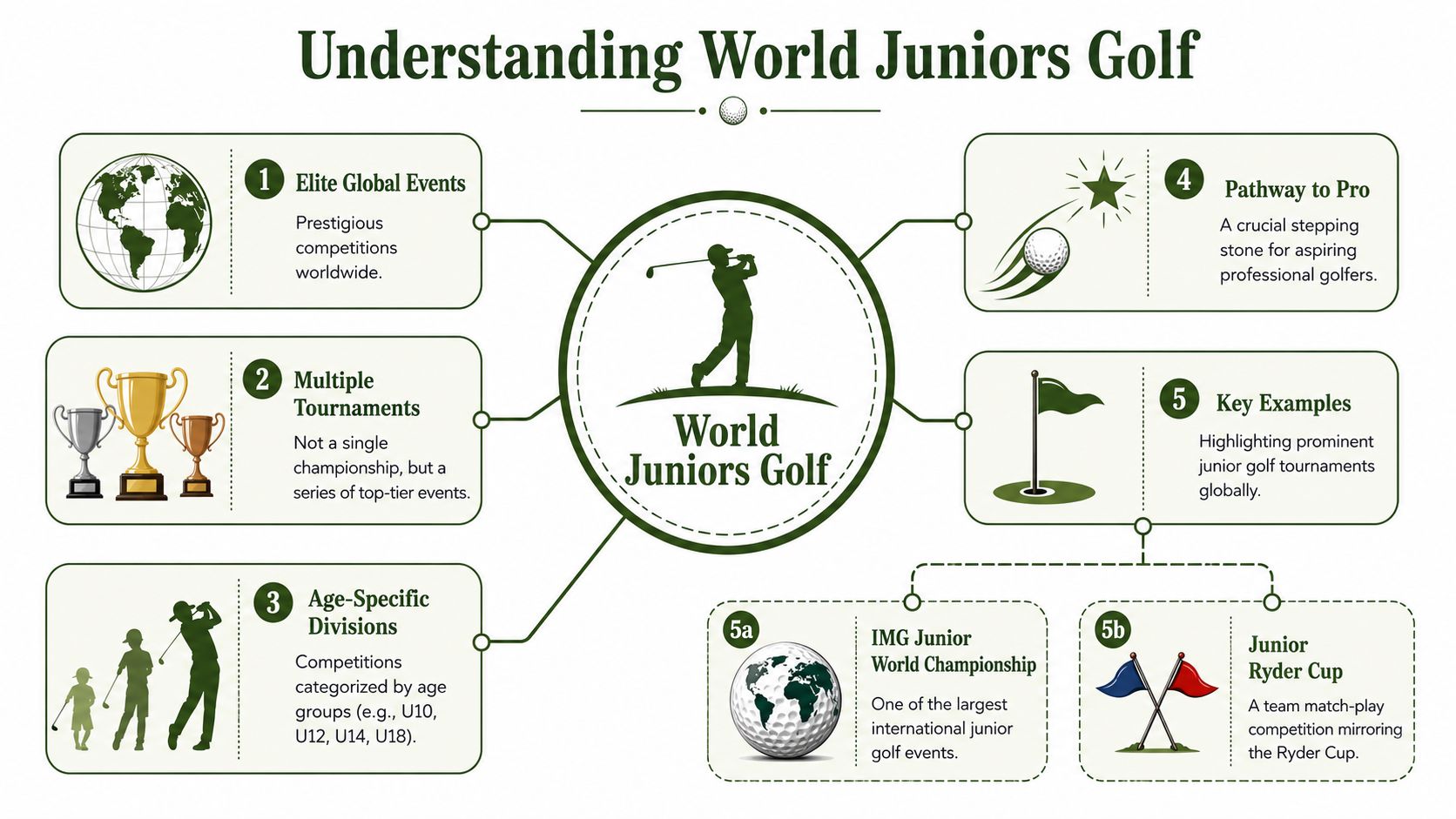
When people say world juniors golf, they're usually referring to a group of top international junior tournaments rather than a single governing body or one universal championship. That distinction clears up most of the confusion right away.
At the top of the conversation, you'll hear names like the IMG Junior World Golf Championships and the Toyota Junior Golf World Cup. These events sit in the elite tier, but they're built differently. One may be known for its size and international reach, while another is defined by team representation and national identity.
The term covers several kinds of events
A useful way to think about world juniors golf is to split it into categories:
Global open-style championships that bring together large international fields across age divisions.
Team-based international events where players represent their countries rather than only themselves.
Invitational elite fields where entry standards, pace-of-play, and conduct rules are closer to high-level amateur golf.
Regional qualification funnels that feed into major championships.
The biggest mistake I see is assuming the same strategy works for all four. It doesn't. A player built for steady multi-round stroke play may not be the best fit for a team event where every score has national significance.
Why certain tournaments stand above the rest
The IMG Junior World Golf Championships held at Torrey Pines is one of the world's largest junior events, with a field size exceeding 1,250 players from over 56 nations, which gives it unusual global weight in junior golf (IMG Junior World Golf Championships). Scale alone doesn't make an event important, but it does change the experience. Players aren't just facing strong competition. They're learning to perform inside a crowded, international, highly visible environment.
A few practical distinctions help:
Tournament type | What defines it | Best fit for |
|---|---|---|
Large international championship | Big fields, many nations, age divisions | Players ready for depth and pressure |
National team event | Country-based representation | Players comfortable with team accountability |
Elite invitational | Tight standards, strong field control | Players already competing at a high level |
Qualifier-driven major | Clear entry route through scores or events | Families who plan early and track eligibility carefully |
Practical rule: Before calling any event “the world juniors,” verify its format, age structure, and entry path. The name alone doesn't tell you enough.
For players and parents, that means asking sharper questions. For organizers, it means studying how the best events communicate structure clearly. The tournaments that earn trust don't just look prestigious. They make expectations obvious.
The History and Enduring Significance of Junior World Events
Junior world events matter because they've been identifying serious talent for decades, long before most players appear on mainstream broadcasts. These championships don't create a player's game, but they do reveal who can travel, adapt, and compete under pressure.
The best historical example is the Toyota Junior Golf World Cup. It was first contested in 1992 and founded to feature national teams of golfers aged 18 and under. That team structure gave junior golf something distinctive: an international proving ground where players carry their country's badge, not just their own scorecard (Toyota Junior Golf World Cup history).
Why legacy still matters
A tournament's history shapes how coaches, federations, and families view a result. Finishing well in a longstanding event means more than posting a number at a random summer tournament. It signals that the player handled a setting with established standards, stronger fields, and more scrutiny.
The Toyota event also matters because of the names tied to it. Justin Rose, a major champion and 2016 Rio Olympics gold medalist, is among its notable past players, which reinforces the event's role as a real checkpoint for future professionals (Toyota Junior Golf World Cup overview). That doesn't mean every participant is destined for the PGA Tour or LPGA. It means these events have a long track record of attracting players who later thrive at the top.
What these events teach beyond scoring
Legacy events expose young golfers to pressures that local tournaments rarely replicate:
National expectation: Team events change decision-making. Players often become more conservative, or sometimes too aggressive, because every hole feels shared.
Travel stress: Sleep, food, climate, and time zones test routines.
Cultural maturity: Players learn how to behave around officials, host clubs, and international competitors.
Competitive patience: Elite junior events often reward players who stay disciplined when early birdies don't come.
A junior event becomes significant when it tests the player and the support system around the player.
That's why these tournaments continue to matter. They're not just prestigious because of the trophy or the venue. They matter because they compress golf skill, self-management, and competitive behavior into one week. For many families, that's the first real glimpse of what higher-level amateur and professional golf requires.
Navigating Tournament Formats and Eligibility
Why do strong junior players miss world-level events? In my experience, it usually starts before the first tee time. Families misread age cutoffs, choose the wrong qualifying path, or prepare for a rules set that does not match the tournament.
A player can have the game and still miss the field. Entry policies, division dates, qualification categories, pace-of-play standards, and equipment rules all shape who gets in and who stays eligible. For parents, coaches, and local organizers, that is not paperwork. It is part of competitive readiness.
Start with format, not prestige
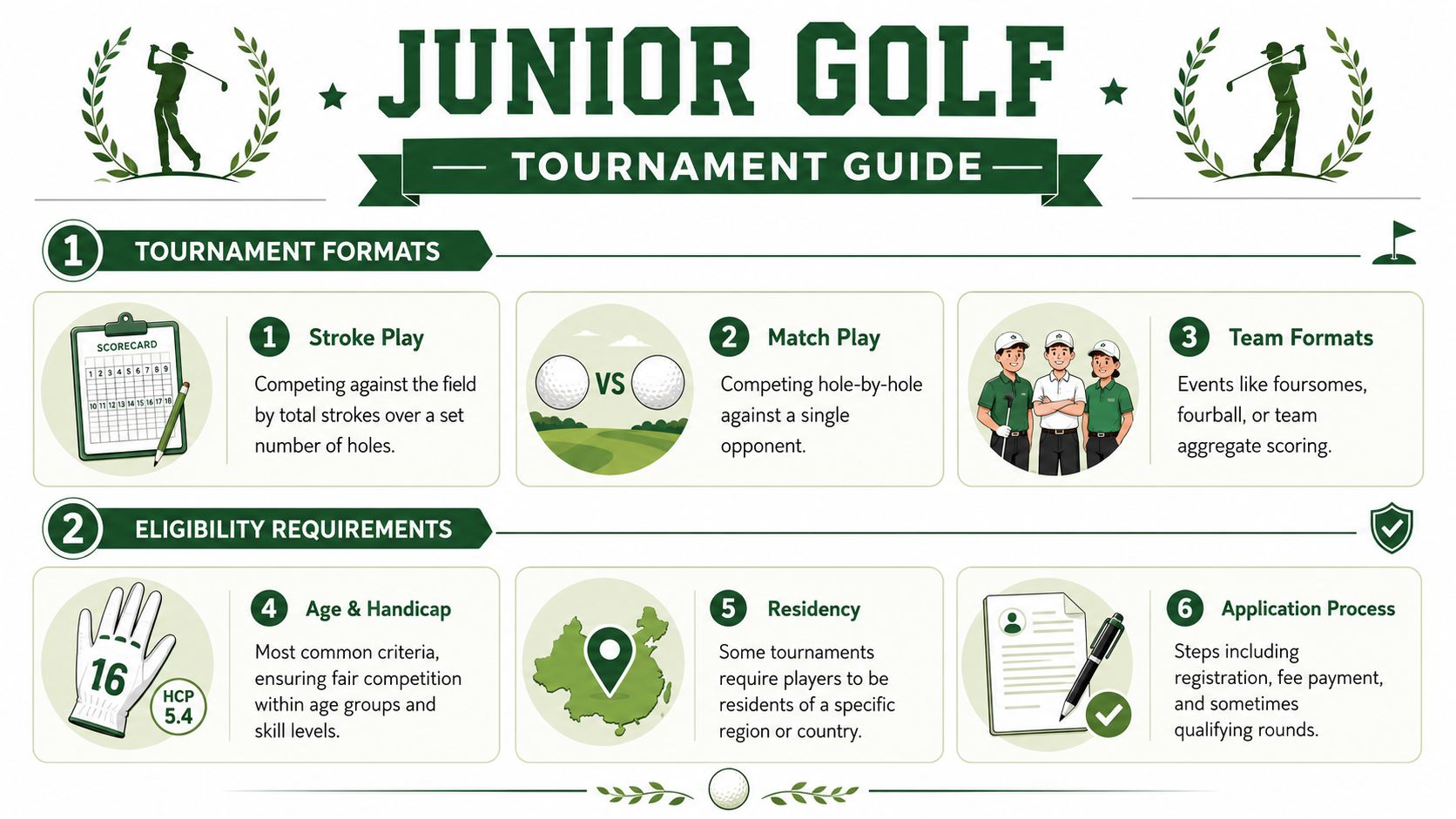
Events that look similar on a calendar can test very different skills. The first job is to sort the format before getting attached to the name.
Use four questions:
Is it individual stroke play or team competition?
How are age divisions defined and on what cutoff date?
Does entry come through rankings, qualifiers, invitations, or direct application?
Which tournament rules change preparation in a meaningful way?
That order saves time. It also gives local organizers a useful model. If you want your own junior event to feel professionally run, publish those four items clearly and early. Confusion at entry usually becomes frustration on site.
Eligibility rules often decide the season
Some championships present entry criteria cleanly. Others require families to piece together information across multiple pages, especially for international applicants. The World Junior Golf Championships entry policies show how much detail sits behind one event, from age-based divisions to application procedures.
That matters because every entry route creates a different season plan. A ranking-based pathway rewards steady scheduling. A qualifier-based pathway asks players to peak on specific dates. A direct application process often shifts the pressure to timing, documentation, and travel coordination.
I tell families to verify three items first: age eligibility on the exact cutoff date, the approved route into the field, and the deadline for each step. Those are the details that determine whether a player has a chance to compete.
Rules that should change preparation
Tournament rules are not fine print. They should shape practice.
At the Dustin Johnson World Junior Golf Championship entry policy, players must complete 18 holes within 5 hours, and distance-measuring devices are allowed only if the slope-measuring function is not used. Those rules affect preparation well before tournament week.
Pace training: Players who take too long over the ball need a faster routine, not just a reminder from a referee.
Device habits: If a player practices all year with slope turned on, they need reps with tournament-legal settings.
Late-round focus: Five-hour rounds test concentration, hydration, and decision-making on the closing holes.
Course-side advice: Match practice rounds to tournament conditions. If slope is banned, turn it off at home. If pace is strict, time every nine holes.
This is also where local tournament directors can learn from elite events. The better junior competitions remove avoidable ambiguity. They publish pace standards, equipment policies, and player conduct expectations before registration closes. That gives families a fair target and gives staff a cleaner week.
A planning checklist that works
Question | Why it matters |
|---|---|
Is the player age-eligible on the event's cutoff date? | Players get excluded even when their scoring level fits |
Does the tournament use direct application, qualifier results, or rankings? | The tournament calendar and prep cycle change with the entry route |
Are there equipment restrictions or pace-of-play policies? | Practice has to match competition conditions |
Is the event individual or team-based? | Strategy, coaching, and expectations shift with the format |
Are travel, lodging, and supervision realistic for the family? | A strong event is still a poor fit if the process creates too much strain |
Good planning is simple, but it has to be specific. Families should confirm the rules early, and organizers should publish them in a way that leaves little room for guesswork. That is one of the clearest lessons world junior championships offer. High standards matter, but clear standards matter just as much.
From Junior Phenoms to Global Superstars
The strongest argument for these championships isn't marketing. It's the alumni list.

The reason players and coaches respect world juniors golf is that the same events keep surfacing in the backgrounds of future stars. That pattern tells you something important. These tournaments don't merely attract good juniors. They attract juniors who can handle unfamiliar courses, formal standards, and the pressure that comes with international competition.
What elite junior results actually signal
A strong finish at this level usually points to more than one quality at once:
Ball control under pressure
Emotional stability after mistakes
Travel discipline
Comfort around stronger peers
Ability to stick to a plan over multiple rounds
That combination is why junior world events often feel predictive, even when no one can guarantee who becomes a pro.
Why the leap to the next level isn't automatic
A lot of families look at famous alumni and assume the pathway is linear. It rarely is. Some junior standouts peak early. Others develop later and benefit more from the experience than from the result itself. The value of these events is often diagnostic. They show a player where the game holds up and where it doesn't.
The scoreboard matters, but the better question is whether the player's habits look sustainable against international competition.
That's why one high finish shouldn't create panic or certainty. A player who learns to prepare better, manage pace, and recover emotionally may gain more from a difficult week than from an easy win at home. The world stage has a way of exposing weak routines quickly. That's useful if the player and family treat the week as feedback, not just validation.
How to Follow the Future Stars of Golf
If you want to follow world juniors golf well, don't wait for major television coverage. Most of the useful information lives in official event channels, tournament websites, and the social accounts connected to players, tours, and local golf organizations.
The smartest approach is to track the events the same way coaches do. Start with entry lists, then watch tee times, then monitor round-by-round scoring, and finally pay attention to who keeps appearing in strong fields. One hot round is interesting. Repeated relevance is the true signal.
Follow the right channels
Use a simple hierarchy:
Official tournament websites for schedules, policies, pairings, and final leaderboards
Junior tour and regional association accounts for qualifying context
Player and family social feeds for practice-round notes and travel updates
Golf media that covers junior competition for summaries and standout names
If you're building a calendar for the season, a practical companion is this guide to the junior PGA tournament schedule. It helps place major junior dates in a broader competitive context.
What to watch besides scores
Leaderboard watching is useful, but it can also be misleading. In junior golf, you learn more by noticing patterns:
Who travels well: Some players perform in multiple regions and countries.
Who closes: Final-round composure says more than a flashy opener.
Who appears in stronger fields repeatedly: Schedule quality matters.
Who improves over the week: A player who adjusts from round one to round three often has a durable competitive mindset.
One practical habit is keeping a small watchlist. Pick a few names in each age bracket and track where they show up next. Over time, that gives you a clearer picture of development than any single tournament headline.
For parents and aspiring players
Following these events shouldn't become comparison fuel. It should become education.
Watch how the top juniors schedule, how often they compete, what types of events they choose, and how they handle official standards. That gives younger players a realistic picture of the level. It also helps parents understand that advancement usually comes from steady planning, not one breakthrough week.
Lessons for Local Junior Golf Programs
Local junior programs don't need a world-championship budget to learn from world juniors golf. They need clarity, consistency, and standards that players can feel.
That opportunity is bigger now because in 2025, junior golf participation on courses reached nearly 4 million, the highest level since 2004, showing that more young players are in the pipeline and that well-run local programs matter even more (NGF golf industry research). When participation rises, the weak spots in local operations become obvious. Slow check-in, unclear rules, late pairings, and inconsistent age-group communication push families away fast.
What elite events get right
High-level junior events usually succeed because they treat organization as part of player development. Local programs should do the same.
Clear standards: Publish rules, pace expectations, and eligibility early.
Professional presentation: Tee sheets, scorecards, and notices should look organized.
Age-appropriate structure: Younger players need support. Older juniors need accountability.
Family communication: Parents need logistics. Players need concise competitive information.
A program doesn't become better by sounding more serious. It becomes better when families know exactly what happens next.
Where local programs often lose trust
The most common failure isn't competitive level. It's inconsistency.
One week the event starts on time. The next week pairings arrive late. One division gets clear rules. Another gets verbal instructions on the tee. Players can tolerate tough golf. Parents can tolerate difficult weather. Neither group likes avoidable confusion.
That's also where equipment planning matters. If you're supporting newer families, practical guidance on golf gear for young players can help them choose age-appropriate essentials without guessing. And if you want an example of how regional junior ecosystems create momentum, this look at Sun Country junior golf shows how local structures can support growth.
Program takeaway: The local event is where players first learn whether golf feels welcoming, fair, and worth committing to.
Well-run local tournaments are not a smaller version of the big stage. They are the foundation that makes the big stage possible.
Run Your Junior Tournament Like the World Stage
How do the best junior championships feel polished before the first group even tees off?
They run on clear standards, repeatable procedures, and visible accountability. Local events can do the same without copying every feature of a global championship or building a large staff. The goal is simpler. Create a tournament that feels fair, organized, and easy to trust.
For organizers, that starts with the work families rarely see. Entry rules need to be posted early. Withdrawals and alternates need a documented process. Pairings need a release time. Scoring needs one official version. If a parent asks who to contact, where to check standings, or how a playoff works, the answer should already exist in writing.

World-class junior events set a high bar because they remove avoidable uncertainty. That lesson matters more than any single eligibility rule. If your event has age divisions, waitlists, points races, exemptions, or coach notes, those details need one clean system behind them. Spreadsheets can cover a small field. They become fragile once late changes, parent questions, and live scoring requests start arriving at the same time.
A practical setup usually includes a few pieces done well:
One registration path: entries, payments, waivers, and division choices should sit in one place
Fast pairing control: staff should be able to adjust fields and publish pairings without rebuilding the day by hand
Clear player materials: tee sheets, scorecards, local rules, and notices should be easy to print and easy to read
Visible scoring: families and coaches want an official place to follow results
Rule communication before round one: pace of play, caddie policy, equipment notes, and conduct standards should be posted early
I have seen strong junior programs gain credibility quickly with those basics alone. I have also seen good events lose trust because one rule lived in an email, another on paper, and a third only in the head of the tournament director.
Operations on site matter too. If your event uses carts for staff, marshals, or approved support roles, basic golf cart operator training reduces risk and keeps traffic around players under control. That may sound minor until a busy tournament morning turns into congestion near tees, greens, and scoring areas.
The bigger lesson for local organizers is straightforward. Professional standards are not about looking important. They are about reducing confusion, protecting fairness, and giving juniors a competitive setting that matches the seriousness of their effort.
If you run junior tournaments and want a simpler way to handle registration, pairings, scorecards, and app-free live scoring, Live Tourney is built for exactly that. It helps courses and organizers deliver a cleaner, more professional event experience without the clutter of older systems.