Aug 18, 2026
vt golf association, vermont golf, golf membership, junior golf tour, ghin handicap
Discover the VT Golf Association's rich history, upcoming tournaments, and step-by-step membership guide for Vermont golfers.

What does someone mean when they search for “VT golf association”? The obvious answer is the Vermont Golf Association, but that answer can send the wrong golfer to the wrong office. Vermont's golf network includes a statewide amateur body, women's and senior organizations, a course-maintenance association, and a professional golf chapter, each serving a different audience.
The most useful way to understand the organization is to match your purpose to the group. A recreational amateur, a junior's parent, a women's league coordinator, a golf-course superintendent, and a PGA professional may all use the same search phrase while needing completely different information. That distinction matters just as much when you're planning a tournament as it does when you're designing a flawless putting green.
What VT Golf Association Means Today
A club golfer, a teaching professional, and a course superintendent might type VT Golf Association into Google, yet each may need a different organization. The phrase usually points to the Vermont Golf Association, or VGA, the statewide amateur body handling club affiliation, handicap administration, course ratings, championships, and junior competition. For a golfer connected through a local club, the VGA links everyday play with statewide amateur events.
The same search can also lead to the Vermont State Women's Golf Association, the Vermont Senior Golf Association, the Vermont Golf Course Superintendents Association, or a New England PGA Vermont chapter. These groups serve different audiences and responsibilities, much like separate departments in one golf community. Their memberships, programs, and contacts should not be treated as interchangeable.
Match the organization to your goal
Choose the VGA for an amateur club connection, an official handicap, course-rating information, or statewide amateur events. The women's association fits women's competitions, while the senior association focuses on senior play. Course-maintenance professionals should look to the superintendents association. Golf professionals and professional programming belong with the PGA chapter.
That distinction turns a broad search into a practical first step. Before registering or contacting an office, identify whether you need amateur membership, specialized competition, a professional network, or event support.
Readers comparing how another state organizes its golf bodies can review the Hawaii Golf Association. Vermont's arrangement still calls for a purpose-first choice, whether you are joining a club, supporting a junior, or designing a flawless putting green.
Origins of the Vermont Golf Association
The VGA's story begins with a small group of clubs rather than a large bureaucracy. The association says it has served as Vermont's authoritative golf body since 1902, making it more than 120 years old and placing it among the state's oldest organized golf institutions. Its founding roster included seven member clubs:
Dorset Field Club
Ekwanok Country Club
Montpelier Country Club
Waubanakee Country Club of Burlington
Old Pine Country Club of St. Johnsbury
Mt. Anthony Country Club of Bennington
Rutland Country Club
Those names show how the original association worked. Club leaders from different Vermont communities created a compact statewide network, giving amateur golf a shared governing voice while the sport was still developing across the state.

A statewide body shaped by older golf traditions
The VGA didn't create Vermont's golf heritage from nothing. Dorset Field Club was founded in 1886 and is recognized as the oldest continuously operating golf course in the United States, according to the Vermont Golf Association. That history helps explain why a statewide association could take root through established clubs with their own local identities.
The founding model was compact, but the modern organization is much broader. The VGA reports that it now represents more than 8,600 amateur golfers and 62 golf clubs across Vermont (Vermont Golf Association). Compared with the original seven clubs, that represents a nearly ninefold increase in affiliated clubs.
The important point isn't only the size of the number. It's what the growth says about the VGA's role. The association has developed from a meeting point for club leaders into the central statewide voice for amateur golf, while still relying on clubs as the practical entry point for many players.
The Five Vermont Golf Organizations You Should Know
Vermont's golf organizations overlap around the sport, but they don't serve the same member. Use the comparison below as a first filter before you send an inquiry or pay for a membership.
Vermont Golf Organizations at a Glance
Organization | Primary Audience | Main Activities |
|---|---|---|
Vermont Golf Association | Amateur golfers and affiliated clubs | Handicap administration, course ratings, amateur championships, junior competition, and statewide club support |
Vermont State Women's Golf Association | Women golfers | Women's competitions, events, and golf programs focused on women players |
Vermont Senior Golf Association | Senior golfers | Senior competitions and events organized around senior amateur play |
Vermont Golf Course Superintendents Association | Course superintendents and maintenance professionals | Professional education, networking, and golf-course operations support |
New England PGA Vermont chapter | Golf professionals | Professional programming, education, and events connected with PGA golf operations |
The VGA is the natural starting point for an amateur who wants a recognized handicap, statewide amateur events, or a club relationship. It's also the relevant organization for clubs that need course-rating and association services.
The Vermont State Women's Golf Association is more appropriate when the question is specifically about women's competition or women-focused events. A woman golfer may still interact with the VGA through her club, but the women's association may be the better contact for a specialized event calendar.
For senior play, contact the Vermont Senior Golf Association rather than assuming every age-related competition is administered by the VGA. Course staff should look to the Vermont Golf Course Superintendents Association, while teaching professionals, head professionals, and other PGA-connected staff should begin with the New England PGA Vermont chapter.
Practical rule: Choose the organization based on the activity you want to perform, not the words you typed into the search bar.
Membership, Handicaps, and Course Ratings
For most new amateur members, the VGA relationship begins through a local club. The club connects the golfer to association services, including an active GHIN Handicap Index and the course-rating system used for member-club courses. The exact membership arrangement depends on the club, so a prospective member should ask the club's golf shop, handicap chair, or membership office which VGA services are included.
Why the handicap matters
An active Handicap Index gives a golfer a consistent way to participate in competitions across different courses and tee sets. That only works when players post scores correctly and courses use reliable ratings.
The VGA applies the USGA Course and Slope Rating system to member-club courses. Those ratings provide the baseline inputs for handicap conversion and help support competitive equity when players move between Vermont venues (Vermont Golf Association membership information).
GHIN posting rules are concrete:
Post all scores: Scores should be posted regardless of where you played.
Post 18 holes: If you played at least 13 holes, post an 18-hole score.
Post 9 holes: If you played at least 7 holes, post a 9-hole score.
Stop below the threshold: Don't post an 18-hole score for fewer than 13 holes, or a 9-hole score for fewer than 7 holes.
Follow the season rule: Don't post out-of-season scores.
For example, a golfer who completes 14 holes has reached the 18-hole posting threshold. A golfer who completes eight holes has reached the 9-hole threshold. A golfer who stops after six holes hasn't reached the stated minimum for a 9-hole score. The point of these rules is consistency, not paperwork for its own sake. Accurate posting helps the handicap represent the player's current ability.
A beginner who wants a plain-language explanation of the rating itself can also review what a course rating means.

Tournament Calendar and Flagship Events
A VGA season makes more sense when you view it as a sequence rather than a single championship week. Club play opens the competitive year, district-level events build the summer schedule, statewide championships create the main amateur focus, and a fall finale closes the active calendar.
Four ways to find your place
Club and district play usually provides the most accessible entry point. A player can start with events connected to their home club before attempting a statewide championship.
VGA championships attract golfers who want the association's most prominent amateur tests. Tee assignments, eligibility, course setup, and handicap information all affect how a field competes, which is why the rating system described earlier matters beyond a player's home course.
Women's and senior events may be administered in partnership with the relevant specialized associations. If your priority is a women's or senior competition, check both the VGA calendar and the appropriate specialized organization rather than assuming one calendar contains everything.
Junior Tour events create a separate developmental path. Juniors need to satisfy the residency, age, and handicap conditions explained in the next section before entering.
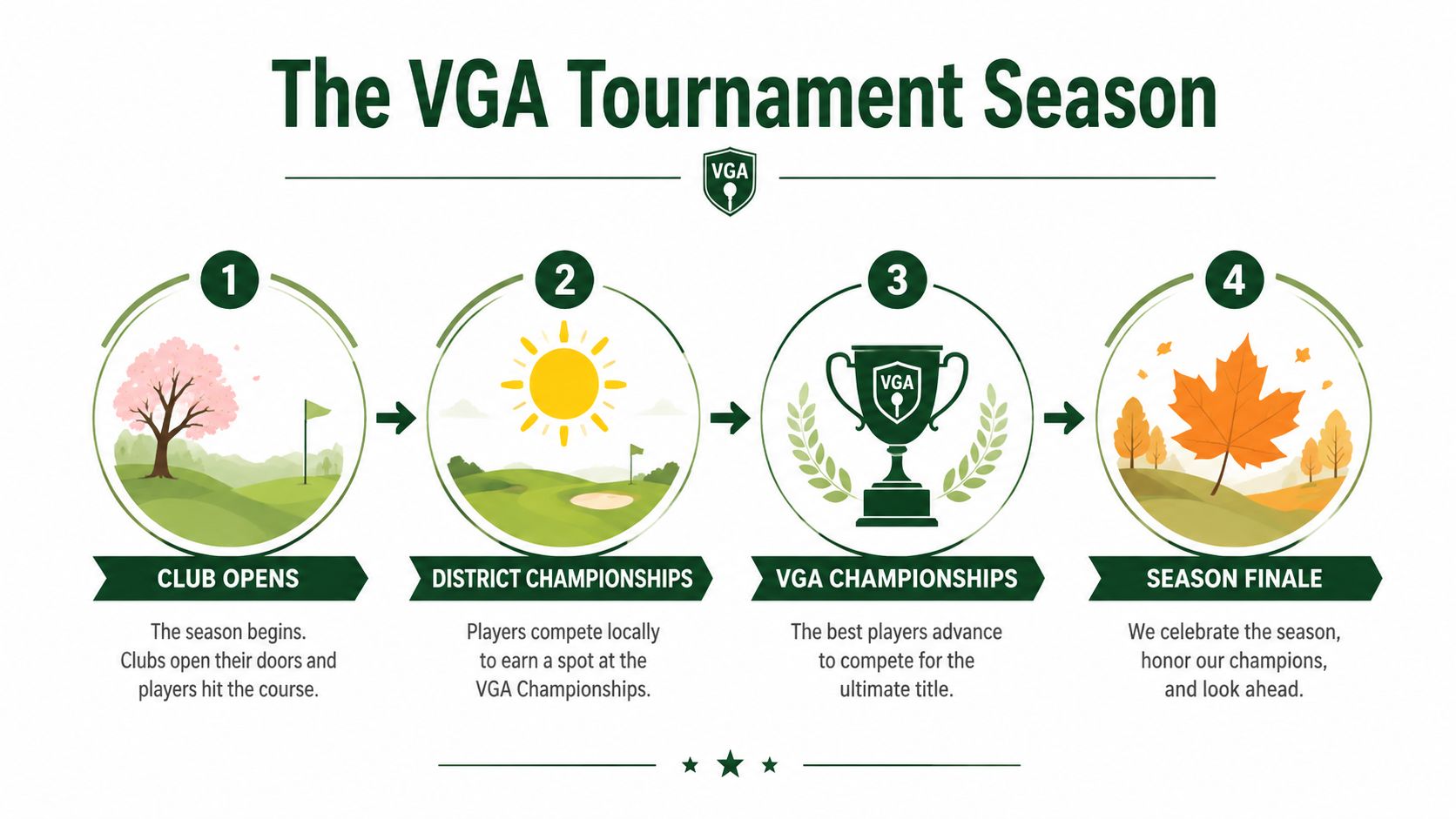
Event organizers should treat the calendar as an operating plan. Before publishing registration, confirm the venue, tees, eligibility rules, format, scoring method, and deadlines. A practical golf tournament planning guide can help organizers turn that outline into a workable event plan.
The best first event for a player isn't always the most prestigious one. It's the competition whose eligibility rules, distance, tee setup, and format match the player's current experience.
The Junior Tour Pathway
A young golfer's first VGA Junior Tour event can turn casual rounds into a more organized competitive record. The entry rules are clear: the junior must be a Vermont resident and must not have reached their 19th birthday by the day of the event or tournament (VGA Junior Tour rules).
That wording matters. Eligibility is determined on the day of play, not by whether the golfer turns 19 later in the calendar year. A parent should check the child's birthday against the actual event date rather than relying on a general age category.
The second requirement is equally important. Every junior golfer must have an active Handicap Index to compete on the VGA Junior Tour. A parent or coach should establish that handicap well before registration, because waiting until the entry deadline can create an avoidable problem.
A practical pathway for families
Start with the junior's home club. Ask how to establish the Handicap Index, confirm the club's posting process, and make sure scores are being recorded accurately.
Next, review the Junior Tour event details. Check the Vermont residency requirement, the age rule on the day of play, registration deadlines, venue, tee information, and any event-specific conditions.
Then treat the first tournament as a learning experience. The junior is not only competing for a result. They're learning tournament pace, score verification, course strategy, etiquette, and how to handle a structured competitive environment.
Parents comparing junior programs may also find a data platform for junior golf useful for understanding how organized youth golf can track competition and development. For the VGA pathway, though, the immediate priorities remain simple: residency, age eligibility, and an active handicap.
Governance, Contact, and How to Host an Event
Which Vermont organization should handle your event? Start with its purpose. The VGA provides the statewide framework for amateur golf, while the women's, senior, superintendents, and PGA organizations serve more specific groups. The right contact is determined by the field, not by the phrase “VT Golf Association.”
A club director preparing a sanctioned event can work through five questions:
Define the field: Is the tournament for general amateurs, women, seniors, juniors, professionals, or club members only?
Confirm the venue: Check the course, available tees, rating information, and proposed date.
Clarify eligibility: Ask the relevant association who may enter and whether an active Handicap Index is required.
Contact the right office: Use the VGA for statewide amateur matters. Contact the specialized organization when the event centers on women, seniors, course staff, or professionals.
Build the operating plan: Set up registration, rosters, pairings, tee sheets, scoring, results, communications, and payouts before play begins.
Technology should follow those decisions. Live Tourney can organize registration, roster management, pairings, live scoring, leaderboards, and tournament reports through a web-based platform. The association and host club still control eligibility, course setup, and official rulings.

A well-run event divides responsibility clearly. The association sets the competitive framework, the club provides the course and local knowledge, and the event system keeps player-facing tasks organized.
Next Steps for Players, Parents, and Organizers
If you're a new amateur, begin with your local club. Ask whether it provides VGA access, establish an active GHIN Handicap Index, learn the score-posting rules, and review events that match your ability and availability.
If you're a parent, confirm Vermont residency and the child's age on the event date. Establish the active Handicap Index early, then review Junior Tour registration details before choosing a first competition.
If you're organizing an event, identify the audience first. The VGA fits statewide amateur needs, while the women's, senior, superintendents, and PGA organizations serve more specialized purposes. Confirm the rules and venue with the right body, then choose tournament tools that cover registration, pairings, scoring, communication, and results.
The phrase “VT golf association” is broad, but your next action doesn't have to be. Match the organization to the player or event, then contact the appropriate club or association with a specific question.
Live Tourney helps Vermont clubs, associations, and event organizers manage registrations, rosters, pairings, formats, live leaderboards, and scoring from a web-based system that players can use without downloading an app. Visit Live Tourney to see how it can support a smoother tournament workflow from registration through final results.