
Jun 7, 2026
dustin johnson world junior, junior golf tournaments, golf tournament management, dustin johnson, TPC Myrtle Beach
Explore the Dustin Johnson World Junior Golf Championship. Learn what makes it a top event and get practical takeaways for running your own junior tournaments.
The difference between an ordinary junior event and a premier one shows up before the first tee shot. You see it in the field quality, the venue fit, the pressure built into the format, and the way players carry themselves because they know the week means something.
An Introduction to a Modern Junior Golf Showcase
The Dustin Johnson World Junior works because it feels like a serious championship, not a dressed-up junior outing. That distinction matters. Players notice it, parents notice it, and college coaches notice it even when nobody says it out loud.

What makes the event worth studying isn't just the name on the trophy. It's the combination of selective entry, a demanding host course, and a format that asks juniors to handle a college-style tournament environment. If you're building your own calendar, whether that's a club major or a regional series, that's the standard to pay attention to.
A lot of organizers chase prestige backward. They start with logos, social posts, and sponsor banners. The better route is operational. Build a competition that strong players want to test themselves in, then give it an identity people remember. If you're looking at where junior events fit into a larger player pathway, the broader junior PGA tournament schedule is useful context, but the Dustin Johnson World Junior shows what happens when an event is designed to feel special from the start.
Practical rule: Players don't remember your mission statement. They remember whether the event felt credible.
Dustin Johnson's involvement matters because it gives the tournament an aspirational layer that juniors understand immediately. But the main lesson for tournament directors is simpler. A recognizable host can open doors, yet prestige only sticks when the competition format and venue support the promise.
What Is the Dustin Johnson World Junior Championship
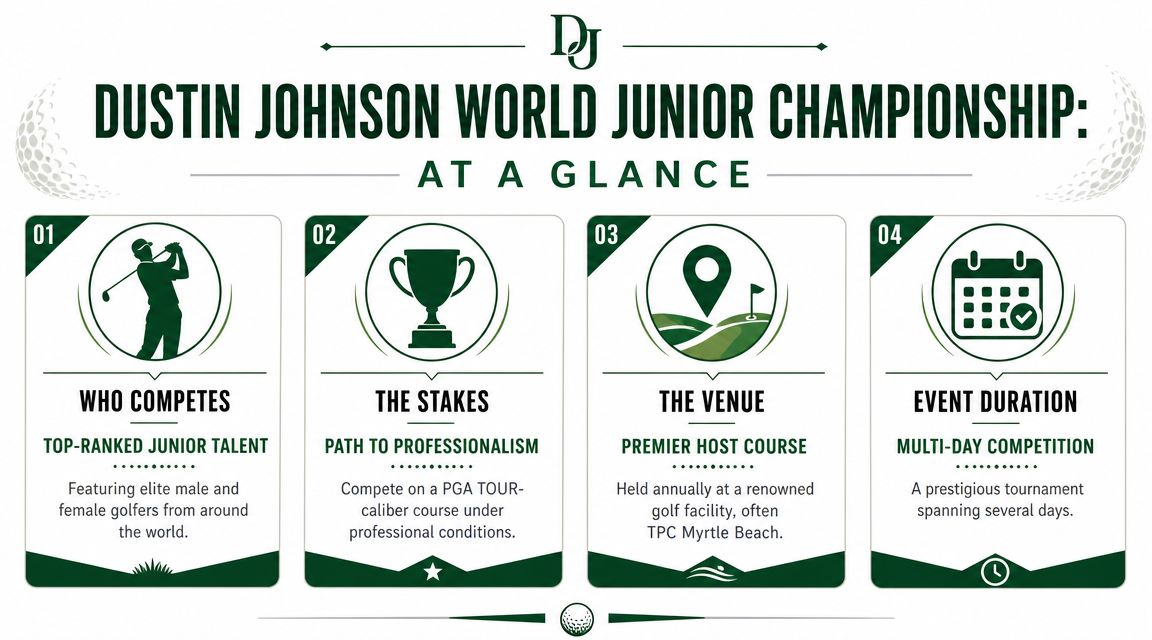
The Dustin Johnson World Junior Golf Championship is a major junior event for boys and girls ages 13 to 18. The event's published details note that the 2026 edition featured 90 players from around the world at TPC Myrtle Beach from March 6 to 8, 2026 according to the official tournament overview.
That one description already tells you a lot. This isn't a wide-open local signup. It's selective, international, and built to put strong junior players in the same arena.
What players are entering
Organizers often make the mistake of describing a junior event only by age group and course name. That leaves out the part that defines the tournament. The Dustin Johnson World Junior is built as an elite field event, and that changes expectations for everyone involved.
Here is the practical breakdown:
Age window matters: The event targets 13 to 18-year-old players, which creates a development environment where younger standouts and older, more polished juniors share the same championship stage.
Field size matters: A 90-player field is large enough to feel substantial but selective enough to preserve quality.
International reach matters: "From around the world" signals that the benchmark isn't confined to one state, section, or region.
Why the venue and timing matter
TPC Myrtle Beach gives the championship a setting that already feels bigger than everyday junior golf. A recognizable course changes player behavior. Warm-up routines get sharper. Practice rounds become more intentional. Staff also tend to tighten standards when the setting demands it.
For tournament directors, the takeaway isn't that you need a famous course. It's that your course choice has to match the event you claim to run. If you market a championship and then use a layout that doesn't reward disciplined golf or create visual importance, players feel the disconnect right away.
A premier junior event needs alignment between field strength, venue, and competitive consequences. If one piece is weak, the whole tournament feels smaller.
The Power of the Dustin Johnson Brand
The strongest tournament brands aren't borrowed. They're fitted. That's why the Dustin Johnson name works here.
The championship is played at TPC Myrtle Beach, and the event organizers describe the course as a tree-lined, strategically bunkered test with challenging greens, a layout familiar to Johnson that adds credibility to his hosting role in the event field announcement. That familiarity matters because players and families can tell the difference between a real hosting connection and a licensing exercise.
What effective branding actually does
A recognizable name can do three jobs for an event when it's used correctly:
Branding job | What it changes | What organizers should learn |
|---|---|---|
Sets expectation | Players assume the week will feel more professional | Your operations have to deliver on that expectation |
Sharpens identity | The tournament stands apart in a crowded calendar | Give your event a story people can repeat easily |
Adds aspiration | Juniors connect the competition to the next level | Frame the event around development, not just decoration |
Most directors overrate celebrity and underrate fit. If the host identity doesn't connect to the venue, region, or player experience, it feels pasted on. The Dustin Johnson World Junior avoids that problem because the branding points back to an actual competitive setting.
How smaller events can apply this
You probably don't have a major champion attached to your event. That's fine. You still have branding tools.
Use local credibility: A respected club, state amateur champion, or long-time teaching professional can anchor an event if the connection is genuine.
Pick one story: Don't try to be elite, family-friendly, charity-driven, and festival-style all at once.
Match visuals to standards: If your branding says premium, your check-in, tee sheet, scoring pace, and awards presentation have to look premium too.
Branding works when it clarifies what the event is. It fails when it tries to hide what the event isn't.
Inside the Tournament A Blueprint for Competition
The best thing the Dustin Johnson World Junior does is use structure to create pressure. That's what separates a good field from a meaningful championship.
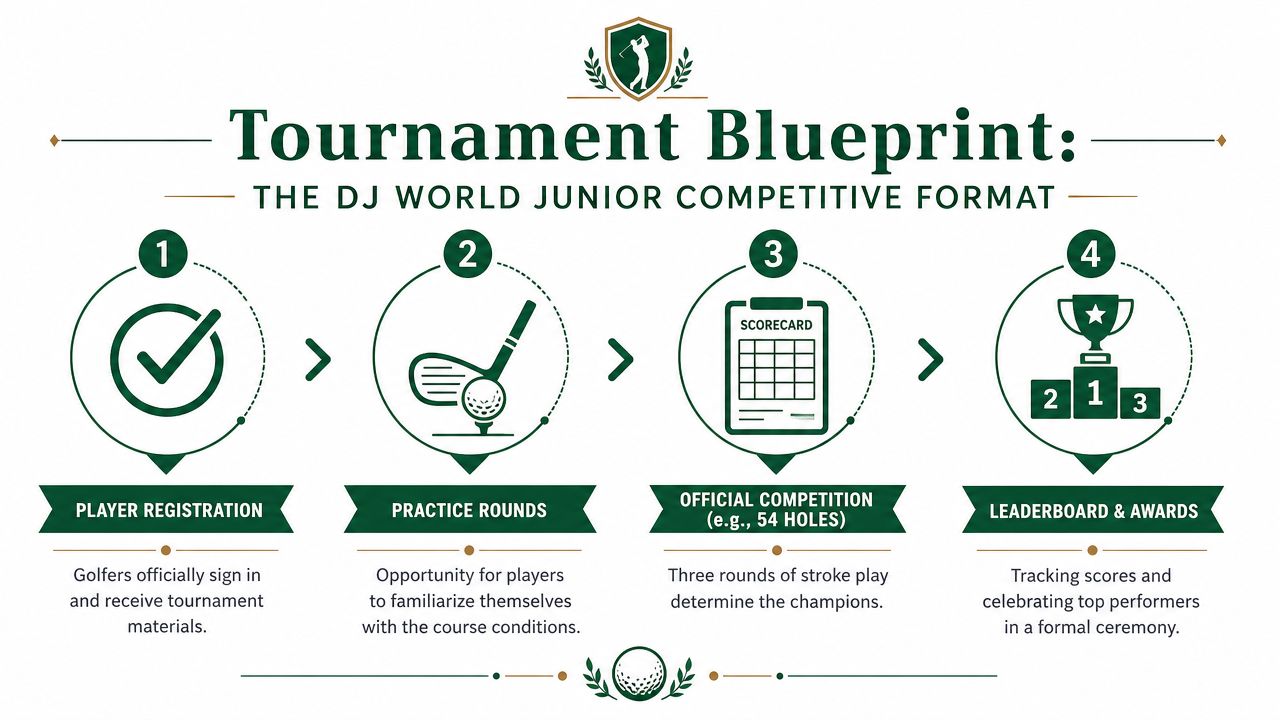
The tournament is a 54-hole stroke-play event with a cut after Round 2, with the top 36 boys and ties plus the top 18 girls and ties advancing, as noted in this event format listing. For organizers, that's the core blueprint. It asks players to perform over multiple days and rewards consistency, not one hot round.
Why 54 holes changes the test
A one-day junior event often tells you who played well that day. A three-round event tells you more about tournament skill.
Players have to manage energy, weather changes, momentum swings, and recovery between rounds. That's closer to the golf they'll see in college and high-level amateur play. It also exposes weaknesses that shorter formats can hide. A player who survives on early birdies and streaky putting can look dominant for 18 holes. Over 54, ball control and discipline start to matter more.
For tournament directors, the lesson is straightforward. If your goal is player development, your format has to force decisions that single-round events never reach.
Why the cut is such a strong design choice
The cut is where the event starts behaving like a championship. It turns the second round into more than a continuation of the first. Players have to think about position, not just score.
That creates real trade-offs:
Attack too early: A player can make avoidable mistakes chasing a number that wasn't necessary.
Play too safe: A player can drift outside the cut because nothing in the round had urgency.
Misread the moment: Juniors who don't understand leaderboard pressure often change strategy too late.
Operational insight: A cut gives every round a job. Round 1 establishes position. Round 2 tests control under consequence. The final round becomes a showcase, not a participation lap.
What works for other organizers
Not every event can run a full 54-hole cut format. But pieces of the model can scale.
Consider these adaptations:
For a club championship, use multiple rounds even if you can't stage a cut. Players need to feel the weight of carrying a score overnight.
For a regional junior series, create a final-day championship flight based on earlier performance.
For invitational events, tighten acceptance standards before adding hospitality extras. Strong structure beats expensive fluff.
Format decisions that raise event quality
Decision | What works | What doesn't |
|---|---|---|
Length | Multi-round play that rewards consistency | A single round marketed as a major |
Advancement | Clear consequences after early rounds | Everyone plays everything regardless of score |
Course setup | Demanding but fair conditions | Trick setups that create confusion instead of pressure |
Final round | Smaller field with visible stakes | A crowded last day with no competitive separation |
Organizers don't need to copy the event exactly. They need to understand why each layer exists.
From Junior Talent to Professional Success
Elite junior tournaments always raise the same question. What does strong play here predict?
Current coverage leaves that mostly unanswered. As noted in this Myrtle Beach golf coverage of the event's broader significance, there's little analytical treatment of how elite juniors at this event translate into college or professional success. That's the most interesting gap around the Dustin Johnson World Junior, because the tournament clearly tests serious players in a serious setting.
What the event can signal
A finish in a field like this can mean several useful things, but organizers and parents shouldn't treat all of them as equal.
A good week may indicate:
Tournament readiness: The player can handle a structured, high-expectation environment.
Course management discipline: The player isn't giving shots away through poor decisions.
Recovery skill: The player can reset after a bad stretch and stay in the event.
Competitive maturity: The player understands when to press and when to protect position.
Those signals matter. They just aren't the same thing as a guaranteed future career outcome.
What it doesn't automatically prove
One result, even at a strong event, doesn't tell you everything about long-term ceiling. Junior golf is full of players who peak early, late, or unevenly. That's why smart evaluators look beyond the trophy and study how the player got there.
I usually pay attention to questions like these:
Did the player stay patient when the round stalled?
Did they handle the second-day pressure properly?
Did their game travel over multiple rounds?
Did they look organized, prepared, and coachable?
Those traits often carry farther than a single low number.
Strong junior events are valuable because they expose behavior under pressure. That's often more useful than the headline result itself.
For coaches, parents, and organizers following the broader development path, resources on minor league golf tours add perspective on what the competitive ladder looks like after junior golf. The bigger point is that the Dustin Johnson World Junior isn't just a showcase. It's a setting where evaluators can watch how talent behaves when the tournament asks adult questions of junior players.
Key Takeaways for Your Junior Golf Tournament
The Dustin Johnson World Junior offers a clean lesson for any tournament director. Prestige doesn't come from saying an event is important. It comes from building a week that players experience as important.
In the most recent reported edition, William Lisle won the boys title by one shot at 4-under-par, according to the championship recap. That narrow margin matters because it reflects a tournament where every decision stayed live deep into the competition. That's what directors should want. Not artificial drama. Real consequence.
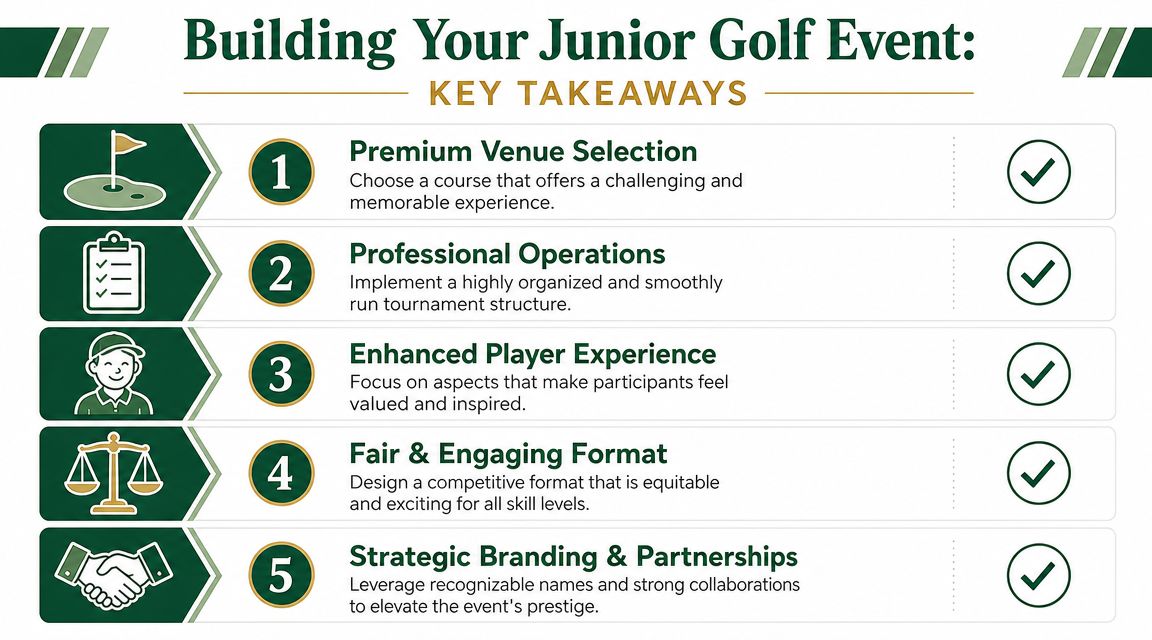
Five lessons worth copying
Build around a credible test: Start with the golf. Choose a course and setup that reward organized play, not gimmicks.
Make the format do the work: If you want the event to feel bigger, add structure that creates consequence. A final-round flight, a cut, or staggered advancement can change the whole week.
Treat presentation as part of competition: Clean registration, sharp pairings, visible leaderboards, and a proper awards moment all tell players this isn't casual.
Create a clear identity: Your event needs one strong story. That could be elite competition, regional pride, player development, or tradition.
Protect the standard: It's better to run a tighter, stronger event than a bloated one with no edge.
What smaller events should avoid
Not every organizer needs championship branding. Plenty of local events get stronger by doing less, but doing it with discipline.
Avoid these common misses:
Mistake | Why it hurts |
|---|---|
Overselling the event | Players feel the gap between marketing and reality |
Using a weak competitive format | The tournament becomes forgettable |
Adding extras before fixing operations | Staff gets stretched, and the core experience suffers |
Ignoring pace and scoring visibility | Energy disappears during the round |
The practical standard
If you're running a junior event, ask one hard question before launch. Would a strong player feel tested, seen, and respected here?
If the answer is yes, you're on the right track. If the answer depends on the sponsor tent, the tee gift, or the social graphics, the foundation still needs work. A useful starting point for the operational side is this guide on how to run a golf tournament, especially if you're trying to tighten execution without making the event feel rigid.
Bottom line: Players return to events that are run cleanly, challenge them honestly, and make the competition feel earned.
Live Tourney helps golf courses and tournament directors run events with less friction and a more modern player experience. If you want simpler setup, app-free live scoring, and tools built for real tournament operations, take a look at Live Tourney.





