Oct 12, 2026
us junior am qualifier, usga junior amateur, golf tournament management, junior golf eligibility, live tourney software
Master the US Junior Am qualifier process. Learn eligibility rules, site strategy, scoring logistics, and how modern tools streamline tournament management.

The most common advice about a US Junior Am qualifier is to enter the site closest to home, meet the national requirements, and let the score decide the rest. That approach misses the competitive reality. A qualifier is an 18-hole, site-specific contest, and the field size, available places, course setup, travel demands, and playoff risk can change the decision before a player hits the first tee shot.
For organizers, the same principle applies. A strong field and difficult finish expose weak scoring processes quickly. Players need a clear plan for choosing and preparing for a venue, while tournament staff need accurate registration, live score validation, immediate tie detection, and a playoff procedure that doesn't depend on hurried spreadsheet work.
Rethinking the US Junior Am Qualifier Pathway
Meeting the national eligibility rules gets a player to the starting line. It doesn't make every qualifying site equally attractive or equally difficult. The U.S. Junior Amateur was inaugurated by the USGA in 1948 as a national competition for leading junior male amateur golfers, and its first edition already used a multi-stage model, with broad sectional participation followed by a compact championship field. The inaugural event attracted 495 entries, reduced to 128 championship players after qualifying at 41 sites, as recorded in the USGA championship history.
The pathway has changed since Dean Lind defeated Ken Venturi in that first championship. The eligibility standard now requires a player not to have reached their 19th birthday by the championship date, and recent championships have generally required a Handicap Index of 2.4 or lower, as outlined in the USGA 2026 fast facts. Those conditions are the baseline, not the complete strategy.
Eligibility is only the entry filter
A player who meets the age and handicap requirements still has to select a venue, understand its field, prepare for its course conditions, and manage a single-round ranking problem. The nearest site may offer convenient travel but a larger field, fewer qualifying places, or a course setup that doesn't suit the player's strengths. A more distant site may create additional cost and practice demands while offering a different competitive profile.
The junior PGA tournament schedule can help families organize dates and avoid treating the qualifying round as an isolated event. The practical question isn't merely, "Am I eligible?" It's, "Which eligible pathway can I prepare for properly and execute under pressure?"
Practical rule: Treat eligibility as permission to enter, not evidence that a site is the right choice.
Tournament directors should communicate the rules early and remove ambiguity around age, handicap documentation, entry deadlines, starting times, and qualifying places. Parents and players should then evaluate the local conditions with the same care they would apply to club selection or tournament preparation. A national championship has a common standard, but the route toward it is local.
Analyzing Site Difficulty and Field Dynamics
The nearest qualifier is often the wrong one. Site selection should be treated as a competitive decision, not a travel shortcut. Field size and available berths establish the advancement pressure, while course setup, weather, scoring history, and travel determine how difficult it will be to produce the required round.
Current qualifier information shows why local comparison matters. One 2026 site listed 84 players competing for four qualifying places and two alternates, while a Texas qualifier listed 120 players competing for five championship places and two alternates. Those figures come from the Nebraska Golf qualifier information. Shared national eligibility rules do not create identical advancement conditions.
Start with the numbers, then add context
The field-to-berth ratio is only the first screen. Players and families should examine the following site-specific factors:
Field composition: Are entries likely to include many players with comparable Handicap Indexes and tournament experience? A smaller field can still be difficult if experienced competitors are concentrated near the qualifying line.
Course setup: Does the venue reward length, precision, recovery play, or conservative target selection? A course that suits a player's normal strengths may offer more practical value than a nominally easier site.
Scoring history: Winning qualifying scores have ranged from 10-under at Cross Timbers to 1-under at Beaver Meadows, according to the Nebraska Golf qualifier coverage referenced above. That spread makes par-relative expectations useful only when paired with local context.
Operational access: Can the player obtain a practice round, study the greens, and arrive without a rushed travel schedule? Travel fatigue and limited preparation can erase an apparent field advantage.
Playoff exposure: Are players likely to cluster around the final qualifying or alternate position? A narrow scoring spread can turn an otherwise sound round into an immediate playoff situation.
The 2026 U.S. Junior Amateur received 3,681 entries, as noted in the USGA fast facts cited earlier. That demand reinforces the value of choosing a site where the player can prepare properly and understand the likely scoring threshold. The decision affects both the number of competitors to pass and the margin required near the qualifying line.
Variable | Low Difficulty / Favorable | High Difficulty / Challenging |
|---|---|---|
Field size | Smaller field relative to available places | Large field with limited berths |
Course setup | Familiar layout with predictable conditions | Unfamiliar course, demanding targets, changing conditions |
Scoring environment | Historical scores close to par | Very low scores required to contend |
Practice access | Practice round and range access are confirmed | Limited access or difficult travel timing |
Playoff risk | Clear separation near the final place | Several players clustered at the qualifying threshold |
Travel burden | Simple arrival and recovery schedule | Long travel, tight check-in, or uncertain preparation |
Choose the site you can execute
A favorable ratio cannot compensate for poor preparation. If a player cannot arrive rested, learn the green complexes, or identify the course's trouble areas, the apparent advantage may disappear. A demanding venue may suit a player with a reliable pre-shot routine and a clear plan for avoiding penalty situations.
Organizers should publish field size, qualifying-place allocation, starting logistics, practice availability, and playoff procedures early. Players can then compare actual conditions instead of choosing solely by distance. The strongest site is the one where preparation, course strategy, and tournament-day execution fit together.
Navigating the 18-Hole Stroke Play Format
The qualifier is an 18-hole individual stroke-play event. Every player completes one round, and qualifying places vary by site according to field size and the number of available berths. That makes the round a high-sensitivity ranking exercise. A penalty, poor finish, or lapse in decision-making can move a player from a qualifying position into an alternate position before there's another round to recover.
The format rewards disciplined scoring more than dramatic recovery attempts. A player should know the likely scoring range, but shouldn't turn that expectation into reckless pin hunting. The correct plan is usually to protect against avoidable damage early, preserve energy for the closing holes, and make a clear decision whenever a penalty area or difficult recovery comes into play.
Prepare for the final qualifying number
The final positions deserve more attention than the medalist position because that's where ties and playoffs create immediate uncertainty. Alabama's player memorandum specified that ties for the final qualifying place or alternate position are resolved through an on-course playoff immediately after the round. Players should therefore know:
Which positions trigger a playoff: The final championship place and, where applicable, the final alternate position can carry direct consequences.
Where the playoff begins: The organizer should identify the playoff hole or holes before play.
What to bring: Players need to remain available, keep equipment ready, and avoid making travel arrangements that assume the result is final before the playoff threshold is settled.
How to reset mentally: The playoff is a new short contest, not a continuation of the entire round. The player who makes the clearest decision on the next shot often handles the pressure better than the player trying to erase the previous 18 holes.
A useful primer on the format is this guide to stroke play in golf, particularly for families who are more familiar with match play or junior team events.
A qualifying round isn't won only by the best shots. It's often decided by who avoids the one decision that turns a manageable score into an unrecoverable one.
Players should confirm scorecard procedures, marker responsibilities, local rules, pace expectations, and the playoff process at registration or the players' meeting. Staff should repeat the critical points near the first tee and after scoring, because a player who doesn't understand the tie procedure may leave the facility before the result is complete.
Managing Real-Time Scoring and Playoff Logistics
The final qualifying positions create a direct connection between player pressure and tournament technology. Staff must know not only the current leaderboard, but also whether each posted score is complete, verified, and correctly ranked. A delayed or manually sorted result can leave players uncertain about whether they should report for a playoff.
The operational sequence should be visible to the scoring team from the moment a group finishes. Scorecards are collected, hole-by-hole totals are checked, signed results are entered, and the leaderboard is sorted automatically. Officials then identify whether the tie affects a championship place or alternate position, rather than treating every numerical tie as the same administrative issue.
Build the process around the playoff threshold

A reliable workflow has six practical controls:
Score collection: Players and markers complete and sign scorecards immediately after the round.
Score verification: Officials cross-check hole-by-hole entries against totals and investigate discrepancies before posting.
Final ranking: The system sorts completed scores so staff can see the qualifying line without manual rearrangement.
Tie detection: The platform flags ties affecting the final qualifying place or alternate position.
Playoff setup: Staff assign the playoff hole, notify affected players, and confirm the starting order.
Playoff resolution: Officials record extra-hole results and update the final standings only after the qualifying position is decided.
The real-time golf tournament scoring guide reflects the same operating principle: live data is useful only when the underlying entries are accurate. A fast leaderboard that contains an incorrect hole score creates more confusion than a slower, verified process.
Don't leave the final calculation to one person
Manual spreadsheets can rank players, but they make the most sensitive moment dependent on file version, formula accuracy, and staff availability. One person may be entering scores while another reads a paper card, and a third is trying to determine which tie matters. That arrangement creates avoidable delays.
Use a defined handoff. One staff member manages scorecard intake, another verifies questionable entries, and the scoring system publishes the current ranking. The tournament director then owns the playoff decision and player communication. This separation makes responsibility clear and gives families a result they can trust.
Upgrading from Spreadsheets to Modern Tournament Software
Spreadsheets remain useful for planning, but they become fragile when they carry registration, pairings, live scoring, communications, and playoff calculations at the same time. Paper scorecards still have a role in official verification, yet they shouldn't be the only source of standings for a high-stakes qualifier.
A modern web-based platform can connect the workflow. Staff can manage the roster, publish pairings, collect scores, and display a leaderboard through a browser. Players and parents can follow updates without waiting for a printed board or downloading a dedicated application.
Compare the workflow, not just the feature list
Task | Spreadsheet and paper process | Web-based tournament process |
|---|---|---|
Registration | Manual entry and repeated roster checks | Online forms with a central player list |
Pairings | Separate files and printed revisions | Pairings published from the event record |
Score entry | Handwritten cards followed by re-entry | Digital entry supported by card verification |
Ranking | Formulas and manual sorting | Automatically sorted standings |
Tie review | Staff inspect the final scores | Thresholds can be flagged for review |
Player updates | Announcements and posted sheets | Live access through a browser link |
Live Tourney is one example of this model. The platform provides web-based registration, pairings, communications, scoring, and live leaderboards, with player access that doesn't require an app download. Its back-office tools also support roster uploads and reports for materials such as scorecards, tee sheets, cart signs, and bag tags.
The benefit isn't that software eliminates judgment. Tournament officials still need to verify scores, interpret rules, and manage playoffs. The benefit is that the system removes repetitive sorting and gives staff a shared source of current information, which is especially valuable when several players finish near the final qualifying position.
Keep technology subordinate to event control
A digital system shouldn't replace a printed contingency plan, trained volunteers, or a clear rules briefing. Staff should test the scoring flow before the first group starts, confirm who can edit results, and make sure players know where to report after signing cards. A simple interface helps, but disciplined procedures still determine whether the event feels professional.
Executing a Seamless Qualifier Event Checklist
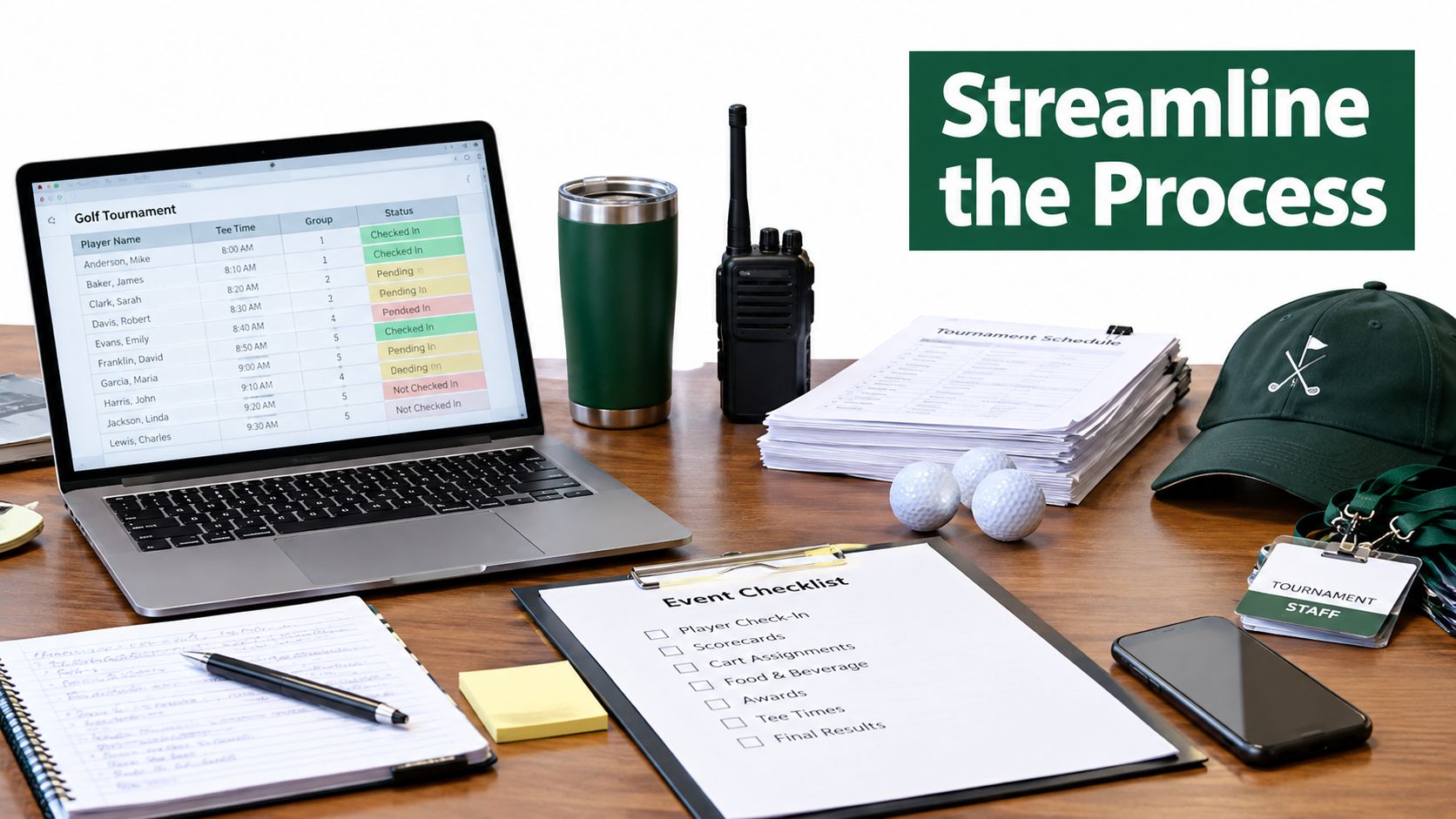
A smooth qualifier starts well before the first tee time. The director should build the event backward from the final playoff decision, ensuring every earlier task supports accurate results and clear communication.

Use this sequence:
Open registration: Verify age, Handicap Index information, GHIN details, entry forms, and payment records.
Prepare the course: Confirm tee markers, hole locations, local rules, range access, and course setup.
Publish pairings: Release starting times, player groups, check-in instructions, and arrival expectations.
Staff scoring: Assign the scoring tent, train volunteers, prepare scorecards, and test the live leaderboard.
Brief players: Explain out-of-bounds, penalty areas, pace of play, scorecard responsibilities, and reporting procedures.
Prepare the playoff: Confirm the hole, order, officials, equipment, and communication process before play begins.
Close the event: Verify results, record playoff outcomes, notify qualifiers and alternates, and submit the required reporting.
A director can also make the arrival experience more useful by sharing local practice and leisure options with families who travel for the event. For a gift or a planned warm-up round outside the competition schedule, a buy a golf round voucher resource can be a practical option, provided it doesn't interfere with the player's rest and preparation.
The final check is simple: no player should have to ask where to go, what score matters, whether a tie is live, or when the official result will be posted.
Live Tourney gives golf organizers web-based registration, pairings, scoring, communications, and live leaderboards for qualifier workflows that demand accurate, timely results. Visit Live Tourney to review the platform and see how it can support a smoother event from entry management through playoff resolution.