
Oct 10, 2026
golf forgiveness, golf club MOI, forgiving golf clubs, golf equipment guide, golf mishits
What Is Forgiveness in Golf. Discover what forgiveness in golf really means for your game. Learn how MOI, club design, and off-center impact affect your scores

Forgiveness in golf is not about making every shot straight. It's about how well a club reduces the distance and accuracy penalty when you miss the center of the face, and the average U.S. golfer shoots about 94 over 18 holes. That means off-center contact isn't an occasional disaster reserved for beginners. It's part of normal golf.
You catch one driver low on the face, heel-side, and watch it peel toward trouble. Or you strike an iron near the toe and feel the dull vibration before the ball lands short of the green. You may blame your swing, and sometimes you should, but the clubhead also determines how severe that mistake becomes.
Understanding Forgiveness in Golf Clubs
A forgiving club doesn't turn a slice into a perfect drive or make a fat iron reach the pin. It reduces the damage caused by a common mishit. The club may preserve more ball speed, lose less carry distance, or send the ball with less unwanted directional error than a less stable design.
That distinction matters because golfers often treat forgiveness as a promise of accuracy. It isn't. A poor swing can still produce a poor shot, but the result may remain playable instead of becoming a lost ball, a missed green, or a difficult recovery.

The practical meaning of a mishit
Suppose your normal iron miss is toward the toe. A low-stability iron may twist at impact, lose speed, and start farther from your intended line. A more stable iron can limit that twisting and retain more usable performance. Your swing still caused the error, but the equipment influenced its consequence.
The USGA reports average Handicap Indexes of 14.2 for men and 28.7 for women, alongside the average U.S. 18-hole score of approximately 94 in its overview of the average golfer (USGA data on handicaps and scoring). Those figures explain why forgiveness matters to such a broad audience. Most golfers aren't making center-face contact on every shot.
Practical rule: Judge forgiveness by the quality of your ordinary misses, not by the best shot you hit during a fitting.
The engineering behind that performance is mainly connected to moment of inertia, or MOI. Engineers use perimeter weighting and larger, deeper head shapes to make the clubhead resist twisting when impact occurs away from its center. The result is a more stable platform, not a magic correction system.
The Physics of Moment of Inertia
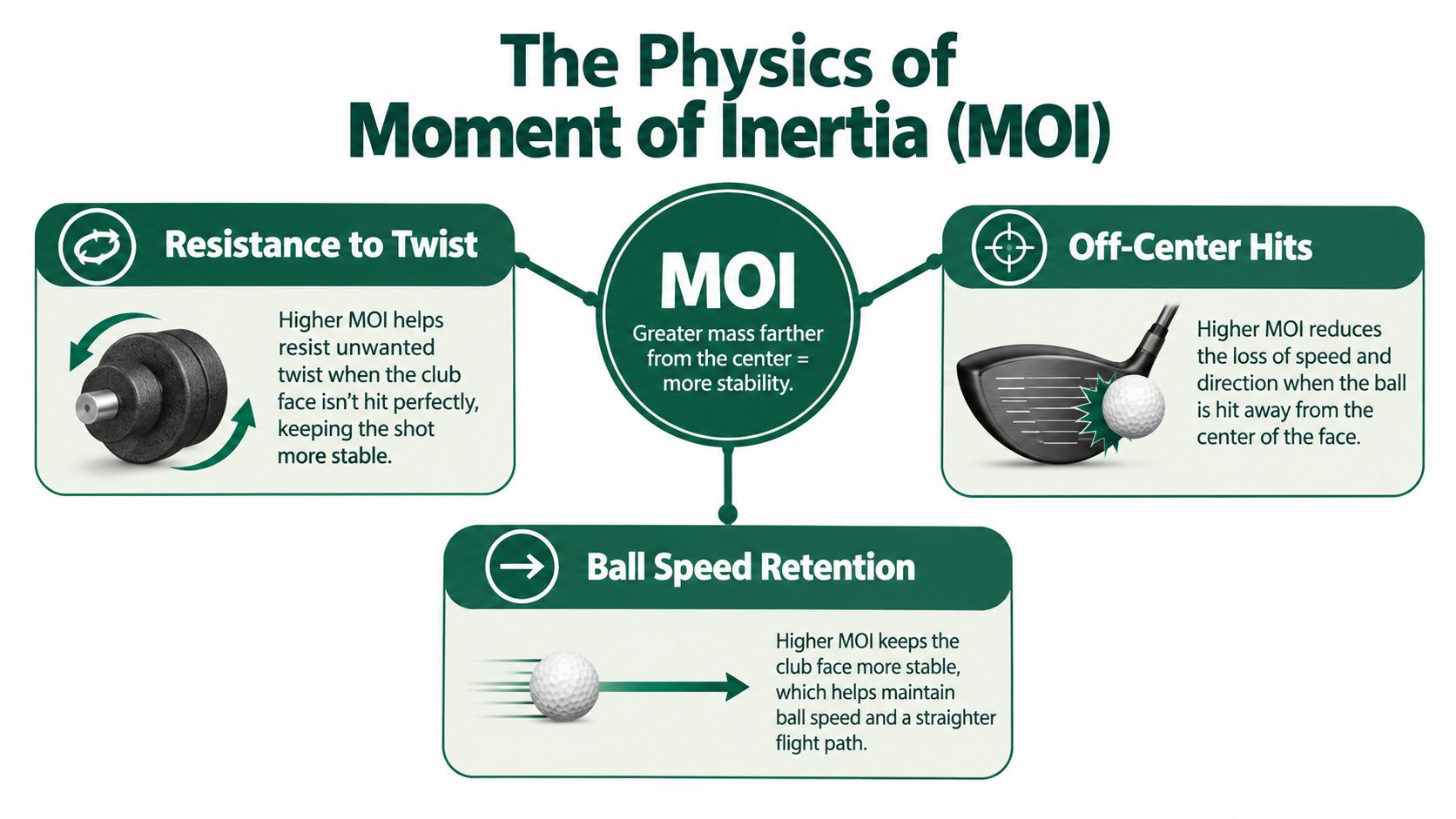
Moment of inertia sounds like a physics exam term, but the basic idea is easy to feel. Think about a figure skater spinning with arms pulled close to the body. The skater can change rotation quickly. With the arms extended, the mass sits farther from the center and the spinning body resists changes more strongly.
A golf clubhead works in a similar way. When the ball strikes the toe or heel, the impact creates torque that tries to rotate the head around its center of gravity. A head with more mass distributed toward its perimeter has higher MOI, so it resists that rotation more effectively.
How designers create stability
Manufacturers generally increase MOI by moving weight away from the central rotational axis. Larger clubheads, deeper profiles, rear weighting, and perimeter structures all give engineers more room to position mass for stability. The design objective is to keep the face from rotating as much during an off-center strike.
A higher-MOI head can help preserve ball speed and face orientation on toe- or heel-side contact. The Titleist explanation of moment of inertia in golf describes MOI as resistance to twisting around the clubhead's center of gravity and explains why mass farther from that axis increases stability.
The effect is measurable, but MOI isn't the whole club. Face construction influences how widely the head preserves speed, while center-of-gravity position affects launch and spin. Loft, bulge and roll, shaft delivery, and impact location all shape the shot that finally appears on the course.
Why the number has a ceiling
The USGA and R&A limit driver MOI about the vertical axis to 5,900 g/cm², with a manufacturing tolerance of 100 g/cm², making approximately 6,000 g/cm² the practical upper ceiling for a conforming driver (driver MOI rules and their equipment context). Manufacturers therefore can't increase stability without limit. They must balance MOI with launch, spin, face behavior, head shape, and how the player delivers the club.
The useful takeaway is simple. Higher MOI generally means greater resistance to twisting, but the best club for you is the one that turns your usual miss into a more playable result.
Why High MOI Does Not Always Mean Straight Shots
A stable clubhead can protect speed without correcting the direction of your swing. If you deliver the face open to the path, the ball can still curve. MOI may reduce how much the head twists during impact, but it won't rewrite your face angle, swing direction, or strike pattern.
That's why forgiveness and correction are different ideas. Forgiveness reduces the penalty of an error. Correction, when a design provides it, influences the tendency of the shot through features such as weighting, offset, loft, or face geometry.
Stability versus shot shape
Consider two golfers. The first strikes the heel and sends the ball right because the face remains open. The second strikes the toe and needs help launching the ball high enough to reach the green. Both may benefit from stability, but they don't need identical club designs.
Center-of-gravity location can change launch and spin. Face bulge and roll influence how off-center strikes behave. Loft can affect how easily the ball launches and how much spin it carries. A high-MOI head with an unsuitable launch profile may preserve speed while producing a flight that still misses the target.
Independent equipment testing makes the same broader point. The USGA player-testing report on alternative driver specifications found statistically significant accuracy reductions of 8% and 9% among male professionals under alternative driver specifications across two rounds. That doesn't predict the benefit any particular recreational golfer will receive, but it shows that equipment specifications can affect measurable accuracy even for highly skilled players.
Ask a better question
Instead of asking, “Which club is the most forgiving?”, ask:
Which club is most forgiving for my miss?
A heel-side player may need a head and setup that help produce a more playable launch and curve. A toe striker may value a design that protects speed and manages gear-effect behavior. A low-face striker may need help with launch and spin more than another increase in headline MOI.
The Golf Digest discussion of forgiving irons gives a practical example. On a strike approximately 0.5 inch from center, a higher-MOI iron could avoid roughly 2 to 3 mph of ball-speed loss, corresponding to about five yards under the cited test conditions. Your result may differ, which is why testing your own miss matters more than copying a specification.
How to Test Forgiveness for Your Specific Miss
A club fitting shouldn't focus only on your best swings. To evaluate forgiveness, you need a repeatable comparison between center strikes and the contact you produce on the course.
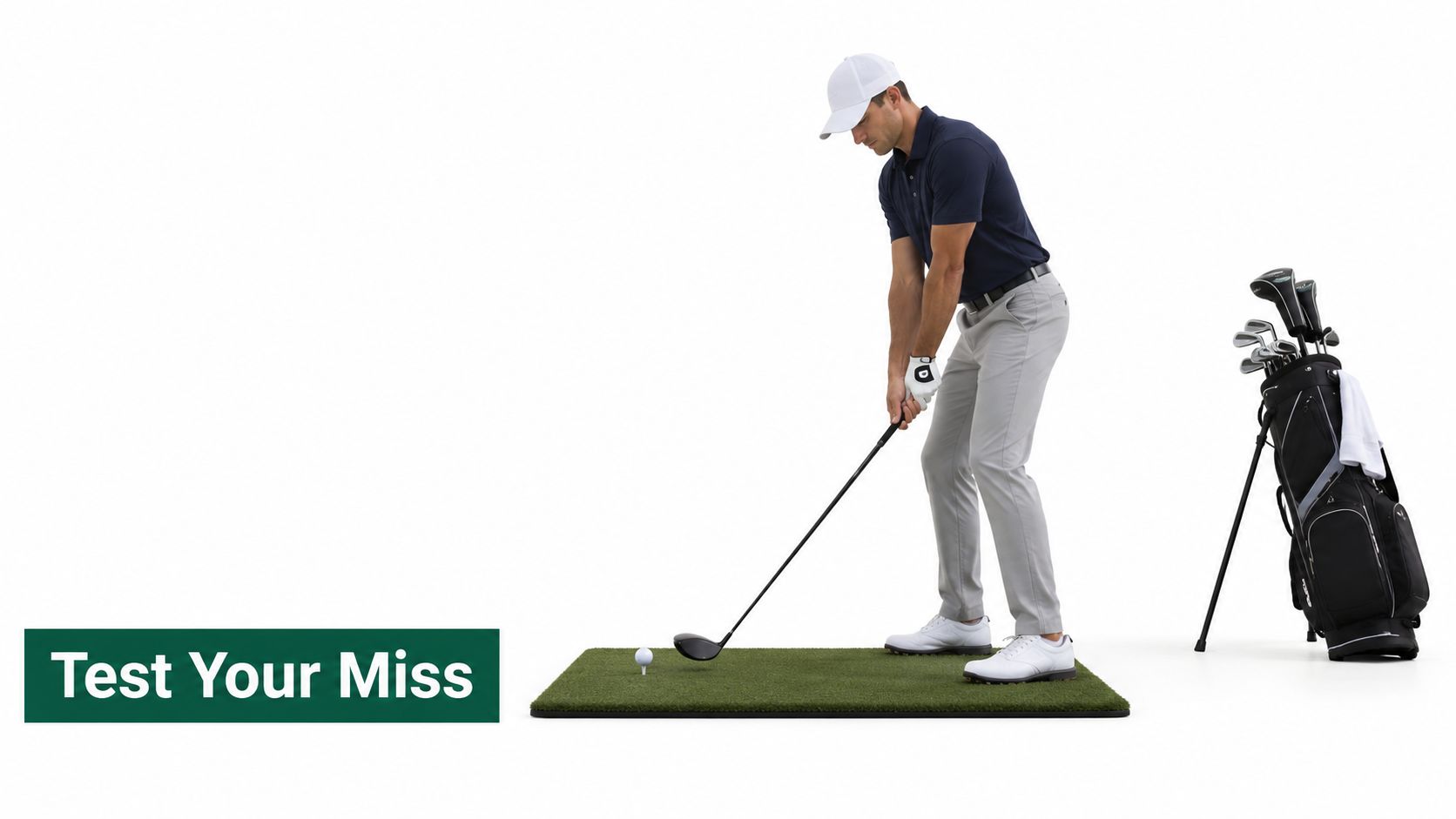
Start by identifying the miss you can reproduce. Use impact spray or face tape, then hit enough shots to establish a pattern rather than reacting to one swing. A heel striker, toe striker, low-face striker, and high-face striker may need different forms of help.
A simple comparison protocol
Record centered contact. Hit a group of reasonably centered shots with the first club, then record median ball speed, launch, spin, carry, and lateral dispersion.
Recreate your common miss. Deliberately produce your normal contact location, such as heel-side impact with a driver or toe-side impact with an iron. Don't turn the test into a contest to hit the ball badly. Reproduce the miss you see during play.
Repeat with the comparison club. Use the same ball, target, setup, and swing intention. Compare the median results rather than the single longest shot.
Measure the penalty. Focus on ball-speed retention, carry loss, offline dispersion, and finish distance. A club that preserves speed but sends the ball farther offline may not be the better fit.
The Golf Digest testing example for forgiving irons recommends recording at least 10 centered and 10 common-miss strikes when comparing equipment. That gives you a more useful sample than a handful of swings dominated by one unusually good or poor strike.
Turn results into a playing decision
A driver that produces slightly less peak distance but keeps your common miss in a playable corridor may lower scores more effectively than a faster club that sends the same miss into trouble. The same logic applies to irons. A small carry loss can be acceptable if the ball finishes closer to the target and leaves a simpler next shot.
For golfers tracking equipment and course performance, a tool such as an Apple Watch for golf can help connect practice observations with on-course decisions. The watch won't replace face-impact testing, but consistent course data can show whether a club's improved dispersion helps your rounds.
Forgiveness Beyond the Clubhead
Golf has another form of forgiveness, and it doesn't come from titanium, steel, or carbon. The handicap system reduces the competitive penalty created by differences in playing ability. A forgiving club helps a golfer survive an imperfect strike. A handicap allowance helps golfers of different demonstrated abilities compete in the same event.
That system has evolved through data. The USGA reports that in 1925 it changed its handicap formula from a player's three lowest scores to the player's 10 best rounds, with at least 50 scores required to establish a handicap. In 1958, the system moved to the best 10 scores from the most recent 25 rounds. By 1967, it used the best 10 of the last 20 rounds (USGA history of handicap calculation).
Potential instead of every result
The principle is familiar to anyone who has watched a golfer post one brilliant round among several ordinary ones. Handicap calculation recognizes demonstrated potential rather than treating every round as equally representative of ability.
Equipment forgiveness follows a related logic. A club doesn't need to make every strike perfect to be useful. It needs to reduce the damage from the strike pattern that appears often enough to affect scoring.
The average Handicap Index figures, 14.2 for men and 28.7 for women, and the average U.S. score of approximately 94 show why both systems matter (USGA average golfer data). Golf remains playable because the game and its equipment acknowledge that golfers have variable days, uneven skills, and imperfect contact.
Golf's traditional handicap system forgives differences between players. Club design forgives some of the distance and direction lost within a player's own swing.
For tournament organizers, that connection has a practical consequence. A well-run event should make competition understandable for mixed abilities, while suitable equipment helps each player keep more shots in play. Resources on GPS systems for golf courses can support course operations, but the underlying player experience still depends on clear formats, fair allowances, and equipment that matches the golfer.
Choosing the Right Forgiving Equipment
A game-improvement club is not automatically the right club for every golfer. Start with your miss, then evaluate head stability, launch, spin, offset, sole design, shaft delivery, and how the club looks at address. The largest available head may feel reassuring, but reassurance only helps if the resulting flight suits your swing.
A golfer who repeatedly strikes the heel might need a setup that makes the face easier to return and produces a more playable curve. A golfer who strikes low on the face may need launch help and a face design that protects performance there. A golfer who hits the toe may prioritize ball-speed retention and a head that manages the resulting directional tendency.
That's why separating golf hype from help is useful before you buy. Marketing language can highlight a single MOI number, but your scorecard responds to playable carry, dispersion, and the quality of your next shot.
Before finalizing a set, test the clubs with the shots you actually hit. Your decision should also account for course strategy, including how you read targets and hazards with a guide to reading pin sheets.
The best forgiving club doesn't promise perfection. It gives you a more stable starting point when your contact is less than perfect, which is exactly what most golfers need.
Frequently Asked Questions About Golf Forgiveness
Are player's irons less forgiving than game-improvement irons?
Usually, player's irons provide less help on off-center contact and often prioritize control, shape, and compact appearance. Game-improvement irons generally use design features that make mishits more playable. Your strike pattern and launch needs still matter more than the category name.
Are drivers more forgiving than woods?
A driver often offers more room for perimeter weighting and a larger face area, but forgiveness depends on the specific head and your contact pattern. A well-fitted fairway wood can be more useful than a driver that produces an unsuitable launch or curve.
Does forgiveness change as you age?
Your swing speed, strike location, launch, and physical comfort may change over time. Equipment that helps you launch the ball and maintain playable distance can become more valuable, but testing remains the best guide.
Common miss | What to evaluate |
|---|---|
Heel-side contact | Face rotation, directional dispersion, and setup bias |
Toe-side contact | Ball-speed retention and gear-effect behavior |
Low-face contact | Launch, spin, and carry retention |
Mixed contact | Overall median carry and playable dispersion |
Can a forgiving club fix a slice?
No. It may reduce the consequences of a slice or make the curve more manageable, but it can't correct a poor path and face relationship by itself. Lessons and a suitable fitting work together more reliably than equipment alone.
Live Tourney helps golf courses and event organizers run tournaments, leagues, and outings with real-time scoring, live leaderboards, registrations, payments, and customizable reports. Visit Live Tourney to set up a smoother event experience on any device, without requiring players to download an app.





