May 29, 2026
tournament in spanish, spanish for golf, golf tournament terms, torneo de golf, bilingual event management
Master 'tournament in Spanish' (torneo) with pronunciation, regional terms, and phrases for 2026 event registration & signage. Get ready for your next golf
The Spanish word for tournament is torneo. That simple answer gets you started, but if you're running a golf event for Spanish-speaking players, torneo is only the first step toward making the day feel organized, clear, and genuinely welcoming.
If you're in the pro shop finalizing pairings, printing cart signs, and cleaning up your registration page, this is usually the moment the search happens. You realize part of the field speaks Spanish at home, or you have sponsors, guests, or volunteers who'd respond better to bilingual instructions. At that point, a one-word dictionary result doesn't help much.
What you need is usable language for the places where confusion shows up: check-in, tee signs, contest boards, payment labels, and live scoring instructions. That's where tournament communication either feels polished or patched together.
Why "Tournament in Spanish" Is a Smart Search
A lot of golf operators start with the obvious question because they need an immediate answer before doors open. Someone on staff is updating a flyer, a cart sign template, or a welcome email and needs the right term fast. That instinct is right.
The problem is that most results stop at the dictionary entry. They tell you tournament = torneo and leave out the phrases people use when they're checking in teams, posting rules, or explaining a side game. That gap shows up even in sports contexts where organizers may need wording such as el bracket del torneo, not just the base noun, as noted by Cambridge's English-Spanish tournament entry.
Where the real work starts
In golf, language issues rarely appear in the event title alone. They show up in small operational moments:
Registration friction: A player understands the event name but hesitates on form labels.
Course confusion: Contest signs are visible, but the wording doesn't sound natural.
Scoring delays: Players can play just fine, yet they aren't sure how to submit scores.
Clear bilingual wording doesn't make an event feel complicated. It makes the event feel cared for.
I've found that the smartest organizers treat translation as part of tournament operations, not as decoration. If the field includes Spanish-speaking players, bilingual wording belongs in the same planning bucket as pace-of-play notes, scorecards, and sponsor signage.
What works better than direct translation alone
A direct translation gives you the noun. A tournament director needs the noun plus the surrounding language. That means thinking in phrases, not isolated words.
For a golf event, that usually includes:
Event naming: torneo benéfico, torneo abierto, torneo de golf
Player-facing labels: names, fees, team fields, and instructions
Staff language: greetings, check-in questions, and simple help prompts
That is why searching for tournament in Spanish is more than a vocabulary question. It's a practical operations question, and it usually comes up at exactly the point where details matter most.
The Core Translation Torneo
Torneo is the standard Spanish translation of tournament. It is masculine singular, so the most common forms you'll use are el torneo and un torneo. Major bilingual dictionaries converge on this same base term, which makes it the safe, standard choice across Spanish-speaking contexts, as shown in Cambridge's English-Spanish dictionary entry for tournament.
Say it with confidence
A simple pronunciation guide is:
tor-NEH-oh
You don't need perfect pronunciation to use it well at your event. Staff confidence matters more than accent perfection. If your team can say the word clearly and consistently, players will understand you.
Use the article correctly
Because torneo is masculine, the article and adjectives around it should match.
English | Spanish |
|---|---|
the tournament | el torneo |
a tournament | un torneo |
the golf tournament | el torneo de golf |
a charity tournament | un torneo benéfico |
This is a small detail, but it's the kind of thing that makes your signage and emails look intentional instead of machine-translated.
The easiest mistake to avoid
Don't stop at the noun when you're writing for players. A registration page that says only Torneo as a heading is technically correct, but it often feels incomplete. In golf operations, players usually need the full label.
Practical rule: Translate the whole phrase the player sees, not just the one word you searched.
That means writing torneo de golf instead of only torneo when the context needs it. It also means using el torneo in announcements and headings where English would naturally use "the tournament."
If you get this base term right, every other bilingual touchpoint gets easier.
Beyond Torneo Synonyms and Regional Nuances
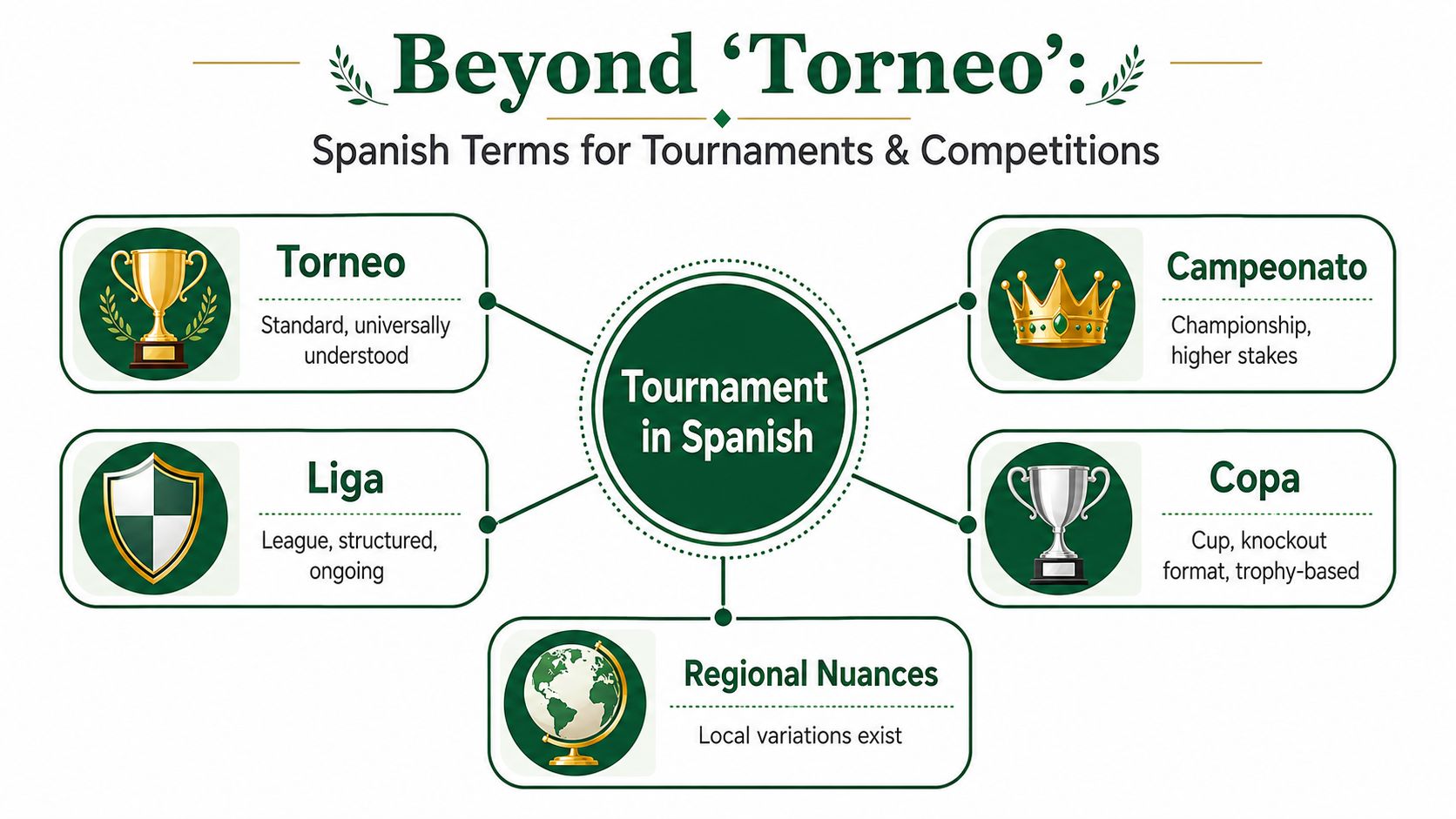
Torneo is the default choice, but it isn't the only competition word you'll see in Spanish sports language. In golf, choosing the right term depends less on strict grammar and more on event tone, format, and what players expect to read.
Which word fits which event
Here's the practical distinction I use when reviewing event copy:
Torneo: Best all-around term for a golf event, outing, invitational, charity day, or competitive field.
Campeonato: Better for a club championship or an event with a title-on-the-line feel.
Competición: Broad and correct, but less natural as the main public-facing label for many golf events.
Copa: Useful when the event is framed around a cup, trophy, or knockout-style tradition.
Liga: Better for league play than for a one-day tournament.
A member-guest can be a torneo. A season-ending club title event may read better as a campeonato del club. A weekly points series is usually closer to liga language.
What to avoid
What doesn't work is mixing these words casually because they seem interchangeable in English. They overlap, but they don't carry the same feel.
For example:
Good fit: Torneo de golf benéfico
Good fit: Campeonato del club
Less natural for a standard outing: Competición de golf benéfica
If you're unsure, torneo is still the safer public-facing choice.
The cleanest event language usually sounds a little simpler than what a dictionary suggests.
Why the term carries weight
The word also has long sporting and cultural roots in Spanish. One visible example is Spain's Copa del Rey, which began in 1903 and is described as the oldest national football tournament in Spain. The competition followed the Copa de la Coronación in 1902, and clubs such as Barcelona, Athletic Bilbao, and Real Madrid have won it 32, 24, and 20 times respectively, which shows how established tournament language is in Spanish sporting culture over time, according to Kiddle's Copa del Rey overview.
That history matters for one reason. Torneo doesn't sound like a borrowed office term. It sounds native, familiar, and well-grounded in sports.
For golf directors, the takeaway is simple. Use torneo as your main word, shift to campeonato only when the event holds championship weight, and keep the rest of your vocabulary aligned with the format you're running.
Spanish for Your Golf Event Practical Examples
Translation either helps the day run smoothly or creates more cleanup for staff. Golf players don't interact with one isolated word. They interact with full labels, prompts, and short instructions. For that reason, translating full collocations matters more than translating the noun by itself. PONS shows examples like torneo abierto for "open tournament" and el Open de Golf de Madrid for "the Madrid Open (golf tournament)" in its English-Spanish entry for tournament.
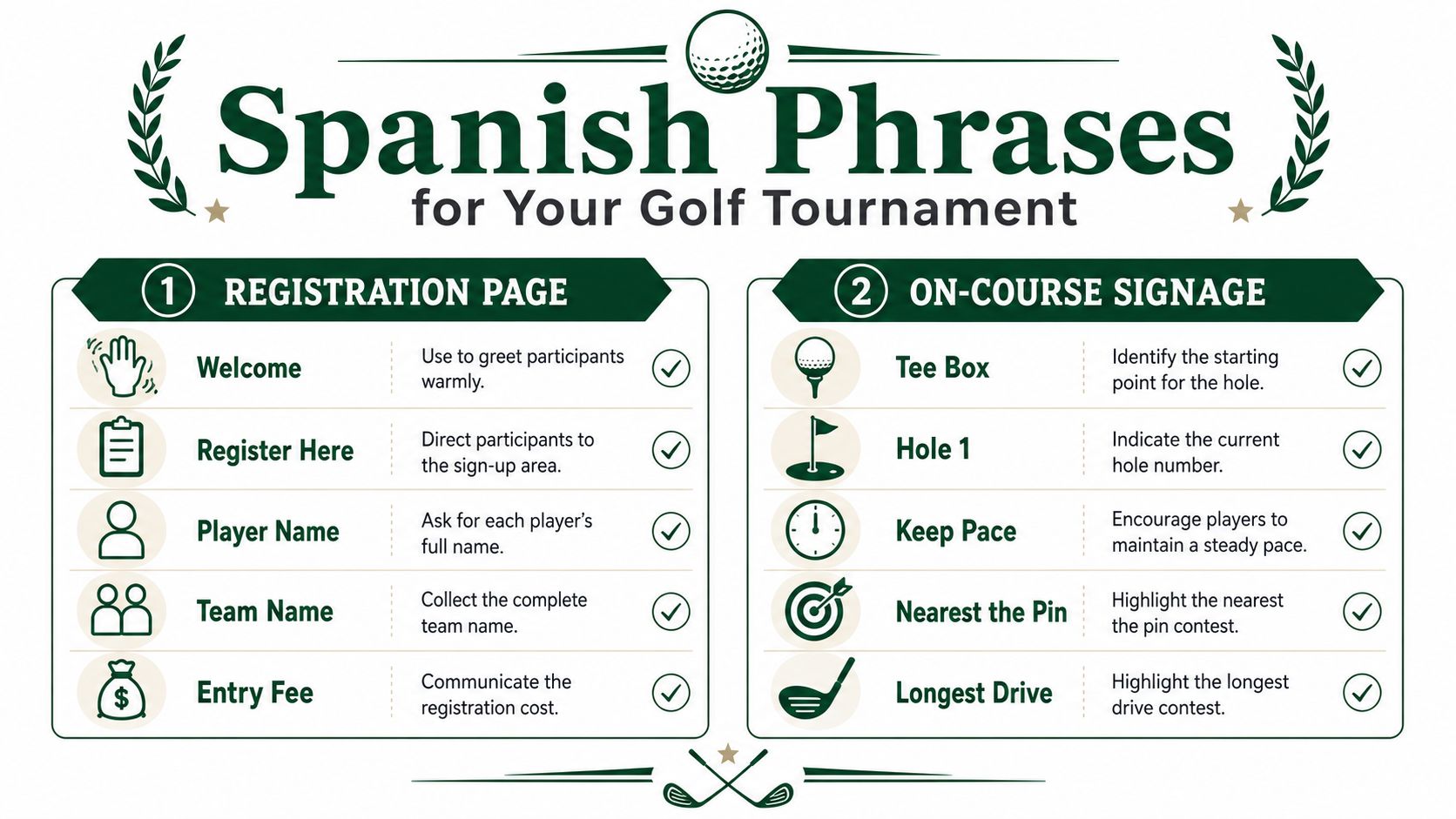
Registration page language
The cleanest bilingual registration pages use short labels and familiar nouns. Keep them direct.
English | Spanish |
|---|---|
Golf Tournament | Torneo de Golf |
Open Tournament | Torneo Abierto |
Welcome | Bienvenidos |
Register Here | Regístrese Aquí |
Player Name | Nombre del Jugador |
Team Name | Nombre del Equipo |
Entry Fee | Cuota de Inscripción |
A couple of practical notes matter here. If your event is casual or community-based, Inscribirse and Registro can both work in context, but consistency matters more than variety. Pick one style and keep it across the page, confirmation email, and printed materials.
For branded apparel or volunteer gear, I also recommend matching your bilingual wording with clear visual identifiers. If you're ordering event caps for staff or sponsors, a practical source for wholesale golf hats can help keep tournament branding consistent across registration and on-course touchpoints.
On-course signs and contest boards
Signage should be shorter than the wording you might use online. Players read signs while moving, often with a cart partner talking and a tee time approaching.
Use compact phrasing like this:
Tee Box: Salida
Hole 1: Hoyo 1
Keep Pace: Mantenga el Ritmo
Nearest the Pin: Más Cerca del Hoyo
Longest Drive: Golpe Más Largo
If you're laying out contest signage, keep English and Spanish in the same visual order on every hole. Don't alternate which language appears first. That small consistency makes signs easier to scan.
Live scoring instructions
Over-translation causes trouble. Players need a short action, not a paragraph.
Good examples:
Click the link to enter your score
Haga clic en el enlace para ingresar su puntajeEnter scores after each hole
Ingrese los puntajes después de cada hoyoNeed help with scoring?
¿Necesita ayuda con la puntuación?
If you're revisiting your event workflow before rewriting those prompts, this guide on how to run a golf tournament is a useful planning reference for the full operation around registration, pairings, and scoring.
One practical option for app-free scoring is Live Tourney, which lets organizers send players a link to enter scores on any device. That's useful when you're trying to keep bilingual instructions short, since "click the link" is easier to communicate than "download the app, create a login, and find the event."
Keep scoring language at an action level. Players should know what to do in one read.
Bilingual Phrases for Tournament Day
Printed translation helps before the round starts. Staff language matters once players walk through the door. A short set of bilingual phrases gives your team enough coverage to welcome players, handle check-in, and solve routine issues without turning every interaction into a handoff.
Front-desk and starter phrases
You don't need your entire staff speaking fluent Spanish. You need them able to greet, direct, and reassure. That effort changes the feel of the event immediately.
Here is a quick-reference table your staff can keep at check-in or in the staging area.
Essential Bilingual Phrases for Golf Tournament Staff
English Phrase | Spanish Translation |
|---|---|
Welcome to the tournament | Bienvenidos al torneo |
We're glad you're here | Nos da gusto que estén aquí |
What is your last name? | ¿Cuál es su apellido? |
Are you checking in for the tournament? | ¿Viene a registrarse para el torneo? |
Here is your scorecard | Aquí tiene su tarjeta de puntuación |
Here is your cart sign | Aquí tiene el letrero de su carrito |
Your tee time is ready | Su hora de salida está lista |
Please wait by the starter area | Por favor espere en el área de salida |
Help phrases that keep play moving
Course-side communication should be even simpler. Players don't need elegant phrasing when a rules question or scoring issue comes up. They need clarity and speed.
Do you need help with scoring?
¿Necesita ayuda con la puntuación?Please enter your score here
Por favor ingrese su puntaje aquíThe leaderboard is updated live
La tabla de posiciones se actualiza en vivoPlease keep pace with the group ahead
Por favor mantenga el ritmo con el grupo de adelante
If you're already redesigning printed player materials, these examples pair well with strong visual formatting. This article on golf cart signs is useful if you're trying to make bilingual cart signs cleaner and easier to scan.
The goal isn't perfect Spanish. The goal is reducing hesitation at the exact moment a player needs an answer.
What staff should and shouldn't improvise
Staff usually do well with greetings and labels. They struggle when they start inventing longer explanations on the fly. That's where consistency breaks.
A good rule is to script the phrases that come up repeatedly:
Check-in questions
Starter instructions
Scoring prompts
Pace-of-play reminders
For anything more complex, keep a bilingual printed sheet at the desk or assign one point person to handle longer conversations. That works better than having five staff members improvising five different versions of the same message.
Run a More Inclusive and Professional Event
Knowing that tournament in Spanish is torneo is useful. Using that word well across your event is what players notice.
The difference shows up in small places: a registration page that reads naturally, contest signs that don't feel translated at the last minute, and staff who can welcome players without awkward pauses. That's what makes an event feel current and professionally run.
If your team wants a simple way to build comfort before tournament day, these actionable tips for speaking Spanish are a practical place to start. For the broader operations side, this overview of golf tournament management software helps when you're tightening up registration, scoring, and event communication as one system instead of separate tasks.
A bilingual golf event doesn't require perfect fluency. It requires preparation, consistency, and respect for the player's experience.
If you're looking for a straightforward way to manage registrations, pairings, and app-free live scoring for your next golf tournament, Live Tourney is worth a look. It gives tournament directors a web-based system for running events and sharing scoring links without adding extra complexity for staff or players.