
Jul 12, 2026
falcon point golf club, katy tx golf, houston private golf clubs, golf tournament management, live tourney
Get a complete guide to Falcon Point Golf Club in Katy, TX. Explore the course layout, membership costs, amenities, and how to plan your visit or tournament.

You're probably looking at Falcon Point from one of three angles. You want a strong private club in Katy and need to know whether it's worth pursuing. You've been invited to play and want to avoid getting beat up by a course with a serious reputation. Or you're trying to host a polished outing at a private club and need to know where the friction usually shows up.
That last angle doesn't get enough attention. Plenty of writeups describe the course, the clubhouse, and the member lifestyle. Very few talk about what happens when a corporate group, charity committee, or non-member organizer tries to run a smooth event at an exclusive club where access, setup, and scoring all matter.
An Introduction to Falcon Point Golf Club
A typical Falcon Point event question sounds simple at first. Can a non-member group play here, and how hard is it to make the day run cleanly? At a private club, those are two different questions. Access, guest policy, timing, and scoring logistics all sit alongside the golf itself, and that is where organizers usually get surprised.
The Club at Falcon Point is a long-established private club in Katy, Texas, with golf at the center of the experience and dining, racquet sports, fitness, and pool amenities shaping how members use the property day to day. The first practical point is straightforward. This is not a public, book-a-tee-time course. Play typically happens through membership, a member invitation, or an organized event approved by the club.
That private status changes more than availability. It affects pace, service standards, and how the club prepares for outside groups. Public facilities are built to process volume. A club like Falcon Point is built around member expectations first, which usually creates a better on-site experience but also means outside organizers need clearer communication before event day.
What kind of club it is
Falcon Point tends to fit households that want more than a place to play 18 holes. The golf matters, but so does the convenience of having dining, recreation, and social use in one location. That broader mix is often what justifies private-club value over time.
From an operator's perspective, that also shapes events. A private club environment can deliver a more polished outing than a standard daily-fee course, but only if the organizer respects the club's structure. Guest access, registration flow, cart staging, sponsor setup, and live scoring all need to be handled with more discipline than many charity committees expect. Groups that arrive with a loose spreadsheet and a few text threads usually feel the pressure quickly.
A better approach is to prepare the event the same way the club prepares the golf. Details first.
What to know before you call
Start by being clear about why you want access. Membership inquiries, guest-play questions, and tournament requests do not follow the same path, and clubs appreciate direct communication.
A practical checklist helps:
State your access type clearly: Say whether you are exploring membership, guest play through a member, or event hosting.
Match your questions to your use case: A family comparing amenities should ask different questions than a competitive player or a corporate organizer.
Ask about process, not just availability: Confirm tours, decision timelines, guest restrictions, and what the club needs from an event organizer before approving a date.
Plan operations early: For groups, pairings, waivers, sponsor visibility, and scoring should be organized before the first planning call. A hole-by-hole tournament planning workflow helps avoid the usual scramble.
One more point matters here. Falcon Point's reputation in Katy creates high expectations. Members expect a certain standard, and invited guests notice quickly when an outing is well run or slapped together. Modern tournament software solves a lot of that friction. It keeps registration, pairings, updates, and scoring organized without forcing club staff and volunteer organizers to patch the day together by hand.
The Course A Player's Guide to the Layout and Challenge
A guest steps onto the first tee expecting a polished private-club round. By the third hole, the distinct challenge is clear. Falcon Point punishes loose strategy more than raw swing speed, and that distinction matters even more when you are bringing out a tournament field that has never seen the property before.
The layout has long held local respect because it asks players to think. Yardage alone does not explain the challenge. The pressure comes from demanding starting lines, approach shots that need the correct side of the green, and putting surfaces that can turn an average iron shot into a defensive two-putt.
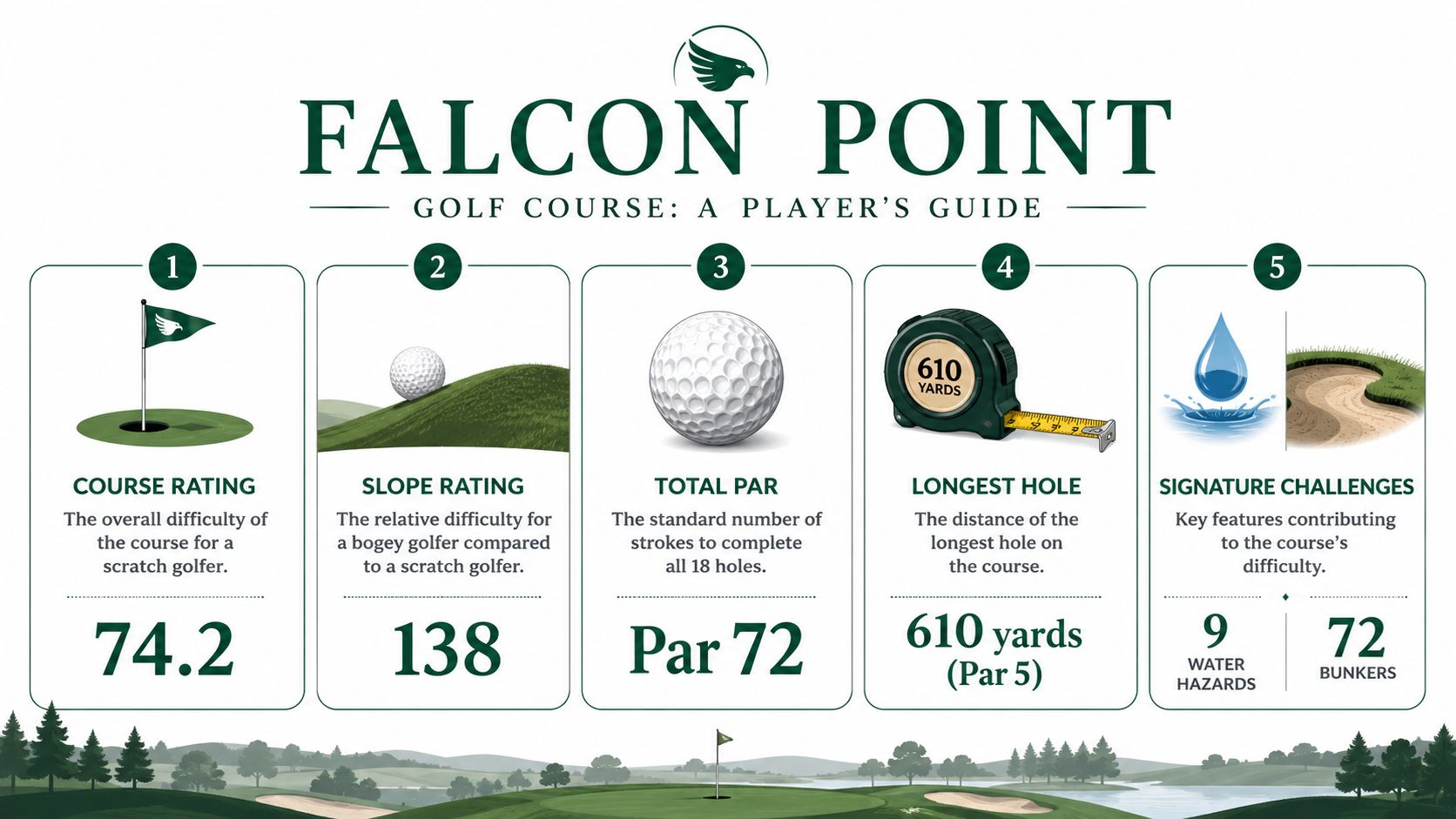
Players usually get in trouble here for one reason. They try to win the hole too early.
That shows up in a few predictable ways:
Driver on the wrong hole: Some tee shots reward position more than distance, especially if your miss brings a blocked angle into play.
Aggressive approaches to side pins: Falcon Point often rewards the player who aims 20 feet from the hole instead of six.
Poor misses around the greens: Short-siding yourself here can turn a routine par save into a scramble for bogey.
Greedy recovery shots: Taking on trees, bunkers, or a narrow opening usually adds another mistake to the first one.
The better rounds are built on discipline. Fairway if possible, center green when in doubt, and a lag putt that leaves stress-free work coming back. That may sound conservative, but on this course it is usually the smartest kind of aggressive.
For competitive players, Falcon Point is a proper shotmaking test. You need distance control with the irons, patience when the hole location tempts you, and enough restraint to accept that par is a good score on many holes. Mid-handicap guests can still enjoy the course, but they should play it as a placement course. Trying to overpower it is how a decent front nine turns into a long day.
A practical game plan looks like this:
Situation | Better play | What usually fails |
|---|---|---|
Demanding driving hole | Hit the club that keeps your preferred miss in play | Reaching for driver without checking the landing area |
Front or tucked pin | Play for the fat side of the green | Attacking every flag |
Quick greens early in the round | Putt to conservative speed and learn the surfaces | Charging the first few birdie tries past the hole |
Trouble after a miss | Take the shot that restores position | Forcing a miracle recovery |
That same discipline matters on the operations side. Non-member events at strong private courses often struggle because organizers build pairings and contests without studying where groups back up, where higher handicaps bleed strokes, or which holes create scoring swings. A hole-by-hole tournament planning workflow helps map those pressure points before carts leave the staging area.
That is not theory. It is how you protect pace, scoring accuracy, and guest experience at a club where the course can expose weak planning as quickly as weak course management.
The trade-off at Falcon Point is straightforward. Bold play can create chances, but it also brings big numbers into view fast. Controlled golf is less flashy and more effective here. Players who accept that usually leave impressed. Organizers who plan around it usually run a much cleaner day.
Membership and Amenities Beyond the Fairways
A prospective member usually asks about dues first. The better starting point is usage.
At Falcon Point, membership value comes from how often the club fits real life. A household that plays golf twice a month, uses the pool in summer, grabs dinner on busy weeknights, and takes advantage of fitness or racquet amenities will judge the club very differently than a golfer who only wants occasional access to the course. That distinction matters because private-club value is rarely just a golf equation.

What members are really buying
As noted earlier, Falcon Point is presented as a full private-club experience, not only a place to book tee times. In practical terms, that means the club can serve several roles at once: golf venue, family recreation option, dining spot, and social hub close to home.
That mix is where many private clubs either justify the dues or fall short.
For a serious player, the golf may carry the decision. For a family, the non-golf amenities often decide whether the membership gets used enough to feel worthwhile. I have seen plenty of households overpay for prestige at clubs they visit rarely, and I have seen others get strong value because the club replaces separate spending on dining, pool access, fitness, and weekend entertainment.
The real evaluation problem
The hard part is not understanding what Falcon Point offers. The hard part is measuring whether your household will use it.
Private clubs also create friction for non-member guests, sponsors, and outside organizers. That does not make the club less appealing. It means members who plan to host charity events, client golf days, or social tournaments should think beyond amenities and ask how event registration, scoring, and guest communication are handled. At an exclusive club, the setting is polished. The workflow behind the scenes is not always as polished unless the organizer brings the right tools.
A practical golf tournament planning guide for private-club events helps clarify that difference before you commit to using the club for more than casual play.
How to Evaluate the Value
Use a simple screen:
Frequent golfers: The case gets stronger if you will play often enough to prefer member access, practice time, and a consistent club environment over public-course rotation.
Families: Pool, dining, fitness, and racquet access matter if they reduce the need for separate weekend plans.
Business users: The club can be useful for client entertainment, but only if you are realistic about guest logistics and event setup.
Social members: The calendar matters more than the brochure. A beautiful clubhouse does not help much if the programming does not match how you spend time.
Ask direct questions before signing. How crowded are the times you would play? Which amenities get steady member use versus brochure attention? How often does your household expect to come out in an average month?
Those answers are more useful than rumor pricing.
One more practical point. If you expect to host indoor activations, sponsor nights, or off-season entertainment tied to your membership, outside vendors can fill gaps the club may not cover directly. The PSW Events golf simulator guide is a good example of how organizers add a golf element without needing full course access.
That is the trade-off with a club like Falcon Point. The upside is a polished private setting with more than one way to use it. The challenge is making sure your household, and any guests you bring into the experience, can use those benefits often enough to justify the commitment.
Hosting Tournaments and Events at Falcon Point
Falcon Point is exactly the kind of property that can enhance a corporate outing or charity event. A private-club setting changes the tone immediately. Guests arrive expecting a premium experience, and that can help with sponsor perception, donor confidence, and overall turnout quality.
But private-club events have a hidden challenge. The venue may feel exclusive and polished while the event workflow behind the scenes is still clunky.

Where non-member events usually slow down
Public-facing coverage of Falcon Point tends to focus on the course. What gets missed is the operational side of running a non-member event at a private facility. That matters because outside organizers don't know the club's internal processes, and they often discover the friction only after invitations have gone out.
The practical issue is straightforward. The operational reality of running non-member events at a private facility like Falcon Point can involve legacy software, creating a bottleneck for organizers who care about fast setup and live scoring, as reflected by the club's event-facing member day tournament page.
In real terms, that can mean:
Manual setup pressure: Pairings, flights, and player imports may take more staff touch than expected.
Scoring friction: If players need extra steps to participate, fewer of them will score live.
Communication gaps: Last-minute updates become harder when the event system isn't flexible.
Format limitations: Creative formats can become harder to execute cleanly.
What experienced organizers should ask before booking
If you're considering Falcon Point for a non-member event, ask operational questions as early as you ask about food minimums or shotgun availability.
Use a pre-booking checklist like this:
Scoring method
Find out whether players will have simple mobile access to scoring or whether participation depends on extra downloads and setup.Turnaround for pairings and edits
Ask how quickly the staff can update tee sheets, pairings, and sponsor placements if your field changes late.Support for your format
Charity scramble, member-guest style games, multi-round competitions, and team formats all create different admin demands.Visibility during play
Live leaderboard access changes how engaged players and sponsors feel during the round.
When organizers ignore scoring and communications until the week of the event, the round may still happen. It just won't feel modern.
A broader golf tournament planning guide for organizers is worth reviewing before you commit to any venue because it helps separate “beautiful property” questions from “can this event run cleanly?” questions.
Matching the venue to the experience
Falcon Point makes the most sense for groups that want a premium golf setting and are willing to do the extra planning that private-club execution often requires. That includes sponsor outings, local corporate entertainment, and charity groups that care about hospitality and presentation.
If your event also includes an indoor component, sponsor activation, or weather contingency planning, outside resources can help shape the full experience. For example, this PSW Events golf simulator guide is useful when you're building a broader golf-themed event around the live round rather than treating the course as the only touchpoint.
The trade-off is clear. Falcon Point can give you a stronger setting than many public venues. But stronger settings usually demand tighter planning. Organizers who respect that tend to have better events.
Planning Your Visit Nearby Dining and Lodging
If you're visiting Falcon Point as a guest, prospective member, or tournament participant, keep the trip simple. The club is in Katy, not a remote destination resort. That means convenience usually beats over-planning. Stay close enough to avoid traffic stress, leave enough time for arrival and warm-up, and choose dining that matches the reason for the trip.

A simple way to choose where to stay
Use your visit type as the filter.
Visit type | Best lodging approach | Why it works |
|---|---|---|
Business trip with a client round | Stay in a polished business hotel near Katy's main commercial corridors | Easier dinners, cleaner logistics, shorter morning prep |
Family visit tied to club amenities | Choose a hotel with more room space and easy parking | Less friction if the whole household is coming |
Tournament or outing participation | Prioritize proximity and early breakfast availability | You want a calm morning, not a rushed check-in |
If your event includes room blocks or out-of-town players, a service guide on golf tournament housing coordination can help you think through the practical side of guest travel, especially when people are arriving on different schedules.
Dining choices that fit the occasion
For a client dinner, pick somewhere quiet enough to talk and close enough that nobody worries about a long drive back. For a casual golf trip, convenience wins. You don't need a marquee reservation after a hard day on a demanding course. You need a reliable meal, predictable service, and a setting that matches the tone of the group.
A few practical guidelines help:
Pre-round meal: Keep it light and familiar. Falcon Point isn't the place to test your digestive courage before a difficult round.
Post-round business dinner: Choose atmosphere over trendiness. Conversation matters more than novelty.
Family meal: Stay flexible and close to your hotel or the club area.
Group dining: Reserve early if your outing has multiple foursomes arriving together.
Pack one level more polished than you think you need. At a private club, underdressing stands out faster than overdressing.
If you're unsure what that means in practical terms, this guide on how to dress for golf is a useful refresher before you show up as a guest.
What makes the day go smoother
The best Falcon Point visits usually come from small decisions, not grand plans. Arrive early enough to settle in. Keep your hotel close enough that forgotten items don't become a crisis. Build in a little margin before and after the round, especially if you're meeting members or clients.
That approach fits the club. Falcon Point works best when the day feels organized, composed, and unhurried.
Is Falcon Point the Right Club For You
Falcon Point fits a specific type of golfer and a specific type of household. If you want a casual public-access experience, this isn't your place. If you want a private Katy club with a respected course, a long local presence, and enough non-golf amenities to make the membership useful beyond tee times, it deserves a serious look.
For the committed player, the appeal is obvious. The course has enough challenge to stay interesting, and that matters more over time than a layout that feels fun for a month and forgettable after that. Falcon Point gives better players a course they can keep solving instead of outgrowing.
For families, the decision is less about handicap and more about habit. A private club only makes sense if people will use it. Falcon Point's broader amenity mix helps there, because the value doesn't need to come from golf alone.
For event hosts, the answer depends on how much control you want over execution. Falcon Point can provide the right setting for a polished day. But high-end venues don't automatically produce high-end operations. Organizers still need to ask sharp questions about scoring, communications, and event workflow. That's where modern tournament tools matter most. Live Tourney has powered over 10,000 golf events and reports a 40% increase in live scoring engagement compared to traditional methods, which directly addresses one of the most common event-day friction points according to the Live Tourney tournament software overview.
The short version is this. Falcon Point is a strong fit for golfers who appreciate challenge, for households that will use a club as part of regular life, and for organizers who want a premium setting and are prepared to manage the details that come with it. If that sounds like you, Falcon Point is worth more than a quick glance.
If you run outings, leagues, charity scrambles, or club events and want a smoother experience for both staff and players, take a look at Live Tourney. It's a modern web-based platform built for golf events, with app-free live scoring, intuitive setup, and tools that help tournaments feel organized instead of improvised.





