Jul 13, 2026
duncan hills golf course, savannah mo golf, missouri golf courses, golf tournament hosting, public golf course
Get the complete guide to Duncan Hills Golf Course in Savannah, MO. Explore course layout, green fees, player tips, and how to host your next golf tournament.

You're often looking for the same thing when a regional event lands on your desk. You need a course players will respect, a setup that won't overwhelm casual groups, and a facility staff can work with without turning every detail into a negotiation. In northwest Missouri, Duncan Hills Golf Course fits that profile better than many public options.
For the single player, it offers a straightforward public-golf experience with enough character to stay interesting. For the event organizer, it presents a more useful question. Not whether the course can host a good day, but whether you're prepared to manage the moving parts that sit around the golf itself.
An Introduction to Duncan Hills Golf Course
You get the call to host a one-day event in northwest Missouri. The budget points you toward a municipal course. The field will include good players, occasional golfers, and sponsors who care as much about pace and presentation as they do about score. Duncan Hills Golf Course in Savannah is the kind of property that can handle that mix.
The course operates as a public municipal facility, and the City of Savannah parks and golf information page identifies Duncan Hills as the city golf course. That matters because municipal venues come with a specific set of strengths. Access is better, pricing is usually more workable, and the staff is often used to balancing daily play with leagues, scrambles, and community events.
Why Duncan Hills gets on an organizer's shortlist
A course like this fills an important slot in a regional market. Private clubs can be cleaner tournament stages, but they often bring higher costs, tighter restrictions, and less flexibility for mixed public fields. Basic munis are easier to book, yet some do not give stronger players enough to think about. Duncan Hills sits in the middle. That is usually the sweet spot for charity events, league finals, and company outings that still want real golf.
Players see a straightforward public course. Organizers should look one layer deeper.
The primary test is operational. Can the course move groups efficiently, give better players a fair contest, and still keep the day manageable for the shop staff? Municipal courses that do this well become repeat venues. Municipal courses that do not usually fail in scoring, communication, or pace control long before the golf itself becomes the issue.
What it offers beyond a casual round
Duncan Hills works for regular public play, but its bigger value is flexibility. You can book an ordinary tee time and get a solid round. You can also build a tournament day around it without asking the facility to pretend it is something else.
That distinction matters if you run events. At a municipal course, the blind spot is often digital scoring. Organizers spend time on pairings, carts, signs, and proximity markers, then rely on paper cards and clubhouse math at the finish. On a course like Duncan Hills, where the appeal is broad access and practical setup, that old scoring model is usually the first thing I would question. A clean public venue can host a very good event, but only if the scoring and player communication are as organized as the shotgun.
For golfers, the appeal is simpler. Duncan Hills gives you a course with enough identity to hold attention and enough practicality to make it part of a normal season, not just a one-off stop.
The Course Story and Classic Design
A course usually tells you how it wants to be played if you know its history. Duncan Hills didn't begin as a polished 18-hole municipal operation. It grew into one, and that matters when you read the architecture.
Duncan Hills Golf Course was originally established as a 9-hole course in 1976 and later expanded to 18 holes in 1993, providing a more challenging layout for golfers, according to the course history page.
From local layout to fuller test
That timeline gives the place its personality. Older public courses that expand rather than arrive all at once often have a more uneven rhythm. That's not a flaw. In many cases, it's exactly why players remember them. Some holes feel straightforward. Then one asks a question you didn't expect.
That fits Duncan Hills well. The course is also identified with H & H (Hankins & Hankins), and that design background lines up with a public-golf approach that values playability but doesn't flatten out the challenge. You don't get the sense that every hole was built to look the same from the tee.
The value of the funky holes
One of the most useful details attached to Duncan Hills is the note that it includes “very funky holes.” That's the kind of phrase golfers remember because it usually means one thing. Standard yardage alone won't solve the course.
A “funky” municipal hole tends to ask for one of these responses:
Lay back for angle: The aggressive line can leave the worse approach.
Club down off the tee: Distance creates trouble faster than it creates advantage.
Accept an awkward second shot: Sometimes the best play is to keep the big number out of reach.
The memorable public courses are rarely the ones where every hole follows the same template. They're the ones that force a player to make decisions.
For an event organizer, those holes are both a strength and a management point. They keep better players engaged. They also create places where mixed fields can bottleneck if pairings aren't spaced carefully and pace expectations aren't set early.
What the design means in practice
If I'm advising a player before a first round at Duncan Hills, I don't tell them to chase a target score. I tell them to identify the handful of holes where ego does damage. That's usually where municipal layouts with character separate smart players from frustrated ones.
If I'm advising an organizer, I look at the same feature differently. Distinctive holes are great for the event experience. They just need structure around them. Starter communication, clean scorekeeping, and clear hole assignments matter more on a course with personality than on a flat, repetitive track.
That's the main design takeaway. Duncan Hills Golf Course has enough individuality to be fun, but it rewards preparation more than people assume.
Dissecting the Scorecard and Key Holes
On tournament morning, this is the section I study first. At a municipal course like Duncan Hills, the scorecard does more than list yardage. It tells you how to set tees for the field you have, and whether your event format will help pace or fight it all day.
A scorecard listing on TheGrint for Duncan Hills Golf Course shows Duncan Hills as a par-71 layout with multiple tee options, including a back setup a little over 6,000 yards and a forward setup under 4,700. That spread matters. It gives better players enough course to hit real approach shots, but it also gives organizers room to protect pace and keep less experienced players engaged.
Duncan Hills scorecard at a glance
Tee | Yardage | Par |
|---|---|---|
Back tees | About 6,000 yards | 71 |
Forward tees | Under 4,700 yards | 71 |
The practical question is not which tee is hardest. The practical question is which tee produces fair scoring and steady movement for your specific field. A scratch-heavy club event can use the back markers without much trouble. A charity scramble, junior event, or mixed corporate group usually plays better from a shorter setup, especially on a course where angle and position matter as much as raw length.
That is where organizers often miss the bigger operational point. They spend time on pairings, carts, and prizes, then treat scoring as an afterthought. On a course with a few unusual holes and likely decision-heavy tee shots, the digital scoring blind spot shows up fast. One rules question, one missed hole score, or one card turned in late can slow results more than any tricky pin position.
What the card leaves out
Duncan Hills does not read like a course where you can hit driver on autopilot. The yardage is modest by modern standards, but municipal courses with personality rarely defend themselves with length alone. They do it with lines that tempt the wrong play, second shots from poor angles, and a couple of holes where restraint beats speed.
That is why a pre-round plan matters here. A useful starting point is this guide on how to evaluate a golf course hole by hole before you play it.
Holes that usually decide the day
Without forcing a hole-by-hole map that is not consistently published across public sources, I would sort Duncan Hills' pressure holes into a few categories that show up on courses like this:
Positional par 4s: Holes where a fairway wood or hybrid leaves the better number and the better angle.
Short par 4s with temptation: Holes that invite an aggressive tee shot, then punish the miss harder than the yardage suggests.
Recovery holes after a mistake: The kind of stretch where one loose swing can turn into two if a player starts chasing it.
For players, the adjustment is straightforward. Pick a conservative target off the tee on the holes that look awkward. Play for the widest part of the green unless the pin is clearly accessible. Let other players force the issue first.
For organizers, those same holes need tighter setup discipline. Put the tee markers in places that make the intended line visible. Give volunteers a clear par and handicap sheet. Use live or hole-by-hole digital scoring if you have it, because courses with a few quirky decision points tend to produce more scorecard errors than plain, repetitive layouts.
I have seen good municipal events lose thirty minutes in the scoring area because the course had one drivable hole, one blind approach, and no clean system for confirming hole-by-hole totals. Duncan Hills looks like the kind of place where that can happen if the committee is casual about administration.
Tournament note: The best score at Duncan Hills will usually come from a player or team that accepts the course on its terms, picks spots carefully, and keeps the card clean. The best-run event will do the same.
Green Fees and Booking Your Round
A municipal tee sheet can look easy from the outside, right up until you are trying to fit a mixed-skill outing into public play, secure enough carts, and keep scoring from turning into a bottleneck. Duncan Hills looks straightforward for a regular round. For an organizer, the details matter.
Duncan Hills accepts tee time reservations through its booking system and by phone. The cleanest way to handle a casual weekend game is still the old-fashioned one. Get your group confirmed early, then book before the weather breaks in your favor and the local sheet tightens up. For current reservation options, contact details, and booking access, use the official Duncan Hills tee times page.
Booking a normal round versus blocking times for an event
For a twosome or foursome, this is a simple booking call. For an outing, it is an operations call.
Those are different jobs, and good organizers treat them that way. A public course can usually absorb everyday demand without much strain, but a tournament block changes cart staging, check-in timing, starter instructions, and pace expectations across the whole morning. That is why I advise confirming four items before you advertise the event internally:
Exact player count and format
Cart needs versus walkers
Preferred starting structure, straight tee times or a grouped block
How scores will be collected and verified
That last point gets missed all the time. Municipal courses are often very good at getting players off the tee and less polished at handling modern event scoring unless the committee brings its own process.
Rates matter, but the real question is value per slot
Publicly available information can change, so fee details are best confirmed directly with the shop when you book. Ask for the current weekday and weekend rate, cart pricing, and whether any group or outing structure applies to your date.
For an individual player, that is enough.
For an organizer, price only tells part of the story. The better question is what each tee time buys you. A lower per-player rate is not much of a win if the event has no defined check-in area, no place to post results, and no plan for score verification. I have seen low-cost municipal events become expensive in staff time because the committee had to fix paperwork problems after the last group finished.
Pace of play should be part of the booking conversation
The course asks groups to keep pace and allow faster play to move through, as outlined on the Duncan Hills tee times and rates page. That matters more for an outing than for a casual foursome.
If your field includes newer players, build around that reality. Leave enough spacing for the format you chose. Make cart assignments clear before players reach the first tee. Tell the starter who is running the event and who can make rulings. A municipal course can run very smoothly if the organizer does not dump every decision on the shop staff five minutes before the shotgun or first reserved time.
What to verify before arrival
Use a short confirmation list and get answers in one call:
Current green fee and cart rate for your date
First check-in time the shop wants from your group
Available space for registration or scoring
Whether outside scoring sheets, proximity markers, or contest signage are allowed
That last item ties into the blind spot many committees still have. They plan pairings, prizes, and food, then treat scoring like an afterthought. On a municipal course, that is where delays show up. If you run outings regularly, it helps to study how better systems handle registration, live leaderboards, and score validation. This guide to best golf course management software for tournaments and outings is a useful benchmark for spotting which jobs are still being done by hand.
Duncan Hills should be easy to book for a normal round. For an event, the stronger approach is to treat booking as the first operating decision, not the last administrative chore.
Player Strategy for Tackling Duncan Hills
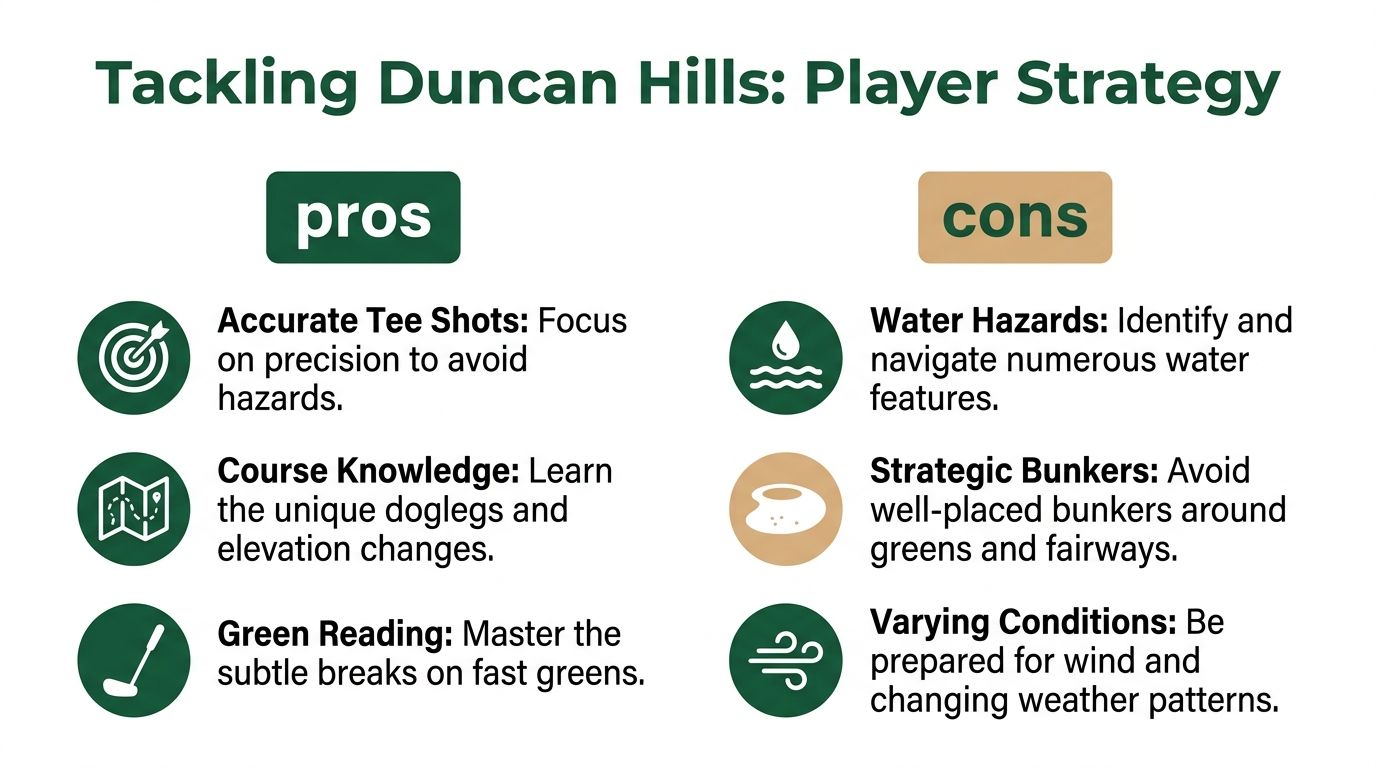
The strategic identity of Duncan Hills starts with one phrase. Deceptive elevation changes. That's the detail that should shape every decision you make from club selection to whether you walk or ride.
While Duncan Hills explicitly permits walking golfers, its reputation as one of the area's most challenging layouts is due to “deceptive elevation changes,” according to the course FAQs.
Start with the slope, not the number on the card
Players lose shots on this type of course when they trust the yardage and ignore the terrain. If a hole climbs, falls, or tilts in a way that isn't obvious at first glance, your stock number can become the wrong club fast.
The cleanest approach is conservative:
Take one extra beat on approach shots: Confirm whether the landing area is playing longer or shorter than it looks.
Respect sidehill lies: These often produce the miss that starts the whole problem.
Aim for the large safe section of the green: On a course with smaller targets, center-green golf travels well.
Walking versus riding
This is a real strategic trade-off, not just a comfort choice. Walking can improve awareness. You feel the grades. You notice where the ground feeds and where it rejects. That helps with club choice and green reading.
But walking also adds fatigue, especially late in the round on an elevation-based layout. For some players, the gain in feel won't offset the drop in execution over the closing stretch.
My rule is straightforward.
Walk if you're a steady player who benefits from seeing the land at ground level.
Ride if your scoring depends on preserving energy and staying physically fresh for approach play and putting.
Better course reads don't help much if tired legs turn a committed swing into a loose one on the back side.
How to handle the greens
Verified public details identify the greens as bent grass elsewhere in this guide's source set, and bent grass generally rewards a committed stroke more than a tentative one. At Duncan Hills, the safer mindset is to avoid short-siding yourself in the first place.
Focus on three things:
Leave uphill looks whenever possible
Miss below the hole if the sectioning isn't obvious
Treat first-putt speed as the priority
The players who score here usually aren't the ones firing at every flag. They're the ones who understand where the next shot comes from. Duncan Hills Golf Course looks most manageable when you play it from the ground up instead of from the scorecard down.
Hosting Modern Golf Events at Duncan Hills
The common failure point at a municipal course is not tee time access. It is assuming the course will also cover the tournament system.
Duncan Hills has already been used for organized competition. The club's own 2024 events calendar shows recurring event activity, including the Donkey Trot, which is enough to frame the course as a workable host site for scrambles, charity days, and local corporate fields. For an organizer, that matters. It means the venue side is believable. The bigger question is whether your scoring, communication, and payout process is ready for player expectations now, not ten years ago.
The blind spot is scoring operations
Frequently, municipal events lose polish at this stage. A course can stage carts, send groups out on time, and still leave the field waiting on handwritten totals, verbal flight updates, or a scoreboard that changes only when someone in the shop has a free minute.
Public information on Duncan Hills does not clearly show whether outside groups get live mobile scoring, manual score entry, or some hybrid process. That uncertainty should shape your plan. If the workflow is not stated up front, assume you need to bring your own system for score capture, leaderboard display, and results distribution.

I treat that as an operations issue, not a tech issue. Players will forgive a modest clubhouse. They will not forgive a long post-round stall while the staff sorts cards and recalculates skins.
What holds up on event day
At a place like Duncan Hills, the cleanest setup separates course duties from organizer duties. The course handles the venue. The organizer controls the tournament layer.
What tends to work well:
Independent registration and roster control
Preassigned pairings and tee sheets shared before arrival
Mobile or staff-managed scoring with one clear entry method
Published rules for flights, ties, skins, and payouts before the first tee
One person assigned solely to scoring questions
What breaks down fast:
Relying on the golf shop to run live results for an outside field
Using paper cards with no verification process
Explaining format details on the first tee instead of in advance
Waiting until scoring closes to decide how payouts will be handled
That separation also helps with staffing. Public-course teams are there to serve daily play first. Expecting them to build a custom event desk, police every scorecard, and push instant updates usually creates friction for everyone.
How I would set up an event here
For Duncan Hills, I would build the day around simplicity at the course and control off the course. Keep the format easy to follow. Send pairings the day before. Give every group one scoring method. Assign a single rules contact. Post local rules and contest holes in writing, not just at check-in.
If weather or turf stress becomes part of the conversation, outside organizers should also understand the maintenance side of public golf. Resources on protecting commercial turf from brown patch are useful background, especially for summer events when course conditioning and cart traffic policies can affect setup choices.
For organizers who want a cleaner operating model, this guide to tournament hosting best practices is worth reviewing. The best municipal events do not feel complicated to players because the difficult parts were solved before anyone arrived.
Duncan Hills is a credible venue for a well-run outing. The professional move is treating scoring and event communication as your job unless the course has clearly told you otherwise.
Planning Your Visit Directions and Facilities
Duncan Hills is straightforward to reach, and that matters more than people admit. A public course that's easy to find and easy to explain removes friction before the day even starts. That helps weekend players. It helps event fields even more.
The course is located at 400 E Duncan Dr, Savannah, Missouri, 64485, and it's classified as a municipal facility with well-groomed fairways and bent grass greens, according to GolfNow's course details for Duncan Hills Golf Course.
Getting there without overthinking it
If you're coming from the St. Joseph area, the route is simple enough that most groups won't need much beyond a standard map app and the address above. For event directors, the better practice is still to include the full address in player emails and cart-sign materials. You'll cut down on late arrivals and panicked calls from players who typed in only the course name.
A concise arrival checklist works well:
Send the street address in every pre-event message
Set an arrival window that leaves time for check-in and warm-up
Tell players whether they'll be walking or riding before they arrive
What to expect on site
The verified public details support a picture of a classic municipal setup rather than a resort-style amenity package. That's not a negative. It means the course's value is tied to golf conditions and practical access, not unnecessary fluff.
For most visitors, the important facility expectations are these:
Playable conditions first: The fairways and greens are part of the appeal.
Municipal-course pacing: Expect a functional environment built around getting golfers on and off the course efficiently.
Event utility over polish: If you're hosting, plan your own layers of organization instead of expecting every operational extra to be built in.
A final practical read on the property
Duncan Hills Golf Course makes sense because it serves two jobs well. It gives public golfers a respected local round, and it gives organizers a course with enough substance to anchor a serious event. That combination is harder to find than it should be.
Maintenance-minded operators will also appreciate that strong turf conditions don't happen by accident, especially in humid parts of the season. If you manage sports turf or municipal grounds, this primer on protecting commercial turf from brown patch is a useful outside resource for understanding one of the more common stress points in maintained grass systems.
For the player, the trip is easy to justify. For the event host, the value is real if you arrive with a plan, communicate clearly, and handle the tournament layer as carefully as the tee sheet.
If you're running events and want the scoring, pairings, registrations, and live leaderboard side to feel as organized as the golf itself, Live Tourney is worth a look. It's a web-based platform for tournaments, leagues, and outings that keeps setup simple, works on any device without an app download, and helps organizers deliver a cleaner player experience from check-in through final results.