Aug 29, 2026
stroke and distance, golf rules, provisional ball, tournament management, golf penalties
Master the stroke and distance rule in golf. Learn when it applies, how to use provisional balls, local-rule alternatives, and tips for tournament directors.

A player has just watched a drive disappear beside a property line. The group is waiting, the next tee is occupied, and nobody agrees whether the ball can be dropped near the boundary or whether someone must walk back. Those few minutes can create a rules dispute, a scoring correction, and a delay that affects every pairing behind them.
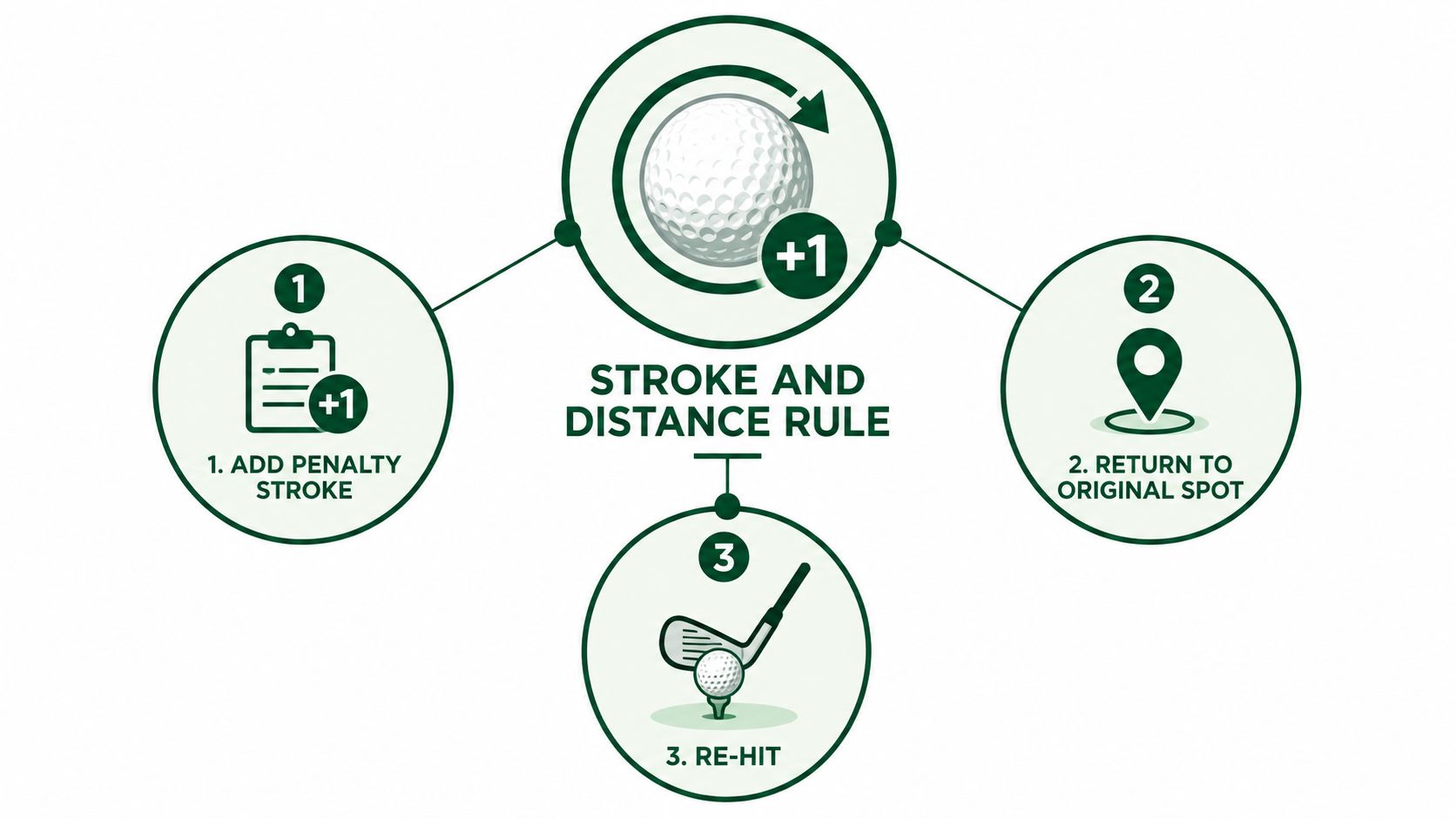
Stroke and distance is the baseline that resolves the situation. For a ball lost outside a penalty area or confirmed out of bounds, the player adds one penalty stroke and plays again from the spot of the previous stroke. Tournament directors who explain that procedure before play, prepare their scoring workflow, and choose suitable local rules can protect both competitive integrity and pace of play.
Understanding the Stroke and Distance Rule
A player strikes a tee shot on a narrow par four. The ball heads toward thick trees, and the group can't tell whether it has stopped in bounds, crossed a boundary, or vanished under vegetation. The player has several immediate responsibilities, but the first question is classification. If the ball is lost outside a penalty area or is out of bounds, the player must use stroke and distance unless an applicable local-rule alternative is available.
Under Rule 18 of the Rules of Golf, the player takes one penalty stroke and returns to the location of the previous stroke. From the teeing area, the player may play again anywhere in that area. From the general area, the player drops within a one-club-length relief area, no nearer the hole. A previous stroke from a bunker requires relief in the bunker, while a ball played from the putting green must be placed on the previous spot.
That means a player generally can't drop beside the point where the ball crossed a boundary. That option belongs to a different procedure, such as an applicable local rule, and it can't be assumed because the walk back is inconvenient.
When the rule applies
The key distinction is between a lost ball outside a penalty area, an out-of-bounds ball, and a ball in a marked penalty area. If the ball is in a penalty area, the player may have penalty-area relief options instead. If it's lost elsewhere or outside the boundary, stroke and distance remains the always-allowed procedure.
A provisional ball can prevent the group from making the full return journey, but it doesn't change the underlying rule. The original ball must still be found or determined to be lost, and the provisional becomes relevant only under the conditions governing provisional play.
For directors, this baseline should appear in the player handbook and rules briefing, alongside a plain explanation of how the event handles out of bounds and lost balls. A short reference to stroke-play scoring principles can also help players understand why the penalty is recorded as part of the hole score rather than treated as an informal extra shot.
Practical rule: If the ball is lost outside a penalty area or out of bounds, start with the previous stroke location. Don't invent a drop point because it seems fair.
Stroke and distance has lasted because it restores the proper progression of play. The player doesn't gain an advantage from an unknown final position. They return to the point from which the errant shot was made, add the penalty, and continue.
How the Penalty Is Applied in Play
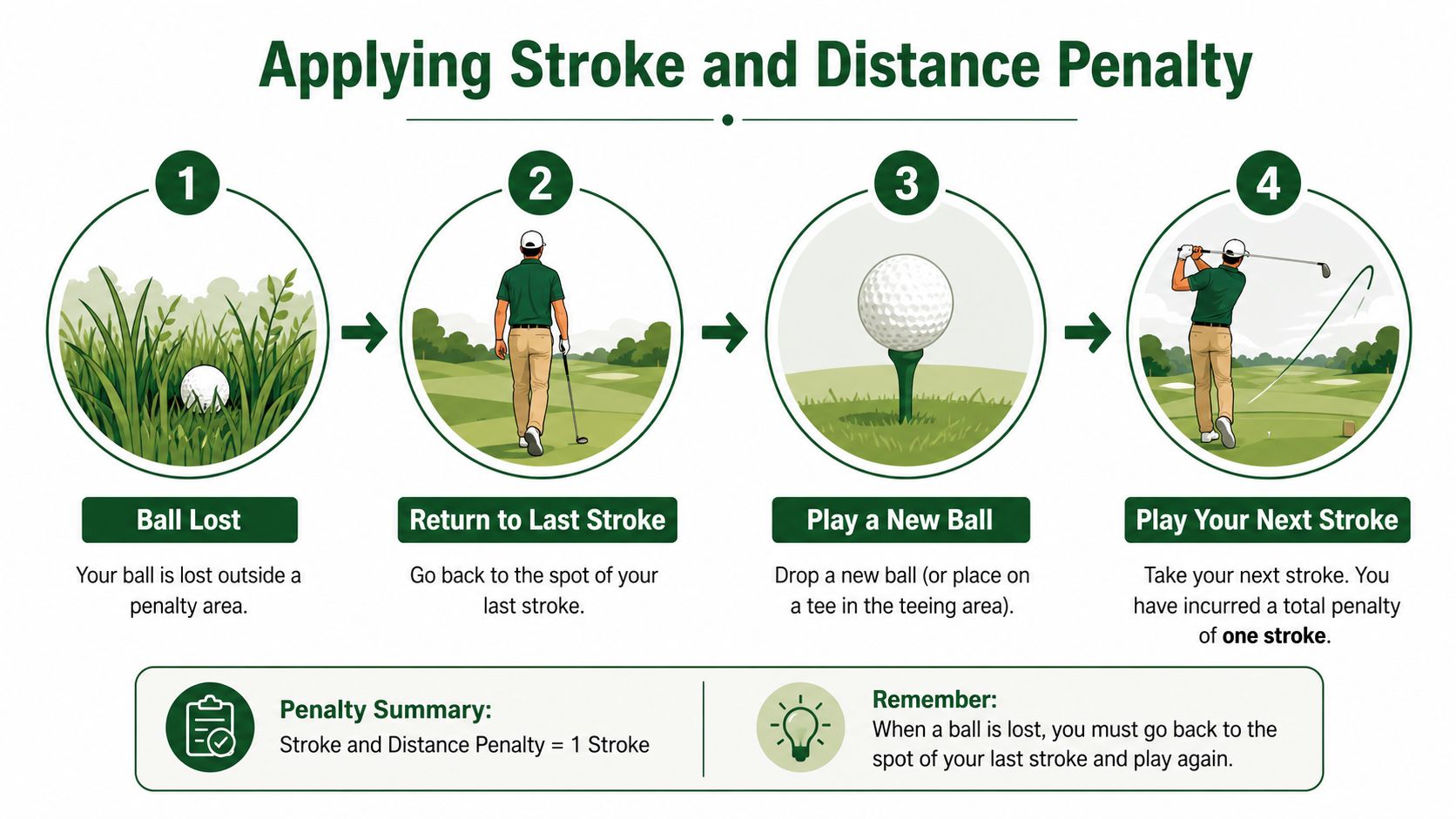
The scoring mechanics are straightforward once the previous stroke location is identified. The player adds one penalty stroke, then plays from the required relief area associated with that location. The procedure is the same whether the previous shot was a drive, an approach, a bunker shot, or a putt.
Applying the penalty step by step
Identify the status of the original ball. Determine whether it's lost outside a penalty area or out of bounds. A ball isn't treated as lost merely because it can't be seen immediately. The search must follow the applicable procedure.
Record one penalty stroke. The penalty is added to the hole score. It isn't a replacement for the original stroke, and it doesn't erase the shot that sent the ball into trouble.
Return to the previous stroke location. The player uses the relief mechanics tied to that location, as summarized by the USGA explanation of stroke-and-distance relief.
Play again. The next stroke is made from the appropriate teeing area, relief area, bunker, or putting-green spot.
A tee shot that goes out of bounds illustrates the familiar “playing three from the tee” result. The first stroke was the drive, the second is the penalty stroke, and the next played shot is the third stroke from the teeing area. The player hasn't hit three shots. The score has advanced by two strokes before the next swing.
An approach shot from the fairway creates the same structure later in the hole. If that ball is lost outside a penalty area, the player adds one penalty stroke and returns to the fairway location of the approach. The replay is the next played stroke, so the hole score includes the original approach, the penalty, and the replay.
Search, boundaries, and mistakes
The search period matters operationally. Players and officials should use the three-minute search window provided by the Rules of Golf, then make a clear ruling based on whether the ball was found and whether it was in bounds. A ball that is found within the search period isn't lost merely because its exact position was difficult to locate.
Near a penalty-area boundary, the group must first determine which rule governs. A ball may be lost in a penalty area, lost outside it, or out of bounds. Those classifications can lead to different relief procedures, so a player shouldn't choose the easiest-looking option without confirming the status.
If a player incorrectly drops near the boundary when stroke and distance applies, the committee should address the wrong procedure under the Rules rather than quietly accepting it. Ask the player and marker to preserve the sequence, document what happened, and obtain a ruling before the score is finalized.
The R&A clarification on Rule 18 is useful for directors because it states the central procedure plainly. A lost or out-of-bounds ball normally requires the player to return to where the previous stroke was made and play again, with one penalty stroke added.
Stroke and Distance vs Local Rule Relief
Traditional stroke and distance is accurate, but the required walk back can slow a field. The modern alternative is the committee-adopted local rule for lost balls and out-of-bounds shots, which gives players a drop-and-play option while imposing two penalty strokes.
The USGA explains that the local-rule relief is designed to be comparable to traditional stroke-and-distance relief. It allows a player to estimate where the ball was lost or crossed out of bounds, identify the permitted reference area, and drop rather than return to the original location. The committee must adopt the local rule for it to apply. Players can't invoke it just because the event feels casual.
Side-by-side comparison
Feature | Stroke and Distance (Rule 18) | Local Rule E-5 Alternative |
|---|---|---|
Penalty | One penalty stroke | Two penalty strokes |
Ball status | Lost outside a penalty area or out of bounds | Lost outside a penalty area or out of bounds |
Where play resumes | At the previous stroke location | In the designated relief area near the estimated lost or out-of-bounds position |
Return walk | Required when no provisional is available | Usually avoided |
Availability | Always allowed under the Rules | Available only when the committee has adopted it |
Main operational benefit | Precise, traditional procedure | Faster continuation of play |
Main trade-off | Can create delays | Costs an additional penalty stroke |
The choice is therefore not “free relief versus a penalty.” Both procedures impose a penalty, but they distribute the cost differently. Traditional stroke and distance charges one stroke and restores the player to the original location. The local rule charges two strokes and lets the player continue from a nearby reference area.
For directors: Pace-of-play relief works only when players know the local rule is active before they face trouble.
The local-rule alternative is particularly practical for non-elite events where a returning player can hold up several groups. It may be less suitable for competitions that require strict adherence to the standard Rules of Golf or for events where the committee wants every player to face the same traditional test.
Communication must be specific. State the local rule on the scorecard, player information, registration material, and opening briefing. At holes with frequent boundary issues, add clear signage that identifies the applicable procedure without suggesting that players can choose relief that the committee hasn't adopted.
The USGA's overview of stroke-and-distance changes also places the modern approach in historical context. Rule makers have repeatedly tested alternatives because the penalty affects both fairness and pace, but stroke and distance remains the worldwide default.
Using a Provisional Ball Correctly
A provisional ball is the cleanest way to avoid sending a group back to the tee when a shot may be lost outside a penalty area or out of bounds. It doesn't eliminate the penalty if the original ball is lost. It preserves the group's position while the players complete the search and determine which ball is in play.
The announcement comes first
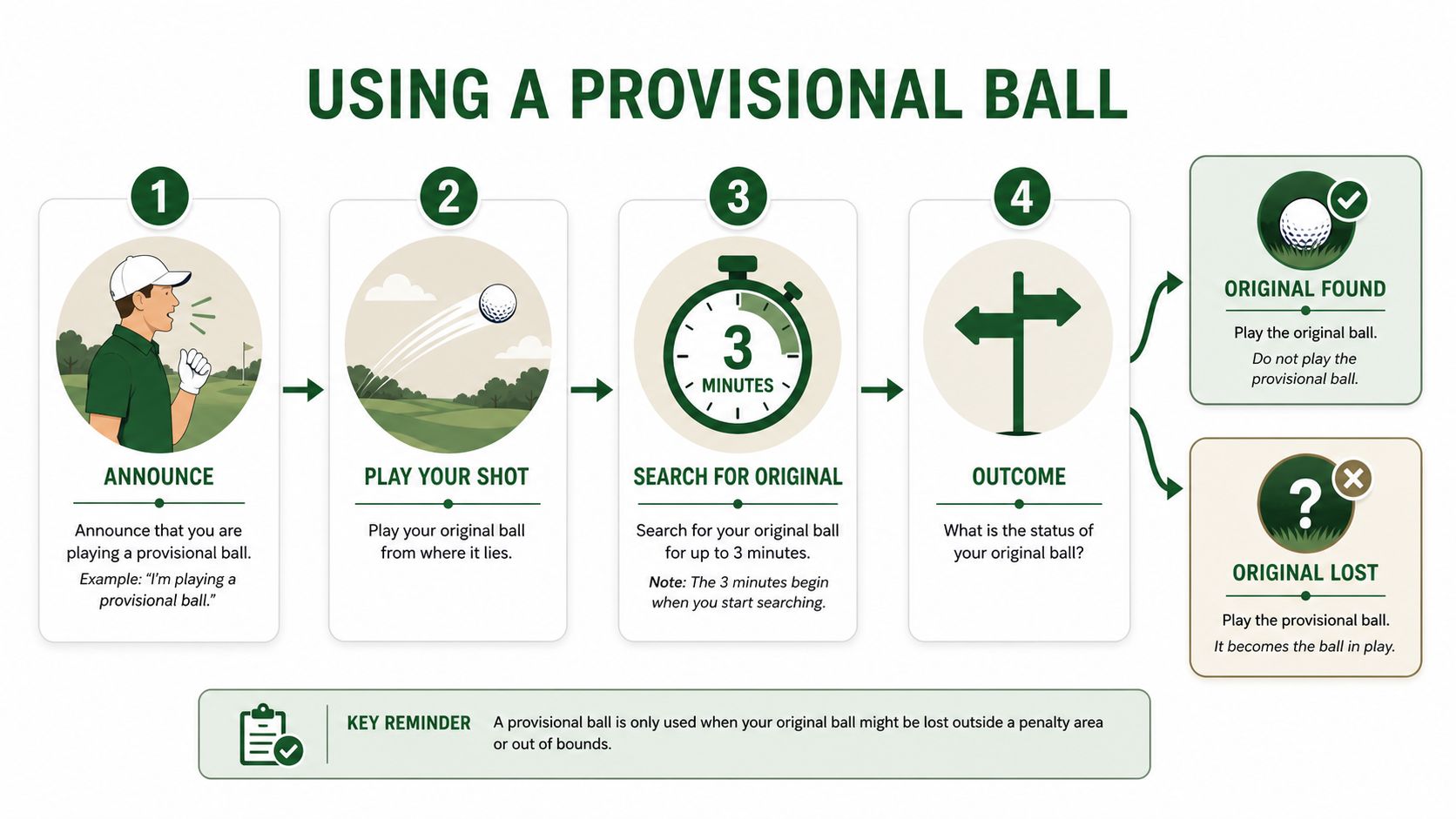
Before striking the second ball, the player must clearly announce that it's a provisional ball. The wording should be loud and unambiguous enough for fellow competitors, opponents, or the marker to hear. Saying only “I'll hit another” can create uncertainty because it may describe a replacement ball rather than a provisional.
The player then plays the provisional from the previous stroke location. That prevents the provisional from becoming a shortcut to a point nearer the hole than the likely position of the original ball.
If the original ball is found in bounds within the three-minute search period, the provisional must be abandoned. The player continues with the original ball, and the provisional doesn't become the ball in play merely because it lies in a better position.
The decision tree on the course
When the original isn't found within the search period, or when it's confirmed out of bounds, the provisional becomes the ball in play under stroke and distance. The group can continue without walking back, provided the provisional was announced and played correctly.
A drive beside a property line is the common example. The player announces the provisional at the tee, hits it, and then joins the search. If the original is found in bounds, the provisional is picked up. If the original is lost or out of bounds, the player continues with the provisional and records the appropriate penalty.
A common error is playing the provisional beyond the point where the original is likely to be found. The provisional procedure is intended to save time, not allow the player to advance beyond the relevant location and then decide which ball is convenient.
For directors and markers, the important record is simple: note that the player announced a provisional, monitor the search, and identify which ball was selected. Clear documentation supports accurate golf score posting when the group returns to scoring.
A provisional ball is a pace-of-play tool, not a second chance to choose the better lie.
Managing the Rule in Tournament Settings
Tournament directors manage two problems at once. They must apply the Rules consistently, and they must prevent one uncertain ruling from stopping the field. Stroke and distance becomes manageable when the committee decides its policy before play and gives staff a repeatable response for common situations.
Build the procedure before the first tee time
The player handbook should state whether the event uses traditional stroke and distance or an adopted local-rule alternative. The rules briefing should explain the penalty, the return point or drop area, and the provisional-ball procedure in plain language.
At high-risk holes, post signs that identify out-of-bounds lines and remind players to announce a provisional before replaying from the tee. Marshals should know where searches commonly occur and should watch for groups that are losing time, without pressuring players into an incorrect ruling.
Live Tourney can be used as one scoring option for entering hole scores, displaying live results, and managing tournament information through a web-based workflow. Regardless of the platform, the director must ensure that the added penalty stroke is entered as part of the hole score and that the resulting net score reflects the ruling.
The committee should also tell markers not to guess. If the group can't agree, mark the situation, contact the rules official, and keep the ruling connected to the player's scorecard before submission. That approach is more reliable than allowing each group to apply a different interpretation.
Tournament Director Checklist for Stroke and Distance
Phase | Action Item | Purpose |
|---|---|---|
Before registration closes | Publish the applicable stroke-and-distance policy | Gives players time to understand the event procedure |
Player briefing | Explain provisional announcements, search timing, and relief locations | Reduces uncertainty at the first disputed hole |
Course setup | Confirm boundary markings and identify high-risk holes | Helps players and marshals classify situations correctly |
During play | Monitor groups where searches or returns may create delays | Limits the effect on following pairings |
At scoring | Verify penalty strokes and hole totals before acceptance | Prevents an incorrect ruling from entering the results |
After the round | Record unusual rulings and recurring questions | Improves future briefings and local guidance |
Pace-of-play decisions should match the event. A club outing, league, or recreational tournament may benefit from the local-rule alternative, while a competition requiring the standard Rules should retain stroke and distance. The committee should never introduce the option informally after players have started, because inconsistent availability undermines the competition.
For staff preparing results, the golf score posting guide provides useful workflow context. The operational principle remains the same regardless of software: record the actual hole score, include the applicable penalty, and preserve a clear ruling trail.
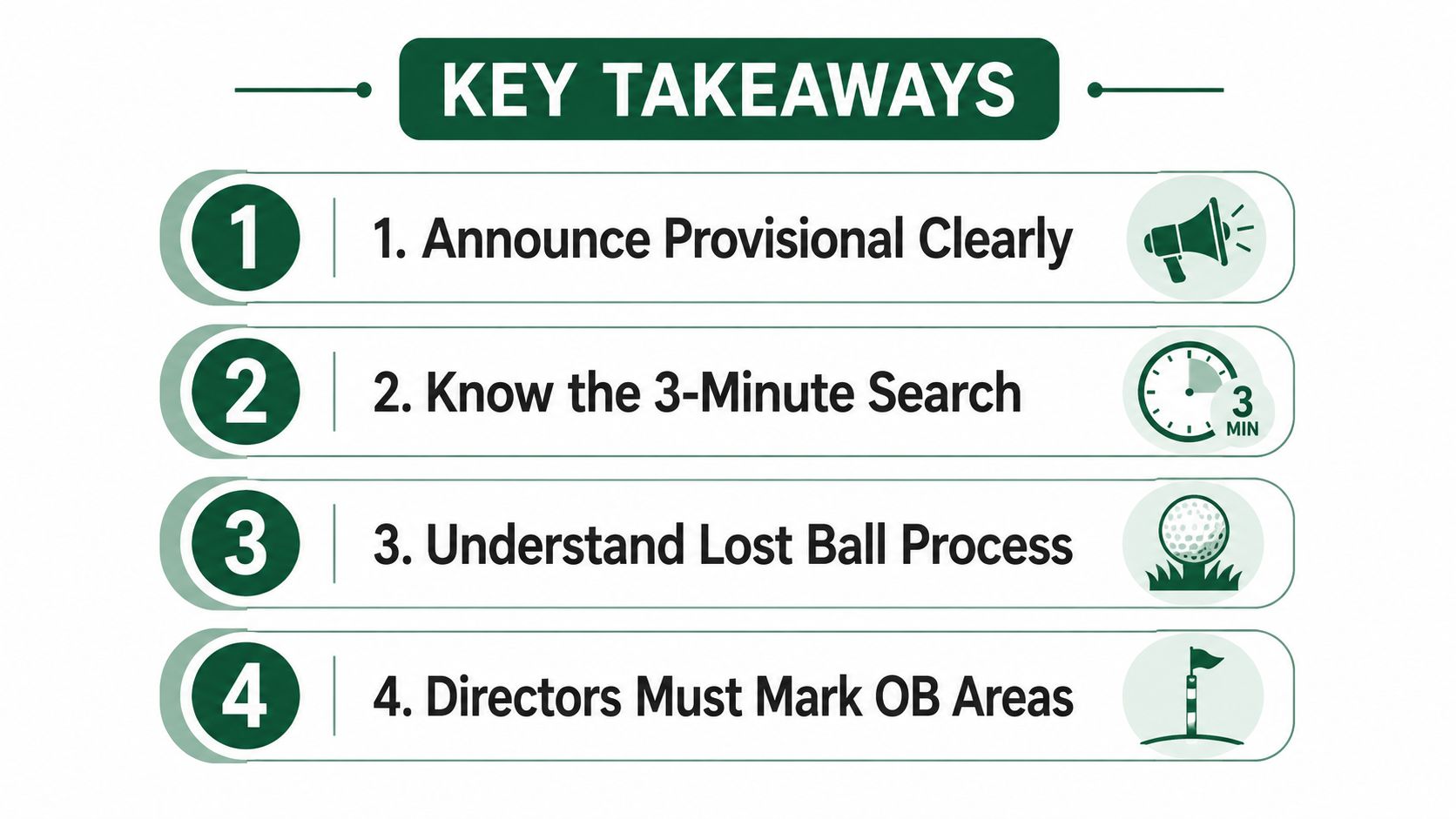
Key Takeaways for Players and Directors
Stroke and distance is easier to administer when everyone treats it as a defined process rather than a judgment call. The player identifies the ball's status, applies the correct penalty, and uses the relief procedure tied to the previous stroke. The director sets the framework before play and makes sure every group receives the same information.
Player checklist
Announce a provisional clearly: Say “provisional” before hitting the second ball, and make sure the group hears you.
Respect the search period: Use the three-minute search window and don't assume that an unseen ball is already lost.
Classify the situation: A penalty area, an out-of-bounds ball, and a lost ball outside a penalty area may involve different procedures.
Confirm the score: Review the hole score and any penalty stroke with the marker before signing or submitting the card.
Director checklist
Publish the rule before play: Put the applicable procedure on the scorecard, player information, and briefing materials.
Mark boundaries clearly: Players need to distinguish out of bounds from penalty areas without relying on guesswork.
Prepare marshals: Give them a consistent escalation process for searches, provisional balls, and disputes.
Audit scoring: Confirm that penalty strokes appear in the hole score and that net calculations remain accurate.
Choose local relief deliberately: Adopt the local-rule alternative when pace matters and the event format allows it, not as an improvised response to delays.
The rule also works as a useful teaching framework for new players because it connects course decisions with honest scoring. For a lighter group activity away from formal competition, organizers may find a paper golf game for groups useful for practicing course-management conversations without putting a live tournament at risk.
Clarity protects the field. When players announce provisionals, markers record penalties, and directors communicate the chosen relief option, stroke and distance supports a fair contest without unnecessary stoppages.
Live Tourney gives tournament teams tools for real-time scoring, live leaderboards, player management, and event administration through a web-based platform that works without an app download. Visit Live Tourney to see how its scoring workflow can help your staff record penalty-adjusted hole scores and keep tournament results moving.