
Jul 19, 2026
golf handicapping services, ghin integration, golf tournament software, handicap management, world handicap system
Explore golf handicapping services, from GHIN to SaaS. Our guide helps courses evaluate features, integrate systems, and run fairer, smoother tournaments.

If you're running events at a golf course, you already know where handicap problems show up. They show up the night before a member-guest when three players still haven't sent their indexes. They show up on the first tee when someone says their number "changed this week." They show up after the round when a team questions whether strokes were applied correctly in a net game.
That friction used to be accepted as part of tournament work. It shouldn't be. Modern golf handicapping services exist to remove that admin burden, apply the World Handicap System correctly, and plug directly into tournament software so staff aren't rebuilding the same information by hand every event.
For courses, associations, and outing operators, the key value isn't just scorekeeping. It's trust. Players want to know the game is fair, the numbers are current, and the leaderboard reflects the format you announced.
Why Manual Handicap Tracking No Longer Works
The old workflow is familiar. A spreadsheet for registrations. Another for pairings. A folder of emailed handicap screenshots. A few texts to confirm numbers. Then someone on staff re-enters everything into the tournament sheet and hopes nobody changed tees, forgot a decimal, or used an outdated index.
That process breaks down fast when the event gets even slightly complicated. Add mixed tees, flights, season-long points, or a net side game, and manual handicap tracking turns into cleanup work.

Where manual systems fail
The biggest problem isn't just time. It's inconsistency.
A player may send a Handicap Index when what you need is a Course Handicap for that day's tees. Another may have an official number, but nobody verifies whether it's current. Then the committee adjusts team totals manually for a scramble or best ball and introduces a math error before the first group even starts.
Practical rule: If your staff has to touch handicap data more than once per player, your process is too fragile.
I've seen organizers spend more energy validating numbers than building the actual event experience. That's backwards. The handicap process should run in the background so staff can focus on pairings, pace, sponsor needs, and player communication.
The industry has already moved
This isn't a niche operational upgrade anymore. The global market for golf handicap management services is projected to expand from USD 1.2 billion in 2024 to USD 3.5 billion by 2033, growing at a CAGR of 13.5%, according to this golf handicap management services market projection.
That matters because it reflects what operators are doing in practice. Courses and event managers are replacing ad hoc methods with systems that standardize player data, update handicaps automatically, and support tournament administration without constant staff intervention.
The shift looks a lot like what happened in other service businesses. Teams that used to coordinate work through calls, whiteboards, and disconnected spreadsheets now optimize cleaning operations with software because manual coordination doesn't scale. Tournament golf is no different. Once player volume and event complexity rise, software isn't a nice add-on. It's the operating layer.
Understanding the World Handicap System
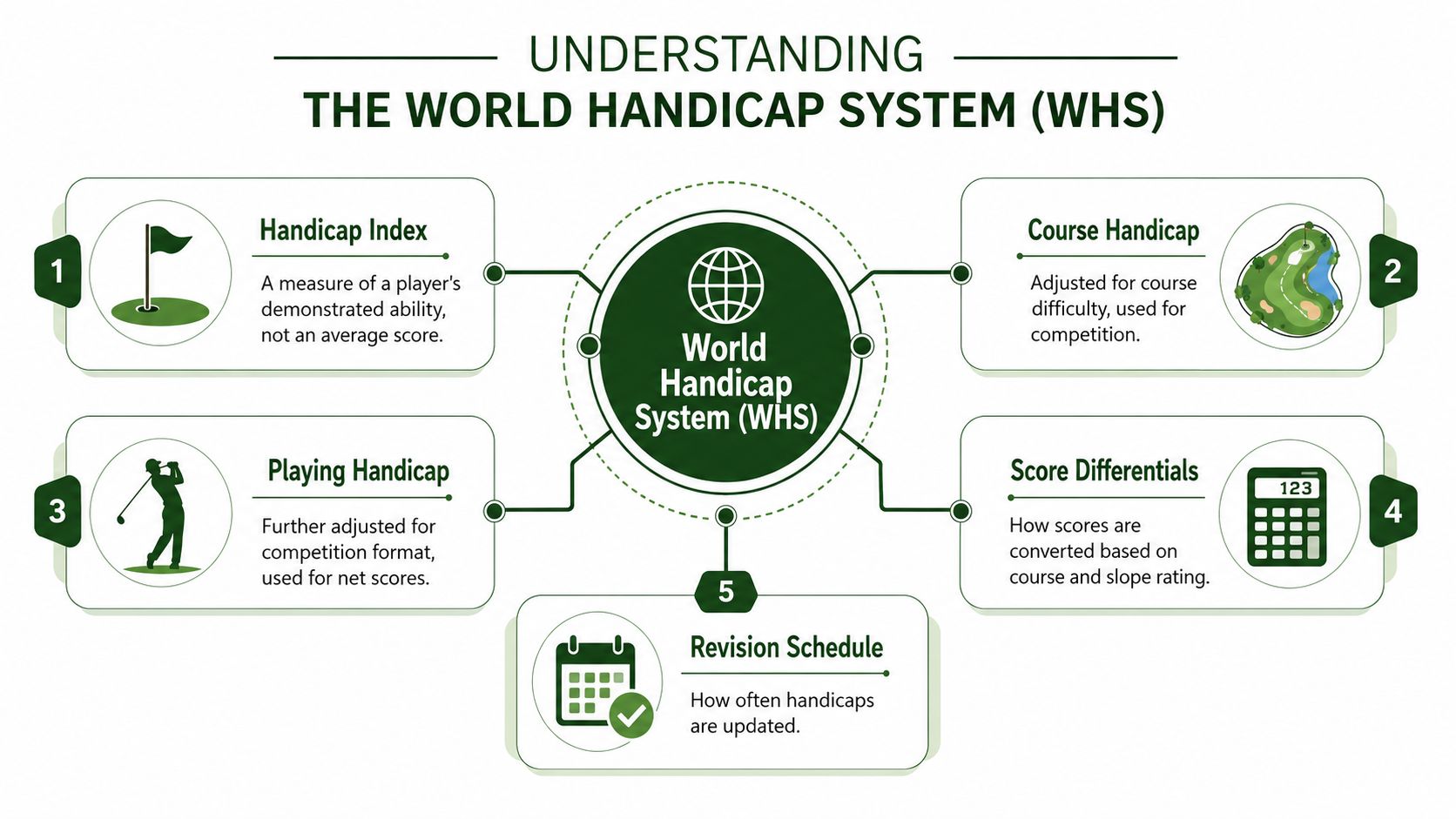
A lot of event problems come from one basic misunderstanding. A Handicap Index is not a player's scoring average. It's a measure of demonstrated ability under the World Handicap System, built to make competition fair across different courses and tees.
That distinction matters because the system is designed for portability and fairness, not simple arithmetic.
What the index actually represents
Think of the Handicap Index as the player's travel number. It belongs to the golfer, not the course. Once the player arrives at a specific set of tees, that number has to be translated into something usable for the day.
Under WHS, a valid Handicap Index is calculated only after a player posts a minimum of 54 holes, and the system uses the lowest 8 of the most recent 20 Score Differentials, updating daily within the WHS database, as explained in the NCGA overview of handicap basics.
For tournament staff, the practical takeaway is simple:
No 54 holes posted: The player doesn't yet have a valid WHS index.
No current scoring record: You can't assume the number is reliable.
No proper conversion for the tees: You still don't know how many strokes the player gets that day.
Course Handicap is the competition number
The second number that matters is the Course Handicap. This is the number used for competition at a specific venue and tee set.
The formula is clear: a player's Course Handicap is calculated as Handicap Index × (Slope Rating / 113) + (Course Rating - Par), according to the USGA World Handicap System FAQs.
That formula is why two players with the same index may receive different strokes on different courses or tees. The adjustment isn't optional. It's the mechanism that makes net competition legitimate.
A clean registration list doesn't guarantee a fair competition. Correct handicap conversion does.
Why organizers should know the language
You don't need to do WHS math by hand, but you do need to understand the terms players and software are using.
A good working vocabulary includes:
Handicap Index: The player's portable measure of demonstrated ability.
Course Handicap: The tee-specific stroke allocation for that course.
Playing Handicap: A format-adjusted number used when the competition allowance changes how strokes are applied.
Score Differential: The normalized result that feeds the index calculation.
In the U.S., approximately 3.2 million golfers maintained an official Handicap Index as of 2024, and the average index is 14.2 for men and 28.7 for women, according to the USGA's handicap participation data. Those numbers matter less as trivia than as a reminder that official handicap management is now a standard part of the player experience.
If you need a practical walk-through of the math and terminology, this guide on how to calculate golf handicaps is useful for staff training.
Comparing the Types of Handicapping Services
Not every course needs the same setup. Some just need official handicap access. Others need a system that connects directly to leagues, registrations, and live scoring. The right choice depends on who runs your events, how often you host them, and how much manual work you're willing to tolerate.
The three common models are club-managed systems, association services, and third-party SaaS platforms.
Handicapping service models compared
Feature | Club-Managed System | Association Service (e.g., GHIN) | Third-Party SaaS Platform |
|---|---|---|---|
Primary role | Local tracking and administration | Official Handicap Index management | Operational layer for events and leagues |
Typical user | Small club or volunteer-run group | Individual golfers, clubs, associations | Courses and organizers running frequent events |
Official WHS index support | Sometimes limited or indirect | Yes | Depends on integration approach |
Manual admin burden | High | Moderate | Low when connected properly |
Tournament workflow fit | Basic | Partial | Strong |
Best for | Small informal groups | Players who need an official index | Organizers who want handicaps tied to scoring, leaderboards, and event formats |
Common weakness | Prone to errors and duplicate entry | Doesn't solve event operations by itself | Needs proper setup and policy decisions |
Club-managed systems
This is the old-school model. The club tracks player numbers internally, often using spreadsheets or light software, and staff handle verification themselves.
It can work for a small, stable player base. It falls apart when your events involve guests, public players, multiple tees, or recurring leagues with rolling updates.
Common trade-offs include:
Low barrier to start: Staff can build it with tools they already use.
High dependence on people: Accuracy depends on whoever enters and checks the data.
Weak audit trail: It's hard to resolve disputes when the numbers were copied manually.
Association services
Association-backed services are the official layer. They're the right answer when your first priority is a recognized WHS-compliant Handicap Index.
They solve legitimacy. They don't automatically solve operations.
That difference gets missed a lot. Official handicap service tells you what the player's handicap is. It doesn't automatically build pairings, apply event allowances, score a match-play bracket, or push net results to a live leaderboard.
If you're still exporting data from one system and retyping it into another, you don't have a workflow. You have a handoff problem.
A useful side note for public-course operators: golfers don't need to belong to a private club to obtain a WHS-compliant Handicap Index. Unaffiliated U.S. players can join a state or regional association online and activate GHIN, which helps broaden eligibility for open events and leagues.
Third-party SaaS platforms
Many practical gains are realized as a third-party platform sits atop official handicap data, connecting it to registration, event setup, scoring, leaderboards, and reporting.
The value isn't that it replaces the rules of handicapping. The value is that it applies them inside the event workflow your staff runs.
When evaluating these tools, it helps to understand the difference between lightweight utility tools and broader event systems. This overview of golf handicap freeware is a good example of that distinction. Free tools can be useful for isolated calculations, but they usually don't remove the bigger operational burden tied to recurring events.
For most active facilities, the choice isn't really between software and no software. It's between software that only stores numbers and software that turns those numbers into a usable competition process.
Key Features to Evaluate in a Handicapping Service
Registration closes at 5 p.m. Pairings go out at 7. Then three players change tees, one guest shows up with an outdated index, and the net skins game uses a different allowance than the main event. That is when a handicapping service proves its value.
The right platform keeps those changes inside one workflow instead of pushing staff back into spreadsheets, side calculations, and last-minute scorecard edits. I judge these systems by one standard. Can they hold up under actual tournament pressure across different formats?
Accuracy and WHS compliance
Start with the math and the source of the data.
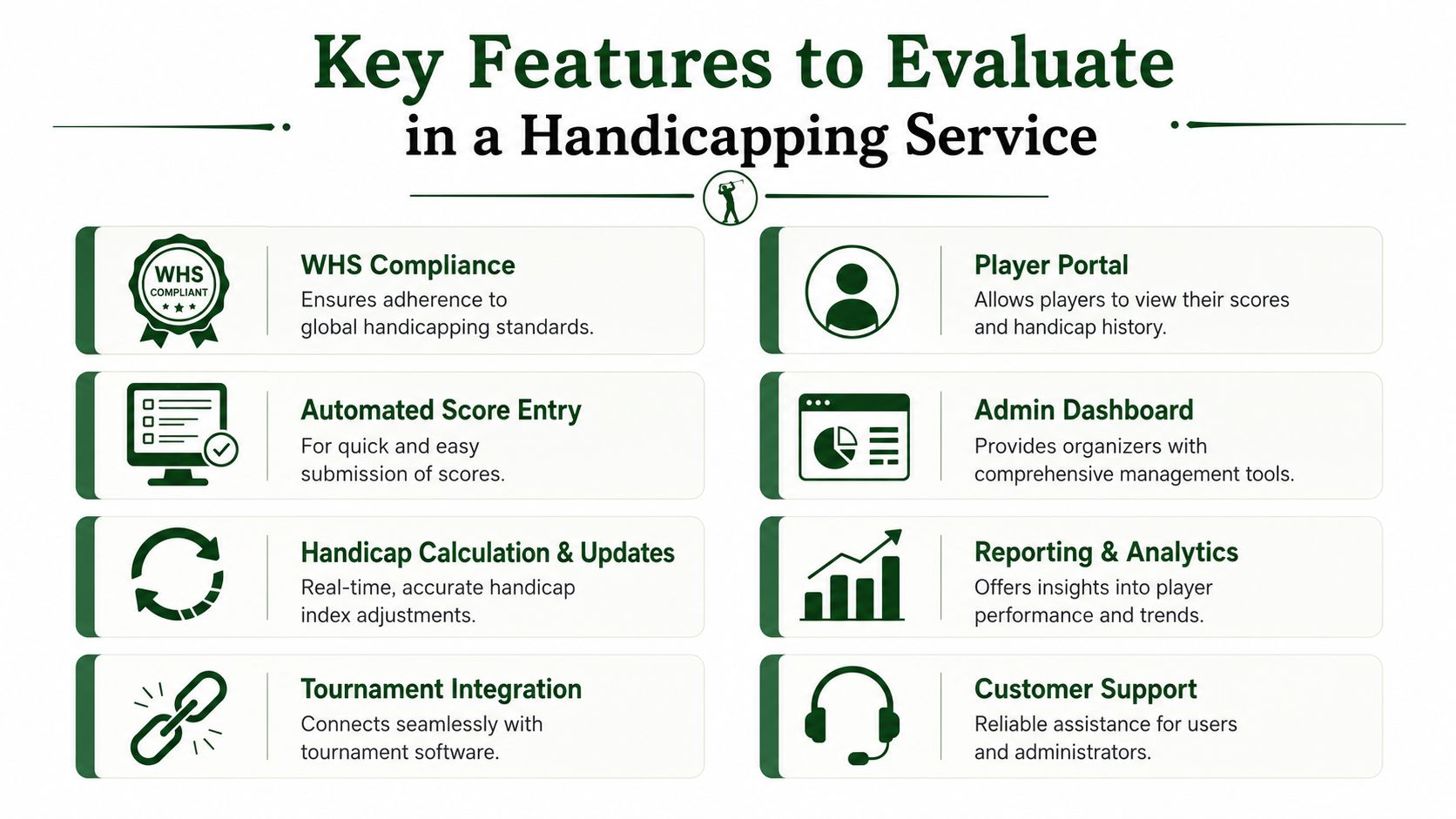
A service should pull official handicap information, apply WHS-based calculations by tee, and handle allowances without staff creating manual fixes. If it cannot do that reliably, every leaderboard, payout, and flight result sits on shaky ground.
The formula matters, but operations matter more. The R&A's explanation of Course Handicap and Playing Handicap is a useful reference point because it shows how the index has to be converted for the course, tee, and format in use.
Ask these questions before you buy:
Does it use official handicap records rather than player-entered numbers?
Does it calculate from the selected tee set every time?
Can it apply different allowances for individual, team, and match-play formats?
Does it recalculate cleanly if a player or tee changes after pairings are built?
One missed setting can affect an entire division.
Integration with tournament operations
This is the feature group that separates a handicap database from a tournament tool.
A good service should connect handicap data to registration, pairings, score entry, live scoring, and final results without repeated imports and exports. If staff still has to move player records by hand, the service is only solving part of the problem.
I look for a clean path from signup to scoreboard. A player registers. The system matches that player to an official record. The event applies the correct tee and allowance. Scores post once. Net and gross results update in the same place.
That matters even more in mixed event calendars. Member-guest events, weekly leagues, two-person team games, and multi-round championships all put different pressure on the setup. The better systems let staff configure those rules once and reuse them instead of rebuilding the handicap logic every time.
Player experience on mobile
Players will use the system you make easy.
If posting a score takes too many steps, staff ends up answering password questions, entering scores on behalf of players, and explaining stroke allocations at the scoring table. That slows down the event and creates doubt about the results.
Good mobile experience usually includes:
Quick access without a confusing login process
Simple score entry that matches the round being played
Clear display of strokes received for that event format
Easy score verification before results are finalized
Clarity matters here. Players rarely object to handicap adjustments when they can see how the system applied them to their card, their match, or their team total.
Admin control and data stewardship
Tournament staff need speed, but they also need control.
Late changes happen every week. A tee sheet shifts. A guest replaces a member. A weather delay changes the order of play. The service should let staff update settings, lock the right fields, and keep an audit trail without giving every volunteer full access to roster and handicap data.
The strongest platforms usually include:
Role-based permissions for staff, volunteers, and scoring officials
Editable event settings after creation, with safeguards
Reporting tools for disputes, results review, and player history
Responsive support on tournament mornings, not just weekday sales coverage
Clear privacy controls for handicap records, contact details, and roster access
Support deserves more weight than many buyers give it. If a vendor is hard to reach when a score sync fails or an allowance is misapplied, your staff absorbs the problem in front of players.
The practical test is simple. Choose the service that reduces manual correction, handles multiple event formats without workarounds, and fits directly into the tournament software your team already depends on.
Your Implementation Checklist for a New Service
Switching systems doesn't need to be painful, but it does need a plan. Most rough rollouts fail for the same reason. The software gets chosen before the course decides how handicaps will be used in leagues, opens, member events, and guest play.
A clean implementation starts with policy, not buttons.
Start with your event mix
Before evaluating vendors, write down the events you run.
That list usually includes some mix of member tournaments, public outings, recurring leagues, charity scrambles, multi-round championships, and match play. Each format puts different pressure on the handicap workflow.
Use a short planning checklist:
List the formats you support. Net stroke play is simple. Team events and bracket formats need more logic.
Define eligible player types. Members only, public players, guests, juniors, and corporate outing participants may each need different handling.
Set your exception policy. Decide in advance how you'll handle players without an official index.
Pick the service that matches staff reality
A lot of clubs buy for the ideal future and ignore the current staffing model. That's a mistake.
If your events are run by a head pro with limited admin support, the right system is the one staff can operate quickly during a busy week, not the one with the longest feature list. If your calendar includes frequent leagues and repeat events, prioritize configuration reuse and roster management over cosmetic extras.
Questions worth asking vendors include:
How are official handicaps verified or synced?
What happens when a player changes tees after pairings are built?
How are mixed-format events handled inside one competition?
What can staff override, and what should remain locked?
Configure before you communicate
Once you've selected the service, do the setup in this order:
Import player data first. Clean names, emails, and association IDs before building events.
Map tees and course settings carefully. Most downstream errors come from this layer.
Test one real event. Use a past tournament or a staff-only rehearsal instead of learning live.
Train the people who will rescue the event. That usually means golf shop staff, not just the tournament chair.
A rollout gets easier when players receive simple instructions, not a system manual.
Tell players what they need to do, when they need to do it, and what happens if they don't. That's the communication standard.
Treat the first event as a live audit
Don't assume the first event proves the system works. Use it to identify friction.
Watch for the points where players hesitate, staff intervene, or format rules require explanation. Those moments tell you where to tighten setup, revise communication, or simplify your local procedures.
By the second or third event, a good service should reduce admin effort noticeably. If it still creates the same manual checks you were trying to escape, the issue is either the configuration or the product fit.
Integrating Handicaps with Your Tournament Software
Registration closes at 5:00. Pairings go out at 5:30. Two players change tees, one index updates, and the shop staff is still checking numbers by hand. That is the moment an integration either saves the event or creates more work.
The primary value of a handicapping service is not the index sitting in a player profile. It is the way that index flows into tee assignments, allowance rules, scoring, and leaderboard displays inside the tournament platform you already use.

What good integration actually changes
When handicaps and tournament software are connected properly, staff stop acting as the system in between. The platform pulls the player record, matches it to the correct handicap source, applies the right tees, and calculates the competition numbers inside the event setup.
That matters because most handicap problems do not start with the index itself. They start when the event software and the handicap service do not agree on tees, allowances, or player identity.
Tournament platforms such as Live Tourney's handicap integration tools are built to handle that workflow with GHIN-connected events, which is a much better setup than keeping one system for handicaps and another spreadsheet for the actual competition.
In practice, a smooth setup does four jobs well:
Connect the player to an official handicap record
Apply the correct tee and course data for that specific event
Calculate course and playing handicaps based on the format
Push net and gross results to the leaderboard without re-entry
I have found that this is the difference between staff supervising a tournament and staff rebuilding one in real time.
For a practical look at score posting on the same operational side of the process, review this guide to posting a GHIN score through tournament software.
Where integration helps most
Single-format stroke play is the easy case. The bigger test is an event calendar with member-guest rounds, league nights, team games, and weekend tournaments that switch formats from round to round.
Good software handles those changes inside the event rules. Old methods usually push that work back onto the golf shop. Staff end up checking allowances on paper, correcting pairings after tee changes, or explaining why the leaderboard does not match the scorecards.
That is why software integration should be evaluated at the event-format level, not just at the handicap-record level. If your service cannot support the way you run competitions, the handicap feed alone does not solve much.
Player expectations have changed too. Golfers are used to digital check-in, live results, and fewer delays. Even outside tournament operations, interest in amenities like best backyard golf greens reflects the same broader shift. Players want golf experiences that feel current and easy to use.
A good integration gives them that without adding work for your staff.
Frequently Asked Questions About Handicapping
How should we handle handicaps in scrambles and best ball
Use the event allowance your committee has adopted and apply it consistently inside the scoring system. For scramble formats, the official recommendation is to apply a percentage of the team's combined handicap, such as 20% for a 4-person team, as outlined in this guide to league software and scramble handicap logic. The important part isn't just the percentage. It's making sure the software applies it the same way for every team.
What about players who don't have an official Handicap Index
Decide this before registration opens. The cleanest approach is to require an official index for net competitions. If you want to include players without one, create a published committee policy for those entrants instead of improvising after pairings are out.
Do golfers need to belong to a private club to get an official handicap
No. Golfers can obtain a WHS-compliant Handicap Index through their state or regional association online without being tied to a specific private club. That's an important point for public-course leagues, charity events, and open competitions that want to widen participation without weakening handicap standards.
If you're tired of spreadsheets, manual handicap checks, and leaderboard disputes, Live Tourney is worth a look. It gives courses and event organizers a web-based way to run tournaments, leagues, and outings with live scoring, flexible format support, and handicap workflows that fit modern event operations instead of fighting them.





