
Oct 25, 2026
two stroke penalties, golf rules, general penalty, stroke play penalties, match play rules
Which rule breaches cost two stroke penalties in golf, how match play differs, and when penalties stack. Clear tables and worked examples for 2026.

In stroke play, the general penalty adds two strokes to the hole score; in match play, the same breach costs the hole. So if you're standing over a shot and wondering whether a mistake means one stroke, two, or something more, the answer depends on the rule, the kind of play, and what happened next.
That distinction matters on an ordinary round, not just in a tournament. A ball played from the wrong place, a club grounded in a penalty area, or a scorecard issue can leave players unsure what to write down. The most useful starting point is to treat two strokes as a threshold, not an automatic response: some mistakes cost one stroke, some bring the general penalty, and some require a different remedy.
Two-Stroke Penalty Situations at a Glance
The table is a quick reference for common situations. It compares the base penalty in stroke play and match play, where the same breach can affect the scorecard differently.
Situation | Rule | Stroke play | Match play |
|---|---|---|---|
Playing from the wrong place | Rule 14.7 | +2 strokes; a serious breach may lead to disqualification if not corrected | Loss of hole |
Playing the wrong ball | Rule 6.3c | +2 strokes | Loss of hole |
Teeing outside the teeing area | Rule 6.1b | +2 strokes | Loss of hole |
Improving the lie or area of intended swing | Rule 8.1 | +2 strokes | Loss of hole |
Touching sand in a bunker to test conditions | Rule 12.2 | +2 strokes | Loss of hole |
Touching the ground or a loose impediment in a penalty area before a stroke | Rule 17.1b | +2 strokes | Loss of hole |
Practice stroke on the course during the round | Rule 5.5 | +2 strokes | Loss of hole |
Non-conforming club used or carried | Rule 4.1 | +2 strokes per hole, maximum 4 strokes | Loss of hole for each hole affected |
Carrying more than 14 clubs | Rule 4.1b | +2 strokes per hole, maximum 4 strokes | Loss of hole for each hole affected |
Lost ball, contrast | Rule 18.2 | +1 stroke, not two | Loss of hole under stroke-and-distance logic |
The general penalty is the standard consequence for many breaches that can provide a more significant potential advantage than a one-stroke infraction. The Rules of Golf are largely unified between the USGA and R&A, so this structure applies broadly across professional, amateur, club, and tournament golf. Rule 1 of the Rules of Golf sets out the framework.
A table can't show every condition. A wrong-place breach, for instance, may require correction if it's serious, while repeated or continuing equipment breaches are subject to a per-hole cap. The rows show the base penalty only; the sections below explain when it multiplies, stacks, or changes.
What the General Penalty Really Adds to Your Score
Think of the general penalty like a fine for an action that could give you a real advantage. A one-stroke penalty is more like a parking ticket for a smaller breach. That analogy isn't a substitute for checking the rule, but it helps explain why two strokes aren't attached to every mistake.
In stroke play, the penalty is added to the strokes already made. It doesn't erase a shot just because that shot was played from the wrong place. Under Rule 14.7, the stroke and subsequent valid strokes normally count, with the penalty added to the hole score. The USGA's Rule 14 guidance explains the wrong-place procedure.
Consider a par 4. You play your second shot from the wrong place, then finish the hole with two more strokes. That's four strokes played, plus two penalty strokes, for a total of six. The shot from the wrong place still counts. If you need extra strokes to finish, the total rises further.
Match play works differently. The penalty is loss of the hole, not an extra number added to a running stroke total. Once the hole is lost, the number of strokes on that hole no longer determines the match result.
A useful check: Ask whether the action created a meaningful potential advantage on the shot or hole. If it did, the general penalty may apply, but always confirm the specific rule before deciding.
The point of the threshold is proportionality. The Rules distinguish breaches with a more significant potential advantage from those carrying a smaller consequence, and some actions instead result in one penalty stroke or no penalty.
Position Breaches Such as Wrong Place and Wrong Ball
A wrong-place breach is easy to misunderstand because the player may have hit a perfectly good shot. The question isn't whether the shot worked; it's whether the ball was played from the place the Rules require.
If you discover that you played from the wrong place, work through these steps:
Notice the error. Identify where the ball should have been played from and where you played it. That establishes what needs review.
Decide whether the breach is serious. A serious breach is one that may have gained a significant advantage. The Committee assesses that question because it determines whether correction is required.
If it wasn't serious, keep the score from the wrong place and add two strokes. You generally continue the hole without replaying from the correct spot. This avoids treating every wrong-place mistake as though it requires a full restart.
If it was serious, correct it before starting the next hole. Play from the correct place in time, or, on the final hole, correct the error before returning your card. The deadline matters because failing to correct a serious breach can result in disqualification.

If you correct the mistake by playing another ball from the right place, the original score is disregarded, but the two-stroke penalty still applies. If both the original ball and its replacement are played from wrong places, the penalties can total four strokes. Rule 14.7 interpretations explain how the Committee evaluates correction and serious breaches.
Playing the wrong ball is a separate position mistake. In stroke play, it brings two penalty strokes, and you must correct the mistake by continuing with the correct ball from the required place. In match play, the breach costs the hole. Check the ball before you play, especially when another ball is nearby.
A teeing-area mistake can also carry the general penalty. For example, teeing the ball two club-lengths in front of the markers means you've played from outside the permitted area. Improving the lie is another common trap: pressing down a divot in the fairway before your stroke changes the conditions affecting the shot. In a bunker, don't touch the sand to test it; that breach carries the same two-stroke penalty. For a related explanation of the separate stroke-and-distance procedure, see how stroke and distance works.
Penalty Area, Practice and Equipment Breaches
A player in a penalty area may touch the ground or a loose impediment in some situations, but grounding the club before a stroke is a different matter. If you rest the club behind the ball before hitting from the area, you incur the general penalty: two strokes in stroke play. Taking penalty-area relief is separate. The relief option you choose costs one penalty stroke, not two; grounding the club before making the stroke can add the general penalty.
Penalty areas and routine club movements
That distinction matters because the relief penalty comes from the choice to take relief, while the extra penalty comes from a separate breach. For example, if you take one-stroke relief from a penalty area, then ground your club behind the ball before playing, the total is three penalty strokes in stroke play.
Practice strokes during the round
A practice stroke on the course during the round carries the general penalty, subject to the rule's exceptions. For example, while waiting for the group ahead, making a rehearsal stroke at a ball between shots can cost two strokes in stroke play. Check Rule 5.5 before deciding whether a particular movement is permitted.
Clubs and the per-hole cap
Carrying more than 14 clubs or carrying or using a non-conforming club brings a penalty for each affected hole, subject to a cap. In stroke play, the general penalty applies per hole, up to two holes, for a maximum of four penalty strokes. In match play, the penalty is loss of hole for each affected hole.
For example, if you carry 15 clubs from the first hole and discover the breach while playing the third, holes one and two are the affected holes. In stroke play, the two-hole cap applies, so the penalty is four strokes. If the breach began on only the third hole, only that affected hole counts toward the cap. The Committee determines which holes were affected, so report when the extra club was first carried.
How Multiple Breaches Add Up to Four Strokes
A player lifts a ball to identify it without marking its spot, then cleans it after the Committee has told them about the first breach. The score depends on the sequence: the first action brings one penalty stroke under Rule 7.3, and cleaning the ball when not allowed under Rule 14.1c brings a separate one-stroke penalty after notification. The total is two strokes, made up of two separate penalties, not one general penalty.
The same number of mistakes can produce a different total. Under Rule 1.3c(4), related breaches committed before an intervening event are generally treated as one breach when they arise from a single act or related acts. A notification of a penalty, or a stroke made after the breach, can be an intervening event. This is a limited rule, not a blanket instruction to combine unrelated mistakes.
Scenario | Rule and penalty | Total penalty strokes |
|---|---|---|
Ball lifted to identify it without marking its spot, then cleaned after notification of the first penalty | Rule 7.3: one stroke. Rule 14.1c: one stroke. Notification separates the breaches. | 2 |
A player plays a stroke from the wrong place, then plays another stroke from a wrong place | Rule 14.7: the general penalty applies for each separate wrong-place breach. | 4 |
A non-conforming club is carried or used on multiple affected holes | Rule 4.1b: the general penalty applies per affected hole, capped at two holes in stroke play. | 4 |
Four strokes is possible, but it is not the automatic result whenever two breaches are reported. A wrong-place stroke followed by another wrong-place stroke can bring two general penalties, while a related series of actions before an intervening event may count as one. The R&A's Rule 1 clarifications explain how to assess related breaches and intervening events.
Keep the order clear. Note what happened, whether the player was told about a penalty, and whether they made another stroke before the next breach. Those details help the Committee apply the right penalty instead of automatically adding two strokes for every reported action.
Misconceptions That Change the Final Score
A lost ball does not automatically cost two strokes. If it is not found within three minutes of the player or caddie starting the search, the player takes stroke-and-distance relief: add one penalty stroke and play again from the previous spot. For a lost tee shot, that means returning to the tee to play stroke three. The penalty is one stroke, though losing the distance of the original shot can make the result feel costlier. The USGA's Rule 18 guidance explains the procedure.

A missing signature does not always mean disqualification. If the Committee has adopted Model Local Rule L-1, a missing player or marker certification brings the general penalty: two strokes added to the player's last hole. Entering scores digitally does not by itself replace the required certification. Check the competition's procedure. The Florida State Golf Association's scorecard guidance discusses certification and electronic scoring.
A score returned after an unnoticed breach is treated differently from one returned after a known breach. Under Rule 3.3c, if a player was unaware of a penalty before returning a lower score, there is no additional penalty for that lower score. If the player knew about the breach but left the penalty off the scorecard, disqualification may apply. The scorecard change removed the extra penalty for an unaware player, not for someone who knowingly returned a lower score. Golf Digest's account of the scorecard rule change describes the change. In match play, the consequence can differ from stroke play, so consult the match-play rules guide.
If a ruling could change the result, check the applicable rule or ask a referee rather than guessing from a general list.
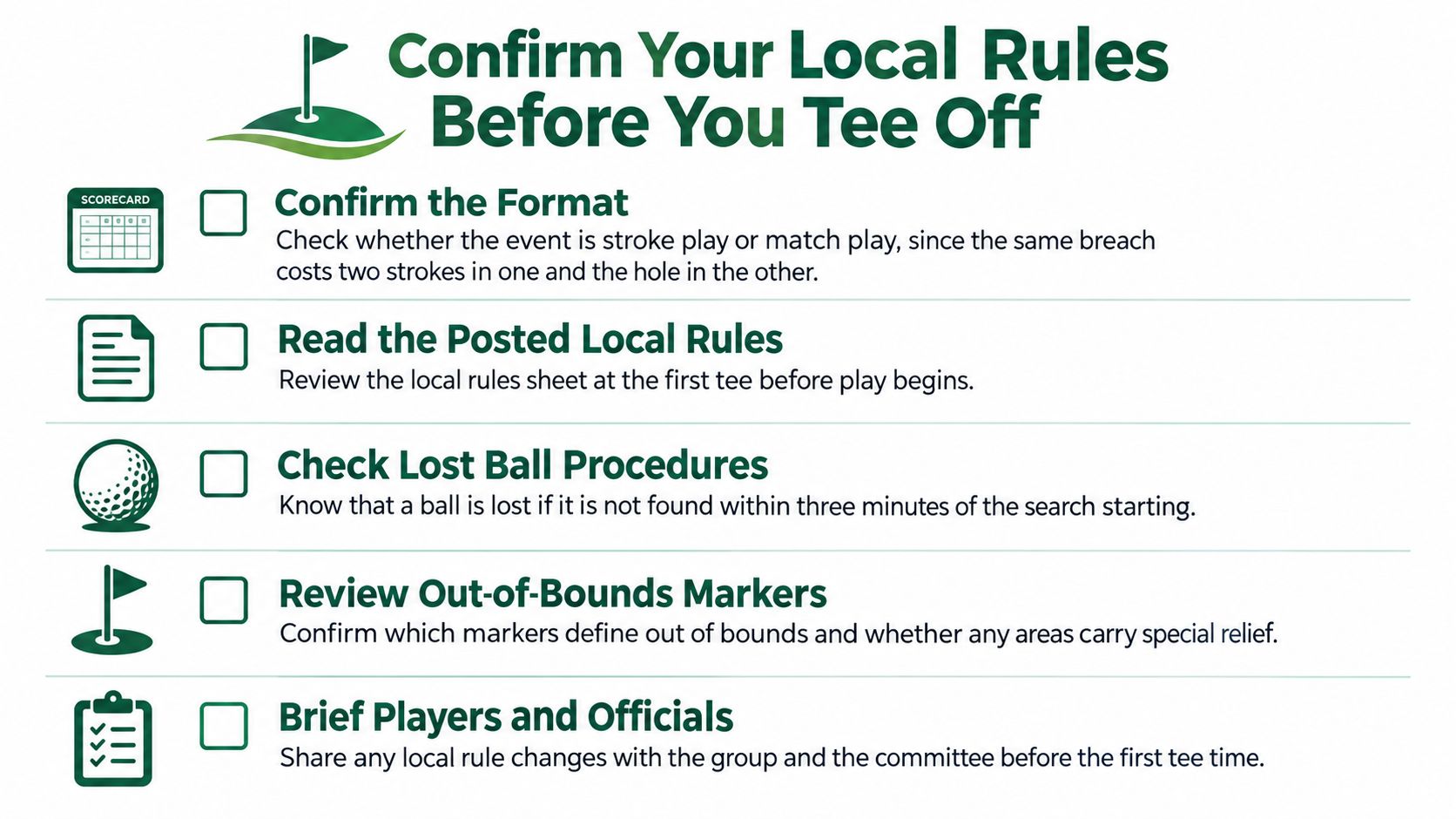
Confirm Your Local Rules Before You Tee Off
A clear ruling starts before play. Players and tournament staff should know which format applies and which Local Rules the Committee has adopted.
Confirm the format. The same breach can cost two strokes in stroke play and the hole in match play, so make sure everyone knows how the competition is scored.
Check for Model Local Rule L-1. It changes the consequence for missing scorecard certification, so confirm whether the Committee has adopted it.
Read the posted Local Rules. Look for changes affecting penalty areas, practice rules, and the teeing area. For example, a relief option may depend on the Local Rules in force.
Explain serious-breach correction. Players should know that a serious wrong-place breach must be corrected before they make a stroke to start another hole.
Agree on penalty records. Keep penalty notes separate from hole strokes, with the rule reference and event time recorded. Scoring platforms such as Live Tourney can hold penalty notes separately from hole scores to support an audit trail.
A Local Rule can also affect what happens after a ball is lifted or moved, so players should check the event's specific procedure for lift, clean, and place.
When a breach is in doubt, stop, ask the Committee or referee, and record the ruling before starting the next hole.
Live Tourney helps tournament organizers manage events, pairings, and live scoring, with penalty notes kept separate from hole scores for clearer review. Visit Live Tourney to see how its tournament tools can support accurate scoring and an auditable record of rulings.





