
Oct 24, 2026
wedges for high handicap golfers, golf wedge fitting, wedge bounce, golf short game, wedge loft gapping
Wedges for high handicap golfers made simple. Learn loft gaps, bounce choices, and a fitting method that turns short-game misses into reliable up-and-downs.

Buying the widest sole, maximum bounce, and a lob wedge for extra options isn't a wedge-fitting strategy. It's a shopping shortcut. The best wedges for high handicap golfers are the ones you can deliver from the lies you face, with carry distances you can repeat. Start with your pitching wedge's loft, examine your contact, and make every additional club earn its place.
Why Standard Wedge Advice Fails High Handicap Golfers
The usual advice sounds sensible: buy a cavity-back wedge, choose plenty of bounce, and add a lob wedge. Those features can help, but they solve different problems. Bundling them together assumes every high-handicap golfer misses the same way.
They don't. A golfer who drives the club into wet fairway turf needs different sole behavior from someone who sweeps the ball off a baked, closely cut approach. Handicap describes scoring ability, not how the club enters the ground.

Fit the miss rather than the category
A steep player taking deep divots generally benefits from more bounce because the sole resists digging. A shallow player on firm lies may need less bounce so the leading edge can reach the ball cleanly. A wide sole can provide useful support, but it can also make tight-lie contact and open-face shots less predictable, as outlined in this wedge grind and delivery fitting guide.
That distinction matters when a seemingly forgiving wedge still produces poor shots. If your club repeatedly buries behind the ball, additional sole support deserves testing. If it skips into the ball and sends it across the green, buying an even wider sole without investigating contact isn't a sensible next step.
Use these questions before looking at models:
Ground contact: Does the club enter behind the ball, underneath it, or barely brush the surface?
Divot pattern: Do you remove a deep strip of turf or leave a shallow scrape?
Usual conditions: Are your approaches soft and grassy, or firm and tightly cut?
Bunker sand: Does the club move through fluffy sand or encounter a compact surface?
Practical rule: Choose a wedge to improve your ordinary miss, not to make your best practice shot look better.
Adding loft doesn't address an unsuitable sole. Nor does a cavity-back head excuse poor turf interaction. Treat head construction, loft, and sole design as separate decisions, then judge the complete club from the ground rather than from the equipment rack.
How to Build Your Wedge Loft Gaps
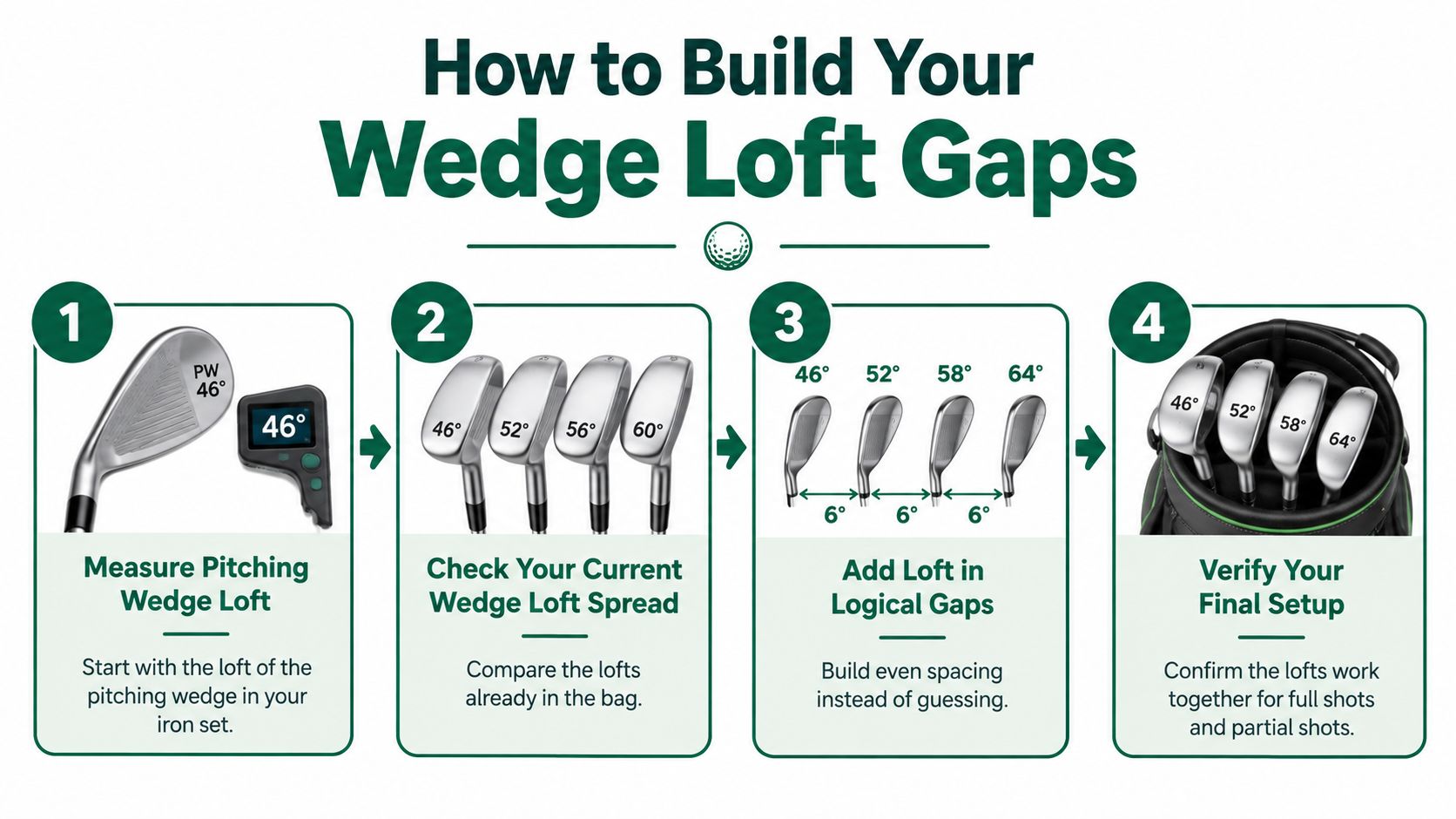
Your pitching wedge decides where the rest of the wedge setup starts. Don't buy a gap wedge because its name sounds like the missing club. Check the actual loft of the pitching wedge in your iron set first.
Stronger pitching-wedge lofts became more prevalent during the 1980s, increasing the traditional distance gap to the sand wedge and helping establish the gap wedge's role. A 50–52-degree gap wedge can therefore address a practical distance problem more effectively than another high-lofted specialty club, according to GolfWRX's explanation of wedge development and roles.
Build a candidate setup, then measure it
A useful starting benchmark is 4–6 degrees between wedges, intended to create approximately 10–15 yards of carry separation. A worked example is a 46-degree pitching wedge, 52-degree gap wedge, and 58-degree sand wedge, but each candidate should be validated with at least eight launch-monitor shots, rather than judged from a single strike, using LaunchPoint Golf's wedge-system testing method.
That example is a starting arrangement, not a recommendation for every player. The highest-lofted club still has to work from your bunkers and ordinary pitching lies. If it doesn't, change the arrangement rather than forcing yourself to use it.
Follow a simple sequence:
Confirm the starting loft: Check the manufacturer's specification and have the club measured if its actual loft is uncertain.
Inventory the bag: Write down the loft of every wedge you already carry.
Test carry separation: Arrange the clubs by measured carry, not by the letter stamped on the sole.
Identify an uncovered shot: Add a club only when it addresses a distance or lie your current setup doesn't handle reliably.
Evenly spaced lofts don't guarantee evenly spaced carries. Swing speed, contact, shaft, ball, and delivery can change the outcome, as the launch-monitor guidance explains.
Be especially suspicious of adjacent wedges that finish in the same landing area. Small loft differences may look tidy on a specification sheet while giving you another club to deliberate over. Fewer wedges with distinct, usable carries beat a crowded bag of overlapping results.
Choosing Bounce for Your Attack Angle and Turf
Bounce is the sole geometry that helps keep the leading edge from digging excessively into turf or sand. Think about the club's contact with the ground, not just the number beside its loft.
For a steep player, the problem often starts before impact with the ball. The club enters soft ground, loses momentum, and leaves the shot short. More bounce can help the sole glide rather than burrow, but it won't turn every heavy strike into clean contact.

Use ranges as testing categories
High bounce around 12–14 degrees generally suits steep delivery and softer conditions. Low bounce around 4–8 degrees is associated with shallower delivery and firmer fairways. Excessive bounce for a shallow player on firm turf can raise the leading edge and encourage thin contact, according to Golf Influence's wedge-fitting guidance.
The categories aren't universally fixed. Golf Digest describes 7–10 degrees as moderate bounce and roughly 4–6 degrees as low bounce. Its historical example is instructive: the first Vokey wedge entered PGA Tour competition at the 1997 FedEx St. Jude Classic, with 56 degrees of loft and 14 degrees of bounce, a configuration associated with soft conditions, soft sand, and steeper attacks in its guide to thinking through wedge choices.
That's a useful correction to the assumption that serious players should always choose low bounce. A professional-style appearance isn't a reason to select a sole that fights your delivery.
What happens during testing | What to investigate |
|---|---|
The club buries in soft ground | More sole support and a higher-bounce candidate |
The sole skips on a firm lie | A lower-bounce alternative and the way you deliver the club |
Fairway shots work but bunker shots don't | Sand conditions and whether another sole configuration handles them better |
Don't make the decision from a clean practice mat alone. Test the club on the surface where the failure happens.
More bounce is useful when it addresses digging. It isn't automatically more forgiving when it makes clean contact harder.
If you play courses with contrasting conditions, prioritize the lies you encounter most often. Then check that the chosen wedge remains usable elsewhere without demanding a shot you can't repeat.
Head Shape and Grind Choices That Actually Help
A cavity-back wedge and a traditional blade deserve an actual comparison, not a verdict based on appearance. The relevant question is which club keeps your ordinary strikes near the intended landing area.
Compare a cavity-back or perimeter-weighted gap or sand wedge against a blade at 40–80 yards, using 10–15 shots per club. Record strike dispersion, carry dispersion, and shots finishing inside a defined target zone, rather than selecting the club that produces the prettiest best shot; this approach prioritizes the predictable outcomes emphasized in Shot Scope's short-game guide.
Separate head forgiveness from sole suitability
A useful understanding of what forgiveness means in golf starts with the mistake you want the club to tolerate. Off-center contact and excessive digging aren't the same problem. Don't assume that improving one automatically fixes the other.
For the head comparison, look at the complete shot pattern. For the sole comparison, watch how the club enters and leaves the ground. A comfortable-looking cavity-back remains a poor fit if its sole makes your usual lie difficult.
Wide sole: Test it for support on ordinary square-face pitches, then check whether it remains predictable from tight turf.
Narrower grind: Test whether the extra room to manipulate the face produces usable shots, rather than merely more possibilities.
Open-face performance: Keep it only if opening the face improves your outcome without making contact unreliable.
Loft, bounce, and grind aren't interchangeable specifications. The USGA's equipment-submission guidelines also treat loft and finish approval separately from the available bounce configurations. Naming a loft alone doesn't fully identify the club you're considering.
Judge the shot choice as well as the club
The fringe benchmarks below reinforce why a specialty wedge shouldn't be the automatic choice. Each figure comes from the Shot Scope guide linked above.
Up-and-Down Conversion by Club for a 25-Handicap Golfer from Fringe Lies
Club | Conversion Rate |
|---|---|
Pitching wedge | Approximately 21% |
Gap wedge | Approximately 22% |
Sand wedge | Approximately 9% |
Lob wedge | Approximately 8% |
Putter | Approximately 62% |
These aren't promises for an individual golfer. They're a reason to test the simplest available shot before assuming a more specialized head will solve the problem.
A Self-Diagnosis and Fitting Routine You Can Do
The loft stamped on a wedge won't tell you whether you can deliver it. Start with your usual miss and the ground you play from. Bring your wedges and a notebook, and describe the problem precisely: for example, the club digs behind the ball from soft fairway lies. That points to contact and turf interaction. “My short game is bad” does not.
Test on representative turf. Note how deep the divot is, where the sole first contacts the ground, and whether the result is heavy, thin, or the wrong carry. Keep the lie and intended shot consistent. A different result from a different lie doesn't tell you which club suits you better.

Run the fitting in a useful order
Map your carry gaps: Start with your pitching-wedge loft and the candidate spacing already under consideration. Identify a real distance gap before changing the whole setup.
Compare turf interaction: Hit from fairway, rough, and tight turf, then try representative bunker sand if available. Compare bounce and sole shape, not just the number stamped on each head.
Check the pattern outdoors: Use the launch-monitor sample described earlier, then see whether the same carry and contact hold up on the course.
Keep mishits in your notes. An accidental strike should not set a club's normal carry, yet removing every poor strike hides recurring problems. Separate contact quality, carry, and ground behavior in your record. That helps show whether a missed target comes from choosing the wrong distance or delivering the club poorly.
Build a carry matrix
Hit partial shots from 30–100 yards and record carry, not total distance. Use three swing lengths per wedge as a starting exercise, and keep options only when they produce repeatable carries and distinct gaps. A 10-yard carry gap can be a useful benchmark, but it is not a reason to add another wedge if you cannot control the shot. Choose a movement cue you can recognize on the course and write it beside each carry.
Fitting checkpoint: A low leading edge may look reassuring at address. Keep the club only if contact stays reliable through the ground.
Bounce is not a measure of overall forgiveness. Low bounce may look easier to slide under the ball, but a steep delivery into soft turf can make that choice harder to play. Let your divots and typical lies guide the test; the best result is the sole that moves through your usual ground without digging or bouncing into the ball.
For context on the approach shots that lead into your wedge play, review greens in regulation by handicap. Keep those broader results separate from your fitting notes, so your carry and contact patterns remain clear.
Building a Wedge Strategy for Bunkers and Partial Shots
A bunker escape, a controlled pitch, and a full approach aren't the same job. Your wedge setup needs to cover those jobs, but it doesn't need a different club for every imagined shot.
MyGolfSpy reports that 35% of high-handicap golfers select a lob wedge from a bunker, with that group getting up and down about 12% of the time. Its broader examples include a 20-handicap golfer converting 27% with a sand wedge, with an average distance from the hole reported as 3.90, and a 15-handicap golfer converting 37% with a gap wedge, in its analysis of bunker club selection.
The reported distance figure doesn't specify a unit in that summary, so it shouldn't become a yardage target. The conversion examples also involve different handicap groups. They don't prove that switching clubs alone produces the difference.
Give every wedge a primary job
Job | What the club must demonstrate |
|---|---|
Full approach | A distinct carry that covers an actual interval |
Partial pitch | A repeatable landing distance from a comfortable swing |
Bunker escape | Reliable clearance from the sand and lips you normally face |
Specialty high shot | A useful outcome that the simpler options can't provide |
Start bunker testing with the sand wedge you can deliver confidently. Assess whether its sole moves through the sand without repeatedly digging or skipping. Then test extra loft only where the bunker's elevation or required landing area makes it useful.
A lob wedge earns its place when you can supply the contact and speed it needs. It doesn't earn its place merely because you sometimes face a short-sided pin.
Choose the landing area before the club
On partial pitches, identify the safe landing area and the route from there to the hole. If the shot can run, don't demand unnecessary height. If it must carry an obstacle, choose a tested carry rather than hoping added loft will compensate for uncertainty.
Knowing how to read pin sheets helps you plan around hole position instead of reacting only when you reach the green. A difficult pin can justify aiming toward more green, not attempting a more elaborate recovery.
Build the bag in order: establish distance coverage, fit the sole, validate partial shots, then assess bunker performance. Add specialty loft only after those jobs are covered. The useful measure is how often you can execute the intended shot, not how many shots the club could theoretically play.
Practice Drills That Make Your Wedges Work
Use a putter or lower-lofted wedge when the lie allows a running shot. Keep a 54–56-degree wedge as a general-purpose option, and reserve 58–60 degrees for shots that require extra carry, stopping power, or bunker elevation, following the Shot Scope short-game guidance cited earlier.
Practice the shots you intend to choose
Carry ladder: Use the swing-length matrix from your fitting session. Call the landing area before each shot, record where the ball first lands, and remove redundant options from your on-course choices.
Bunker baseline: Begin with your sand wedge. Reward a reliable escape onto the putting surface before chasing proximity, and introduce the lob wedge only when the bunker demands it.
Partial-shot test: Move between targets within your calibrated pitching range. Judge carry separately from rollout so a favorable bounce doesn't disguise the wrong distance.
Don't default to the lob wedge, attempt flop shots from poor lies, or spend every session hitting full swings. Practice club selection alongside technique.
Your practice shot should have the same landing plan and club-selection logic you'll use on the course.
If you're considering a home practice area, Modern Yard Landscapes' guide to backyard putting green costs in Austin is a relevant planning resource. Check whether the proposed space supports your intended practice, and keep natural-turf wedge testing in the routine.
Take your carry notes into league rounds. Record whether a missed recovery came from contact, club selection, or the landing plan, then bring that specific problem to your next session.
Live Tourney provides app-free live scoring, real-time leaderboards, and management tools for golf leagues, tournaments, and outings. Put your wedge practice to work in competitive rounds, and visit Live Tourney to see how your club or league can keep scoring organized while players focus on the next shot.





