
Jul 8, 2026
texas golf association, tga membership, texas golf tournaments, usga handicap texas, texas junior golf
Your complete guide to the Texas Golf Association. Learn about membership, tournaments, handicaps, and how to get involved as a player or club in 2026.

Saturday morning in Texas often looks the same from the golf shop counter. A member wants to post a score. A junior player asks which events matter. A committee chair wants a cleaner tournament signup process. A superintendent wants to know whether a competition policy will protect the course rather than punish players. Everyone is talking about golf, but they're often talking about different parts of the same system.
That system is the Texas Golf Association.
For players, the Texas Golf Association is the doorway into official handicapping, competitive access, and a broader golf community. For clubs, it's the framework that keeps competition credible. Rules, course rating, event standards, and player services all work better when they run through one governing body with statewide reach.
That reach isn't new. The Texas Golf Association was officially founded in April 1906 with seven member clubs and 46 players, marking the formal beginning of organized amateur golf governance in Texas and making it one of the earliest state-level amateur golf organizations in the United States, as noted in this Texas Golf Association history feature. For any operator or serious player, that matters. The TGA isn't a side organization. It's part of the structure that has shaped Texas amateur golf for well over a century.
If you're a player, this guide will help you understand what membership gets you. If you run events, it will help you make better decisions about competition setup, player communication, and where tradition should stay firm versus where your technology should improve.
Introduction The Heart of Texas Golf
A member signs up for the club championship on a phone during lunch. The golf shop needs a clean field list by evening. The committee wants the competition to follow recognized standards, but players still expect fast updates and simple communication. That mix of tradition and day-to-day pressure is where the Texas Golf Association keeps proving its value.
The TGA matters because it gives clubs and players a common operating standard. A handicap means the same thing from one facility to the next. Eligibility is easier to verify. Rules decisions do not depend on who happens to be in the shop that morning. For operators, that consistency saves time and avoids preventable disputes.
A simple visual helps frame that role.
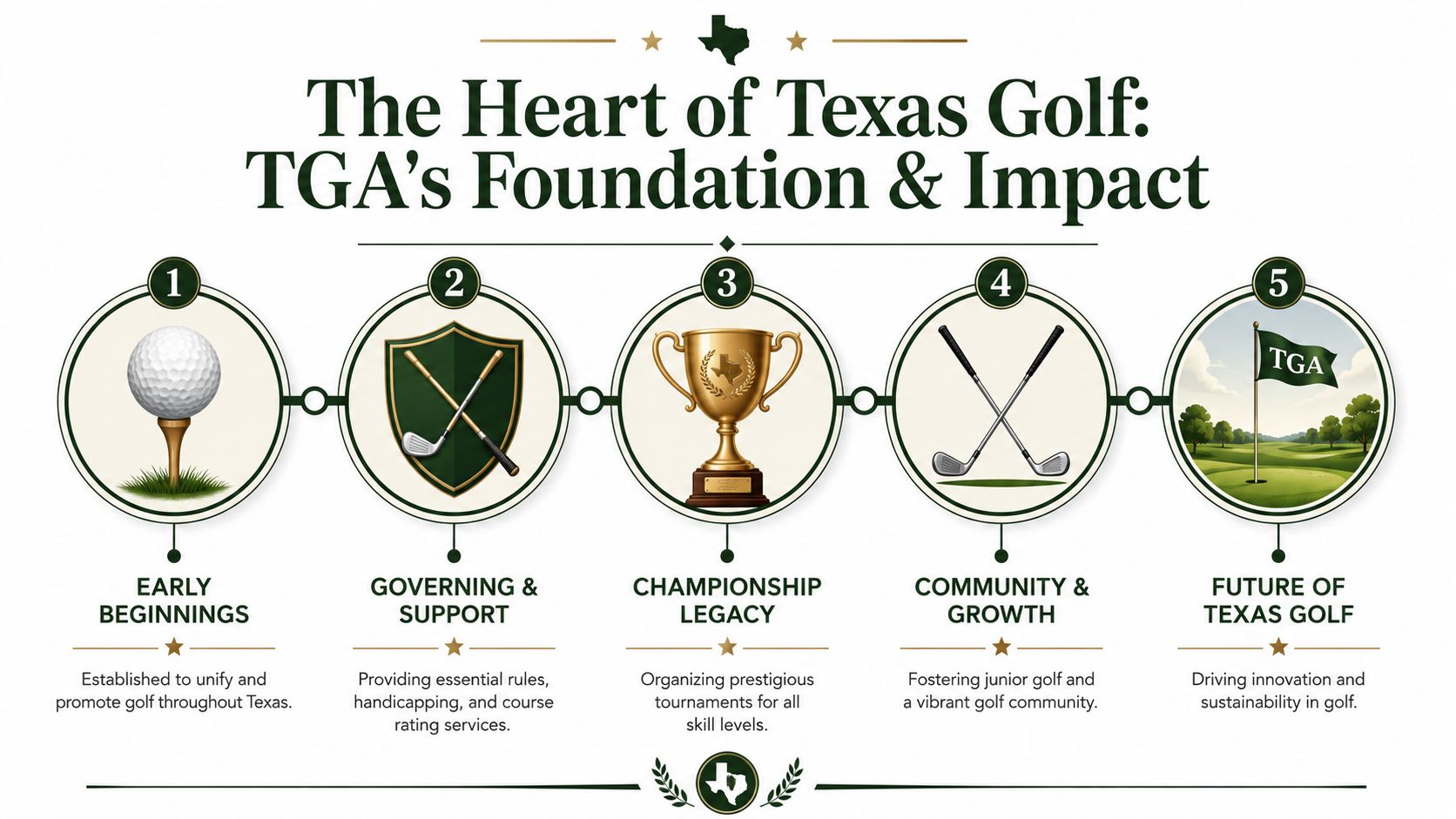
Why players and clubs keep coming back to the TGA
Players return to systems they trust. Clubs return to systems that hold up under pressure.
The TGA gives players a recognized path into competitive golf, but the bigger reason it keeps its place is reliability. If a golfer posts scores, enters events, and carries an official handicap through one accepted framework, other competitors know what those numbers mean. That trust is hard to build locally and easy to lose when procedures vary from event to event.
For clubs, the value is practical.
Competition holds up better under scrutiny. Pairings, eligibility checks, flighting, and scoring all run better when the standards are established before the first tee time.
Staff decisions get easier. The golf shop does not have to invent policy every time a rules question or handicap dispute appears at check-in.
The club keeps its own identity. A good association framework supports the event. It does not turn every member tournament into the same product.
That last point matters. Clubs want the credibility of recognized governance, but they also want events to feel like their events. The best operators keep the TGA structure for handicapping, rules, and competition integrity, then modernize the delivery side with better registration, live scoring options, text-based updates, and faster results distribution. In many cases, that works better than forcing every player into another app download they may never use again.
What the TGA means in day-to-day golf operations
At a well-run facility, the TGA shows up in small decisions long before a championship weekend. It affects how scores are posted, how a course is presented for competition, how staff answer rules questions, and how seriously players take the results.
It also sets a clear operational standard.
Players still want the traditional parts of the game handled correctly. They also want an easy event experience. Clubs that combine the TGA's structure with simple, app-free tournament tools usually get the best of both. The governance stays credible, and the player experience gets faster, clearer, and easier to manage at scale.
TGA Membership Explained for Texas Golfers
Saturday morning, a member wants into the club net championship. The golf shop pulls up his record and finds a problem. He has scores in two different apps, no clearly maintained Handicap Index, and no one is sure which record the committee should trust. That situation is avoidable. TGA membership gives the player and the club one recognized framework for handicap administration, eligibility, and score history.
For Texas golfers, membership is less about carrying a card and more about having a record that stands up when competition gets serious. A casual score log is fine for personal tracking. It does not help much when a committee needs to verify an entry, apply terms of competition, or settle a handicap question before the first group goes out.
What membership actually gives you
The exact setup depends on how a golfer joins and which facility is involved, but the practical benefits are consistent. A TGA-connected membership ties the player to recognized administration instead of scattered scorekeeping tools that do not hold the same weight in competition.
Benefit | Included with Membership | Description |
|---|---|---|
Official Handicap Index® | Yes | Gives players a recognized handicap record for posting scores and entering competitions that require official handicap verification. |
Tournament Access | Yes | Opens the door to TGA-administered events and competitions that rely on recognized eligibility and scoring standards. |
Rules and Governance Connection | Yes | Keeps players inside the same framework used for Rules of Golf administration, score posting, and competitive integrity. |
Member Club Integration | Often | Makes it easier to participate in club events that tie into TGA and USGA processes rather than standalone local systems. |
Educational Resources | Yes | Includes access to rules education that helps players understand scoring procedures and keep posted scores accurate. |
That last point matters for operators as much as players. Clubs run better events when the handicap source is recognized, the player list is clean, and the committee is not piecing together information from text messages and third-party apps.
Common ways golfers join
Many golfers join through a member club or public facility. That is usually the simplest route because the staff already knows the process, can explain posting procedures, and can tell the player how the local program fits into TGA administration.
Golfers without a traditional club still have options, but they should make sure the path supports official score posting and recognized member services. Start with the course you play most often. Ask a direct question: does this facility offer a TGA-linked membership that supports an official Handicap Index and event eligibility?
Who gets the most value from joining
The answer depends on how the golfer uses the game.
Competitive players need a handicap record and eligibility that can be verified quickly.
Regular club players benefit when member events use one accepted system instead of house rules and informal score histories.
Golfers who are trying to improve get a clearer picture of progress when scores are posted properly over time.
Parents of junior golfers should view membership as part of the development path, because tournament golf asks for more structure than casual play.
I have seen the difference at check-in. Players with a current record move through the process fast. Players with partial score histories usually need staff time, committee judgment, and follow-up that could have been avoided.
A handicap has value only if the scores behind it are current, credible, and posted under the right procedures.
Where clubs can get more out of membership
This is the part many articles miss. TGA membership solves the governance side. It does not automatically solve the player experience side.
A club still has to handle registration, pairings, announcements, scoring flow, and final results in a way players will use. The best setups keep the TGA structure for handicap integrity and eligibility, then run tournament communication with simple, app-free tools such as mobile web registration, text updates, and scoring options that do not require every guest to download another platform. That is a practical trade-off. The association framework protects credibility. Modern delivery tools reduce friction for players and staff.
What does not work
Problems usually start when golfers want official competition access but do not maintain an accurate posting record. Clubs run into the same issue when they accept mixed score sources without a clear policy.
Use the membership as it is intended. Post scores consistently. Learn the rules that affect scoring and score submission. Keep one reliable player record. That approach saves time in the shop, gives the committee fewer judgment calls, and gives the player a handicap record that holds up when it matters.
Competing in TGA Tournaments and Championships
A strong state association gives players a pathway, not just a calendar. That's what makes the Texas Golf Association competitive ecosystem useful. A junior player can enter early-stage events, learn how serious competition feels, and gradually move toward championships that carry real prestige. Adult amateurs can find the right lane too, whether they're chasing a state title or trying to test their game outside the home club.
That system matters even more because participation keeps growing. The Texas Golf Association has facilitated over one million rounds of golf in less than a single year, the fastest expansion in its modern history, according to the TGA's local knowledge overview. When that many rounds move through the ecosystem, players need clear competitive pathways and clubs need events that don't feel improvised.

The player journey inside TGA competition
The junior side is where many Texas golfers first see the value of structured competition. A player starts by learning pace, etiquette, scoring discipline, and how tournament golf differs from a casual round. That's not a small jump. Plenty of good ball-strikers struggle the first time every stroke matters and every procedure is observed.
From there, the competitive ladder broadens. State-level amateur events carry a different kind of pressure. Tee times feel sharper. Pairings matter. Course setup tends to reveal weaknesses quickly. Players who want a broader view of this competitive environment can review this overview of Texas amateur golf pathways.
What works for players entering TGA events
Players usually perform better when they prepare for the event environment, not just the golf course. That means understanding pace expectations, walking protocols where applicable, and how tournament administration handles things like starting procedures and score verification.
A few habits separate prepared entrants from frustrated ones:
Read the player information carefully. Many avoidable problems start with details the player skipped.
Know your category. Junior, amateur, mid-amateur, senior, and women's events can have different competitive rhythms and expectations.
Practice scorekeeping discipline. A sloppy casual-round habit becomes a tournament problem fast.
Arrive ready for procedure. Tournament golf asks more of you before and after the round, not just during it.
Tournament players often over-prepare for swing mechanics and under-prepare for administration. The second mistake causes more needless stress.
Where clubs fit into the championship ecosystem
Host sites carry part of the burden of making championship golf look and feel serious. The best host clubs understand that state-level events are not just larger member tournaments. The communication has to be tighter. Practice round logistics need structure. Staff roles must be clear.
What doesn't work is treating a TGA event like a normal shop game with a bigger field. Players notice the difference immediately. So do parents, coaches, and returning competitors.
For clubs that want to earn a reputation as reliable hosts, the lesson is simple. Championship golf rewards discipline on the operations side just as much as it rewards talent on the player side.
Understanding Rules Handicapping and Course Rating
A common problem shows up the week before a member-guest or club championship. One player asks why his index travels differently at another course. Another posts a score that should not have gone in. By the time the committee notices, trust in the net results is already under pressure.
That is why the Texas Golf Association's work on rules, handicapping, and course rating matters to club operators, not just to competitive players. It gives Texas facilities a shared standard for how scores are posted, how indexes travel, and how courses are measured. Without that consistency, interclub events turn into arguments about math instead of golf.
If a staff member cannot explain why an 82 at one course converts differently than an 82 at another, start with the basics of course rating and slope. Players do not need the full technical formula. The golf shop does need enough command of it to answer questions clearly and set up competitions that members trust.
Why rules knowledge still affects scoring
Golf still relies on player integrity. It also relies on players knowing the procedure.
A bad drop, a scorecard mistake, or a misunderstanding of a local rule can affect whether a score is acceptable for handicap purposes. In tournament golf, those errors can also change the competition itself. The TGA supports rules education for exactly that reason. Clubs should treat that education as operating discipline, not as an optional extra for rules enthusiasts.
The practical standard is simple. Head professionals, tournament chairs, and outside staff should know the recurring issues that create scoring problems at their facility. Relief procedures around penalty areas. Preferred lies when they are in effect. How scorecards are checked and finalized. Those are not abstract rules topics. They show up in real events.
How governance appears in day-to-day policy
Association governance is easy to dismiss until a club has to apply it under pressure. Then details matter fast.
The TGA's competition policies set expectations that are specific enough to enforce, including attire standards and footwear rules for certain competitions, as outlined on the TGA's competition policy pages. That level of specificity helps in three ways:
It protects the golf course. Modern cleat standards reduce unnecessary wear in high-traffic event periods.
It reduces avoidable disputes. Clear dress and equipment expectations keep staff out of subjective arguments at check-in.
It gives events a consistent look. Players notice when a competition feels organized from the first tee to score posting.
For clubs, the lesson is straightforward. If your local event policies drift too far from association standards, players will feel the mismatch as soon as they enter a TGA event or qualifier.
The handicap side that clubs often mishandle
Handicapping breaks down in ordinary ways. Scores get posted late. Staff assume every format is acceptable for posting. Committees fail to review exceptional scores until after payouts are done.
Those are preventable mistakes.
A well-run club has a simple process for posting guidance, score verification, and committee review. It does not need to be complicated, and it does not need another app to function well. In fact, many operators can improve the player experience in this area without changing the TGA framework at all. Keep the association's standards for handicaps, ratings, and rules. Then use modern, app-free tournament tools at the club level to make score entry, leaderboard visibility, and committee oversight easier for players and staff.
That combination works. The TGA provides the competitive structure. The club's job is to deliver that structure in a way members can follow without confusion.
Running Modern Tournaments with the TGA
In this situation, many Texas clubs have a real opportunity.
The Texas Golf Association gives clubs a strong competition framework. It helps with standards, rules, handicapping, and event credibility. But player expectations at the club level have changed faster than many event workflows have. Golfers still respect tradition, yet they also expect registration to be simple, scoring to be visible, and leaderboard updates to happen without confusion at the turn.
That creates a practical question for head professionals and tournament directors. How do you run events that fit within the TGA's traditional structure while delivering a modern experience players will enjoy?
Where the current gap sits
Publicly, there isn't much transparency around how TGA-affiliated clubs are adopting app-free live scoring. The TGA promotes member experience and broad support for the game, but there is no public data on how many of its 1,000+ affiliated clubs use modern, no-download live scoring during events, as discussed in the TGA Foundation context at this TGA page. That same verified data also notes that app-free live scoring is associated with 40% higher participation and that 68% of club directors prioritize ease of scoring.
For operators, that gap matters. If you don't know what peer clubs are using, you tend to default to whatever has been around the longest. That's often a mistake. Legacy systems may still function, but they can create extra setup work, more training friction, and less player adoption if the process feels clunky.

What modern tournament operations should look like
A TGA-aligned club event doesn't need to feel old-fashioned on the administration side. In fact, modern delivery often helps clubs honor the spirit of organized competition better because staff have more time for setup, player service, and rules support instead of chasing paperwork.
Clubs should expect these operational basics from current tournament software, and you can compare those needs against broader options in this guide to golf tournament management software:
Fast event setup: If a small event takes hours to build, staff will avoid using the system well.
Simple player entry: Registration should not require players to fight through unnecessary steps.
App-free scoring access: The fewer barriers a player faces on the first tee, the more likely they are to use live scoring correctly.
Live leaderboard visibility: Players engage more when they can follow the event as it unfolds.
Clean back-office control: Pairings, flights, score review, and communication should be manageable by golf staff, not only by one tech-savvy employee.
What works and what doesn't
I've seen the same pattern repeatedly in club operations. Technology works when it removes staff burden and reduces player hesitation. It fails when it adds another layer of explanation.
What works:
Short training paths for staff
Scoring access through a simple link
Clear round setup before players arrive
Visible leaderboards that don't need manual patchwork
Communication tools that keep pairings and notices in one flow
What doesn't work:
Systems that require too much pre-event administration
Player instructions that need a speech on the first tee
Platforms that feel designed for software people instead of golf staff
A split workflow where one tool handles registration, another handles scoring, and staff still reconcile everything by hand
Good tournament tech should disappear into the event. Players should notice the leaderboard, not the software struggle behind it.
The right way to combine tradition and convenience
Some operators worry that modern scoring tools somehow cheapen tournament golf. I don't buy that. Good technology doesn't replace the TGA framework. It supports it.
If the association side provides the rules, standards, and competitive legitimacy, then club-side technology should handle the delivery layer. Let the TGA anchor the competition model. Let modern software make signups, scoring, and communication easier. That's the combination that serves players best.
Clubs that get this right usually look more organized without becoming less traditional. That's the sweet spot.
How to Get Started with the Texas Golf Association
If you're ready to move from interest to action, keep it simple. Most golfers and most clubs don't need a complicated entry plan. They need a short checklist and a reason for each step.
For players
Choose your membership path. Start with the club or facility where you play most often and ask how they handle TGA-linked membership.
Set up your handicap record correctly. Don't wait until the week of an event to figure out score posting.
Review the event calendar. Pick one event that fits your level and one stretch goal event that gives you something to prepare for.
Read the policies before registering. Eligibility, attire, and procedures are part of competition, not side notes.
For clubs and golf staff
Confirm your association relationship. Make sure your facility knows how it connects to TGA processes for handicapping and competition support.
Audit your tournament workflow. Registration, pairings, live scoring, printed materials, and score validation should work as one system.
Train staff before the event rush. A calm shop team runs better tournaments than a talented team improvising at the last minute.
Align local policies with sanctioned expectations. If your club prepares players for the standards they'll see in TGA events, everyone has a better experience.
One final operational note
Don't overcomplicate your first step. A golfer only needs a valid path into membership and a reason to use it. A club only needs one well-run event process to start building momentum. Clean administration beats ambitious chaos every time.
Frequently Asked Questions About the TGA
A common scene in the golf shop goes like this. A player wants to enter a Texas event, has a handicap number on file, and assumes that covers everything. Then staff find a gap in membership status, score posting history, or event eligibility, and the fix becomes a last-minute scramble.
That confusion is avoidable. Here are the questions golf staffs and players ask most often.
Is TGA membership the same thing as just having a GHIN number
They are connected, but they are not the same administrative step. A GHIN record handles handicap identification and score tracking. TGA membership ties that record into the association structure in Texas, which matters for eligibility, governance, and access to many competitions.
For tournament staff, the difference matters at registration. If a player only knows their number but not how their membership is set up, verify it early instead of on the entry deadline.
Can you join if you aren't a member of a private country club
Yes, in many cases. A private club is one path, not the only path.
Public-course players, daily-fee players, and golfers tied to other recognized member facilities often have a valid route. The practical question is simple. Where is your scoring record housed, and is that path recognized for the type of event you want to play? Get that answer before you build a tournament schedule around assumptions.
How do players keep their handicap valid under current rules
Post scores on time, follow the Rules of Golf that affect hole-by-hole scoring, and keep your record clean. Players get into trouble when they guess on unplayed holes, post incomplete rounds incorrectly, or ignore rules situations that change the score that should be entered.
For clubs, this is also an operations issue. If your events rely on live scoring or digital leaderboards, the scoring process still has to match the handicap and rules standards players are expected to follow. Good tournament tech helps the shop collect scores faster, but it does not replace score validation.
What should juniors and parents focus on first
Start with habits that hold up in competition. A junior needs a proper membership path, accurate score posting, and a basic understanding of pace, procedures, and scorecard responsibility.
I tell parents the same thing every year. Prestige can wait. A player who checks in on time, understands terms of competition, and returns a correct scorecard is easier to place into better events and develops faster once the stakes rise.
If a young player can handle registration details, arrive prepared, and return a correct scorecard, they're already ahead of many more talented players.
Can clubs modernize tournament operations without drifting away from TGA standards
Yes, and they should. The best setup keeps the TGA framework for competition, handicapping, and rules integrity while improving the player-facing side of the event.
That usually means reducing paper shuffling, cleaning up registration flow, and using app-free scoring tools that work for guests, members, and older players who do not want another download on tournament morning. The trade-off is straightforward. New technology helps only if it makes check-in, scoring, and score verification easier for the staff as well as the field.
If your club wants to match the Texas Golf Association's competitive standards with a smoother player experience, Live Tourney is worth a serious look. It gives golf staff a practical way to run tournaments, leagues, and outings with app-free live scoring, simple setup, and cleaner administration on any device. For head professionals and event organizers who want less friction on the operations side, it's a modern fit for traditional golf.





