Jul 3, 2026
gpro golf tour, developmental golf tour, golf tournament management, golf event software, run a golf tour
Understand the GPro Golf Tour model and learn how to manage similar developmental tours. A guide for organizers on formats, operations, and modern software.

If you're looking at the GPro Golf Tour from the organizer side, you're probably not asking what it is in the abstract. You're asking a more practical question. What does a tour like this require from a host course, and what does it teach you about running serious competitive golf without creating chaos for staff and players?
That's the useful lens. The GPro Golf Tour matters because it represents a familiar part of the golf ecosystem: the developmental circuit where talented players chase status, sharpen competitive habits, and try to stay alive professionally. For operators, head pros, and tournament directors, tours like this also expose the gap between a casual event and a professionally run competition. That gap is usually operational, not aspirational.
The Dream and the Grind of Professional Golf
Every developmental tour starts with the same raw material. A player believes he's good enough to move up. Sometimes he just finished a strong college career. Sometimes he's been grinding mini tours for years. Sometimes he had status somewhere before and is trying to get it back.
What looks romantic from the outside is usually a week-to-week test of travel, money, patience, and execution. The big tours get the cameras, but the middle layers of professional golf do the filtering. They decide who can post scores when the pressure is real, the margins are small, and one loose stretch can undo a month of work.

Why developmental tours exist
The top of the pyramid is brutally narrow. Only about 5% of PGA Tour players ever win a tournament, which says a lot about how hard it is not just to arrive, but to finish the job at that level, as noted in Golf Digest's post on average tour pro stats.
That single number changes how you should view a tour like GPro. It isn't a side show. It's part proving ground, part sorting mechanism, and part business model built around competitive ambition.
Practical rule: If your course hosts a developmental event, treat it like professional sport, not an upgraded member game.
For facilities, that matters. These tours bring players who care about pace, setup, rules, scoring accuracy, pairings, payout clarity, and communication. They also bring a chance for a course to become known as a place that can handle serious competition. That reputation sticks when events run cleanly, and it slips fast when they don't.
What organizers often miss
The dream belongs to the player. The grind belongs to everyone involved.
A developmental tour only works when the event experience supports the competitive standard. If registration is messy, starting times keep changing without clear notice, or scores are delayed and disputed, the event loses credibility. Players notice immediately. Sponsors notice eventually. Staff feel it all day.
For an operator, that's the core lesson behind the GPro Golf Tour model. Ambitious players create demand for well-run tournaments. Courses that can supply that experience don't just host golf. They become part of the pathway.
Dissecting the Developmental Tour Model
The fastest way to understand the GPro Golf Tour is to treat it as a template. A developmental tour sits between amateur competition and the larger professional stages. It gives players repeated exposure to tournament pressure in an environment that still has regional accessibility and manageable logistics compared with the top tiers.
That sounds simple until you break down what the format has to accomplish. A real developmental tour must identify skill, reward consistency, and expose weaknesses over more than a single hot round.

The core pieces of the model
Most tours in this category rely on a similar structure:
Stroke play matters: Players need to post a total score over complete rounds, not just survive a novelty format or team event.
Points carry weight: Season-long standings give players a reason to show up consistently and compete through the full calendar.
Fields need standards: A tour has to feel earned. If entry standards and tournament procedures are loose, the product weakens.
Progression has to be visible: Good players need to see how performance on one circuit helps them move toward higher opportunities.
That's why the minor league golf tour landscape matters to organizers. It shows there isn't one single route. There's a ladder made of tours that differ in geography, entry standard, cost structure, and competitive depth.
The scoring standard is higher than many hosts expect
Developmental tours aren't charity scrambles with a pro label attached. The scoring baseline alone tells you that. On the PGA Tour, the typical player averages approximately 3.5 birdies per round, while the best player on tour averages about 4.5 birdies per round, according to this professional scoring breakdown.
That stat matters because it reminds organizers what elite scoring looks like. Even great players don't make birdie at will. They create a few chances, convert enough of them, and avoid the big mistakes that derail a round.
The better the field, the less tolerance there is for sloppy setup, vague rulings, or delayed score handling.
What this means for event design
If you're running a tour stop or building your own local series, design for competitive clarity:
Focus area | What works | What doesn't |
|---|---|---|
Field structure | Clear entry process and published policies | Last-minute exceptions and verbal rules |
Course setup | Consistent tee and hole setup philosophy | Surprise changes with no explanation |
Scoring | Fast verification and visible results | End-of-day paper bottlenecks |
Season value | Points race with meaning | One-off events that don't connect |
The GPro Golf Tour model works when each event feels like part of a larger professional journey. If it feels improvised, players treat it that way.
Who Plays and Who Profits from These Tours
The player pool on a developmental tour is more mixed than many club operators expect. You'll see recent college standouts, strong amateurs testing whether they can compete for money, mini-tour regulars who know the routine cold, and former higher-level pros trying to rebuild form and status.
That mix creates an interesting operational challenge. These players don't all arrive with the same résumé, but they usually arrive with the same expectation: the event should function like professional golf.
The player side of the equation
The serious developmental player is buying three things from a tour.
First, he wants reps under pressure. Qualifying rounds and one-day events can show flashes of talent, but repeated tournament rounds reveal whether a player can manage mistakes, travel fatigue, and closing pressure.
Second, he wants visibility. Not celebrity. Credibility. He wants to point to finishes, standings, and a season body of work that tells a coherent story.
Third, he wants predictability. That's the underrated one. Players will tolerate hard conditions and tough rulings. They won't tolerate confusion that feels avoidable.
The host side of the equation
For courses and local organizers, the return is broader than entry fees or a single event day. A good tour stop can sharpen the facility's identity and create a different kind of relationship with players, sponsors, and the local golf community.
The benefits usually fall into a few buckets:
Course positioning: Hosting competitive professional golf tells players and clubs in your region that your facility can stage serious events.
Sponsorship value: Local partners have a cleaner story to support when the tour looks organized, repeatable, and credible.
Food and beverage lift: Tournament traffic creates longer on-site dwell time than many ordinary rounds.
Community relevance: A recurring tour stop gives local golfers something to follow, not just something to hear about afterward.
A host course profits most when the event feels bigger than a tee sheet. It has to feel like a platform.
Where organizers make money and where they lose it
The mistake is assuming that prestige alone carries the business case. It doesn't. Prestige helps after the operation works.
What holds value is repeatability. Can the course staff absorb the event without wrecking daily operations? Can sponsors understand what they're supporting? Can players trust the process enough to return? Those are the practical questions that decide whether a developmental tour becomes a strong annual property or a draining one-off experiment.
The GPro Golf Tour is useful here because it represents a category that rewards well-run hosts. The players are chasing advancement, but the host is building something too: reputation, process discipline, and an event product that can keep compounding over time.
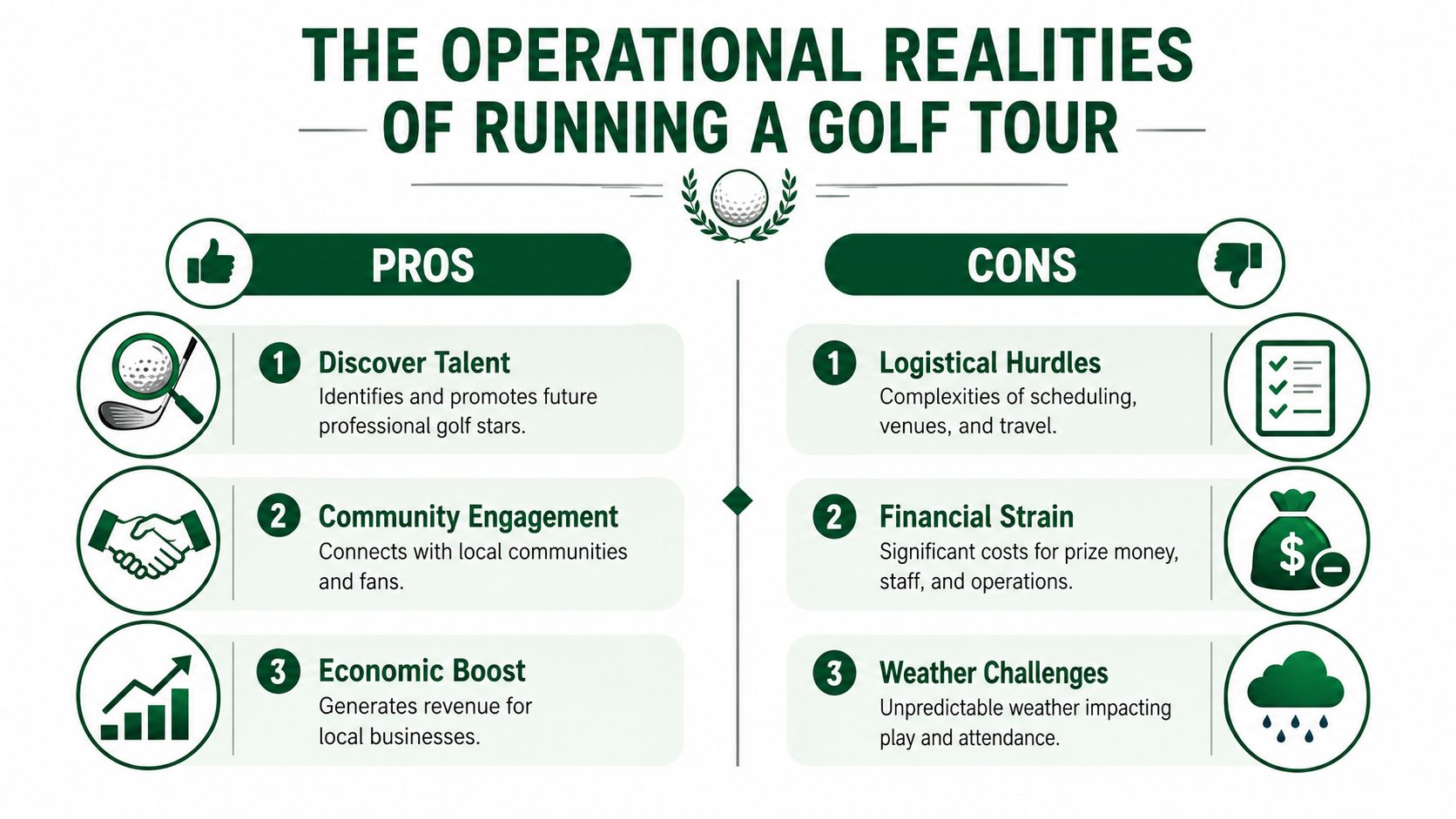
The Operational Realities of Running a Tour
Those not involved in tournament operations see the leaderboard. They don't see the pairings edit at 10:30 p.m., the withdrawal text at sunrise, the scorecard issue on the back nine, or the staff member trying to explain a side game payout while also fixing cart signs.
That's where tour management gets exposed. A developmental event looks lean on paper, but the moving parts stack up quickly when you're handling multiple rounds, competitive players, policy questions, and a host facility that still has normal business to run.
The hidden workload
The recurring friction points are familiar to anyone who has run local or regional events:
Registration control: Who has paid, who is waitlisted, who withdrew, and who still needs confirmation.
Tee sheet management: Pairings, repairs after late scratches, and communication that reaches everybody quickly.
Scoring and verification: Getting scores in, checking them, posting them, and resolving disagreements before they spread.
Payout administration: Prize calculations, skins, side games, and any season points implications.
Player communication: Rules notes, weather plans, start changes, and operational reminders.
Those are exactly the kinds of issues highlighted in the discussion around under-resourced tours, where the recurring problem is cost-effective tournament automation for rosters, tee sheets, and side games without expensive software, especially as college golf and related operational complexity strain older systems, as described in Stephen Curry's Underrated Golf Tour post.
Old tools break first under pressure
Spreadsheets still have a role. Paper still has a role. But neither should be carrying the whole event.
What fails first is usually communication. One outdated list, one late text thread, one handwritten change, and suddenly different players are operating from different information. That's where avoidable tension starts.
A lot of organizers also underestimate branding details. If you're trying to make a developmental tour stop look polished for sponsors and photos, basics like signage and staff presentation matter. Even practical items such as custom golf headwear can help volunteers, staff, and player gifts feel coordinated instead of thrown together.
Local tours feel these problems the most
Regional and community circuits don't have the luxury of extra admin layers. They need simple workflows, not more moving parts. That's why the lessons from local golf tours are so relevant. The smaller the operation, the more dangerous manual bottlenecks become.
If staff need to touch the same player information in three places, the process is already too fragile.
What works is boring in the best sense. One system of record. One clear scoring flow. One communication path players can follow. Most operational stress in tour golf comes from duplication, not difficulty.
Modernizing Your Tour with Digital Tools
The old way of running tournaments isn't noble. It's just familiar. Directors keep patching together forms, spreadsheets, text chains, paper scorecards, and manual leaderboard updates because that's what they inherited.
The problem is that players now expect cleaner execution. They live on their phones, but they don't want another app, another login, or another layer of friction. Staff want less training burden, fewer score-entry mistakes, and faster setup before the first group goes off.
What better systems actually change
Improvement isn't “more features.” It's fewer handoffs.
A modern tournament workflow should let an organizer import the field, build pairings, publish tee sheets, push scoring access, and monitor the event without forcing players or staff into a complicated onboarding process. That's the practical promise behind web-based tournament management.
There's a hard efficiency case for that approach. Live Tourney delivers a 3x faster tournament setup process compared to legacy systems, moving organizers from roster import to a live-scoring event in minutes rather than hours, according to its overview of best golf tournament software.
The app-free point matters more than most vendors admit
The strongest digital scoring tools reduce resistance at the exact moment players need to participate. If access is instant through a link, adoption is smoother. If a player has to search an app store, create credentials, verify an account, and learn a new interface in the parking lot, the event starts with friction.
That same principle shows up in hospitality more broadly. The best systems remove unnecessary steps for guests and staff. For a wider perspective, MODERN LYFE's insights on hospitality innovation are useful because they focus on how technology should improve experience instead of adding ceremony.
What to look for in a platform
If you're evaluating options, use operational criteria, not marketing language:
Decision point | Strong approach | Weak approach |
|---|---|---|
Player access | Link-based scoring on any device | App-first process with extra setup |
Staff adoption | Minimal training and clear screens | Heavy onboarding and workarounds |
Event output | Tee sheets, scorecards, signs, live results | Disconnected tools and manual exports |
Admin control | Fast edits during live play | Delayed updates and brittle workflows |
You can see that philosophy reflected in current golf tournament management software. The important thing isn't the label. It's whether the tool makes tournament day quieter for staff and clearer for players.
Your Next Steps for a Professional Tour Experience
If you want your event to feel more like a real tour stop and less like a patched-together competition, don't start by asking what software to buy. Start by auditing where your event loses trust.
Look at registration first. Then pairings. Then score collection. Then communication. Most tournament directors already know where the pain sits because staff and players complain about the same points every time.
A practical review of your current setup
Use a simple test.
Before the event: Can players register, pay, and receive clear information without back-and-forth emails?
During the event: Can players access scoring quickly, and can staff verify results without building a paper backlog?
After the round: Can you post accurate standings, handle payouts, and communicate outcomes without a cleanup project?
If one of those stages depends on too many manual touches, that's the first place to fix.
Build the player experience from the phone screen backward. If the player side is clumsy, the staff side is usually worse.
Raise the standard in the right order
The best upgrade path is usually sequential, not dramatic.
Start with the systems players feel directly. Registration clarity and scoring access shape the event's reputation fastest. Then tighten the back office. Pairings logic, communication templates, and payout workflows are less visible, but they determine whether the tournament staff can stay ahead of the day instead of chasing it.
There's also a meaningful engagement case for live scoring. A major underserved angle in tour operations is practical guidance on app-free, real-time scoring for junior and community events, despite a 40% increase in live scoring participation when such systems are adopted, as discussed by MyGolfSpy in its piece on reimagining golf.
What a professional tour experience actually feels like
Players don't define “professional” by purse size alone. They define it by whether the day runs cleanly.
A professional-feeling event has clear policies, reliable starting information, fast score flow, visible standings, and communication that answers questions before frustration builds. That's as true for a local developmental stop as it is for a larger circuit.
The GPro Golf Tour is a useful case study because it points to the broader truth. Developmental golf depends on operational discipline. If you can deliver that consistently, you don't just host better events. You become the venue and organizer players trust when the stakes matter.
If you're ready to see how a modern, app-free system can simplify registration, tee sheets, live scoring, and player communication, take a look at Live Tourney. A short trial will tell you quickly whether your next event can run with less admin stress and a more professional experience from the first tee to final results.