
Sep 13, 2026
golf trip planning, golf travel, golf itinerary, golf group tips, live scoring
Golf Trip Planning. Plan a golf trip with confidence using this step-by-step guide covering budgets, courses, lodging, itineraries, group coordination, gear

Six weeks before departure, the organizer is staring at a half-finished spreadsheet, twelve text threads, and a deposit deadline that no one else seems to remember. Two players haven't confirmed their flights, one wants to walk every round, another needs a cart, and the group still hasn't agreed on whether this is a serious competition or a buddies' getaway. The tee times are only one part of the problem.
Most golf trips fail in planning, not execution. The rounds usually run smoothly once the right people are in the right place with the right information. The trouble starts earlier, when a vague idea becomes a booking before anyone has defined the group, the budget, the routing, or the experience they want.
Picture the Trip You're Organizing
Your first booking decision should follow a written trip profile, not a course search. Record who is going, how many days are available, the travel season, the target region, and the trip's purpose. A bucket-list trip built around iconic courses needs a different booking strategy from a relaxed buddies' getaway, corporate hospitality event, or competitive match-play weekend.
Separate requirements from preferences before comparing destinations. A hard constraint might be a fixed departure date, a maximum total budget, a mobility limitation, or a requirement that the group plays at least one top-tier course. Preferences include a private house, a late-morning tee time, or a restaurant within walking distance. Make every preference mandatory and the plan either costs too much or loses its workable options.
Write the trip profile first
Record the group's average handicap range, walking and riding expectations, and preferred pace. Perfect handicap data is unnecessary. An honest assessment of the group's pace is not. Decide whether players want brisk rounds, conversation between shots, or a demanding course that may test less experienced golfers.
Use the profile to answer six planning questions:
Group: Who's attending, and are spouses, partners, or non-golfers included?
Schedule: Which dates are fixed, and how much flexibility exists?
Purpose: Is the trip about golf quality, competition, social time, sightseeing, or a mix?
Money: What's the maximum each golfer can comfortably spend?
Golf: How many rounds are realistic, and which course characteristics matter?
Logistics: Who can drive, who needs a cart, and who has dietary or mobility needs?
A course should earn its place in the plan by satisfying the profile. A famous layout is a poor choice if it strains the budget, overwhelms the group, or forces exhausting transfers. Destination design, booking windows, transportation, and live event details must support the same trip instead of becoming separate decisions.
Practical rule: Test every later booking against the trip profile. Keep the course, lodging, and schedule only when they work for the group as a whole.
Golf travel is a substantial economy rather than a niche booking habit. The global golf tourism market has been estimated at USD 29.5 billion in 2026 and projected to reach USD 71.8 billion by 2036, with a 9.3% compound annual growth rate, according to Future Market Insights' golf tourism sector overview. That scale makes coordination important: tee sheets, lodging, transportation, and packaged itineraries need to fit together as one system.
Set a Realistic Golf Trip Budget
A realistic golf trip budget starts with the booking plan, not a target price divided among golfers. Price transportation, lodging, golf, food, competition, and reserves together, because a cheap tee time can become expensive after transfers, rental clubs, cart fees, or schedule changes. Add caddie or forecaddie costs, tips, range balls, snacks, side-game payouts, and weather-related adjustments before collecting deposits.
Build the budget line by line
Use this order:
Travel: Flights or driving fuel, airport parking, rental cars, transfers, tolls, and luggage costs.
Lodging: Every night, including arrival and departure nights, plus taxes, resort fees, cleaning fees, or house deposits.
Golf: Green fees for each round, carts, caddies, forecaddies, tips, range balls, club rentals, and replay fees.
Food: Breakfasts, casual lunches, on-course beverages, snacks, one group dinner, and meals for non-golfing guests.
Competition: Side-game pots, prizes, scorecards, small awards, and event administration.
Protection: A contingency for weather delays, replacement equipment, transport changes, and medical needs.
Reserve: A small discretionary amount for a dinner upgrade, extra drinks, or an unplanned shop purchase.
As a planning guide, lodging and travel usually consume 45% to 60% of the total, golf takes 25% to 35%, and food plus side costs make up the remainder. Treat those as allocation ranges, not promises. A remote resort can raise transportation and lodging costs, while a premium golf destination can make the golf category the largest line.
For a domestic trip with eight golfers, four rounds, and three nights, set the ceiling before asking anyone for a deposit. The sample below uses a USD 12,000 planning ceiling to show how the categories fit together. It does not predict a universal trip price.
Category | Total | % of Budget | Per Player |
|---|---|---|---|
Travel and ground transportation | USD 3,000 | 25% | USD 375 |
Lodging | USD 3,000 | 25% | USD 375 |
Green fees, carts, and practice | USD 3,600 | 30% | USD 450 |
Meals, snacks, and beverages | USD 1,400 | 11.7% | USD 175 |
Side games and prizes | USD 400 | 3.3% | USD 50 |
Weather and logistics contingency | USD 400 | 3.3% | USD 50 |
Discretionary reserve | USD 200 | 1.7% | USD 25 |
Total | USD 12,000 | 100% | USD 1,500 |
The per-player figure changes as soon as room usage changes. Charge spouses and non-golfers for their lodging, transportation, and meals, but exclude golf costs they will not use. For a rental house, divide the property by occupied room or an agreed room value. Splitting it automatically among golfers creates resentment when room arrangements differ.
Build payment rules into the same plan. Set the deposit deadline, cancellation responsibility, and treatment of late additions before anyone books. Keep the contingency under group control, and record every shared expense in one ledger. That prevents the common end-of-trip dispute over who paid for carts, groceries, tips, or a replacement transfer.
The National Golf Foundation's report on golf's expanding travel economy reports more than USD 30 billion annually in tourism-related expenditures away from the course, including travel, lodging, meals, and incidentals. It also reports more than 12 million annual golf travelers from 2022 through 2025. Golf trips generate substantial spending beyond tee times, so budget the full operating system, not just the rounds.
Choose Courses and Accommodations That Fit the Group
Start with the group's operating needs, then choose the destination. Courses, rooms, transportation, and shared time must work as one system. A lower green fee stops being a saving if it creates a long transfer, forces an early departure, or leaves everyone too tired for dinner and side events.
Build a short destination filter before anyone gets attached to a famous course. Check the season, likely flight cost, ground routes, and lodging availability. Then compare each course by green fee, difficulty, pace of play, walking policy, dress code, slope, rating, and suitability for the full skill range. For a plain-language explanation, read what a golf course rating means.

Match the golf to the players
One bucket-list course plus several playable resort rounds usually serves a mixed group better than four punishing tracks. Judge the walking demands, forced carries, green complexity, and expected pace against the least experienced player, not only the strongest golfer. If that player cannot enjoy the round, the course choice weakens the entire trip.
Booking timing also affects the design. Direct reservations may offer control, while stay-and-play packages can combine rooms and tee times. Compare both, then inspect the details. A package may exclude carts, caddies, meals, transfers, or cancellation conditions from its headline price. Record those exclusions before comparing the cost.
Treat lodging as part of the course decision
On-site lodging usually works best for early tee times, multi-course resorts, and groups that plan to gather for dinners or side events. An off-course hotel or rental house can provide lower costs, a kitchen, parking, and common space. Choose it only when the driving route remains manageable for every scheduled round.
Set the booking target early for marquee courses. International destinations and venues with limited tee times may require even more lead time. Policies vary sharply by property. Kiawah Island Golf Resort's golf FAQ states that non-guests can reserve tee times no sooner than 60 days in advance. Destination Geneva National's policies permit general bookings up to 60 days ahead and groups of 16 or more up to a year ahead.
Large groups need a separate check before you announce the venue. Destination Geneva National limits tee times to two to 15 golfers and directs groups of 16 or more to its Group Sales office. Confirm player limits, booking access, room inventory, and cancellation rules together. A course that fits the golf may still fail the trip if the lodging or reservation process cannot support the group.
Build a Multi-Day Itinerary That Flows
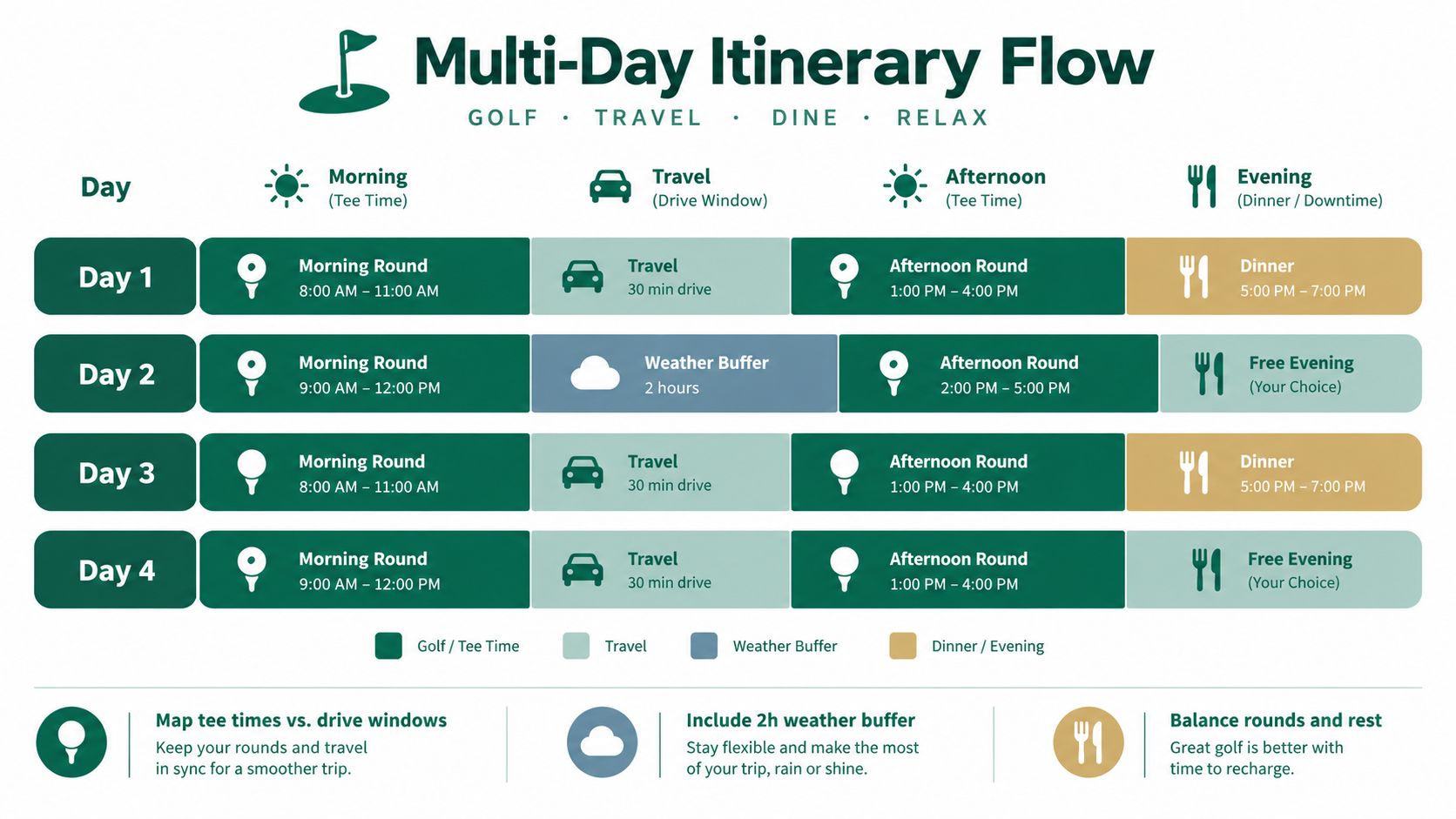
A good itinerary has empty space on purpose. Put tee times, drive windows, meals, check-in, warm-up, and recovery on the same calendar. If they live in separate messages, the organizer will eventually schedule a round that collides with a transfer or dinner reservation.
Golf-trip planning data points to a compressed booking window. One industry survey found 44% of travelers book one to three months out and 32% book four to six months out, while only 25% described planning as easy and 75% said it requires substantial research, email, and phone coordination. The survey also found 64% of bookings are made directly with resorts, hotels, or courses. Those findings support an operational approach, not casual browsing, as reported by The Golf Wire.
Sequence the rounds intelligently
Use the arrival day for a short practice round, warm-up session, or easier course when travel allows. Put the hardest or most important course in the middle of the trip, after players have adjusted to the destination and before fatigue becomes the dominant factor.
Avoid back-to-back 36-hole days unless the group is conditioned for them. A second round can look efficient on paper and become the reason players skip dinner, rush shots, or withdraw from the final day. A buffer day also protects the schedule from rain, lightning, travel delays, and blisters.
A workable day might look like this:
6:30 a.m.: Breakfast and weather check.
7:15 a.m.: Leave the lodging or begin the walk to the clubhouse.
7:45 a.m.: Check in, collect carts, buy range balls, and review pairings.
8:15 a.m.: Tee off.
10:30 a.m.: Turnhouse break or halfway-house stop, depending on pace.
12:45 p.m.: Finish, settle scores, and eat a proper post-round meal.
2:00 p.m.: Optional practice, sightseeing, or recovery time.
5:30 p.m.: Group dinner reservation.
7:30 p.m.: Review the next day's weather, tee sheet, and transportation.
The exact times will move with the tee sheet. The principle won't. Give the group enough time to arrive without panic, eat without rushing, and change plans when conditions turn.
Plan food around the course
Ask whether the course has a halfway house, turnhouse, or beverage cart, then decide whether lunch belongs on property or off-site. A group that leaves the course for lunch needs a realistic travel and parking window. A group that eats on the course needs a preordered plan if the next tee time is tight.
Demand supports dense, efficient trips. The National Golf Foundation's golf travel analysis reports that more than 12 million Americans have traveled to play golf each year since 2022, compared with an estimated 8.2 million in 2018. It also reports an average trip length of 3.33 days, with more than half of U.S. golfers taking at least one golf trip annually and 31% taking two or more. Build short, well-routed days, not an exhausting collection of isolated tee times.
Coordinate the Group and Lock In Pairings
A group chat can build excitement, but it is a poor booking system. Send one shared form with a firm deadline. Collect each traveler's handicap range, walking or riding preference, preferred tee-time range, food allergies, room needs, travel status, and decision about side games.
Collect decisions in one place
Use a master sheet with one row per traveler. Record emergency contact information where appropriate, arrival and departure details, deposit status, room assignment, and any restriction that affects play. The organizer should identify every player in each round without searching through old messages.
Group size can change the booking path. Larger parties may be handled as group sales instead of ordinary tee-time bookings, while a club that limits each tee time to four players may require a separate event contact, deposit arrangement, or contract. Ask the course about those rules before collecting deposits. A booking window that works for individual golfers may not work for your full group.
Set the pairing plan at the same time as the reservation plan. Pairings affect tee-time spacing, transportation, side games, and how many players need each starting slot.
Use a fair pairing rotation
For eight golfers, label players A through H and create two foursomes per round. Rotate partners so everyone meets different players, while keeping pace, temperament, and competitive balance in view.
A simple four-round rotation is:
Round one: A, B, C, D versus E, F, G, H.
Round two: A, B, E, F versus C, D, G, H.
Round three: A, C, E, G versus B, D, F, H.
Round four: A, D, F, G versus B, C, E, H.
Adjust the pattern for skill and personality. A high-handicap player should not spend every round with three golfers who rush every shot. A low-handicap player should not carry the same group match throughout the trip. Put one steady pace-setter with players who need more time, and use handicaps to create fair contests rather than separating golfers by ability.
Pairings should solve two problems at once. They need to make the competition fair and the conversation enjoyable.
Set a cancellation policy before deposits become difficult to recover. Decide whether the remaining players share an added room cost, whether a replacement pays the departing player's unrecoverable deposit, and who contacts the course. Write those decisions in the master sheet.
Non-golfing partners also need a workable plan. Offer rest-day choices such as dining, spa time, sightseeing, or a scenic drive, so the trip does not force every traveler into the same schedule. Recheck the roster before final pairings, because one cancellation can affect rooms, tee times, transportation, and every side game.
Pack Smart With a Complete Golf Trip Gear List
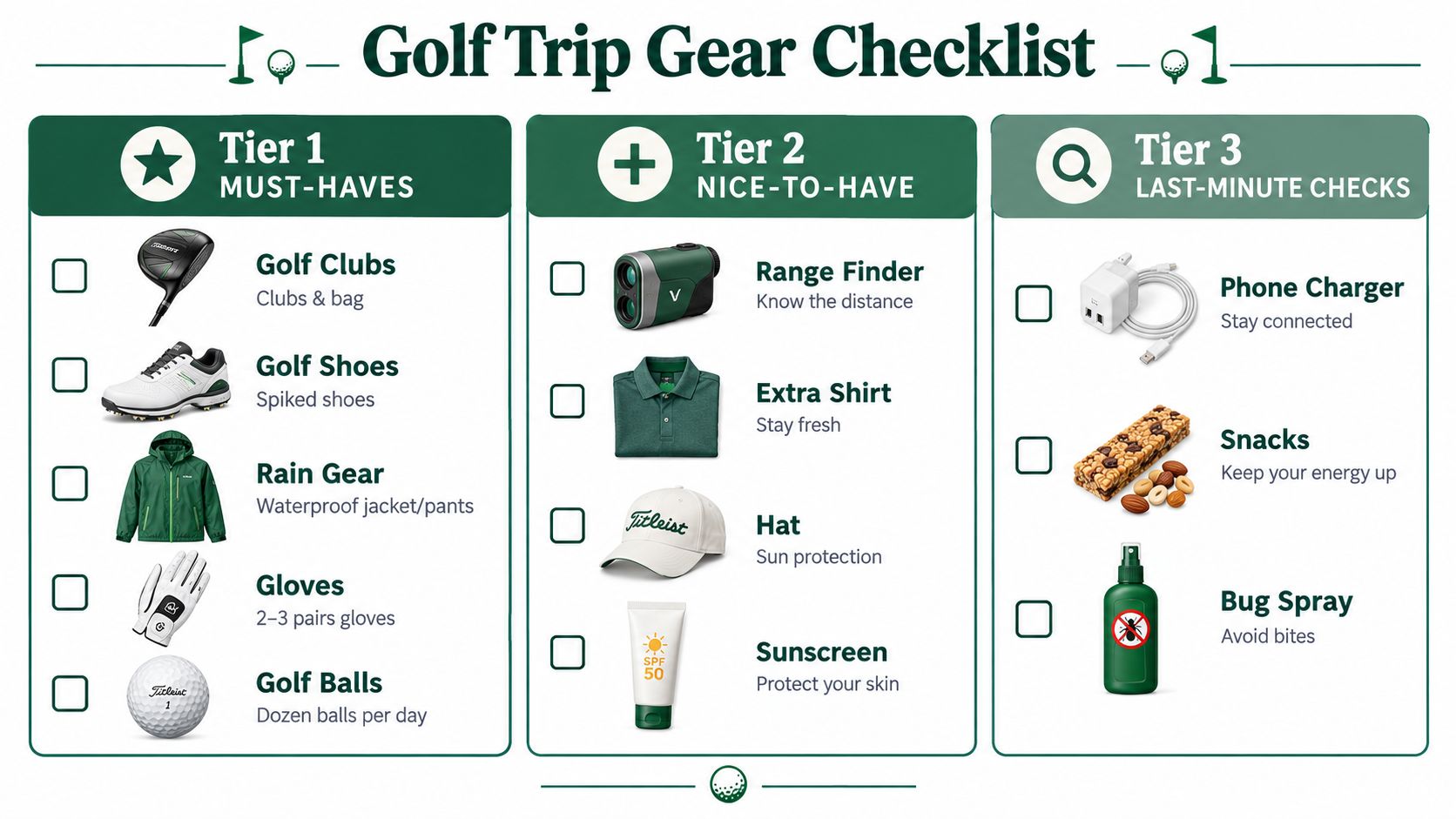
Packing fails when players remember their clubs but forget the items that keep them comfortable through changing conditions. Use three tiers, then make one final check before leaving for the airport or driving to the course.
Must-haves
Pack the playing essentials first:
Clubs and bag: Include your normal setup, headcovers, and a name tag.
Shoes: Bring golf shoes that match the walking and weather demands.
Weather gear: Pack a waterproof jacket and rain pants, not just a light shell.
Gloves: Carry multiple gloves so one wet glove doesn't end the day.
Balls and tees: Bring enough balls for the trip, plus tees, ball markers, and a divot tool.
Distance tools: Pack a rangefinder or GPS device and its charger or batteries.
Clothing layers: Early tee times can start cold and finish warm, so use shirts, mid-layers, a hat, and adaptable outerwear.
Check the airline's current rules for golf clubs, oversized baggage, weight limits, and fees before choosing between checking the bag and shipping it. Shipping clubs ahead can reduce airport handling, but confirm the receiving address, storage policy, delivery date, and insurance terms with the lodging provider.
Nice-to-haves and last-minute checks
Add a backup glove, extra rangefinder batteries, a towel, sunscreen, lip balm, pain relievers, snacks, and a small first-aid kit. Bring an umbrella, waterproof bag cover, hand warmers, and a warm beanie when the forecast can shift. For trips longer than four days, decide whether to use laundry service, pack a compact detergent, or reserve enough golf clothing to avoid washing on the road.
Elbow discomfort can ruin a multi-round trip faster than a missed connection. If taping is part of your normal care routine, review this practical guide to step-by-step elbow taping before departure, and don't use a new support method for the first time on the most demanding round.
Keep the final check short:
Devices: Phone charger, watch charger, rangefinder batteries, and power bank.
Course items: Snacks, bug spray, sunglasses, hat, and spare glove.
Travel documents: Identification, booking confirmations, insurance details, and club-shipping information.
Clothing: Rain layer, warm layer, clean socks, and a change of shoes.
For players using a smartwatch for distances or scoring, review Apple Watch golf functionality before the trip and charge the device each night.
Lock Down Bookings, Side Events, and Live Scoring
The final two weeks should run from one operations document. Confirm every tee time, lodging hold, transportation reservation, deposit, remaining balance, named venue contact, and cancellation deadline in writing. Don't rely on a confirmation number buried in one organizer's inbox.
Cancellation windows vary enough to affect the entire schedule. Some resorts publish 48-hour or 72-hour tee-time deadlines, while top-tier venues can require up to 14 days. TeeTimeGo's cancellation guide notes that Cabot Cape Breton requires 72 hours' notice for tee-time cancellations and 24 hours' notice for accepted caddie requests. Put every deadline on the master calendar, then set an earlier internal decision date.
Make the competition easy to run
Choose formats that create interest without slowing play. A skins game across all rounds, a two-day team competition with a Stableford component, and a closest-to-the-pin pool give players several ways to stay engaged. Finish with an awards dinner where the results are revealed, but keep the rules written and visible before the first tee shot.
Assign a non-playing scorekeeper if someone volunteers. Otherwise, rotate the duty and state who owns the score after each hole. A screenshot of the official scorecard should settle disputes, not a debate after dinner.
For organizers who need a more structured way to collect travelers, payments, and trip details, a Samba tour operator booking solution can be considered alongside a shared spreadsheet. Choose the simplest system that keeps deposits, contacts, and deadlines visible to everyone who needs them.
Set up the scoring event before departure. Enter player names and handicaps, create the event with its round dates, and test score entry during a practice round. On the trip, have one phone per group record scores hole by hole so the process stays consistent. A platform such as Live Tourney's golf tournament live scoring system can support live leaderboards and organized event scoring without asking players to download an app.
Close the trip properly. Send the payout summary, resolve any outstanding expense split, and share one photo folder. The organizer's final job isn't announcing the winner. It's making sure nobody is still asking who owes what after everyone gets home.
Live Tourney lets organizers set up golf outings, manage rosters and pairings, run side games, and publish live scores from any device without an app download. Visit Live Tourney to see how it can keep your next golf trip competition organized from the first tee time through the final payout.





