
Oct 28, 2026
9 point golf game, nines golf, golf scoring, handicap golf, tournament scorecard
Score the 9 point golf game with a 5-3-1 split, tie rules, handicap options, and a sample threesome scorecard.

A standard 9 point golf game is for exactly three players and awards 5, 3, and 1 points by finishing position on every hole, with ties sharing those points and the total always staying at 9.
You're on the tee, the group wants a game, and someone says to play Nines. Then the better player wants gross scoring, the higher-handicap player wants strokes, and the marker wants to know what happens when everyone ties.
Settle the handicap method before anyone hits. The arithmetic is straightforward; deciding which scores you're comparing is what changes who wins.
How the 9 Point Golf Game Awards Points
With the threesome waiting for a ruling, give the scoring answer before discussing bets or strategy. The 9 point golf game, also called Nines, ranks each player's score on each hole rather than comparing their cumulative strokes for the round.
The Caddie nine-point rules award 5 points to the lowest score, 3 to the middle score, and 1 to the highest; across 18 holes, a player's theoretical maximum is 90 points, while the group distributes exactly 162.
That maximum is a ceiling, not a sensible target. You're trying to finish with more points than the other players, and a bad hole doesn't erase points you've already earned.
Use the same lookup table on every green
9-point results that always total 9
Result on the hole | Points awarded | Hole total |
|---|---|---|
Outright low, middle, and high | 5, 3, and 1 | 9 |
Two-way tie for low | 4, 4, and 1 for third | 9 |
Two-way tie for high | 5 for the winner, then 2 and 2 | 9 |
Three-way tie | 3, 3, and 3 | 9 |
Tied players share the points attached to the positions they occupy. They don't each collect the full award for that position, and the group doesn't settle the tie with a putting contest or an informal countback.
That distinction matters. A tie isn't an unfinished result that needs a winner. It's a complete result with its own allocation, ready to enter on the card.
Keep the table beside the scoring columns, not buried in a rules email. A marker should be able to glance at it while the other players confirm their scores.
Decide what lowest score means
Before the first tee shot, agree whether the ranking uses gross scores or net scores. Gross means the strokes taken, including penalties. Net means the score after subtracting the handicap strokes allocated to that hole.
Don't award points from gross scores and then adjust the points for handicap. Make any stroke adjustment first, rank the resulting scores, and only then use the table.
For organizers comparing this format with other points-based golf games, the useful distinction is that Nines allocates a fixed pool among playing partners. The marker isn't awarding points against a separate par-based scale.
The hole-total column gives staff a quick audit. If the figures don't balance, investigate that hole before questioning the entire leaderboard.
Nine points leave every hole, never more and never less.
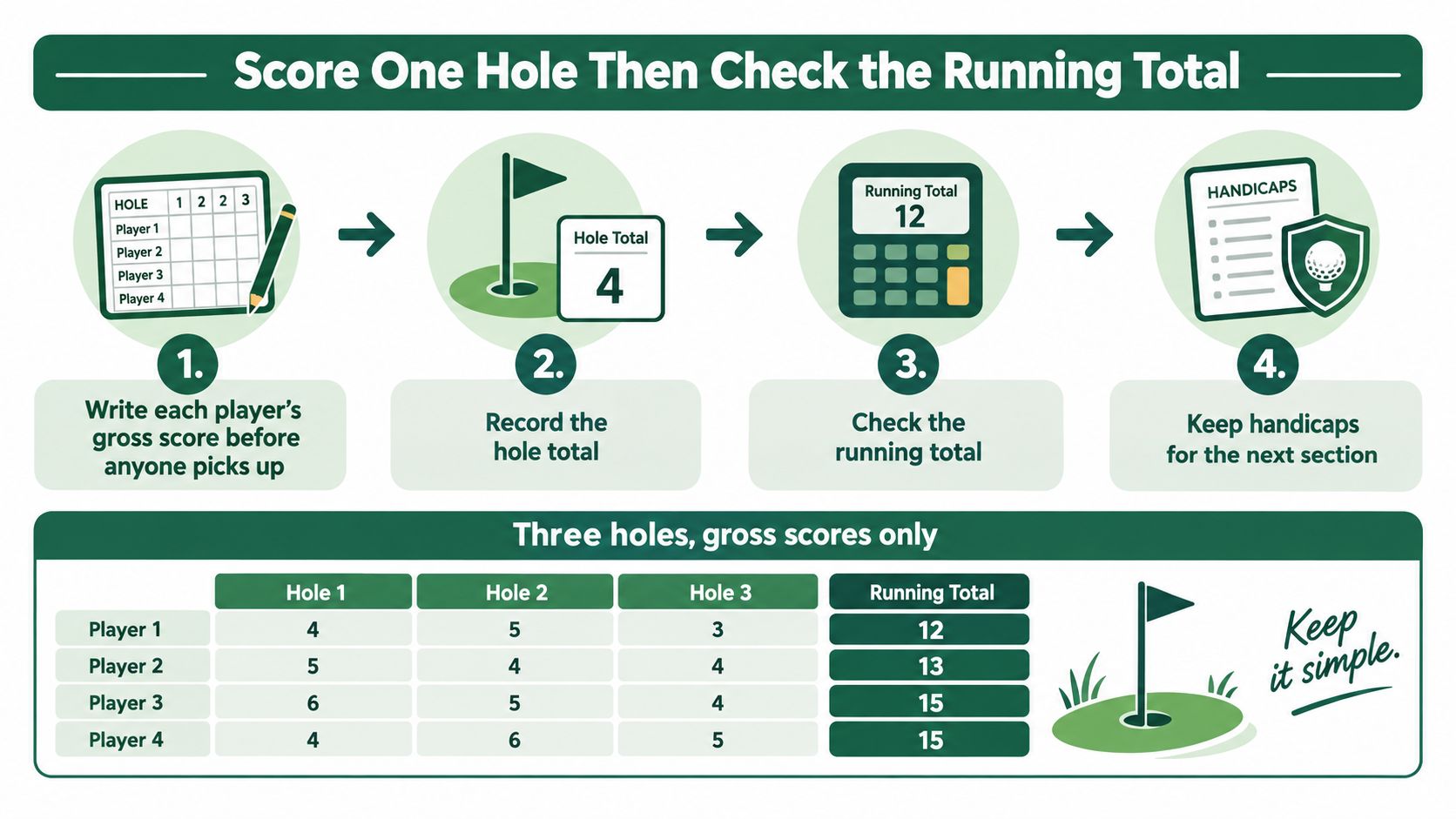
Score One Hole Then Check the Running Total
The marker needs a repeatable routine, not mental arithmetic performed while driving to the next tee. Record the strokes, make any agreed adjustment, award the points, and verify the total while everyone still remembers what happened.
Use a paper scorecard with separate score and points boxes, or the equivalent fields in a digital card. Don't squeeze both figures into an unlabeled square.
The marker's routine
Write each player's gross score before anyone picks up. Confirm the completed score aloud. If a pickup is permitted under your event rules, enter the agreed pickup result rather than leaving a blank.
Apply any allocated strokes. If the game is net, subtract the strokes marked for that hole. For a gross game, keep the original figures.
Rank the results from lowest to highest. Compare the agreed scoring figures, not par, reputation, or who receives strokes elsewhere.
Award the points. Use the outright allocation or the appropriate tie split. Don't improvise when players finish level.
Update each running total and check the hole. Confirm that the awarded points add to 9 before the group leaves the green.
The workflow illustration is a reminder to separate score entry from total checking. The Nines contest itself still uses a threesome, regardless of the illustration's player count.
Work a gross-only example
Say Players A, B, and C are playing gross. On hole 1, they record 4, 5, and 6, respectively. Their points are 5, 3, and 1, so those are also their opening running totals.
On hole 2, they record 5, 5, and 6. A and B share low score, so the awards are 4, 4, and 1. Their running totals become 9, 7, and 2.
On hole 3, everyone records 4. Each receives 3 points, leaving running totals of 12, 10, and 5.
The check is 12 + 10 + 5 = 27, which is 9 × 3 holes. That's the proof that every point available in this example has been assigned.
A correct combined total doesn't guarantee that every player has the right individual total. The marker can still swap players' awards. Keep names above the columns and read the allocation back in that same order every time.
If the combined check fails, look at tied holes first. A tie entered as an outright win is the usual suspect, especially when someone announces that they won the hole before noticing another player matched them.
Don't let a pickup become a blank
Agree before play how the contest treats a pickup, such as a published maximum for that hole. Specify whether that maximum is gross or net, and make sure everyone understands how it affects the contest.
A pickup convention is an event rule, not permission to invent a completed score for handicap posting. Keep the contest record and any handicap submission requirements distinct.
Use the same green-side ritual throughout: three scores, three point figures, a hole total of 9. It takes less effort than rebuilding an argument from memory at the scoring desk.
Choose Gross or Net Handicap Scoring
A higher-handicap player can make a perfectly respectable score and still feel they never had a chance. A lower-handicap player can feel equally aggrieved if the group starts handing out extra strokes without a clear method.
Neither complaint is settled by saying everyone agreed to play Nines. The handicap setup is part of the game, not an administrative detail.
Match the method to the group
Handicap setups for a 9-point threesome
Method | Who receives strokes | Use it when |
|---|---|---|
Gross | Nobody | Players are similarly skilled |
Net off the low player | Only the differential above the lowest handicap, such as 8 and 18 from handicaps 6, 14, and 24 | A mixed threesome needs a fair game |
Full course handicap | Each player's course handicap on stroke-index holes | A league or flight already posts handicaps |
Gross scoring fits players of similar ability, roughly within a few strokes. It removes stroke dots and makes the card easy to manage, but it doesn't compensate for a meaningful ability gap.
For a mixed casual group, I would start with net off the low player. In the example of course handicaps 6, 14, and 24, the lowest player plays scratch for the contest, while the others receive 8 and 18 strokes. Mark those strokes against the scorecard's stroke-index holes before play.
Full course handicaps suit a formally handicapped league or flight where the organizer already has an established procedure. Everyone receives their applicable allocation, and the marker compares the adjusted results.
The GolfApp Nine Point guide describes the full-handicap and net-off-low choices, including the 6, 14, and 24 example, and notes the USGA requirement that all nine holes must be played for an acceptable 9-hole handicap score.
Don't assume full handicaps and net off low will produce identical hole results. Removing the lowest player's allowance changes where relative strokes fall. Pick the method deliberately rather than treating the names as interchangeable.

Make the adjustment visible
The Settle the Card Nines rules give a useful example: a gross 5 on a par-4 with one allocated stroke becomes net 4; if the other players each make gross 4 without a stroke, everyone has net 4 and receives 3 points.
The player who took more actual strokes hasn't been given bonus points. Their score has been adjusted before the ranking, which is the whole purpose of the net contest.
For organizers who need a fuller explanation of course-handicap allocation, a consistent handicap scoring procedure prevents staff from giving different answers at registration and on the tee.
A player without a current handicap needs an agreed temporary number before the round, or a gross game. Label any temporary allowance as an event arrangement; don't present it as an established handicap.
Starter's check: Name the method, identify who receives strokes, and confirm that ties still split.
For a standalone nine-hole event, keep the contest result separate from whether the round qualifies for handicap submission. Winning the side game doesn't make an incomplete handicap score acceptable.
Build a Tournament Scorecard and Pairings
At a shotgun start, the starter shouldn't be rebuilding groups while carts are heading out. Set the threesomes, confirm the scoring method, and print cards that make the handicap allocation visible.
Keep each Nines game at exactly three players. If your entry list leaves a single player or a pair over, give those players a different side game or adjust the event arrangement. Don't add another player to a scoring system designed around a threesome.
Pair for the contest you're running
For net-off-low groups, placing a lower-, middle-, and higher-handicap player together can make an inclusive social contest. Check the actual stroke allocation, though. Balanced-looking names on a pairing sheet aren't a substitute for correct handicap marks.
For gross flights, group players of similar ability. A broad gross flight saves setup work but can leave the weaker players competing for minor places before the round has properly started.
Use golf pairing software to keep the roster, starting assignments, and printed material aligned. When a withdrawal forces a change, update the group and its handicap allocation together.
Your printable card should include:
Hole information: Hole number, par, and stroke index.
Player scoring fields: Gross score, strokes received, net score, and points for each player.
Audit space: A hole-total box that must read 9, plus clearly labeled running point totals.
Contest identification: Player names and the agreed gross or net method.
Don't omit gross scores because the leaderboard uses net points. Staff need the original score and stroke allocation to investigate a disputed entry.
Give staff a sample they can copy
Use this hypothetical net-score example on a staff reference sheet. The net figures are already adjusted, so the marker only has to rank them and allocate points.
Sample net scorecard for three holes
Hole | Net A | Net B | Net C | Points A-B-C | Hole total |
|---|---|---|---|---|---|
1 | 4 | 4 | 4 | 3-3-3 | 9 |
2 | 4 | 4 | 5 | 4-4-1 | 9 |
3 | 4 | 5 | 6 | 5-3-1 | 9 |
Three-hole total | Not applicable | Not applicable | Not applicable | 12, 10, and 5 | 27 |
The matching cumulative check helps staff distinguish a scoring problem from a display problem. If the point awards are right but a player's leaderboard total is wrong, inspect the running addition or entry rather than changing the hole result.
Keep a record of corrections. A crossed-out paper entry should remain readable, and a corrected digital score should be confirmed with the group before prizes are settled.
Publish the payout separately
State the bet before play. For example, the group might agree on a small pot for the highest point total, or a 60-30-10 place payout ranked by the group's own points.
Also decide what happens when players tie in the final standings. Hole ties already have a scoring rule, but a tied overall prize needs its own settlement agreement.
Cart signs and bag tags don't need the whole rules sheet. Names, tee time, and a clear label such as 9-point, net off low or 9-point, gross are enough. Keep the detailed stroke allocations on the scorecard where the marker can use them.
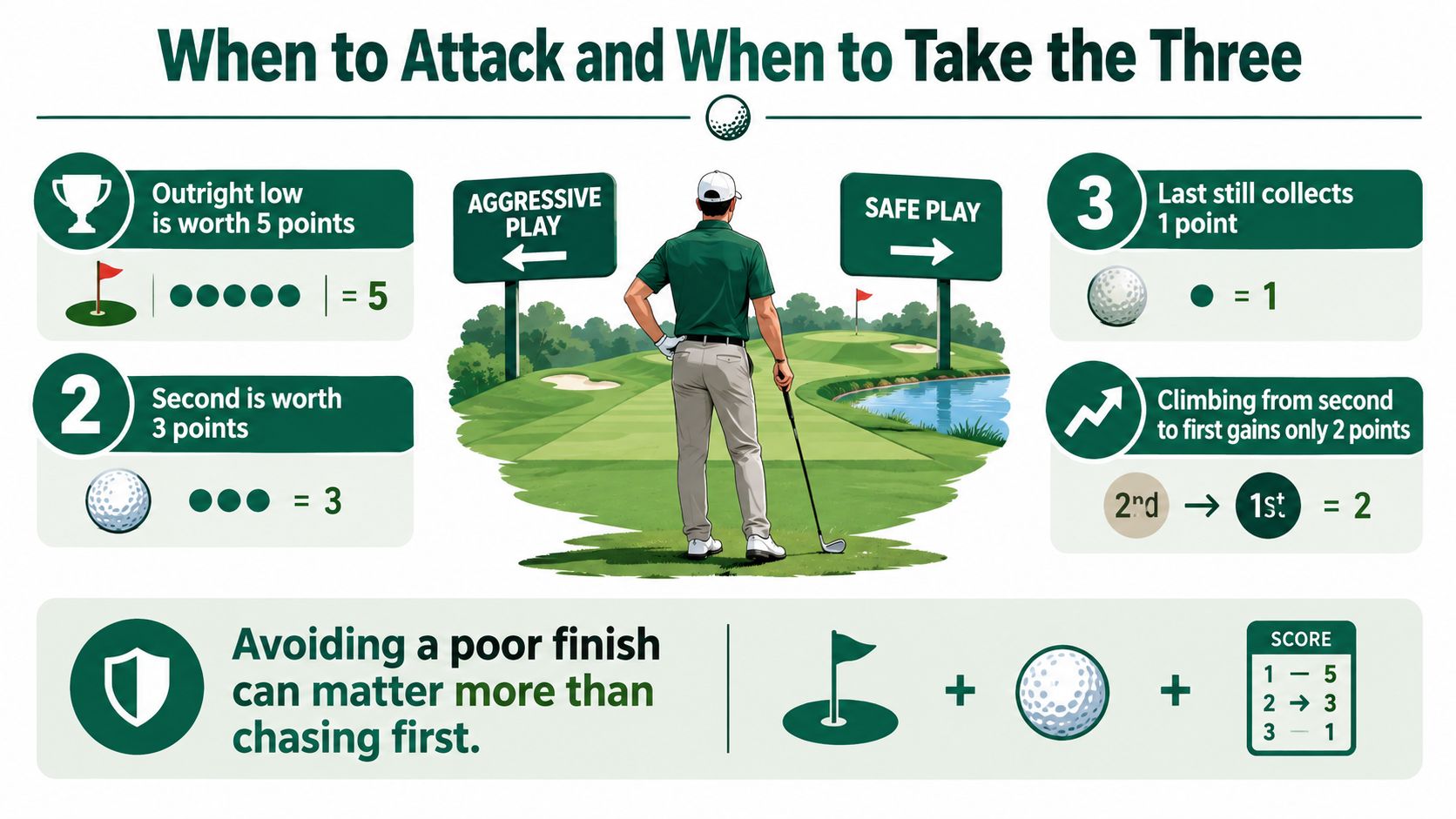
When to Attack and When to Take the Three
The strategic decision starts with the size of the reward, not the excitement of the shot. Moving up a place is useful, but a failed attempt can cost just as much as a successful one gains.
The Duck Hook Nines guide puts an outright win at 5 points, second at 3, and last at 1: moving from second to first gains 2 points, while avoiding last protects the same margin; repeated over 18 holes, that 2-point swing can create a 36-point differential.
That isn't an argument for timid golf. It's an argument for choosing aggression when your actual chance of improving position justifies the risk.
Attack the opportunity, not the flag
On a long par 4 or a guarded par 3, play toward the part of the green that leaves a manageable miss. A safe approach and an ordinary putting finish can be valuable when an opponent is already in trouble.
Short par 4s and reachable par 5s deserve a different calculation. If your normal shot can reach a useful position and the miss leaves a playable recovery, attacking can be sensible.
Ask what happens when you don't strike it perfectly. A fairway bunker with a clear exit isn't the same risk as a penalty area, and a chip from short grass isn't the same recovery as a short-sided shot over sand.
Choose a club for its reliable flight and landing area, not its best-ever distance. If you're reviewing equipment for those approaches, you can shop woods for fairway shots at Fayrway, then assess the loft and carry window against the shots you need. A new club isn't a reason to attempt a carry you haven't established.
Read the other players' positions
Nines is played against the people beside you. Their ball positions matter when you're deciding whether to take on a difficult shot.
If an opponent is safely on the green, weigh whether your aggressive line can realistically beat their likely score. If both opponents are recovering from trouble, there's little sense in volunteering for the same problem.
Protect a useful finish: Choose the wide target when your current position is competitive.
Press with a credible advantage: Attack when the distance, lie, and miss pattern suit your normal shot.
Stay with the agreed scoring: Review the posted tie table before betting, rather than negotiating after a close finish.
A safe shot isn't automatically defensive. Sometimes it's the best way to make the other players earn their points.
The player with the most birdies doesn't necessarily win. A player who repeatedly avoids the worst finish and takes the available outright wins can beat someone who alternates spectacular shots with costly recoveries.
Lock the Rules Before the First Tee
Write the contest rules before sending the pairings. Put the same wording in the player email and on the scorecard so the starter isn't choosing a handicap policy while players are waiting to hit.
Keep that wording consistent for weekly leagues and charity outings. Change it only through a clear announcement before play, not because a result suddenly feels unfair to someone in the group.
The pre-round checklist
Confirm the groups. Every Nines contest has exactly three players.
Name the handicap method. State gross, net off low, or full course handicap, and show each player's strokes.
Prepare the card. Print hole, par, stroke index, and the 9-point check.
Confirm the bet. Specify a winner's pot or the agreed 60-30-10 split, including tied-place treatment.
Post the points table. Keep it visible to markers rather than relying on a verbal explanation.
Add the pickup policy and identify who resolves disputed entries. Ask players to confirm scores before leaving each green, then return or approve the completed card through the same procedure.
If staff are still adding nines by hand after the round, Live Tourney provides real-time leaderboards and instant score updates without app downloads, helping keep hole-by-hole points and the 9-point check visible while groups are on the course.
Publish the rules with the pairings. Let players concentrate on the next shot instead of wondering which version of the game they're playing.
Live Tourney can generate scorecards, tee sheets, cart signs, bag tags, and more, helping your Nines event start with consistent information. Visit Live Tourney to try the 10 Day Full Access Free Trial and set up your next threesome contest with a clear scoring procedure.





