
Sep 12, 2026
golf club labels, golf bag tags, custom bag tags, tournament signage, Live Tourney
Learn golf club labels types, materials, sizes and printing options plus how to create bag tags and cart signs for events with Live Tourney.

The first tee time is approaching, and the clubhouse is already busy. Bags are arriving, rental sets are moving between the pro shop and the carts, and players are asking where to check in. Without clear identification, a staff member may need to open several bags to find the right set or confirm which cart belongs to which group. Golf club labels, bag tags, and cart signs give everyone a quick visual reference before the round begins.
A good labeling system does more than add a name. It helps staff organize equipment, supports loss prevention, gives players confidence that their clubs are easy to return, and carries the event's identity across the course. The practical question is how to make those labels durable, readable, and connected to the rest of the tournament paperwork.
Introduction to Golf Club Labels and Why They Matter
Tournament morning is a test of the event's identification system. A guest leaves a club near the practice area, a rental set reaches the wrong cart, or two players arrive with nearly identical bags. Clear labels give staff a reliable visual reference, so they can act without depending on memory or repeated checks.
Shaft labels put a small identifier directly on a club. A player name, initials, phone detail, or set number can distinguish one club from another. The person holding the club gets an immediate clue; the staff roster and inventory record remain the system of record.
Bag tags identify equipment from a greater distance. They can show the bag owner, member, group, or access status before anyone handles the clubs. Some club and course operations also use bag tags as visible membership or access markers. A European golf supplier states that golfers entering the fairway must visibly attach a bag tag as proof of green-fee payment. Its supplier's bag-tag information describes bag tags as tools for club protection and quick return when equipment is misplaced. The example demonstrates how one printed item can support identification and day-to-day compliance.

Practical rule: A label should answer one question quickly. Who owns this club, which group uses this bag, or where should this cart go?
A tournament-ready system carries one visual language across every asset. For example, a sequential number on a bag tag can match the number on a cart sign and the group record in Live Tourney. The logo and event name can follow the same template, so staff are not rebuilding each item as a separate job.
The full workflow starts with the shaft label and continues through bag tags, cart signs, proofs, and production. Material and adhesive choices affect how well a label stays readable during play. A repeatable system also gives staff a clear handoff: prepare the club identifiers, match them to bags and carts, check the event details, then distribute the finished materials. That structure turns one-off printing into a process new staff can follow with fewer questions.
What Golf Club Labels Are and How They Work
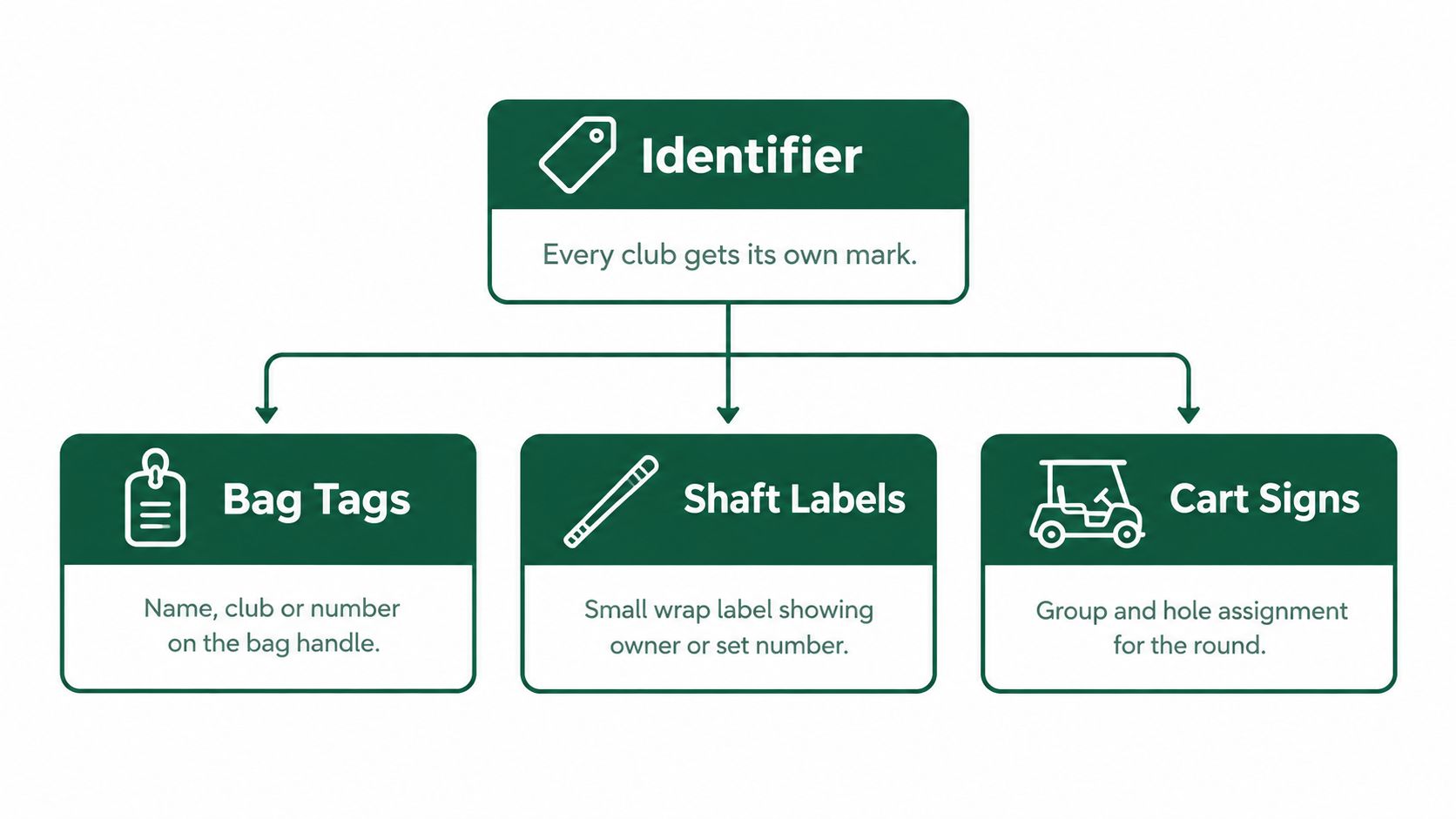
Start with the simplest definition. A golf club label is an identifier attached to equipment, much like a luggage tag identifies a suitcase or a name badge identifies a person. The label doesn't need to explain the entire event. It needs to make the right club or set recognizable at a glance.
The placement determines the job:
Shaft labels: These wrap around or adhere to the shaft, usually where a player or staff member can see them without interfering with the grip or swing.
Bag tags: These hang from the bag handle or another visible attachment point and identify the bag, member, group, or payment status.
Cart signs: These sit where staff and players can see them from outside the cart, showing a group, starting hole, or assignment.
The identifier is the common thread
The three formats look different, but they should work together. A shaft label might show a player name or rental-set number. The matching bag tag can show the same number in a larger format, while the cart sign places that number beside the group assignment. Staff then follows one identifier from storage to cart to course.
The information printed on each item should match its distance from the reader. Small shaft labels need short, high-contrast text. Bag tags have more room for a name, club logo, event title, or number. Cart signs should prioritize group and hole information because they serve a fast-moving staging area.
Identification is not the same as rules conformance
This distinction prevents a common mistake. Stick-on labels are useful asset tags, but they aren't permanent club markings for equipment-conformance purposes. The USGA says identifying markings on club heads should be permanent, clear, unambiguous, and difficult to replicate. It also says information on stick-on labels won't be recognized as an identifying marking. The USGA equipment guidance explains that changes in color, font, or size don't substitute for a true distinguishing marking.
Use labels for ownership, inventory, routing, and event organization. If a program needs rules recognition, pair the label with permanent clubhead markings or a reliable roster and inventory record.
Origin marking creates another separate issue for imported equipment. U.S. Customs guidance says imported articles generally need a conspicuous, legible, indelible, and permanent English country-of-origin marking, while an assembled golf club may be handled differently when its outermost container is properly marked for the ultimate purchaser. The Customs ruling on golf-club marking is the appropriate reference for that distinction. A tournament label isn't a substitute for either regulatory marking or a conformance marking.
Types of Golf Club Labels by Material Size and Printing
Material choice controls how long a label stays readable and attached. Golf equipment faces sunlight, moisture, sweat, repeated handling, and friction from the bag. A paper label may look fine at the printer and fail once it rubs against neighboring clubs.
Two common constructions are metallized polyester, also called PET, and laminated vinyl. Technical descriptions from golf-label suppliers present metallized polyester as a thin outdoor substrate, while laminated vinyl adds a protective surface that helps resist water, fading, and abrasion. Pin High's golf-label materials guidance emphasizes the relationship between the substrate, overlamination, and adhesive performance.
Material Type | Durability Features | Typical Size | Best Use Case |
|---|---|---|---|
Metallized polyester PET | Thin construction with resistance to club wear and outdoor handling | About 2 inches by 0.75 inches for shaft applications | Personal clubs and compact member identifiers |
Laminated vinyl | Waterproof surface, UV-resistant overlamination, and abrasion resistance | About 2.5 inches by 0.75 inches for shaft labels | Recurring events, rental sets, and exposed equipment |
Laminated label stock | Printed surface protected by a clear laminate | Size selected for the available label sheet | Small outings and controlled in-house production |
The listed technical descriptions include a metallized polyester film that is 2 mils thick, showing that a durable label doesn't have to be bulky. Another recommendation uses a shaft label of roughly 2.5 inches by 0.75 inches and calls for a 24-hour adhesive cure before clubs return to play. Those figures come from supplier guidance, so treat them as useful starting points rather than universal specifications.
Readability matters as much as toughness
A label can survive the weather and still fail operationally if the text is too small or the contrast is weak. Put the identifier first, then add supporting details such as a logo, phone number, or event name. On a shaft label, avoid filling every available space. Staff should be able to scan the mark while moving clubs between a bag, cart, and rack.
Printing quality depends on the method and the stock. An office printer with compatible sheets can suit a small outing, but the result depends on alignment, ink or toner adhesion, and protective lamination. A vendor can produce labels on purpose-built outdoor material, which is more appropriate when the same format will be used repeatedly.
The laminate is the rain jacket. The substrate is the shirt underneath. Both matter, but the jacket can't fix a weak shirt.
Before applying labels, clean the shaft surface and let the adhesive cure for the supplier's stated period. Applying a label and immediately returning the club to a crowded bag invites edge lift. For a broader look at how physical identification can translate across branded gear, this guide to designing a custom label for apparel offers useful context on layout, branding, and label presentation.
How to Choose and Create Labels for Events and Leagues
A tournament morning can become confusing when a staff member must open every bag to identify a set. Start by asking what the team needs to see at a glance. A group number, event identity, and player or set detail usually connect each physical label with the roster and the rest of the tournament assets.
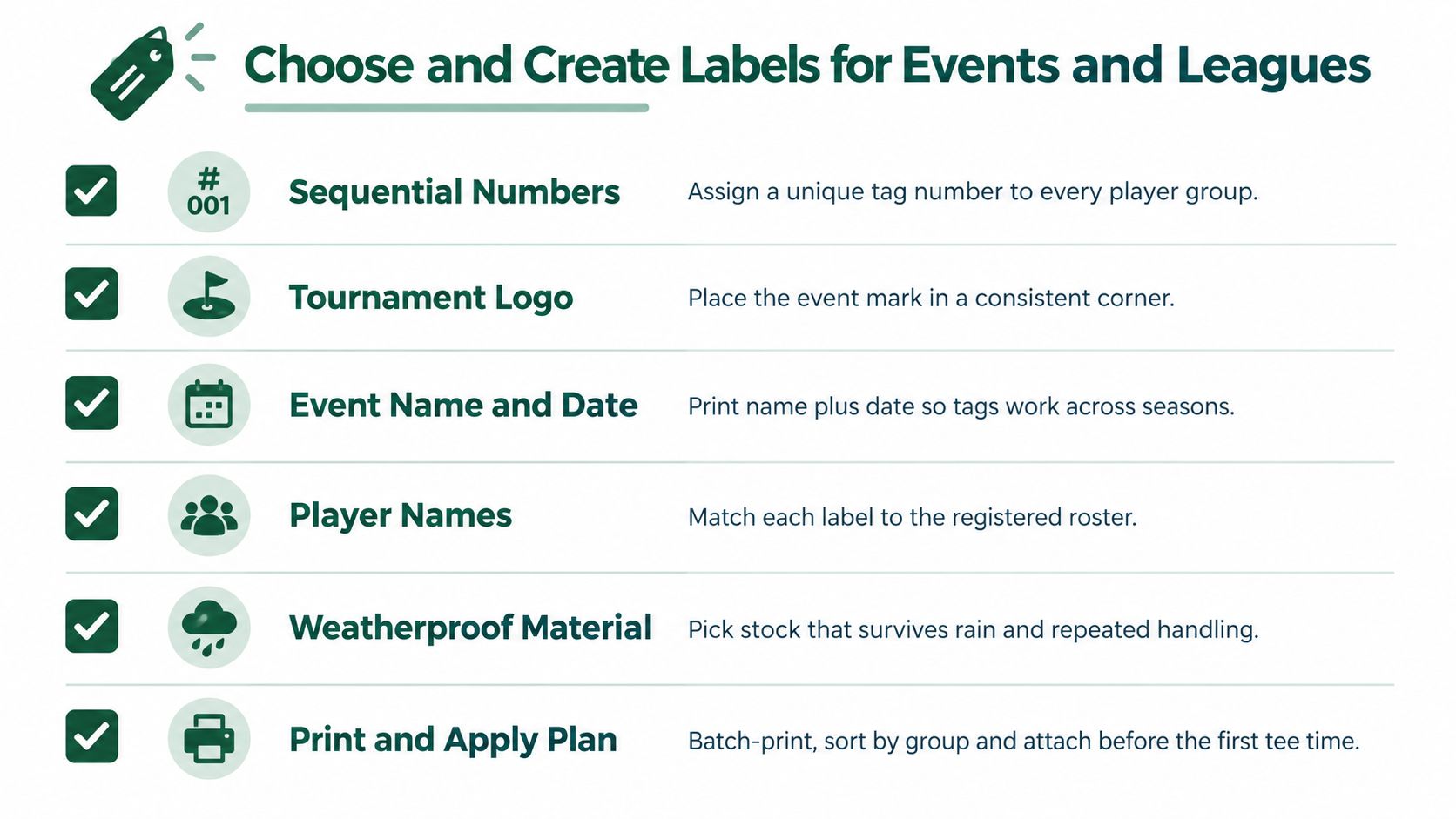
Use one visual hierarchy across shaft labels, bag tags, and cart signs. Make the sequential number the quickest reference, then add the course logo, tournament name, and event date. That shared structure works like a course map: staff can recognize the same information whether they are moving clubs, staging carts, or checking equipment. Live Tourney's bag-tag design guidance highlights these elements for member tournaments, public-course leagues, and corporate outings.
Build the label around the roster
A label works only when it matches the correct person or group. Before printing, compare names, guest details, team assignments, and rental-set numbers with the registration record. Keep one master list so the pro shop, tournament desk, and cart staff are working from the same information.
Use a proofing pass to check:
Numbers: Confirm that each sequential number appears once where required.
Names: Match player and guest names to registration records.
Branding: Check logo placement, contrast, and clear space.
Dates: Verify the event date and remove details that could confuse a later season.
Placement: Make sure the label remains visible after attachment.
Print order: Sort sheets by tee time, group, cart, or staging area.
Separate templates help when labels serve different jobs. A rental label may need a set number, while a member label may give priority to a name. Guest services, junior programs, and repaired clubs can each require different fields. One crowded design is harder to read and easier to misapply.
Plan quantities and timing
Recurring events benefit from a standard format and planned production run. Order early enough to review a physical proof and correct roster data before printing. Keep a small reserve for late registrations, damaged tags, or a rental change.
For a small league outing, in-house printing may be practical. Larger events need a clear handoff between roster approval, label production, sorting, and placement. Treat the process like a relay. Each staff member should know which version is approved and where the finished labels belong.
Clothing labels follow the same naming principle. If staff are preparing player apparel alongside equipment, event stick on clothing labels offers guidance on name placement and consistent presentation across tournament materials.
DIY Versus Vendor Options for Golf Club Labels
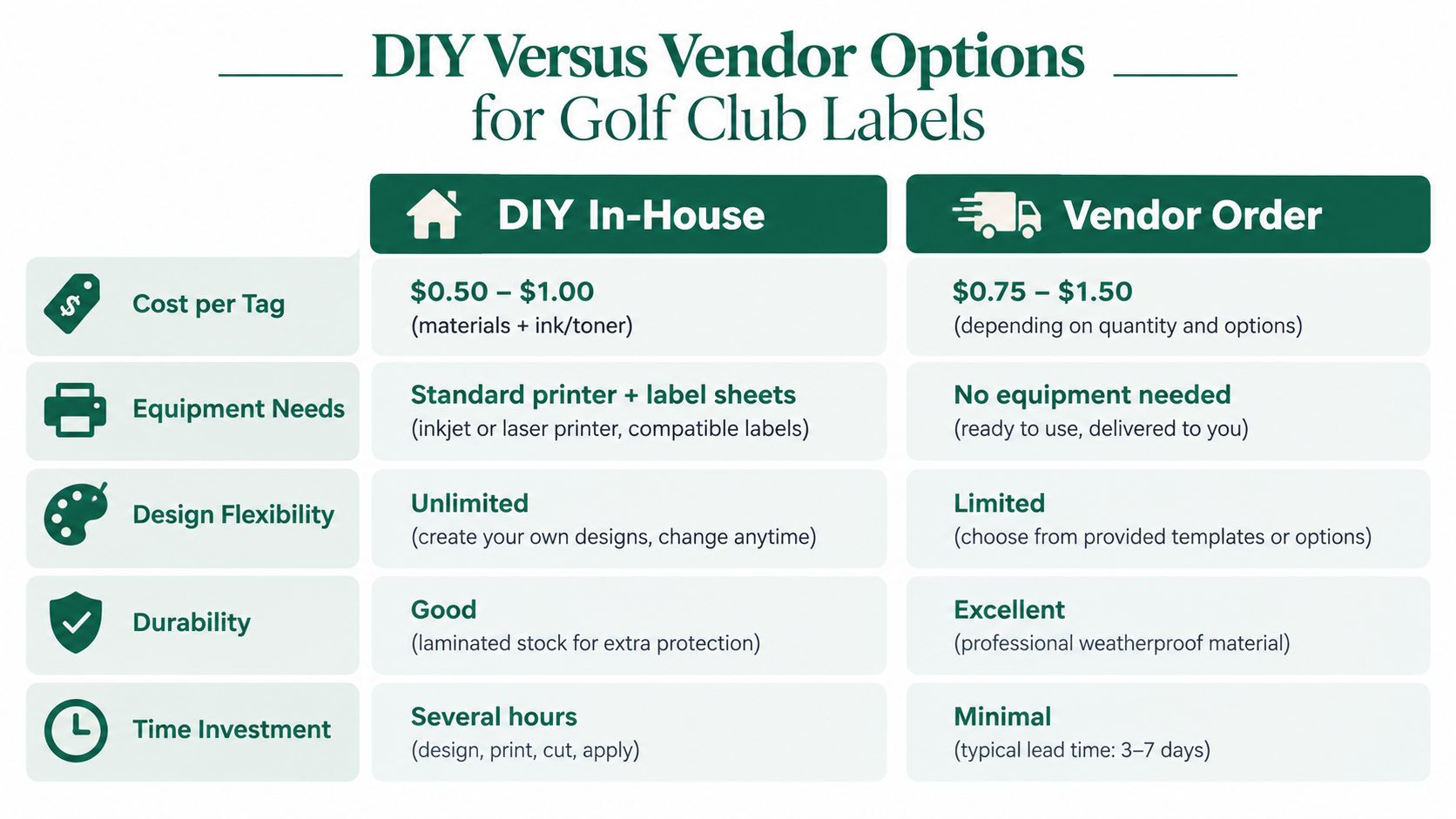
A nine-hole junior session may change its player list shortly before the first tee time, while a recurring league may need the same label format each week. The production method should match that working reality. For a small outing, staff can create golf club labels in-house with a standard printer, compatible sheets, and a clear template. This keeps names and late changes under immediate control.
The trade-off is staff time. Someone must format the roster, check alignment, print, separate or cut the labels, laminate them when needed, sort them, and attach them. A home or office printer may also struggle with outdoor substrates or adhesive sheets. A label that looks fine on paper can fail once it meets moisture, handling, or repeated equipment use.
When in-house printing makes sense
DIY production suits a manageable label count and a simple design. It works for a junior session, a small league day, or an event with frequent roster changes. Staff can print only the required labels and adjust the starting row and column on a partly used sheet.
In-house printing also gives organizers more freedom while preparing tournament assets. The risk grows when several people handle the file. A typo, shifted alignment, or mixed sorting order can cause confusion at check-in, even when the finished label looks polished. Use one approved template and one clearly named roster file to reduce that handoff risk.
When a vendor earns its place
A vendor order suits recurring leagues, rental fleets, and events that need outdoor durability. Suppliers may offer metallized polyester or laminated vinyl, UV protection, and adhesive construction designed for the job. Product examples place personalized labels in the approximate $15.95 to $26.95 range, while an industry guide gives a roughly $20 to $30 range for personalized tags. These figures are examples rather than universal prices. Format, quantity, and finish affect the final cost.
Before approving an order, request a proof, verify the data source, confirm the material, and ask about adhesive cure time. Save the approved design so the next shaft-label run, bag-tag order, or cart-sign set starts from a known template instead of a blank page. For production preparation and printing guidance, see this bag-tag printing guide.
Choose DIY when flexibility and quick changes matter most. Choose a vendor when consistent materials, weather resistance, and repeatable output justify the lead time. That choice helps turn separate tournament items into a process staff can repeat confidently.
Integrating Labels With Bag Tags and Cart Signs in Live Tourney
The best labeling process doesn't treat shaft labels, bag tags, and cart signs as separate creative projects. They should draw from the same roster, group assignment, and numbering plan. When staff enter information once and reuse it across reports, the chance of a mismatched name or cart number falls because fewer people retype the same details.
Live Tourney is a web-based tournament platform that includes roster uploads and customizable report tools for scorecards, tee sheets, cart signs, and bag tags. Its label and bag-tag reporting options let staff generate printed assets from event information, while its tournament tools support formats including scrambles, match play, Ryder Cup, and round robin. For a golf facility, that creates a useful bridge between registration data and the physical items waiting at the clubhouse.
Use one identifier across the course
A group number can appear on the bag tag, cart sign, tee sheet, and staff sorting list. A rental-set number can appear on the shaft labels and the inventory record. A junior-program label can use the same player or group reference that staff use at check-in.
That consistency helps in several places:
Check-in: Staff match a player or group to the correct printed packet.
Guest services: Employees identify rental or demo equipment without opening every bag.
Staging: Cart staff place signs and bags together by group or starting hole.
On-course support: A visible identifier helps staff route questions and equipment.
Post-round recovery: Found clubs and bags have a clear path back to the right group.
Cart signs also carry a visual burden. They need larger, simpler information than shaft labels, especially when staff are scanning several carts in a staging area. A decorative design can work, but the group and assignment should remain dominant. If your event uses decorated vehicles or has a parade theme, this guide to a parade-ready electric cart offers relevant ideas for balancing visibility with presentation.
For a focused look at the sign itself, Live Tourney's golf cart signs resource can help organizers think about information hierarchy and placement. The larger lesson is simple. A label system becomes staff-friendly when the same data drives every physical touchpoint.
Final Takeaways for Professional Golf Club Labeling
Professional golf club labeling starts with clear roles. Shaft labels identify individual clubs or sets. Bag tags identify the bag from a distance and can support membership, access, payment, or recovery workflows. Cart signs direct groups and assignments. Each format should carry only the information people need at its viewing distance.
Material selection follows the environment. Metallized polyester and laminated vinyl are suitable starting points for outdoor equipment, while UV protection, abrasion resistance, adhesive quality, and cure time determine whether the label remains useful after repeated handling. A durable substrate won't compensate for poor placement or unreadable type.
Event design should also serve operations. Use a recognizable sequential number, a consistent logo position, the tournament name, and the event date. Match every printed item to one roster. Proof names and numbers before printing, sort the finished labels by group or staging area, and keep a documented template for the next event.
The final improvement is integration. Instead of creating a bag tag, cart sign, and tee sheet as unrelated files, connect them to the same event information. That approach gives staff a repeatable process for member tournaments, leagues, corporate outings, rental sets, and junior programs.
Start with your next event's roster and identify the three moments where staff lose time, usually check-in, cart staging, or equipment return. Assign one identifier to each group or set, choose the material that fits the exposure, and prepare matching labels and signs before tournament morning.
Live Tourney provides roster uploads and customizable reports for bag tags, cart signs, tee sheets, scorecards, and other tournament assets, alongside web-based registration and live scoring tools. Visit Live Tourney to explore a repeatable event workflow and prepare your next labeling system from one organized source.





