Aug 28, 2026
bag tag design, golf tournament ideas, golf bag tags, tournament templates, event branding
Explore 8 bag tag design ideas for tournaments and outings, from branded numbered tags to QR codes, sustainable materials, layouts, and printing tips.

Bag tags have been part of organized golf for much longer than many tournament directors realize. An archived example from the First Annual 1983 Las Vegas Pro Celebrity Golf Tournament shows that tournament-branded tags were already serving as memorabilia and participant identifiers by the early 1980s, as documented by the history and customization overview from ParGolf. Today, the small tag attached to a golf bag can do far more than identify its owner.
A well-planned tag can organize pairings, clarify divisions, reinforce course and sponsor branding, support live tournament information, and become a keepsake players remember after the final round. The strongest bag tag design depends on the event format, information density, personalization level, material, attachment method, and printing timeline.
The eight concepts below treat bag tags as working tournament materials, not decorative extras. Each example connects a visual approach to a specific audience and format, then addresses layout, production, durability, and practical use. If you're also exploring personalized tags for younger players, personalized bag tags for kids offers a useful reminder that identity and keepsake value can coexist in one compact product.
1. Classic Numbered Bag Tags with Course Branding
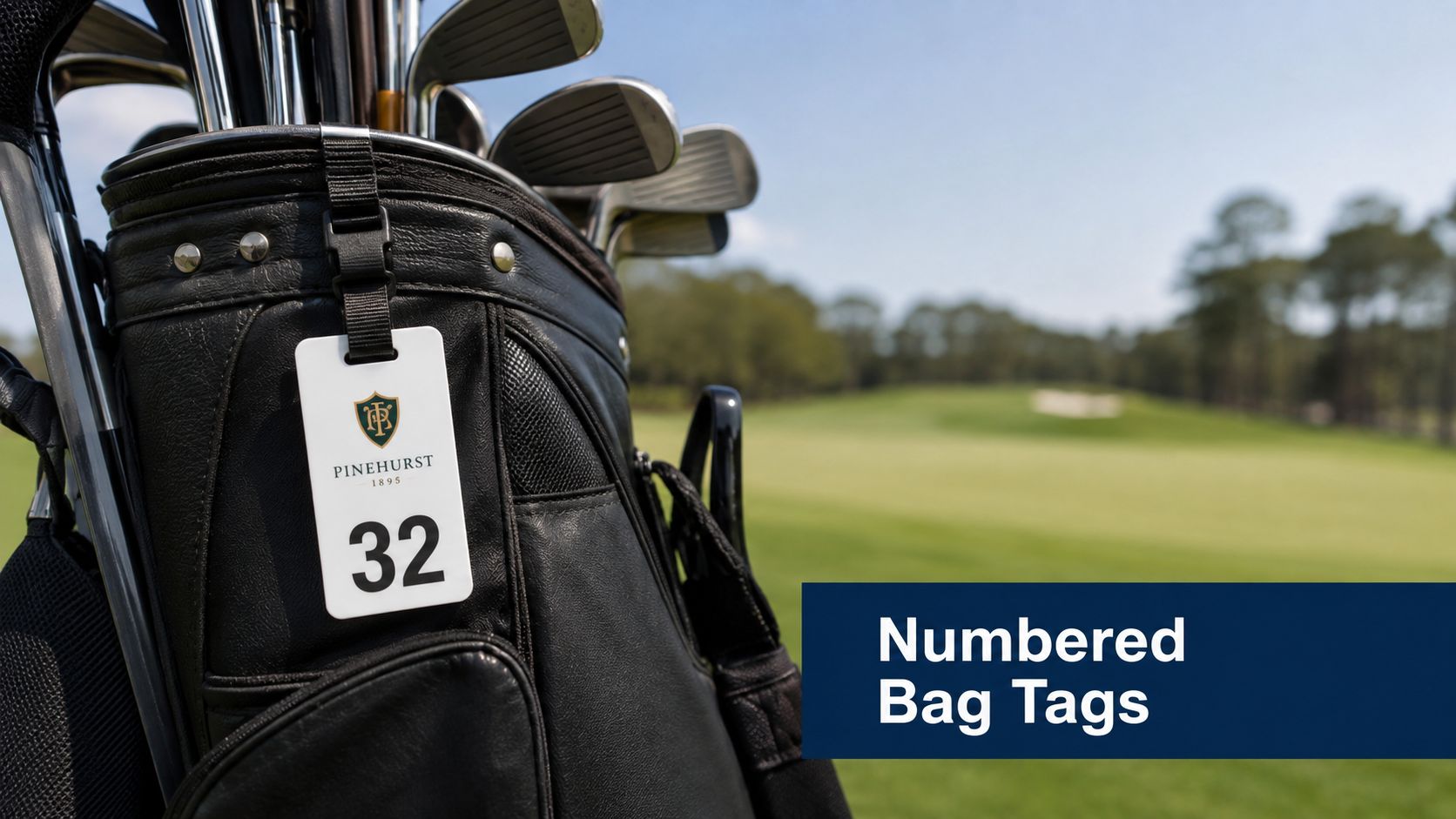
The numbered course tag remains the safest choice when staff need to identify players quickly. A large sequential number, course logo, tournament name, and event date create a simple visual system that works for member tournaments, public-course leagues, and corporate outings. The number can correspond to a pairing, cart assignment, starting group, or internal tournament record.
A championship course might use a restrained black, white, and metallic palette with its crest at the top and the player number as the dominant element. A public course running recurring league play may prefer a reusable branded layout with changeable numbers. A corporate host can reserve a lower panel for the sponsor while keeping the course identity and player number visually stronger.
Make the number the first thing staff see
Use a bold sans-serif typeface and avoid decorative numerals. Staff and volunteers should be able to recognize the number at a distance without turning the bag or interpreting a crowded design. A double-sided print helps because bags often face different directions on carts, racks, and staging areas.
A small hole or slot also matters. Live Tourney's bag tag printing guidance emphasizes practical production details such as rounded corners, weather protection, and finishing before punching. A tag that looks polished but catches on cart hardware or splits around its attachment point will create work for staff.
Practical rule: Design the number for fast sorting first, then fit the logo and sponsor message around it.
Lamination or sealing protects printed surfaces from rain and handling. Waterproof plastic suits wet-weather operations, while leather, metal, bamboo, and aluminum can create a more premium course identity. If a QR code links to a live leaderboard, place it on a clean, high-contrast reverse side rather than competing with the number on the front.
2. Flight-Based Color-Coded Bag Tags
Color-coded tags solve a different problem. They help officials, volunteers, and players distinguish divisions at a glance when an event has Championship, A, B, and C flights or separates groups by age, sponsorship, or playing format.
A member club might assign gold to the Championship flight, blue to A flight, white to B flight, and red to C flight. A corporate outing could use one color for sponsor teams and another for general participants. The design works especially well when staff are moving players through registration, cart staging, scoring, and prize presentation.
Color shouldn't carry the entire meaning. Print the flight name clearly on every tag, because lighting, print variation, and color-vision differences can make color-only systems unreliable. Numeric redundancy also helps. A club could reserve one number range for one flight and another range for a second flight, provided the numbering system remains easy for staff to understand.
Build accessibility into the palette
Avoid relying on red and green as the only distinction. Use contrast, labels, patterns, or a strong border treatment to make each group identifiable without perfect color perception. Test proofs in sunlight, shade, clubhouse lighting, and the lower-contrast conditions often found around cart staging areas.
Metallic or fluorescent finishes can make a charity or corporate event feel more distinctive, but they can also introduce glare. A matte surface may be easier to read under strong sun, while a gloss finish can make saturated colors appear more vivid. The correct choice depends on whether the tag's main job is rapid sorting or commemorative presentation.
Use a consistent location for the flight label, number, and sponsor mark. That way, a marshal doesn't need to relearn the layout for every group.
3. Player Name and Personalized Information Tags
Personalized tags suit events where the participant experience matters as much as operational sorting. A club championship, destination golf event, anniversary tournament, or corporate gathering can print each player's name, home club, handicap, team, or short event message directly on the tag.
The benefit is emotional and practical. A player receives something that feels made for the occasion, while staff get a visible identity marker that can confirm the correct bag. The risk is production complexity. Names arrive in inconsistent formats, late registrations change the roster, and long names can overwhelm a layout designed around a short sample name.
Treat roster data as part of the design
Collect the final roster early enough to allow proofing, corrections, and production. Don't approve a personalized run from an unverified spreadsheet. Confirm capitalization, spelling, club names, divisions, and any information that will appear on the finished tag.
A clean front might use the player's name as the largest line, the event logo in a fixed corner, and the tournament date or host club beneath it. The reverse can carry a QR code to the event page, leaderboard, or sponsor information. Keep the code away from seams, holes, and heavy background patterns.
For a high-end club championship, engraving or laser marking can produce a durable identity piece. For a corporate outing with changing sponsors and participants, printed plastic may be easier to update and reorder. A flexible workflow matters more than choosing the most expensive material.
A personalized tag fails when the name is technically present but too small to read. Let identity have room before adding another sponsor or message.
Package premium tags individually if they'll be presented at registration or an awards ceremony. That small handling decision changes the item from a loose tournament supply into a deliberate participant gift.
4. Paired Team Format Tags with Split Design
Team formats need a tag that acknowledges two or more players without turning the bag into a crowded information panel. A split design works for best ball, scramble, match play pairs, couples events, and co-ed league play.
The front can show the team number and format in one strong block, with the player names placed in two clearly separated fields. A horizontal orientation often gives both names more breathing room than a narrow vertical layout. One side can carry the team identifier while the reverse displays player details, sponsor information, or a short scoring instruction.
Separate team identity from player identity
Use a strong dividing line, contrasting background blocks, or two restrained accent colors. The team number should remain dominant if staff use it for cart staging or scoring. Names should be large enough to confirm the pair without competing with the number.
A corporate scramble may give the upper panel to the event sponsor and the lower panel to the team. That works only if the sponsor mark stays secondary. If the logo becomes the largest element, the tag stops helping staff identify teams quickly.
Secure attachment is particularly important for paired formats because teams may move between carts, staging areas, and scoring locations. Select a hole, slot, loop, or strap that matches the bag hardware, and test a finished sample before ordering the full run. A weak attachment can make a perfectly organized team system useless once tags detach in transit.
For live scoring, keep the team number consistent across the printed tag, pairing sheet, cart sign, and digital leaderboard. Staff then have one identifier to use throughout the day, reducing confusion between player names and team records.
5. Specialty Format Tags for Match Play and Elimination
Match play and bracket events give bag tags a narrative function. The tag can identify a player's bracket position, opponent, round, or progression, turning a functional marker into a visible record of the tournament journey.
A club championship might issue first-round tags with bracket positions and update them as players advance. A weekend elimination event could prepare different tag versions for the winners' and losers' paths. An invitational match play event may use a restrained championship palette, while a casual club bracket can use stronger colors and round labels.
The production workflow needs more planning than a fixed stroke-play tag. Bracket positions change, pairings can shift, and staff may need replacement tags after each round. Live Tourney's guide to creating a tournament bracket can support the operational planning behind that format, while the physical tag should remain understandable to players who aren't familiar with every bracket convention.
Prepare for movement between rounds
Print stable information, such as the event name, division, and player identity, on the main tag. Add changing information through a replaceable insert, a short round label, or a freshly printed tag when the next matchup is confirmed. Don't force staff to handwrite complex bracket information on a glossy surface during a busy transition.
A QR code can point to the live bracket, but it shouldn't be the only way to understand the player's immediate assignment. Include the round and opponent in readable text when that information is operationally important. Keep backup tags ready for late changes, damaged tags, and players who advance unexpectedly.
Use contrasting colors for bracket positions only when the labels remain clear in print. A visual system is useful, but the written round and matchup should always carry the meaning.
6. Eco-Friendly and Sustainable Material Tags
Sustainable materials fit events whose identity includes environmental stewardship. A resort with visible conservation programs, a club promoting responsible grounds management, a junior event teaching environmental values, or a corporate outing with environmental commitments may want the tag to reflect those priorities.
Material options can include recycled plastic, FSC-certified cardboard, cork, bamboo, and plant-based polymers. Each option brings a different balance of weather resistance, finish quality, flexibility, and replacement cost. The correct choice depends on whether the tag is intended for one event, repeated seasonal use, or long-term membership identity.
Match the material to the event lifecycle
A short charity outing may tolerate a lighter commemorative material if the tag isn't expected to survive repeated seasons. A club that issues tags annually needs a construction that remains legible through handling, outdoor exposure, and attachment stress. Rigid plastic is often practical for recurring operations, while bamboo or cork can provide a distinctive tactile finish when the event places more emphasis on presentation.
Don't make broad environmental claims without confirming the material's composition, manufacturing process, and disposal route. Put a concise sustainability message on the reverse or in event communications, but make sure the statement can be supported by the supplier.
Sustainable bag tag design isn't just a material decision. It also includes reorder frequency, expected lifespan, packaging, and what happens when the event ends.
Test the finished tag in the actual climate before placing a large order. Humidity, rain, heat, cart contact, and repeated bending can expose weaknesses that aren't visible in an artwork proof. Round corners, protect the surface where appropriate, and check the attachment point after finishing.
7. Digital Integration Tags with QR Codes and NFC Technology
A digital tag connects a physical bag to the tournament's live information layer. A QR code can lead to a leaderboard, player profile, sponsor page, event schedule, or tournament instructions. NFC can offer a tap-based alternative, while printed information keeps the tag useful for players who don't scan or tap.
The most successful implementation starts with one clear destination. A crowded tag that links to several unrelated pages creates more friction than value. Use a short instruction such as “Scan for live scores,” then send the player to a mobile-friendly page that loads without requiring an app download.
Design for scanning in real conditions
Place the QR code on a plain, high-contrast area with generous clear space around it. Keep it away from holes, curved edges, glossy reflections, and artwork that breaks up the code. Test it on multiple phones in sunlight and shade before production, then test the final finished material rather than relying only on a digital proof.
The exact code size should be determined by the intended viewing and scanning distance. A code on a tag held close to a phone can use a different treatment from one staff members scan while bags remain on a cart. Don't assume that a code that scans on a designer's monitor will scan reliably after lamination or metallic printing.
Live Tourney's digital golf scorecards provide a useful operational destination for a connected tag. Keep a non-digital fallback for essential information, including the event name, player or team number, and basic instructions.
Live Tourney's Verifeye system also describes a more advanced model, where bag-tagged RFID chips are read at discreet course stations and consolidated into a dashboard for pace-of-play and movement analysis, as explained in this overview of branded RFID golf bag tags. That approach requires reliable attachment, consistent placement, durable construction, and a course layout that supports reader stations. A decorative tag isn't automatically a dependable tracking carrier.
8. Premium Commemorative and Engraved Bag Tags
Premium tags are best reserved for occasions with lasting significance. A club champion, member-guest winner, anniversary event, hall of fame designation, or major invitational can justify brass, stainless steel, anodized aluminum, embossing, or detailed engraving.
The strongest premium designs are restrained. Include the event name, year, championship designation, and recipient identity, then let the material and finish create the sense of importance. A large sponsor panel, excessive copy, or multiple competing marks can make an expensive tag feel like ordinary promotional merchandise.
Decide who receives the premium version
A club may issue standard printed tags to every participant and reserve one engraved tag for the overall champion. A milestone event may produce a premium run for all players if the tag is intended as the principal keepsake. Both models can work, but the audience should be decided before artwork and pricing are approved.
Verify every name before engraving. Corrections are more difficult and costly once the material has been marked, so use a final proof with exact spelling and championship designation. Ask the supplier how the finish handles outdoor exposure, scratching, and contact with cart hardware.
Live production guidance from CPCards' golf bag tag material advice highlights the practical difference between durable plastic and more premium options. Plastic supports flexible seasonal updates, while metal and engraved formats are better suited to long-lived identity or recognition. The right choice depends on whether the event's roster and sponsor details are stable.
Present champion tags in an elegant package and display notable winners in the clubhouse or pro shop when appropriate. The tag then becomes part of the club's visual history rather than another item left in a registration box.
8-Way Bag Tag Design Comparison
Tag Type | 🔄 Implementation Complexity | ⚡ Resource & Cost | 📊 Expected Outcomes | Ideal Use Cases | ⭐ Key Advantages |
|---|---|---|---|---|---|
Classic Numbered Bag Tags with Course Branding | Low, straightforward sequential print and mounting | Low, standard plastic/laminate, bulk economical | Clear pairing identification and consistent course branding | Daily leagues, member tournaments, high-volume events | Universal recognition, cost-effective, integrates with live scoring |
Flight-Based Color-Coded Bag Tags | Low–Medium, requires flight mapping and separate color runs | Medium, multiple color sets, possible specialty finishes | Instant division identification; smoother operations and volunteer coordination | Multi-division club events, corporate/charity mixed-skill tournaments | Fast visual sorting, spectator-friendly, reduces official confusion |
Player Name and Personalized Information Tags | Medium–High, roster collection and individualized printing | High, per-unit personalization, premium materials/finishes | Strong player engagement, memorable keepsakes, increased perceived value | Club championships, destination/resort tournaments, milestone events | Boosts loyalty, photo-worthy, enables roster verification |
Paired Team Format Tags with Split Design | Medium, split layout, dual info and mounting considerations | Medium–High, wider tags or custom holders, more complex print | Clear team membership display; reduces confusion in team formats | Best-ball, scramble, corporate team events, partner tournaments | Communicates team pairing, doubles as keepsake for both players |
Specialty Format Tags (Match Play, Bracket, Elimination) | High, dynamic updates, round progression logistics and reprints | High, frequent reprinting, complex design and QA | Clarifies bracket progression, enhances spectator narrative and management | Match play championships, elimination brackets, playoffs | Visual tournament storytelling, reduces reliance on physical boards |
Eco-Friendly and Sustainable Material Tags | Medium, supplier sourcing and material testing required | Medium, some options cost-competitive; specialty materials may be premium | Positive ESG impact, marketing differentiation, appeals to eco-aware players | Clubs with sustainability programs, eco-certified resorts, junior programs | Aligns with sustainability goals, marketable CSR asset |
Digital Integration Tags with QR Codes and NFC Technology | High, tech integration, link/NFC testing, data/privacy setup | Medium–High, QR inexpensive, NFC increases unit cost and complexity | Real-time engagement, analytics, sponsor interactivity, reduced signage | Tech-forward resorts, corporate events, live leaderboard tournaments | Seamless digital access, engagement metrics, sponsor-friendly features |
Premium Commemorative and Engraved Bag Tags | High, specialized engraving/finishing processes and quality control | Very High, premium metals, engraving, packaging and lead times | High prestige, lasting memorabilia, strengthens tournament legacy | Championship awards, milestone anniversary events, winner presentations | Heirloom quality, elevates event prestige, durable and collectible |
Turn the Right Tag Into a Better Tournament
The right bag tag design begins with the tournament's operating problem. If staff need to sort carts and pairings quickly, use a large numbered tag with strong course branding. If the event has multiple divisions, combine color coding with written flight labels and, where useful, a secondary numbering system. Don't rely on color alone.
Choose personalization when the event is meant to feel personal or commemorative. Player names, home clubs, event dates, and short messages can turn a practical identifier into a keepsake, but only if the roster is accurate and the typography remains readable. Engraving and premium metal make sense for championships, milestone events, and winner recognition. They make less sense when sponsor marks or participant lists will change shortly before production.
Team formats need split layouts that make the team number and player identities easy to distinguish. Match play and elimination events need a workflow for updating round information without creating confusion. Sustainable materials suit values-led events, but the environmental claim should match the verified material and the tag's actual lifecycle. QR and NFC options work well when the linked experience has a clear purpose and staff have tested it under real course conditions.
Material selection should follow use, not trend. Golf bag tags can be produced in metal, leather, plastic, bamboo, and aluminum, with engraved, laser-marked, printed, and die-struck finishes, according to ParGolf's overview of custom bag tags. Bulk tournament production and individualized ordering also lead to different decisions. GolfTournament.com's bag tag information shows how suppliers serve teams, country clubs, corporate tournaments, luggage use, and personalized orders, including both bulk and no-minimum approaches.
Check the finished system, not only the artwork
Before ordering, confirm the tournament format, roster fields, pairing numbers, sponsor marks, and information that must appear on the front or reverse. Select a readable size and material, then check the hole, slot, loop, or strap against the actual golf bags and cart hardware. Suppliers list several common shapes and sizes, including round formats around 88 to 90 mm, a diamond format around 92.5 mm square, a rectangle measuring 62 x 95 mm, and a larger teardrop option measuring 102 x 137 mm, as shown in Diamond Printed's bag tag leaflet.
Attachment mechanics deserve their own proof. Examples include an 8 mm hole or a 16 x 4 mm slot for 86 x 54 mm cards, along with 5 mm holes or slots for larger formats and integrated loops on flexible tags, according to The Card Network's golf bag tag specifications. Finish the tag before punching or adding the grommet where the production process requires it. Then test for snagging, tearing, glare, legibility, and scan reliability.
Live Tourney can support the operational side through customizable reports for printable materials such as bag tags, tee sheets, cart signs, and scorecards. Its tournament tools also connect roster management, formats, live scoring, and tournament information, so the physical tag can use the same player, team, or event data as the digital experience. That matters whether you're running a club championship, a scramble, match play, a league, or a corporate outing. For broader club operations, a golf club F&B management platform can sit alongside tournament systems when the event includes hospitality planning and food and beverage coordination.
Order backups for late additions, spelling corrections, damaged tags, and staff assignments. A final proof should include real names, the actual sponsor marks, the chosen finish, and the attachment hardware. A bag tag earns its place when it stays clear, secure, useful, and appropriate from registration through the final presentation.
Live Tourney provides real-time scoring, roster and pairing management, live leaderboards, and customizable reports that can include printable bag tags. Visit Live Tourney to connect your bag tag workflow with a simpler, app-free tournament experience.