Oct 26, 2025
Learn how to create a tournament bracket from scratch with simple steps, seeding tips, and the best free tools.
So, you need to create a tournament bracket. At its core, it's about picking a format, seeding players based on skill, mapping out the matches, and tracking who moves on until you have a champion.
You could sketch one out on a notepad, wrestle with a spreadsheet, or just use an online bracket generator to get it done fast. The real trick isn't just filling in the names—it's building a structure that’s fair, logical, and keeps things interesting.
Why Your Tournament Bracket Matters More Than You Think
Planning any kind of competition, whether it’s a casual office ping-pong league or a weekend golf tournament, really comes down to one thing: having a clear path to a winner. That’s what a good bracket does. It’s more than just a list of matchups; it builds hype, guarantees a level playing field, and gives your whole event a story.
This guide is about more than just downloading a template. We’re going to get into the strategy behind building a tournament that feels both fair and exciting. The format you choose has a ripple effect on everything from scheduling to how much fun people have.
The Foundation of Fair Competition
The whole idea behind brackets started as a way to make competitions easier to manage and more exciting for everyone. Just look at the NCAA men’s basketball championship. It began back in 1939 with a simple eight-team, single-elimination bracket.
As March Madness blew up, the bracket grew with it—to 16 teams in 1951, 32 in 1975, and finally the 64-team brawl we know today. It’s a perfect example of how a good, scalable bracket is essential for any event that wants to grow. You can actually explore the evolution of the March Madness bracket to see how it’s adapted over the years.
A well-thought-out bracket makes sure your best players don’t knock each other out in the first round, saving the biggest showdowns for later. It also gives everyone—players and fans—a clear, visual road to the finals.
Key Takeaway: Your bracket isn't just an administrative chore; it's the entire backbone of your tournament. Getting the format right can be the difference between a chaotic mess and a memorable competition people want to come back to.
Choosing a Path to Victory
You’ll quickly see that different bracket styles serve different purposes. The right one for you depends entirely on your event. Before you decide, think about these key factors:
Number of Participants: Are you dealing with a massive field or a small, tight-knit group?
Time Constraints: Is this a one-day shootout or a tournament that unfolds over an entire season?
Competitive Fairness: Does every player deserve a second chance after a loss, or is it one-and-done?
Overall Vibe: Are you going for a high-stakes, cutthroat competition or something more fun and relaxed?
This guide will help you nail that decision right from the start, beginning with a look at the most common bracket types you’ll run into.
Choosing the Right Tournament Format for Your Event
The entire vibe and success of your tournament really come down to how you structure it. Every format strikes a different balance between excitement, fairness, and how much work it is to run. The right choice depends on how many players you have, your schedule, and the kind of competitive feel you're going for.
Let’s break down the three most common options: Single-Elimination, Double-Elimination, and Round Robin. Once you get the hang of how they work, you'll know exactly how to create a tournament bracket that fits your event perfectly.
Single-Elimination: The Fast and Decisive Format
This is the most straightforward, no-nonsense way to find a winner. One loss, and you're heading to the clubhouse. It's a high-stakes format that's perfect for big groups and tight schedules—think one-day charity outings or a massive corporate event where you need to get through matches fast.
The biggest upside is its simplicity. For 64 players, you only need to run 63 matches to crown a champion. But that's also its biggest drawback; it's completely unforgiving. One bad round can send your best player home way too early.
Double-Elimination: The Second Chance Bracket
When you want to make sure the best player truly wins, double-elimination is a fantastic option. This format gives everyone a safety net. After a loss, a player drops into a "losers' bracket" with a shot to fight their way back into the final championship match.
It gives a much more accurate picture of who the top competitor is by making sure a single off-game doesn't ruin their chances. This format is hugely popular in events like collegiate baseball and esports where a second chance is valued. It does mean more matches, which you have to plan for, but it boosts fairness by not kicking someone out after just one mistake. You can dive deeper into the history of different tournament structures over on Wikipedia).
This decision tree gives you a quick visual on whether single or double-elimination is the right call for your event.
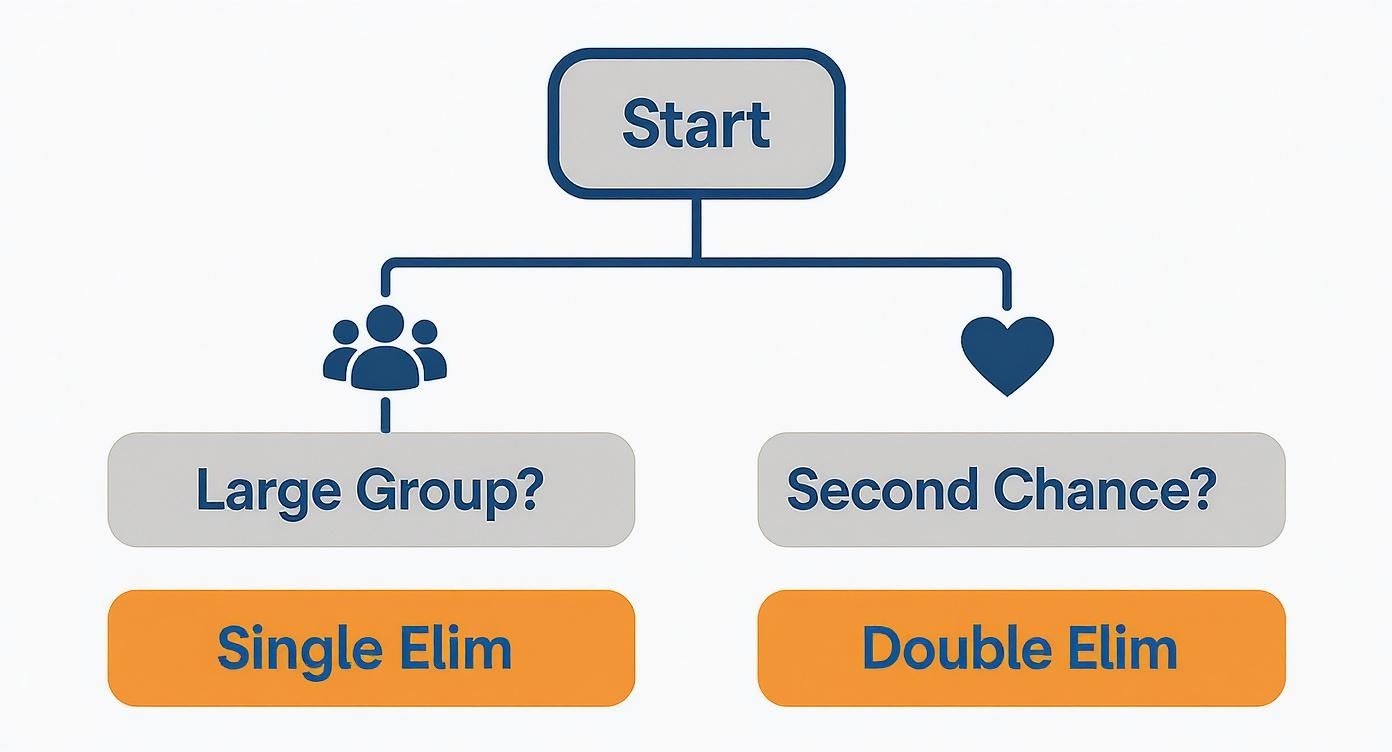
As you can see, it’s all about balancing your number of players with the desire to give everyone a fair shot at the title.
Round Robin: The Ultimate Test of Skill
In a round-robin, everybody plays everybody. It’s the gold standard for smaller groups where you absolutely want to find the best overall player. This works great for season-long club leagues or a small, competitive invitational.
While it guarantees the most golf for everyone involved, it’s also by far the most time-consuming.
Pro Tip: For a 10-player round-robin, you'll need to schedule a whopping 45 matches. That’s why it's not practical for events with more than a dozen players unless you can spread the matches out over several weeks or even months.
To make the decision a little easier, here's a quick comparison of the formats.
Tournament Format Comparison
Format Type | Best For | Pros | Cons |
|---|---|---|---|
Single-Elimination | Large events, tight schedules, one-day tournaments | Fast, simple to manage, creates high-stakes drama | Unforgiving; one bad day ends a player's run |
Double-Elimination | Competitive events where fairness is key | More accurate winner, gives players a second chance | More complex, requires more matches and time |
Round Robin | Small groups, leagues, season-long competitions | Guarantees maximum play, definitively finds the best player | Very time-consuming, not practical for large fields |
Ultimately, choosing your format is all about matching your event's goals with the reality of your timeline and player count. Pick the one that sets the stage for a smooth, fair, and exciting competition for everyone.
Smart Seeding and Handling Byes Like a Pro
Once you've locked in your tournament format, it's time to talk about seeding. This isn't just about plugging names into slots; it's the art of creating fair matchups that build suspense and prevent your top contenders from knocking each other out in the first round.
Good seeding creates a logical, exciting path to the championship.
How you approach it really depends on the vibe of your event. For a casual corporate outing, a simple random draw is totally fine—it even adds a fun element of surprise. But if you're running a serious club championship, you'll want to use performance-based rankings to build a balanced, competitive bracket.
Different Approaches to Seeding
Performance-based seeding is the standard for any competitive tournament. The whole point is to place your strongest players at opposite ends of the bracket, giving them the best chance to meet in the later rounds. It just makes for a better story.
Here are a few common ways to rank your players:
Past Tournament Results: Use standings from last year’s event or a season-long points list.
Player Handicaps or Ratings: In golf, this is the most direct way to measure skill.
Qualifying Rounds: For bigger events, you can hold a qualifier to get a snapshot of everyone's current form.
By seeding the #1 player against the lowest-ranked player, #2 against the second-lowest, and so on, you create a structure that rewards skill and consistency. People love a good bracket. Just look at March Madness—ESPN reported over 20 billion brackets were filled out in 2023. That’s a huge jump from the first known contest in a Staten Island bar with just 88 people.
Solving the Puzzle of Byes
So what happens when you don't have a "perfect" number of players, like 8, 16, 32, or 64? Let's say you have 11 golfers. This is where "byes" come in.
A bye is just a free pass to the second round. You give them to your top-seeded players to make the bracket work out mathematically.
Figuring out byes is actually pretty simple. First, find the next power of two (2, 4, 8, 16, 32...) that's bigger than your number of participants. With 11 players, that number is 16. The number of byes you need is just the difference.
Here's the quick math:
Next power of two after 11 is 16.
16 (ideal bracket size) - 11 (actual players) = 5 byes.
You'd award those five byes to your top-seeded players. Seeds #1 through #5 get a pass, while Seeds #6 through #11 play first-round matches. This ensures your bracket flows correctly into the second round with an even number of competitors.
Properly managing byes is one of those small details that makes a huge difference, and it’s one of the many tournament management features that can take the headache out of running your event.
Alright, you've picked your format and figured out your seeding strategy. Now for the fun part: actually building the bracket. This is the visual roadmap for your whole tournament, and you've got a few ways to tackle it, from old-school pen and paper to slick digital tools. What you choose really depends on the scale and vibe of your event.
For smaller, casual tournaments, you can't go wrong with the classic pen-and-paper approach. A big whiteboard or a giant sheet of poster board does the trick. Everyone at the venue can see the matchups at a glance, which is great for building a bit of buzz. Just make sure you grab a ruler and write clearly—a sloppy, hard-to-read bracket is a recipe for confusion. While it’s simple, this method has its limits. You can see why most organizers eventually move on by checking out the pros and cons of pen-and-paper tournament management.
Using Spreadsheets for More Control
If you're handy with a spreadsheet, firing up Excel or Google Sheets is a solid step up. You can lay out a clean, organized bracket and even use some basic formulas to automatically move winners into the next round. This is a huge time-saver compared to manually rewriting names, and it cuts down on simple mistakes. Plus, a spreadsheet is easy to email out to players and can be updated on the fly.
The Power of Online Bracket Generators
Honestly, for most people running tournaments these days, a dedicated online bracket generator is the way to go. These tools were built specifically for this purpose, and a lot of them are free for basic use. They take almost all the grunt work out of the equation.
It’s as simple as this:
You plug in your list of players.
You select the tournament format (like single-elimination).
You either input your seeds or just let the tool randomize them.
And that's it. The software spits out a perfect, professional-looking bracket in seconds.
Key Takeaway: Online tools handle the most tedious parts of building a bracket—seeding, placing byes, and scheduling. This lets you focus on running a great event instead of getting lost in the administrative weeds.
Here’s what a clean, printable bracket from one of these online tools looks like.
The clarity is a game-changer. Players can easily see their potential path to the finals. Many of these platforms also give you a shareable link to a live version of the bracket, which is fantastic for keeping everyone engaged, even those who aren't at the course.
When you're looking at online tools, it's also worth considering systems that do more than just build brackets. For example, some integrated tennis/padel court reservation software can also manage your scheduling and venue bookings, which are huge parts of running a smooth event. Whether you need a simple generator or a full-blown tournament management platform, digital tools give your event a level of polish and efficiency that's tough to match with a pen and paper.
Running Your Tournament and Sharing the Results
You've built the bracket, seeded the players, and now it's time to shift from planning to execution. This is where a good plan turns into a great tournament experience for everyone. Smooth execution is everything.
The first thing on your list? Clear communication. Before anyone hits the first tee, make sure every single participant knows their schedule—match times, locations, and any specific rules for the day. An email with the final schedule is great, but also post a large, visible copy at the venue. For bigger events, having a dedicated person to answer questions is a lifesaver. It keeps things moving and cuts down on confusion.
Managing the Flow of the Tournament
As scores start rolling in, real-time updates are what keep players and spectators hooked. If you're going old-school with a physical bracket on a whiteboard, put one person in charge of updating it the second a match ends. No delays. This ensures everyone sees the most current standings at a glance.
The real test of a great tournament director is handling the unexpected. And trust me, something unexpected will always happen. No-shows, last-minute cancellations, and on-course disputes are practically guaranteed.
For No-Shows: Have a clear policy from the start. Usually, it’s a forfeit, and the player who showed up gets to advance. Simple.
For Disputes: Designate a rules official or a small committee to make a final, fair decision on the spot. No lengthy debates.
Having these protocols ready saves you from having to improvise under pressure. If you want to dive deeper into getting prepared, our complete golf tournament checklist covers all the bases, from pre-event logistics to post-event wrap-up.
Key Takeaway: Proactive communication and a solid contingency plan are your best friends. The goal is to minimize downtime and confusion so the competition can be the main event.
Sharing Your Bracket and Engaging Everyone
Making the bracket easy to find isn't just a nice-to-have; it's essential. A big printout at the clubhouse is a classic touch and still works, but sharing it digitally is a game-changer for engagement. Most online bracket tools give you a simple, shareable link you can text or email to everyone.
This simple step means players who are done with their rounds or fans who couldn't make it out can follow the action live from their phones. Want to look even more professional? Embed the live bracket right on your club’s website. It creates a central hub for all tournament info.
For the best experience, you absolutely need to integrate live scoring. There’s nothing quite like players entering their scores hole-by-hole and watching the leaderboard update in real-time. It creates a buzz and keeps everyone locked in until the final putt drops, turning a simple tournament into a live, dynamic event. When you share results this way, every single participant feels connected to the action from start to finish.
Common Questions About Creating Tournament Brackets
Even with a solid plan, a few questions always seem to pop up right when you sit down to build your tournament bracket. Getting these details right is often the difference between a smooth event and a logistical nightmare.
Let’s walk through some of the most common issues we see organizers run into.
What’s the Best Way to Handle Tie-Breakers?
This is probably the biggest one, especially if you’re running a qualifying round or a round-robin that feeds into a bracket. You absolutely need a clear, pre-determined policy. Don't try to wing it on the day of the event.
The standard method in golf is the scorecard playoff. It usually works by comparing scores on the back nine, then the last six holes, then the last three, and finally going hole-by-hole backward from the 18th.
Whatever you decide, announce the rule before the tournament starts. It keeps things fair and transparent for everyone.
What Is the Best Tool for Making a Bracket?
A whiteboard and a marker might work for a small, casual outing with a few friends, but it gets messy and impossible to manage for anything more serious. Spreadsheets give you more control, but they can be clunky to update and a pain to share with players.
For most events these days, an online bracket generator is the way to go. These tools handle the tedious stuff for you—automating the seeding, placing byes correctly, and giving you a clean, professional-looking bracket you can share with a simple link. It just removes the chance for human error and saves a ton of administrative time.
Pro Tip: Find a tool that includes live scoring. When players can punch in their scores on their phones and see the bracket update in real-time, it creates a much more engaging and professional feel for the entire tournament.
Can I Change the Bracket After It Starts?
This is a tricky one, but the short answer is: you really shouldn't.
Once the first match tees off, the bracket should be locked in. Making changes mid-tournament, even with the best intentions, can completely undermine the integrity of the competition and open the door to complaints.
Of course, things happen. A player might have to withdraw due to an injury. In that case, the standard procedure is a forfeit. The injured player loses, and their opponent simply advances to the next round.
To keep things clean, just follow these simple guidelines:
Finalize Your Roster: Make sure you have a confirmed list of all participants before you even start building the bracket.
Double-Check Seeding: Give the player rankings and matchups one last look to catch any obvious mistakes.
Publish and Lock: Once you share the bracket with the players, consider it final.
By setting clear rules from the start and using the right tools, you can handle these common challenges with confidence and make sure your tournament runs smoothly from the first tee shot to the final trophy.
Ready to run your next golf event without the hassle? Live Tourney makes it effortless with app-free live scoring, rapid setup, and intuitive management tools. Ditch the clunky software and see why top courses trust us to elevate their tournaments. Start your free trial at livetourney.com and create a professional tournament experience today.