
Jul 30, 2026
US Open cut rules, golf cut rule, top 60 and ties, USGA majors, cut line explained
Understand US Open cut rules with this 2026 explainer. Learn how the top 60 and ties formula works and how the cut line shifts.

The US Open cut rule comes down to this: after 36 holes, the USGA keeps the top 60 players and ties and sends everyone else home. Out of a starting field of 156, that narrows things down to roughly the top third who get to play the weekend.
What the Cut Actually Looks Like in Practice

Here's where it gets interesting. That "and ties" part matters more than people realize. Say 62 players finish within the top-60 threshold — all 62 advance. That's why you'll sometimes see weekend fields balloon into the 70s. The number isn't fixed at exactly 60; it's whoever's actually sitting in those spots.
US Open Cut Rule at a Glance
This table breaks down the essentials so you can see the structure at a glance.
Detail | Current US Open Standard |
|---|---|
Total field size | 156 starters |
Players who typically make the cut | Top 60 and ties |
Typical weekend field percentage | Approximately 38–48% depending on ties |
Standard format | 36-hole cut after second round; final 36 holes over weekend |
The cut is a hard filter after 36 holes that rewards steady scoring across two rounds — not just one good day.
Why the US Open Cut Feels Stricter Than Other Majors
The USGA's top-60-and-ties approach is tighter than the top-70-and-ties you'll find at some other majors, including The Masters and the PGA Championship. Fewer players make it to the weekend, which naturally creates a more compact leaderboard and ratchets up the pressure heading into Friday afternoon.
For context, when you compare stroke play formats across tournaments — you can read more about how stroke play works in tournament golf — you start to see how different cut thresholds shape the entire feel of a championship's back half.
What Players and Organizers Actually Deal With
Consistency is non-negotiable. One great round followed by a rough one usually won't cut it. You need two solid days.
Tee sheet logistics shift dramatically. Organizers plan for a smaller weekend field, which affects everything from staffing to spectator flow and broadcast windows.
Ties at 60th create real variability. Some years you'll see 61 players on Saturday, other years 73. That unpredictability ripples through the entire weekend schedule.
A Simple Way to Think About It
Picture a music competition where judges advance the best 60 acts after two qualifying rounds. Someone ties for the last spot? Nobody gets cut at that line — everyone tied moves on. It sounds straightforward until you're one of those players hovering around that number on a Sunday afternoon, waiting to see if your name stays on the board.
The bottom line for anyone involved — whether you're competing or running the event — is that early-round strategy, consistent scoring, and planning for tie-driven variability are the keys to managing expectations and staying ahead of weekend logistics.
How the 36-Hole Cut Actually Works on Tournament Day
The cut doesn't happen until players finish their second round — 36 holes are in the books before the US Open cut rules kick in. Once scores freeze, it's the Top 60 and ties standard that determines who plays the weekend.
Here's where it gets tricky: weather, course conditions, and pin placements all push scoring numbers around, so nobody knows the exact cut line until late Friday afternoon. 67 players made it through at the 2019 U.S. Open. Then in 2024, 74 players advanced. Those ties for 60th are exactly why the weekend field can balloon past the magic number.
Pairing sheets have to stay flexible because the final field size is anyone's guess until scoring wraps up. Tournament organizers build in contingency plans for staffing, scoring personnel, and marshals so they can scale up or down on short notice.
Early Friday afternoon tasks for staff:
Confirm provisional Saturday starting times
Alert volunteer shifts that might run into the evening
Prep scoring kiosks and media briefings for variable field sizes
Getting a read on the projected cut line early gives tournament teams room to breathe — they can lock pairings, print revised tee sheets, and adjust hospitality plans before things get hectic.
Live scoring platforms make this whole process far less painful. Leaderboards update as players finish holes, so managers can watch the cut line shift in real time and pre-stage pairings for likely scenarios. It eliminates a ton of last-minute scrambling and keeps communication flowing to players and spectators.
Timing and Logistics for Weekend Play
When the final putt drops on Friday, staff immediately shift into verification mode. Player lists, starting times, scoring assignments, cart allocations — everything gets a final check. Broadcasters and streaming partners receive an updated roster so commentary and camera plans can lock in.
Immediate steps:
Verify the official scoreboard and post the cut list
Update starting times and pairings for Saturday
Send automated notifications to players about their tee times
Midterm steps:
Adjust volunteer and marshal deployments
Confirm clubhouse and hospitality capacities
Reprint scoring sheets and pairings for noticeboards
Ties are the reason this gets interesting. Say three players tie for 60th place — all three advance. That simple rule is why some years the field sits in the low 60s while other years it swells into the 70s.
Practical Playbook for Organizers
Use live scoring to anticipate cut-line movement during late Friday play and prepare multiple tee-sheet drafts.
Communicate early and clearly — automated messages cut down on player confusion when tee times shift.
Budget for unpredictability. Equipment, catering, and shuttle services should all have scalable options.
A scenario players feel in their bones: A golfer sitting at even par on the 18th tee Friday watches the leaderboard like a hawk. The cut could slide from +3 to +4 within minutes. For organizers, that single ripple means printing extra pairings and reallocating staff — small decisions with surprisingly big operational consequences.
Read also: Curious how live leaderboards and scoring actually work in tournament settings? Check out our guide on golf scoreboard explained.
How US Open Cut Rules Have Evolved Over Time
Golf history reads like a slowly tightening filter when it comes to the U.S. Open cut rule. Early championships let every entrant play through all rounds, but over the decades the USGA narrowed who tees it up on the weekend to spotlight the highest-performing competitors. This infographic maps out those shifts and the big changes that set today's standard.
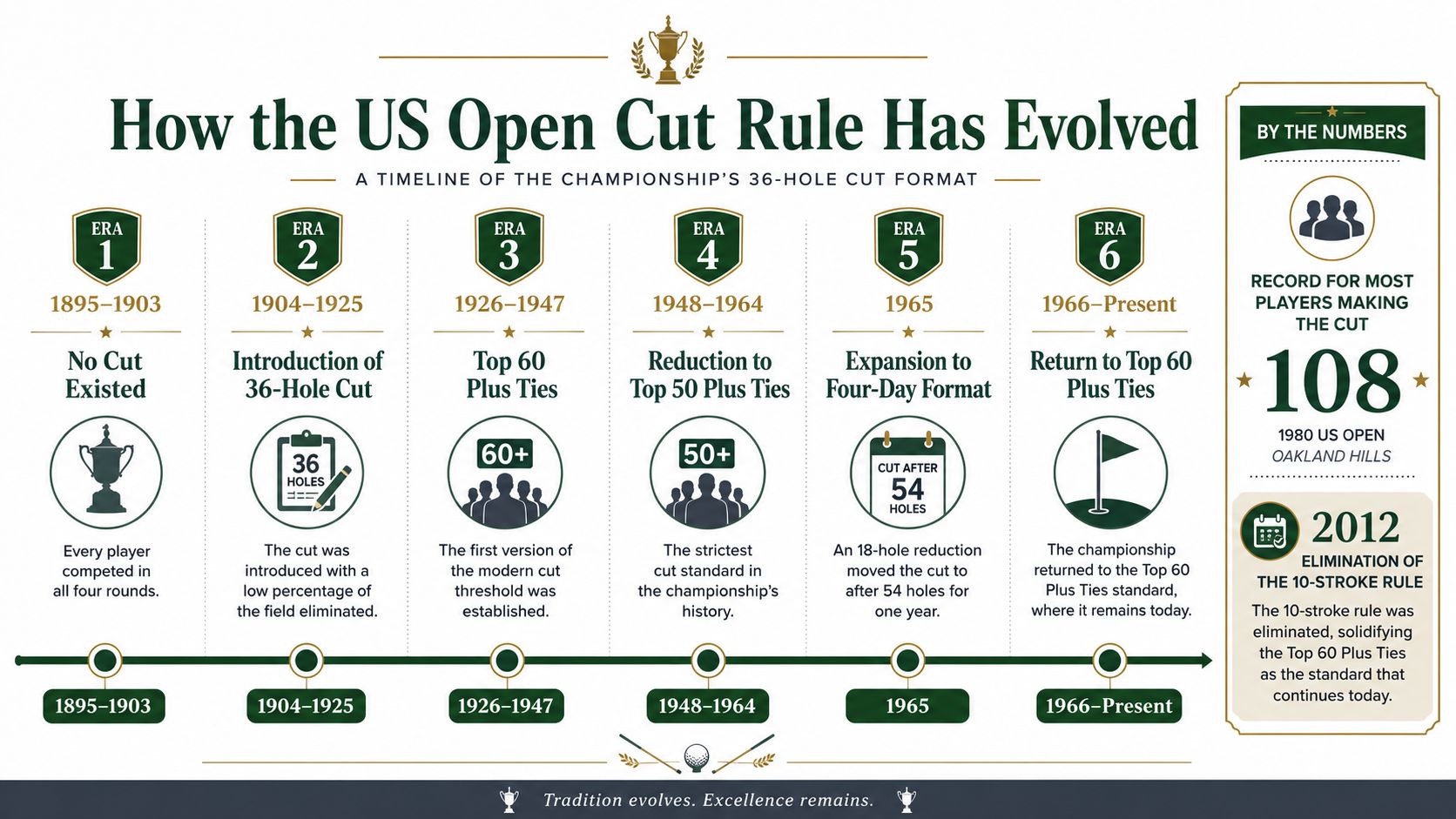
Six eras of change are laid out here, and one thing jumps out right away: 108 players making the cut at one point. That's a historical outlier that really drives home just how much variability existed back then. The chart also highlights the 2012 rule adjustment that dropped the 10-stroke exception and locked in the modern cutoff.
Early Years and the First Cut Rule
From 1895 to 1903, there was no cut. Every entrant played through the final rounds, period. Field size, not score, determined who got the weekend experience — every competitor got equal time on championship greens, whether they were in contention or miles off the pace.
Think of it like a marathon where every single starter runs the whole race, no matter their time. It's a generous setup, sure, but it gets unwieldy fast when the sport starts growing.
The introduction of a formal cut changed the championship's rhythm and raised the stakes for early rounds.
Introduction of the 36-Hole Cut
In 1904, the USGA introduced the 36-hole cut, trimming a chunk of the field after two rounds. The initial cut wasn't dramatic — they only eliminated a modest percentage — but the idea stuck. As crowds grew and logistics got more complex, the weekend field needed thinning.
It's a lot like a talent show narrowing to semifinalists: early rounds filter the group so the later performances feel more concentrated and intense.
1904–1925: 36-hole cut introduced
Impact: Reduced weekend logistics and tightened up the competition
The Top 60 Plus Ties Era and a Stricter Stretch
Between 1926 and 1947, the championship adopted a top 60 plus ties standard — close to what we see today in spirit. Then from 1948 to 1964, the USGA tightened the screws further to top 50 plus ties. That stretch remains the strictest period in the Open's history.
Imagine reducing lanes on a busy highway. Fewer players get that smoother ride onto the weekend greens.
Evolution of the US Open Cut Rule
Era | Cut Format |
|---|---|
1895–1903 | No cut existed |
1904–1925 | 36-hole cut introduced |
1926–1947 | Top 60 plus ties |
1948–1964 | Top 50 plus ties |
These shifts tell a clear story: the USGA kept experimenting with how to balance a competitive weekend field against the practical realities of running a major championship.
Four-Day Experiment and Return to Top 60
In 1965, the Open tried something different — a four-day format that moved the cut to after 54 holes. It lasted exactly one year. By 1966, they reverted to top 60 plus ties, and that format has largely governed the event ever since.
It's like rearranging the stage layout for a concert, playing one show, and deciding the original setup worked just fine.
The 2012 Change and Modern Standard
The most significant recent change came in 2012, when the USGA removed the 10-stroke rule. That rule had served as a safety net, letting players who were far behind the leader still advance to the weekend. Dropping it reinforced the top 60 and ties approach and cut down on weekend field volatility.
Key modern takeaway: Today's rule creates a more selective weekend field and sets clearer expectations for everyone involved — players, organizers, and fans alike.
Historical range: Weekend qualifiers once peaked at 108, which shows just how wild earlier eras could be.
This whole progression explains why the U.S. Open cut rules feel uniquely strict today, and why they evolved the way they did: balancing competition quality with the practical demands of running a major tournament.
Why the Cut Line Score Changes Every Year

Here's the thing about the cut line—it's not some fixed number carved in stone. It's always expressed in strokes relative to par, which means course toughness and weather directly push that number up or down. A brutal setup or gusting winds can send the qualifying score several strokes higher than anyone expected, completely reshuffling who sticks around for the weekend.
Look at the numbers and the pattern becomes obvious. The 2023 U.S. Open at Los Angeles Country Club played relatively gentle, with a cut at +2. Fast forward to Shinnecock Hills in 2018, and players needed +8 just to make the weekend. Oakmont's 2025 setup pushed the line to +7, proving once again that venue choice and pin placement have an enormous say in who advances.
Course setup is the single biggest lever the USGA pulls to shape scoring and the cut line for the championship.
Think of it like weather on a road trip. A smooth interstate lets everyone cruise at speed, but throw a storm into a mountain pass and suddenly the average pace drops—fewer drivers hit their target window. Golf works the same way. Tight fairways, firm greens, and deep rough compress scores upward and lift the cut right along with them.
The historical extremes really drive this home. The 1955 U.S. Open posted a cut of +15, one of the highest ever recorded. More recent decades tell a different but still demanding story—an 11-year average of +5.2 from 2012 through 2022. Those numbers confirm what most players already feel: the U.S. Open consistently sits well above typical tour scoring expectations.
How Weather Timing Interacts With Setup
A calm morning versus an afternoon storm front can completely change hole-by-hole difficulty in the middle of a round. When weather rolls in during Friday's play, early finishers catch a break while late pairings get hammered—and that nudges the cut in unpredictable directions. It's exactly why organizers and players alike keep glancing at the forecast hour by hour.
Course factors that push the cut line higher:
Firm, fast fairways reduce stopping power on approach shots, making par saves harder to come by
Narrow landing areas and penal rough reward precision and punish anything off-line
Tough pin placements generate more three-putts and bogeys than players can afford
What Organizers and Clubs Can Learn
Understanding how the U.S. Open operates gives local clubs a blueprint for setting smart cut thresholds in their own events. Want a tighter weekend field? Take a page from the USGA playbook—narrow those fairways and place pins where only precise shots reach them. Running something more forgiving for amateurs? Soften the green speeds and widen the landing zones to bring that cut line back down.
A practical checklist for event directors:
Model projected scores using course rating and slope before setting your threshold
Monitor weather windows and plan tee times around expected conditions
Communicate cut scenarios to players before round two begins
When you compare years, venues, and weather patterns, the picture becomes clear. The U.S. Open cut rules produce variable cut-line scores because they respond to concrete, controllable course choices mixed with uncontrollable weather forces. That variability is both the championship's signature trait and a valuable lesson for anyone running a major-style event.
Read also: Learn more about course difficulty and rating in our article on what is a course rating
Comparing the U.S. Open Cut With Other Major Championships
The U.S. Open cuts to the Top 60 and ties after 36 holes — noticeably tighter than what you'll see at most other men's majors. That smaller weekend field tends to produce denser leaderboards, higher-stakes pairings, and a competitive atmosphere that feels a notch more intense.
The Masters plays by different rules, and the PGA Championship and The Open Championship both lean toward a more generous standard. The practical effect? The U.S. Open routinely sends more players home on Friday than its peers, and that shapes the entire feel of the weekend.
Quick Comparison Table
Major | Cut Format | Typical Weekend Field |
|---|---|---|
U.S. Open | Top 60 and ties | ~60–75 depending on ties |
The Masters | Top 50 and ties (Masters-specific rule historically varies) | ~45–65 |
PGA Championship | Top 70 and ties | ~70–85 |
The Open Championship | Top 70 and ties | ~70–85 |
Looking at the numbers, the U.S. Open's tighter threshold trims the weekend field by roughly 10–15 players compared with a top-70 standard — assuming a similar number of ties at the cutoff.
Here's the thing about the cut — it sets the tone. Fewer bubble players make the weekend, which sharpens the storylines and puts real pressure on Friday afternoon finishes.
That smaller field compresses competitive tension into fewer pairings. You get more head-to-head battles, clearer broadcast narratives, and a weekend that feels like it matters from the very first tee shot. Players know there's less margin for error across those opening two rounds, and it shows in how they approach early holes.
For tournament organizers, the implications are pretty concrete:
Pace of play improves with fewer groups on the weekend, which reduces bottlenecks and makes TV scheduling less of a headache.
Gallery size can shrink on Saturday and Sunday, which affects ticket revenue and hospitality planning in ways that need to be accounted for early.
Broadcast and sponsorship packages often favor tighter leaderboards because the storylines are easier to package and promote.
Choosing a Cut Format — What Organizers Should Think About
Decide on your weekend density. Tighter cuts create concentrated competition but mean more players go home early.
Model your spectator flow. Smaller fields reduce crowd spread and can lower staffing needs across the course.
Plan for tie scenarios. Ties at the cutoff can expand the field beyond expectations — build in capacity buffers so you're not caught off guard.
When a Stricter Cut Makes Sense
If you want a championship feel with intense weekend pairings and leaner operations, the U.S. Open's top-60 approach is worth emulating. If inclusivity and larger weekend galleries are higher priorities, a top-70 rule might serve you better. Running pilot events or smaller test tournaments can reveal which format fits your audience and venue before you commit to anything permanent.
At the end of the day, the cut rule isn't just a procedural detail — it's one of the biggest levers you have for shaping the identity of your event. The U.S. Open has leaned into that for decades, and it's a big reason why the tournament feels like the tougher test.
What the Cut Rule Means for Players and Organizers

The US Open cut rule forces a sharp early filter: only the Top 60 and ties continue after 36 holes, so more than 60% of starters usually head home by Friday evening. That reality changes how players approach the first two rounds from the very first tee shot.
There's real pressure to score early. The margin for error is tighter than at most other majors, which means a conservative opening round can leave a golfer chasing the cut line all afternoon Friday. On the flip side, smart risk-taking on reachable holes can push a player into the comfortable middle of the pack before the weekend even starts. This compression of scores tends to create tighter leaderboards, which makes for better television.
Picture this: a small cluster of players hovering near the projected cut line on Friday. Every hole feels like a sprint against the clock. That psychological squeeze shows up in club selection, putting aggression, and short-game decisions — and it feeds directly into the storylines broadcasters are telling that afternoon.
Organizers deal with the ripple effects too. Weekend staffing gets easier to plan with a leaner field, meaning fewer scorers, marshals, and hospitality stations to manage. Pairings and tee sheets simplify, but ties create uncertainty, so plans need to stay flexible until scores are official.
Staffing implications
Scale volunteer and marshal assignments based on projected weekend field size
Have contingency pairings and printed materials ready for expanded cut scenarios
Spectator and broadcast implications
Smaller weekend fields improve pace of play and tighten broadcast windows
Fewer groups on the course make camera scheduling easier and storylines crisper
Eliminating the 10-shot rule in 2012 tightened the weekend field and improved pacing. Broadcasters and fans noticed the difference right away.
Modern tournament software takes a lot of the operational weight off. Real-time scoring platforms track the cut line as it shifts, send automated notifications about tee times, and push instant pairing updates to administrators. These tools let local organizers run events that feel polished without needing a massive crew.
For organizers, the practical playbook looks like this: model multiple cut-size scenarios ahead of time, use live scoring to pre-stage pairings, and automate player communication so nobody's confused about their status. For players, the message is straightforward — start strong, stay aggressive when the moment calls for it, and treat Friday like a final exam where small mistakes get expensive.
Frequently Asked Questions About the US Open Cut Rule
How are ties handled when multiple players sit on the cut line?
Everyone tied for 60th place moves on. It's that straightforward. The projected field of 60 can balloon to 65, 74, or even more depending on how many guys share that exact score. Say three players tie for 60th — all three play the weekend, which throws a wrench into pairings and forces the committee to scramble behind the scenes.
What replaced the 10-shot rule and why was it removed?
The USGA scrapped the 10-shot exception back in 2012 and went all-in on the Top 60 and ties standard. That old rule had been a backdoor — it let players well behind the leader sneak into the weekend based purely on stroke differential. Getting rid of it tightened up the field, made Friday afternoon more predictable for broadcasters, and honestly just kept the pace of play from turning into a mess.
What happens to players who barely miss the cut in prize money and FedEx Cup points?
Players who miss the cut still walk away with something. The purse payouts are structured so even non-weekend finishers get a check, though it's a fraction of what the leaders will bank. FedEx Cup points are a different story — they usually go only to players who survive Friday. Miss the cut, and your season standings barely move. That's why the pressure on Friday afternoon feels so heavy for anyone hovering near the line.
Does the U.S. Women's Open cut rule differ from the men's event?
For the most part, no. The women's side runs a 36-hole cut that mirrors the men's approach. The governing bodies occasionally tweak field size or qualifying criteria, but at its core, both tournaments use the same two-round filter. Consistency over 36 holes is what matters — no gimmicks.
Are there any notable exceptions or rare scenarios to expect?
Every now and then, extreme weather or weird scoring conditions push the weekend field way past normal. Historical records show as many as 108 players making the cut in older eras — a logistical nightmare. These days, the USGA plans for tie-driven swell with contingency staffing and pairings, and modern live scoring tools let them adapt on the fly instead of reacting after the fact.
What's the best way for organizers to prepare for cut-line uncertainty?
Run the numbers ahead of time. Model multiple cut-size scenarios and use live scoring to prestage pairings and staffing before the first player finishes on Friday. Automated notifications and dynamic leaderboards keep players and spectators in the loop, so when things shift, you're not stuck making decisions in the dark.
Key takeaway: The US Open cut rule is simple on paper — Top 60 and ties after 36 holes — but the downstream effects on payouts, FedEx Cup points, logistics, and broadcast scheduling make those Friday finishes incredibly consequential.
If you're running an event and want a tool that handles pairings, live scoring, and automatic player notifications around cut time, check out Live Tourney.





