
Jul 27, 2026
torrey pines north scorecard, torrey pines scorecard, torrey pines yardages, torrey pines tournament, printable scorecard
Get the complete Torrey Pines North scorecard with hole-by-hole yardages, pars, and ratings. Plus printable PDFs, tips, and tournament setup advice.

If you're holding a tee sheet, a printer tray, and a half-finished event packet the week before a Torrey Pines round, the Torrey Pines North scorecard is the document that keeps the day from drifting. The wrong tee set, an outdated PDF, or a copied yardage chart from a fan site can throw off scoring, handicap allowances, and even the way players judge the round before they start.
Setting Up a Tournament Round at Torrey Pines North
The first mistake most organizers make is treating the scorecard like a brochure. At Torrey Pines North, it works like an operating sheet, because the course is a public municipal venue and the city keeps the core information centralized for bookings and tournament use. That matters the week of your event, when the difference between a clean tournament and a messy one often comes down to whether everyone is looking at the same version of the card.
I'd start by confirming three things before I print anything. First, which tee set the field should use. Second, whether the card you've got is the city-issued version, not a third-party listing or an old screenshot. Third, whether your scoring workflow needs just yardages or the full hole-by-hole structure with handicap strokes.
What I verify first
Practical rule: If the card you're using doesn't match the official city PDF, don't build the event around it.
That may sound obvious, but it's where tournament directors lose time. A scorecard is only useful when it matches the tees you're assigning, the format you're running, and the sheet players will hold in the cart. If you're setting up a charity outing, a club championship, or a league night, the scorecard should drive the pairings, the side games, and the posting logic.
For Torrey Pines North specifically, the smart move is to treat the scorecard as a working document, not a static reference. That means checking the routing, validating the tee set, and making sure the printed card matches the event setup before anyone tees off. If you only use the card as a last-minute handout, you'll miss its real value, which is helping the entire tournament run on one common reference.
Official Scorecard Sources and Contact Information
The cleanest starting point is the City of San Diego scorecard PDF for the North Course. The official document identifies Torrey Pines North as an 18-hole municipal course at 11480 North Torrey Pines Road, San Diego, CA 92037, and it lists separate contact lines for the golf shop, 858-452-3226, and reservations and information, 858-581-7171. The city-issued file is the version you want when you're validating a scorecard for event use, because it ties the course details to the operator that controls the tee sheet and tournament setup.
When I'm checking a card against outside listings, I use third-party pages only as a cross-check, not as the authority. That helps catch common errors, especially when a page mixes up North and South Course details or carries stale yardages. If a listing and the city PDF disagree, the city version wins for tournament work.
The safest way to confirm the card
Download the city PDF first. Use the official North Course scorecard PDF as your base document.
Match the address and phone lines. The municipal contact information should line up with the card you're printing.
Cross-check any third-party listing only after that. Use it to spot obvious mismatches, not to replace the official file.
Call if anything looks off. Mid-season operational changes are always easier to confirm directly than to guess at from a random screenshot.
A lot of public-course confusion comes from assuming every online scorecard image is current. At Torrey Pines North, that's the wrong habit. The city-issued PDF gives you the current operational frame, and that's what should sit in your binder, your cart signs, and your scoring notes.
Tee Set Ratings, Slope, and Yardage Summary
The tee card at Torrey Pines North matters because it doesn't just describe distance, it changes the scoring expectation. The White tees play par 72, 6,647 yards, with a course rating of 72.1 and slope rating of 129. The Blue tees play par 72, 6,326 yards, with a rating of 70.0 and slope of 119. The Red tees play par 74, 6,118 yards, with a rating of 75.4 and slope of 134.
Torrey Pines North Tee Set Summary | |
|---|---|
Tee | Par, Yardage, Course Rating, Slope |
Blue | Par 72, 6,326 yards, 70.0, 119 |
White | Par 72, 6,647 yards, 72.1, 129 |
Red | Par 74, 6,118 yards, 75.4, 134 |
The key number for mixed fields is slope, because it shows how sharply the course can play differently for golfers of different ability levels. The White and Red sets, in particular, show that Torrey Pines North is not a simple short-course setup where you can slide everyone back or forward without consequence. The Red set's higher slope and different par structure mean it's not just a shorter copy of the same course.
If you need a primer on how course rating works in practical handicap terms, the clearest companion explanation is this course rating overview. Use it when you're deciding whether a flight should play the White set, the Blue set, or the Red set.
What the numbers mean in practice
Blue tees: Best when you want a more playable championship setup for stronger men's fields or a format where pace matters.
White tees: The most common neutral benchmark when you want the course to feel full, but not overlong.
Red tees: Useful when the field needs a different par structure and a higher handicap adjustment, not just a shorter walk.
Hole by Hole Yardage and Pars on the North Course
A tournament card is only useful when it works hole by hole, because that's what players, scorers, and pairings touch. The North Course scorecard gives you the full routing, and the biggest practical advantage is that it shows where the tees change par and where the hole length shifts enough to alter the match pressure.
Hole | Blue Par | Blue Yardage | White Par | White Yardage | Red Par | Red Yardage | HCP Stroke |
|---|---|---|---|---|---|---|---|
1 | 4 | 390 | 4 | 403 | 4 | 382 | 8 |
2 | 4 | 440 | 4 | 449 | 4 | 415 | 2 |
3 | 4 | 407 | 4 | 423 | 4 | 392 | 12 |
4 | 3 | 176 | 3 | 187 | 3 | 139 | 18 |
5 | 5 | 521 | 5 | 538 | 5 | 488 | 4 |
6 | 4 | 400 | 4 | 411 | 4 | 353 | 10 |
7 | 3 | 224 | 3 | 235 | 3 | 205 | 14 |
8 | 4 | 404 | 4 | 420 | 4 | 379 | 6 |
9 | 5 | 495 | 5 | 503 | 5 | 452 | 16 |
10 | 4 | 364 | 4 | 382 | 4 | 369 | 15 |
11 | 3 | 145 | 3 | 155 | 3 | 132 | 17 |
12 | 5 | 573 | 5 | 565 | 5 | 497 | 5 |
13 | 4 | 423 | 4 | 440 | 4 | 394 | 7 |
14 | 4 | 399 | 4 | 419 | 4 | 371 | 9 |
15 | 4 | 398 | 4 | 415 | 4 | 369 | 11 |
16 | 3 | 217 | 3 | 210 | 3 | 177 | 13 |
17 | 4 | 430 | 4 | 444 | 4 | 390 | 1 |
18 | 4 | 459 | 4 | 473 | 4 | 389 | 3 |
The two places where the scorecard really changes are hole 12 and the overall tee structure for the Red set. Hole 12 stretches into a demanding par 5 on every tee line, while the Red card also shifts the overall par to 74, which is a major scoring consideration for women's events and any mixed competition that needs the handicap system to do real work.
For day-to-day tournament use, this table is the part to copy into a spreadsheet or print alongside pairings. It gives scorers enough detail to validate birdies, pars, and net scoring without guessing what a hole was supposed to play.
Front Nine vs Back Nine Difficulty Profile
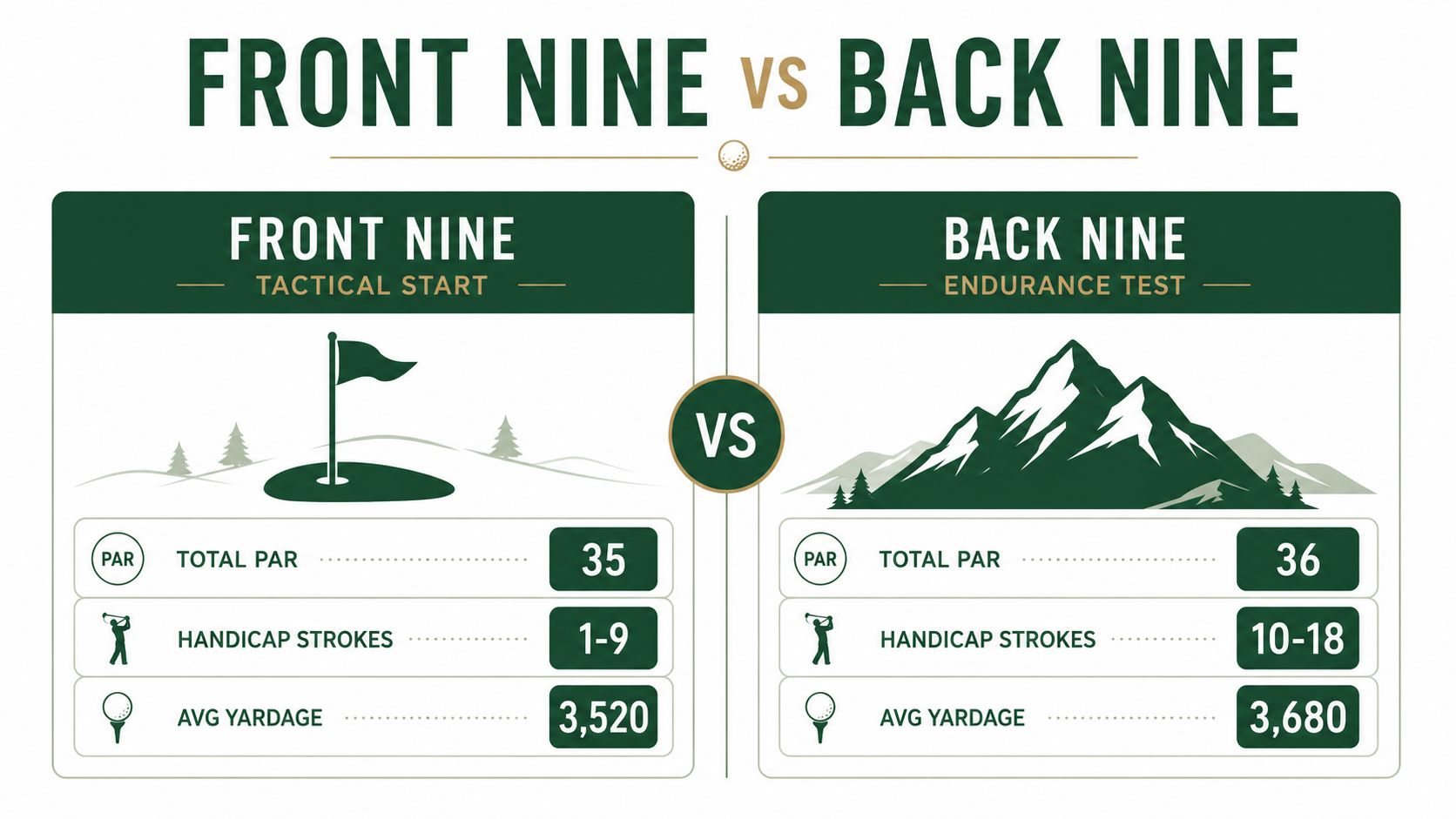
The front nine at Torrey Pines North asks for discipline, because the scoring pressure builds before players settle into the round. The back nine gives you more room to separate patient players from impatient ones, especially when the long par 5 on hole 12 and the closing stretch demand better decisions than a simple swing thought. That split matters to tournament directors because pin placement, pace-of-play expectations, and scoring talk all change depending on where the field is more likely to leak shots.
Where the card turns
The easiest way to read the nine-by-nine profile is by looking at the holes that carry the most weight in a scorecard conversation. The short par 3s create birdie chances if the wind stays manageable, but the longer par 4s, especially on the back side, punish players who try to force recovery swings. The stroke indexes reinforce that reality, because the tougher holes are spread to keep the match from tilting all at once.
The safest tournament setup is the one that rewards pars where the card says the hole is hard, and lets birdies happen where the routing already gives players a chance.
For pace-of-play planning, that means you can be a little firmer on tee-time flow when the field reaches the middle of the round. Players tend to settle into a rhythm early, then the back nine can break that rhythm when one or two holes demand extra thought. That's exactly where a director should pay attention to marshaling and scoreboard updates, because the round often turns there rather than on the opening holes.
Choosing Tees for Different Tournament Formats
Tournament format should drive tee selection, not the other way around. For a men's club championship, the Blue tees are the better choice when you want a serious test without turning the event into a slog, while the White tees make more sense if the field is broader and you need a fairer standard for a larger mix of ability levels. The White card's 72.1 rating and 129 slope give you the benchmark feel most club events are after.
For women's championship play, the Red tees deserve special attention because they're not just shorter, they carry a par 74, a 75.4 rating, and a 134 slope. That combination changes how the round should be framed, especially when you're building net and gross divisions. If you ignore the different par structure, you'll end up comparing results that don't mean the same thing.
A simple tee logic for common formats
Senior divisions: Start with the White tees unless the field's ability or pace suggests the Blue set is more appropriate.
Junior events: Use the Red tees when the goal is an honest scoring chance, not a watered-down version of the course.
Mixed-team scrambles: Keep one tee set for the team if possible. If you must mix tees, make the rule explicit before the first tee shot.
The practical test is simple. If the field needs a course that feels playable without losing credibility, the White set is usually the cleanest default. If the group wants to measure itself more sternly, the Blue set works better. If you're running a women's event or a format that needs the card's par structure to reflect the competition, the Red set is the correct choice.
Hole by Hole Strategy Notes for Tournament Directors
The holes that matter most at Torrey Pines North are the ones where a conservative card can save the tournament from becoming lopsided. Hole 6 is the kind of par 4 where players can talk themselves into a hero shot that isn't there, while hole 12 is the back-nine hole directors should keep in mind when they're building pin sheets and pace expectations. Those are the places where a card can look manageable on paper and still create real pressure in competition.
I'd treat the short par 3s as the scoring reset points. If the wind stays calm, those holes can restore a round quickly, but they can also expose a player who has started forcing things. The long par 4s ask for position first and target second, which is exactly why tournament groups often look fine through three holes and then start posting uneven scores once they reach the harder middle stretch.

For directors, the takeaway is straightforward. Don't overpromote aggressive play on the hardest holes just because the card says par is reachable. Let the course do its job, and build the competition around the holes that can separate the field without turning the day into guesswork.
Printing, Importing, and Digitizing the Scorecard
The most useful scorecard is the one you can move into three places at once, the binder, the cart sign, and the scoring file. The official North Course PDF notes that the course is operated as part of Torrey Pines Golf Course and lists the reservations line as 858-581-7171, which is the kind of operational detail you want alongside your printed card when you're finalizing the event packet. For printed materials, use the city PDF as your source file and keep the layout clean so the hole numbers, yardages, and tees stay legible after copying.
The next step is turning the card into a spreadsheet. If you're building a CSV for import, keep one row per hole and one column per tee so you can use the same file across the field. That makes it easier to feed the data into tournament management software, generate pairings, and keep side games aligned with the same hole structure.
CSV Template for Torrey Pines North | |||||
|---|---|---|---|---|---|
Hole | Par | Blue | White | Red | HCP Stroke |
If you want a scorecard format that's easier to distribute, this best golf scorecard guide is a solid companion for layout ideas. The key is to make the card readable at a glance, because tournament staff usually need it under pressure, not in a design review.
A clean workflow looks like this. Export the PDF for print use, paste the hole-by-hole data into CSV form, and keep the source file unchanged so every downstream version matches. That's the difference between a scorecard that looks official and one that keeps the event organized.
Pairing the Scorecard With Live Scoring Platforms
Once the scorecard data sits in a spreadsheet, it becomes usable for live scoring, pairings, and leaderboards. Public-course events benefit most from platforms that can handle straightforward municipal workflows without custom coding or a long setup cycle. If your event staff is posting scores from phones, tablets, or a clubhouse screen, the platform should accept the course file without making you rebuild the entire event manually.

A practical benchmark for any tool is whether it lets you move from scorecard to leaderboard without extra work. That's especially important for charity outings and league nights, where the pace of updates matters as much as the format itself. For a broader look at roster, communication, and event workflow features outside golf, the review of sports team software is a useful comparison point because it shows how organizers think about admin burden in other sports environments.
The same logic applies to score tracking inside golf. If the system can't ingest the tee data cleanly, you spend more time fixing setup than running the event, which defeats the whole point of digitizing the scorecard. For a deeper look at score entry and event visibility, this golf score tracking guide is a practical companion.
Quick Reference Card in One Page
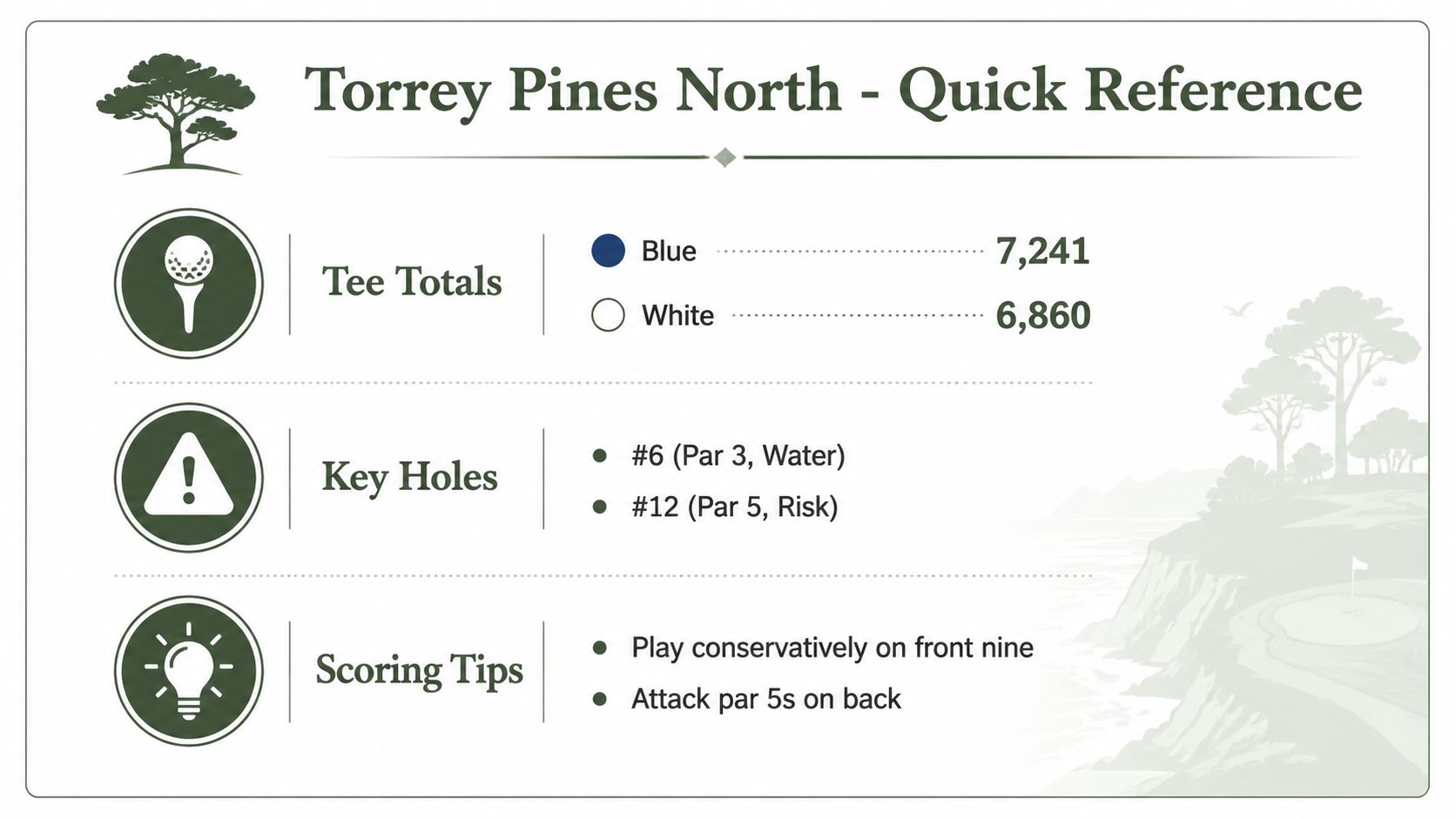
If you only keep one page with you, make it this one. Blue tees are the cleaner competition benchmark for stronger fields, White tees are the safest all-around tournament choice, and Red tees are the right answer when the event needs a different par structure and a fuller handicap framework. The card is most useful when it's tied to the format, not just the yardage.
One-page field notes
Tee totals: Blue 6,326 yards, White 6,647 yards, Red 6,118 yards.
Key holes: Hole 6 asks for restraint, hole 12 is the back-nine tension point.
Scoring tip: Play conservatively early, then press where the routing gives a real opening.
Contact line: Reservations and information, 858-581-7171.
If you're sharing the packet by email, make sure the attachment is the version players will open. A quick check through a deliverability tool like this how to check if emails are going to spam guide can save you from sending a perfect tournament packet that nobody sees before tee time.
For a head pro or director, this is the page that belongs in the binder, on the clipboard, and in the cart. Everything else is context.
Is the Card Worth the Green Fee
The value question at Torrey Pines North is real, especially for public golfers who are comparing the card against other municipal options. Independent course listings note visitor fees of $148 Monday through Thursday, $185 Friday through Sunday, plus a $45 cart fee, so the card has to justify more than curiosity. On pure scoring terms, the answer is yes, because the 72.1 rating, 129 slope, and the tournament scoring record showing a 75.13 total average score over 318 rounds on one published Golfstat dataset point to a course that can play well above the number on the card.
That doesn't make the pricing question go away. It just means the decision is about more than distance. The North Course gives public golfers a benchmark round at a nationally known venue, and the scorecard shows enough teeth to make the round feel earned rather than just scenic. For tournament directors, that's exactly why the card works, it's demanding enough to justify the event, but still manageable enough to organize without private-club complexity.
If you run golf events and want the card, pairings, score tracking, and leaderboard flow to feel as polished as the venue, try Live Tourney. It gives you a cleaner way to manage tournament setup, live scoring, and event documents around a course like Torrey Pines North, so your staff spends less time wrestling files and more time running the day.





