
Jun 8, 2026
jones cup invitational, amateur golf tournaments, ocean forest golf club, elite amateur golf, live golf scoring
Your complete guide to the Jones Cup Invitational. Explore its history, format, past winners, and how to follow one of amateur golf's most prestigious events.

The first time you stand beside the rope line at Ocean Forest during the Jones Cup Invitational, the sound tells you as much as the leaderboard. You hear crisp contact, then a beat of silence while players and caddies watch a ball fight the breeze, land firm, and release.
The History and Prestige of the Jones Cup
By the time players arrive at Sea Island in January, they already know what a good week at the Jones Cup can mean. In amateur golf, a few events carry results that people remember well beyond the trophy presentation. The Jones Cup is one of them because it blends pedigree, a serious field, and the kind of scrutiny that follows players into college championships, national team selections, and eventually the professional game.
The tournament began in 2001 at Ocean Forest Golf Club in Sea Island, Georgia, and after starting as a biannual event, it became annual in 2009, according to the Jones Cup Invitational overview. That change did more than add another date to the schedule. It gave elite amateurs a reliable early-season checkpoint, and over time that consistency helped turn the event into a measuring stick.

Why the name carries weight
The prestige starts with place and family history. The A.W. Jones family helped establish Sea Island as one of the country's enduring golf destinations, so the tournament arrives with roots rather than borrowed branding. Serious amateur players notice that. Organizers do too, because invitations mean more when the event feels tied to a real golfing tradition instead of built around a temporary opportunity.
That sense of lineage has practical value. College coaches, national program staff, and competitive amateurs tend to trust tournaments that have a clear identity and a host site with standards to protect. The Jones Cup has developed that trust over time, which is one reason its status extends well beyond Georgia. For readers comparing it with other events around the state, this overview of golf tournaments in Georgia shows how rare that mix of history and competitive relevance really is.
Practical rule: Prestige in amateur golf comes from repeat proof. Strong fields return, players talk, and a result starts carrying weight in selection rooms and locker rooms.
Why top amateurs treat it seriously
The Jones Cup is classified as a Category A tournament in the World Amateur Golf Ranking. That designation sounds technical, but the effect is straightforward. Players with national ambitions want starts that test them against other elite amateurs and reward a high finish with ranking value that moves the needle.
That is why the tournament matters in the broader amateur ecosystem. A strong performance here is not viewed as a nice winter result. It is read as evidence. Coaches see how a player handles a respected event. Evaluators get an early look at whose game is ready. Fans who follow elite amateur golf get a field that often includes future PGA Tour players before the wider public knows their names.
The Jones Cup has earned a reputation as a proving ground, and that reputation is hard to fake. Plenty of tournaments are enjoyable and well run. Far fewer become places where players can announce themselves, where organizers can consistently attract a field with real depth, and where serious fans know the leaderboard is likely to matter later in the year.
Tournament Format and Demanding Venue
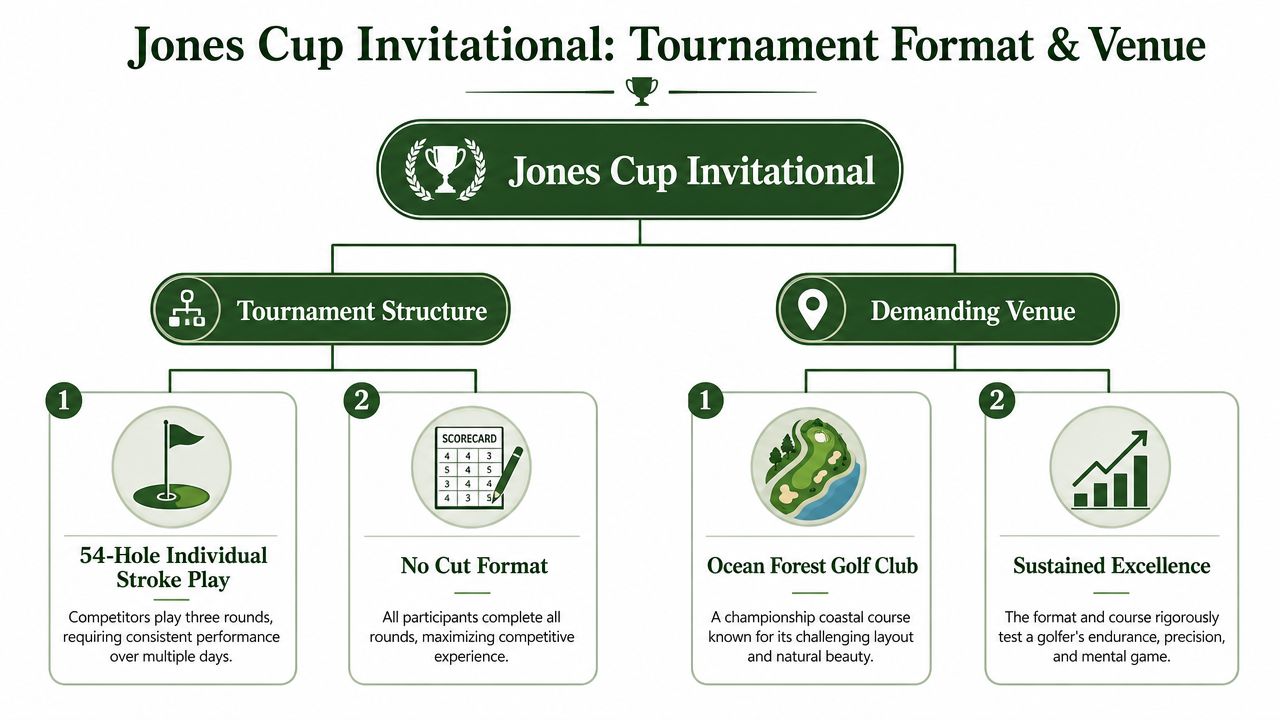
The Jones Cup Invitational's challenge starts with its structure and gets sharper because of where it's played. A 54-hole individual stroke-play format sounds simple. It isn't. Over three rounds, there's nowhere to hide, no partner to steady a bad stretch, and no alternate format to soften a mistake.
What the format rewards
Stroke play over multiple rounds identifies the player with the strongest complete game, not just the hottest day. That's why the Jones Cup means something to coaches, national program staff, and anyone who evaluates talent for a living. A player has to manage a card, absorb bad breaks, and keep producing quality swings after the adrenaline of the opening round fades.
The official tournament information describes the event as a 54-hole, individual stroke-play amateur tournament at Ocean Forest Golf Club, a Rees Jones design that opened in 1995 and hosted the 1998 Georgia Amateur. That setup matters because a coastal championship course tends to reward trajectory and spin control more than raw power, as noted on the Jones Cup Invitational tournament page.
If you want a broader framework for understanding why some courses separate the field better than others, this explainer on what course rating means in golf is a useful companion. It won't tell you how Ocean Forest plays shot by shot, but it helps clarify why structure and setup matter so much in elite amateur events.
Ocean Forest asks different questions
Ocean Forest isn't the kind of venue where a player can rely on one strength and survive. That's the key distinction. Long hitters can still gain an advantage, of course, but they have to pair that with flight control and disciplined misses.
On a coastal property, the same yardage can ask for a different shot from one hour to the next. Firmness changes the landing area. Wind changes the window. Nerves change both.
Here are the traits that usually travel well at a place like this:
Flighted iron play: Players who can hit a stock shot only one way often get exposed.
Distance control into firm greens: Being pin-high is more valuable than looking aggressive and missing in the wrong spot.
Patience after a bounce goes against them: Coastal courses produce awkward outcomes. The best players reset quickly.
Short-game imagination: Tight lies and wind make basic up-and-downs feel less basic.
Ocean Forest doesn't just test whether a player can hit quality shots. It tests whether he can choose the right shot when the obvious one isn't available.
What doesn't work here
The wrong approach at the Jones Cup usually looks familiar. A player arrives in good form, sees a wide enough target, and assumes the course will reward assertiveness on nearly every hole. Then the course starts asking for restraint.
What works is selective aggression. What doesn't work is confusing aggression with control.
That distinction is one reason the tournament has such value as a proving ground. Ocean Forest acts like an evaluator. It reveals who can shape a round, not just who can produce isolated highlights.
Notable Winners and Tournament Records
The cleanest way to understand the Jones Cup Invitational's place in amateur golf is to look at the type of player who tends to win it. This event has become one of those early signals that makes industry people pay closer attention. When a player handles this field and this style of test, the result doesn't guarantee a professional career, but it usually tells you the ceiling is worth following.
Why the winners list resonates
A strong amateur event can produce a few recognizable champions and still remain mostly local in impact. The Jones Cup isn't that kind of event. Its winners list has enough crossover with later professional relevance that people in the game treat it as a real marker.
That doesn't mean every champion follows the same path. Some move quickly into the professional ranks. Others build through college golf first. The common thread is that winning here suggests a player can manage a serious competitive environment before the cameras and prize money increase.
The best amateur events don't just identify talent. They identify talent that travels.
Notable Jones Cup champions and pro success
Year | Winner | Notable Professional Achievement |
|---|---|---|
2012 | Justin Thomas | Went on to become a prominent PGA Tour professional |
2021 | Ludvig Åberg | Advanced from elite amateur golf into high-level professional golf |
2010 | Patrick Reed | Built a successful professional career after his amateur rise |
2014 | Corey Conners | Progressed from amateur standout to established professional |
2009 | Kyle Stanley | Moved from amateur success into the PGA Tour ranks |
The point of a table like this isn't to suggest the Jones Cup predicts every future result with precision. Golf doesn't work that way. Players develop unevenly, and some excellent amateurs peak later or take a different route entirely.
Still, tournament directors, college coaches, and serious fans care about pattern recognition. The pattern here is clear. Winning the Jones Cup tends to align with a player who already has a tour-level skill base or is very close to it.
Records matter less than context
Fans often ask about tournament records because scorelines are easy to compare. In practice, context matters more than the number itself. Ocean Forest can look generous for a stretch, then become exacting when conditions shift. So a winning score tells only part of the story.
What insiders watch more closely is how a champion built the score. Did he separate with iron play? Did he avoid the big number? Did he keep his shape when the field compressed late? Those are the details that translate.
A Jones Cup title carries weight because of the environment around it. The champion usually had to solve a real golf problem over multiple rounds, instead of catching a hot week on a soft setup.
What organizers and fans should notice
For organizers, the alumni effect is powerful. It gives the tournament continuity. Every new field arrives with the knowledge that past winners used this event as part of a larger climb.
For fans, it creates a different way to watch. You're not just looking at a leaderboard. You're looking at players who may be on a first-name basis in college golf now and on television later.
That's why the Jones Cup Invitational occupies a rare spot in amateur golf. It's both a tradition and a preview.
How to Follow the Jones Cup Invitational
Following the Jones Cup Invitational well means paying attention to rhythm, not just final totals. If you're on site, the course gives you that rhythm almost immediately. If you're following from home, live scoring becomes the tool that restores it.

Watching in person
At a tournament like this, walking with a group is usually better than camping in one spot all day. Amateur events move differently from large professional tournaments. You can often get a clearer sense of a player's decision-making by staying with him for several holes than by waiting near a single green.
A few habits make the day better:
Arrive early enough to catch the range: You learn a lot from ball flight before the round starts.
Follow players through exposed holes: That's where club choice and commitment show up most clearly.
Watch body language after misses: Elite amateur golf often turns on who resets fastest.
Keep your own notes: If you're serious about the event, jot down momentum shifts instead of relying on memory.
Following remotely without losing the story
If you can't be there, live leaderboard coverage is the next best thing. Good score tracking lets you see more than a ranking by total score. It helps you spot streaks, stalls, and pressure moments.
This guide to golf score tracking is useful if you want to understand what a solid live-scoring experience should include. The best systems make it easy to follow holes completed, relative movement, and where a round is gaining or slipping.
For fans who also watch professional golf online, broader viewing habits can help. A resource like this LIV Golf Invitational Series streaming guide shows how modern golf audiences piece together coverage through streaming and digital updates, even when a traditional broadcast isn't the main access point.
What to look for on a leaderboard
A leaderboard is only useful if you know how to read it. Don't just focus on who's first.
Look for these clues instead:
Hole progression
A player at the same total as the leader but with fewer holes completed may have more momentum than the table suggests.Clusters near the top
Tight groupings usually mean a course is asking enough questions that late swings are likely.Consistency over bursts
In amateur events, a player who avoids soft bogeys can be more dangerous than one who makes a quick run of birdies.Round-by-round shape
If scoring data is available, compare how players finish, not just how they start.
One practical option for organizers in events like this is Live Tourney, which provides app-free live scoring and leaderboard management for golf tournaments. That's relevant because strong scoring tools don't just serve staff. They help spectators and families follow the competition in a more meaningful way.
2026 Jones Cup Results and Highlights
By the time the fog cleared at Ocean Forest, the 2026 Jones Cup had turned into a different kind of test.
The field did not get the full 54-hole examination players expect here. It got 36 holes, less margin for error, and a leaderboard that stayed tight deep into the finish. William Sides handled that version of the tournament better than anyone, winning at 6-under 138 with rounds of 69 and 69. Frankie Harris and Miles Russell shared second at 140, and Tyler Weaver and Luke Poulter tied for fourth at 142, as reported in AmateurGolf.com's 2026 Jones Cup final results.
That result fits the event's reputation more than casual fans might assume.
A weather-shortened Jones Cup can look less demanding on paper, but players know the opposite is often true. With fewer holes, there is less time to absorb a bad swing, less room to wait for a round to settle, and more pressure to make disciplined choices from the start. Sides' two straight rounds in the 60s mattered for that reason. They showed control over two days when the tournament rewarded clean management as much as shotmaking.
The margin at the top mattered too. Two shots separated first from the tie for second, and the group just behind the winner included players who are more than capable of closing ground quickly. That is part of what gives the Jones Cup weight in elite amateur golf. Even in a shortened edition, the event still asked the same core question. Who can handle a strong field, a demanding venue, and the pressure of having almost no wasted holes?
The 2026 answer was Sides.
For serious fans, this year offered a good reminder of why the Jones Cup remains a proving ground. The winner did not survive on one hot stretch. He posted two steady rounds, adapted to a changed schedule, and beat a packed top of the board. That is the kind of performance that tends to hold value well beyond one January week.
Frequently Asked Questions
How much does a strong Jones Cup week matter to college coaches
A lot, especially for players who are trying to show they belong in the highest tier of amateur competition.
College coaches do not need one tournament to tell them everything about a player. They already have scoring records, recruiting reports, and plenty of head-to-head results. What the Jones Cup can do is confirm that a player's game holds up in a field where nobody is impressed by junior success alone. A clean week here can strengthen a coach's belief that the player is ready for a demanding college lineup. A poor week usually does not sink a prospect, but how the player responds to it can still leave an impression.
Do players usually use caddies, and does that matter
Yes, and the caddie role matters more than casual fans often realize.
At this level, a good caddie is not there to read every putt like a tour looper. Its primary value is judgment. Yardages, wind checks, club selection around conservative targets, and keeping a player emotionally steady after a mistake. On a course that asks for restraint as often as aggression, one calm conversation can save a round from drifting.
What part of Ocean Forest tends to separate contenders from the rest
The course asks players to handle exposure, uneven lies, and uncomfortable approach shots. The hardest stretch is not always about one famous hole. It is the accumulation of shots where full commitment is required, but the miss has to be chosen carefully.
That is an important distinction. Plenty of elite amateurs can hit the heroic shot. The Jones Cup often turns on who keeps taking the sensible one.
What does a week like this tell scouts and player managers
They watch for habits as much as score.
A serious amateur event gives scouts a close look at pace, body language, pre-shot discipline, and how a player manages a round when momentum shifts. Those details matter because professional golf gets harder, not easier, once the spotlight gets brighter. A player who stays organized, accepts a bad bounce, and keeps making clear decisions usually gives evaluators more confidence than someone who flashes brilliance and loses structure.
Is the event useful for players who do not contend
Yes. For many entrants, the week functions as a benchmark.
Players leave with a better sense of whether their game travels against this class of field. Sometimes the lesson is technical. A player may realize the ball flight is not strong enough in coastal wind, or that distance control with short irons is not sharp enough. Sometimes the lesson is tactical. The player attacks pins that better competitors ignore. Those are valuable takeaways because they shape what gets worked on before spring amateur events and the college season.
What should spectators watch if they want to learn something real
Watch the decisions around trouble, not just the swings.
Follow how players choose targets after a bogey. Listen for whether they and their caddies talk about front edges, safe numbers, and miss patterns. Pay attention to wedge shots from awkward yardages and to lag putting from long range. Amateur stars stand out because they avoid giving shots back in careless places. That part of the game is easier to see in person than on a leaderboard.
How should remote fans read the leaderboard more intelligently
Start with timing and context.
A player who posts early may look secure for a while, but conditions often change through the day. Watch who is steady across nines rather than who makes one burst of birdies. If live scoring includes hole-by-hole updates, look for stretches where a player keeps making pars on demanding holes. That usually says more about long-term upside than one hot run on the friendlier part of the course.
What does a Jones Cup start do for a player's reputation inside amateur golf
It can change how people in the game talk about that player.
Invitations are part of the currency in elite amateur golf. A player who earns a place in this field has already gained a measure of trust from tournament committees and other stakeholders. A player who performs well often finds it easier to get into other respected events because the Jones Cup is treated as a serious reference point, not just another line on a resume.
If you run tournaments, leagues, or member events and want a cleaner live-scoring experience, Live Tourney is worth a look. It gives golf organizers a web-based way to manage scoring, leaderboards, registrations, and event administration without requiring players to download an app.





