Jul 2, 2026
golf playoff rules, tournament tiebreakers, golf sudden death, golf tournament formats, golf scoring rules
Master golf playoff rules for 2026. Explore sudden death, aggregate score, and scorecard tiebreakers for PGA Tour to club events.

The last group is in, the scoring table is crowded, and someone from the golf shop says, “We've got a tie.” That's the point where a tournament can either look polished or unravel fast.
Most organizers don't get in trouble because they don't know what a playoff is. They get in trouble because they haven't nailed down the procedure before the tie happens. Players start asking which holes they're using. Someone assumes it's sudden death because that's what they see on TV. Another player insists the event sheet said scorecard match. Meanwhile, daylight is going, carts are getting called in, and your staff is trying to confirm totals.
That's why golf playoff rules matter so much at the club and local-event level. The issue usually isn't the rule itself. It's the execution. A clean playoff feels fair, calm, and professional. A messy one leaves people talking about your process instead of the competition.
I've always looked at tiebreakers the same way I look at pace of play policies and score verification. They don't need to be complicated. They need to be decided early, written clearly, and applied the same way every time.
The Moment of Truth When Scores Are Tied
The final putt drops, the cards come in, and the leaderboard shows two names at the top. Everyone notices at once. Players lean over the scoring table. Spectators start asking what happens next. Staff members look to the tournament director for an answer right now.
That moment is exciting, but it's also where bad preparation gets exposed.
At a major event, the broadcast team fills the silence while officials coordinate the next step. At a club event, there is no buffer. Your players are standing there waiting. If your notice to competitors is vague, or if your shop staff gives different answers, confidence in the result starts slipping immediately.
Where events usually go sideways
Most problems come from one of three mistakes:
No written playoff policy: The organizer planned to “figure it out if needed,” which works until it doesn't.
Confusing first place with other ties: A playoff for champion is one issue. Splitting merchandise credit, skins, or net prizes is another.
Poor communication at the finish: Players hear different versions from different staff members and assume the process is changing on the fly.
Practical rule: If players learn your playoff procedure only after the tie occurs, you're already behind.
The fix is simple. Treat the playoff procedure as part of the event setup, not as an end-of-day decision. That means deciding whether first place is settled on the course or by a non-playing tiebreaker, choosing the holes in advance, and giving staff a script they can use word for word.
What players actually want
Players don't need a dramatic speech. They want clarity.
Tell them who is in the playoff, what format applies, where it starts, how scoring will be handled, and what happens if play can't continue. If it's a team event, tell them whether the playoff is for gross, net, or both. If first place is determined one way and other positions another way, say that plainly.
That's the standard. Not fancy. Just clean, consistent, and defensible.
Understanding the Two Core Playoff Formats
Every version of golf playoff rules comes back to two basic stroke-play formats. If you understand those, you can build a policy that fits almost any local event without confusing players or staff.
Sudden death
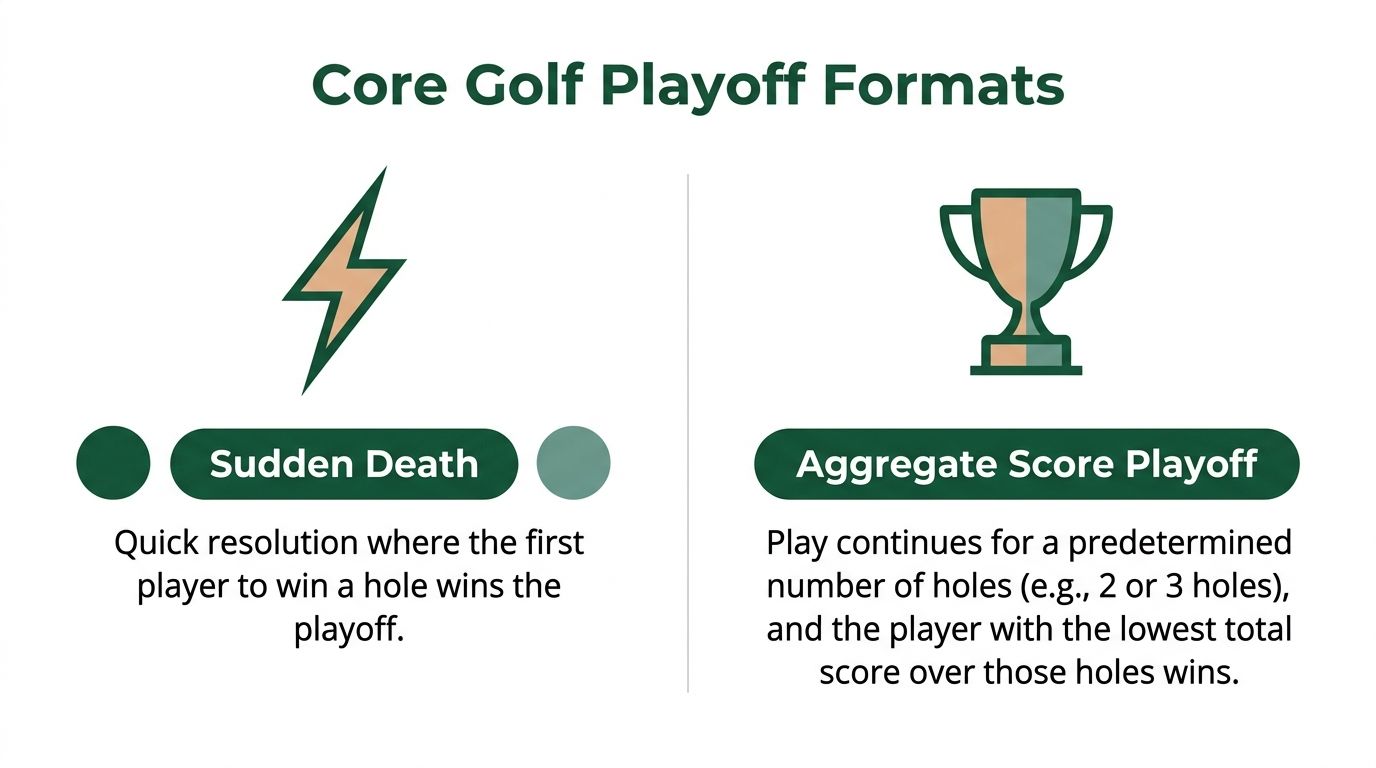
Sudden death is the cleanest format to explain. The tied players continue hole by hole until one player posts a lower score than the others on a playoff hole. The playoff ends immediately when that happens.
This is the penalty shootout version of golf. It's direct, easy to follow, and usually the best option when you need a winner without holding the course for too long.
Why organizers like it:
It's simple to announce: Players understand it instantly.
It's easy to stage: You can often start on a finishing hole or another high-visibility hole.
It resolves quickly in many situations: That helps when daylight, staffing, or outside event timing matters.
What doesn't work as well is using sudden death without planning the hole order. If the first playoff hole is a par-3 bottleneck near public play, or if spectators and carts can't move safely, the format may be fine but the operation won't be.
Aggregate score playoff
Aggregate score means the tied players compete over a predetermined set of holes, and the lowest total over those holes wins. If there's still a tie after that stretch, the written policy should say what happens next, often a move to sudden death.
This is closer to extra time in soccer. It gives players more than one hole to settle things and can feel more balanced when you want a champion decided over a short but fuller test.
A few reasons organizers choose it:
It reduces the one-hole swing feel that some committees don't like.
It lets you showcase a sequence of holes instead of one repeated stage.
It can match the tone of a championship event better than a one-hole sprint.
The trade-off is operational. Aggregate playoffs take more setup, more time, and more communication. Staff has to be clear about the exact hole sequence and what happens if the tie remains.
Match play is different
In match play, a playoff is usually just more match play. If the match is all square after the scheduled holes, the players continue until one side wins a hole. If you want a refresher on the format itself, this guide to match play rules in golf is a useful companion.
A playoff format should fit the event you're running, not the tournament you watched last Sunday.
For most club events, sudden death is easier to run well. Aggregate can be excellent, but only when the committee can support it cleanly.
Playoff Rules of the PGA Tour and Major Events
Players often look to televised events for precedent, and that's fair. The biggest championships offer practical models because each one reflects a different philosophy about how a champion should be decided. The trick for local organizers is to borrow the logic, not blindly copy the production.
What the major events tend to model
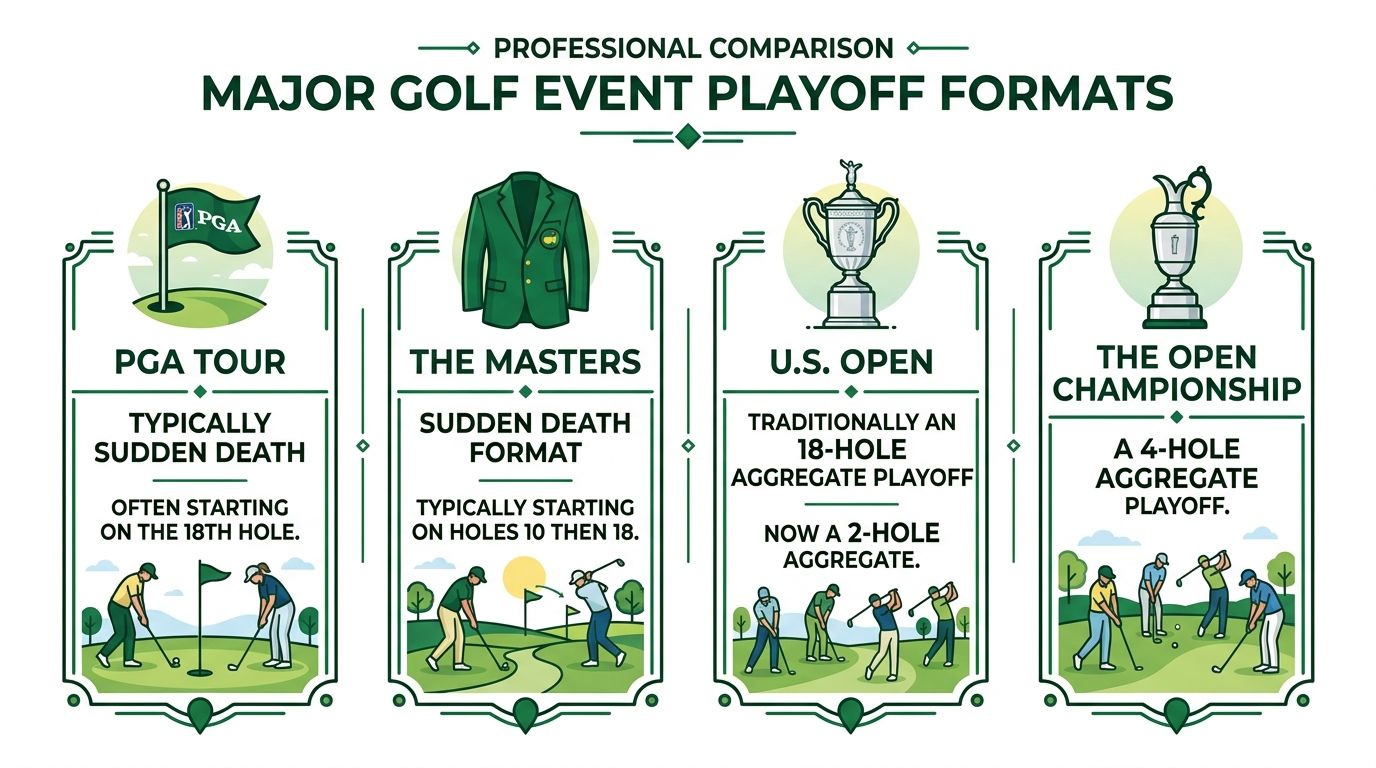
The PGA Tour commonly uses sudden death, often beginning on a finishing hole that is already set up for scoring, spectators, and television. That makes sense. It's efficient, easy to follow, and creates immediate drama.
The Masters is associated with sudden death as well, typically starting on holes 10 and then 18 in rotation. That setup reflects the course and the event's preference for a decisive finish without dragging the conclusion across too many holes.
The PGA Championship uses a three-hole aggregate playoff. The idea is clear. The winner has to perform across a short run of holes rather than a single swing moment.
The U.S. Open moved away from its old full-round playoff tradition and now uses a two-hole aggregate playoff. That change kept some of the championship feel while making the finish more practical for modern scheduling.
The Open Championship uses a four-hole aggregate playoff, which gives the players a broader test before any further tiebreaking step becomes necessary.
Quick comparison for organizers
Event | Typical approach | Why it appeals to committees |
|---|---|---|
PGA Tour | Sudden death | Fast, simple, spectator-friendly |
The Masters | Sudden death | Clear finish with iconic hole routing |
PGA Championship | Aggregate playoff | More than one-hole sample |
U.S. Open | Aggregate playoff | Balances tradition and practicality |
The Open Championship | Aggregate playoff | Strong championship-style test |
What to copy and what to leave alone
A local club event usually shouldn't mirror a major event hole for hole. The better move is to copy the reasoning.
If your priority is speed and minimal disruption, the PGA Tour model makes sense. If you want the finish to feel more like a club championship and you can control the course, an aggregate model is a credible choice. If your routing makes returning to the closing hole awkward, don't force it just because a major does something similar.
The best playoff procedure is the one your staff can run correctly under pressure.
That's the lesson from high-level tournaments. They don't just have rules. They have a plan built around the venue, the timing, and the people managing the finish.
A Step-by-Step Guide to Running a Fair Playoff
Golf playoff rules either remain theoretical or are put to use. Running a fair playoff comes down to sequence, control, and communication. If you handle those three well, the players will feel the event is in good hands.

Start before the event starts
The playoff policy belongs in your Conditions of Competition, entry information, or tournament notice. First place should never be left to assumption.
Write down:
Which places require a playoff: Usually that's overall champion only, not every paid position.
What format applies: Sudden death, aggregate, or scorecard match if no playoff will be played.
Which holes are used: Include the sequence, not just the starting point.
What happens if the tie remains: Especially important in aggregate formats.
How suspension affects the result: Weather and darkness need a written answer.
If your event uses live scoring, printed cards, and shop-side verification together, your staff also needs one scoring workflow. A good reference point for clean scoring processes is this explanation of golf scoring formats and procedures.
Choose holes that work in real life
A playoff hole isn't just a golf question. It's an operations question.
The ideal hole is easy to reach, easy to monitor, safe for carts and pedestrians, and unlikely to interfere with regular play more than necessary. The dramatic finishing hole isn't always the best answer. Sometimes the smarter playoff hole is one closer to the clubhouse, the scoring area, or a staging zone where staff can keep control.
Consider these factors before you lock it in:
Safety: Can players, officials, and spectators move there without crossing active holes?
Visibility: Can staff and observers see key shots and rulings?
Traffic: Will public play or returning groups get trapped?
Set-up consistency: Will the hole still be in proper competition condition late in the day?
Announce the procedure with zero ambiguity
Once the tie is official, give the tied players a direct briefing. Don't wing it. Use the same words every time.
A clean announcement covers five points:
The players involved.
The format.
The hole or holes to be played.
The order and timing of departure.
Who is recording and confirming scores.
That short announcement should also go to your shop staff, starters, marshals, and anyone handling the leaderboard. Mixed messages are what create arguments.
If two staff members describe the playoff differently, players will assume the committee is improvising.
Control scoring and rulings during the playoff
A playoff needs official oversight, even in a small event. Assign someone to walk with the group or meet them at the green to confirm hole scores. Don't rely on memory after the fact.
The cleanest operating model usually includes:
One designated official or committee member with the group
One scoring point of contact back in the shop or scoring area
One clear method for posting updates so players and spectators aren't working off rumors
For aggregate playoffs, verify the running total after each hole. For sudden death, confirm immediately whether one player has won the hole outright under stroke-play scoring.
Declare the winner the right way
When the playoff ends, don't treat that as informal. Announce the result, update the board, and record the method used. If prizes, shop credit, or points standings depend on that result, make sure every downstream record reflects the playoff outcome rather than the tied regulation total.
The staff standard is simple. Everyone should be able to answer the same question the same way: who won, how they won, and under which published rule.
Common Tiebreakers When a Playoff Is Not an Option
Sometimes you can't put players back on the course. Darkness is closing in. Weather stops play. The course needs to reopen to public traffic. Or the event format was never designed for an on-course playoff. In those cases, the most useful golf playoff rules are the non-playing tiebreakers you can apply consistently.

The scorecard match
The most common fallback is the scorecard match, sometimes called matching cards. Committees use it because it's simple, accepted, and easy to explain when it has been published in advance.
The standard approach is to compare scores in this order:
Back nine
Last six holes
Last three holes
Final hole
If players are still tied after that sequence, many committees continue comparing earlier portions of the round under their published policy. The key is consistency. Don't invent a new method at the table because the first one didn't separate the field.
How to apply it correctly
Organizers often make errors concerning scorecard matches. A scorecard match isn't about where the player started; it's based on the course card positions used for the competition. If the field had a shotgun start, you still compare the designated back nine and final segments as defined by the scorecard, not the holes a player happened to finish on in real time.
For handicap competitions, the committee should also decide in advance whether the tie is broken on gross scores or net scores and apply handicap strokes to the compared holes accordingly. If that isn't written down ahead of time, confusion is almost guaranteed.
Other non-playoff methods
Some events use other approaches, but they should be chosen carefully.
Method | Best use | Main caution |
|---|---|---|
Scorecard match | Club events, leagues, one-day competitions | Must be published clearly |
Split prizes | Casual or social events | Doesn't produce a single champion |
Co-champions | Team or ceremonial events | Not ideal if points or trophies require one winner |
Lot or random draw | Rarely appropriate | Usually a last resort and poor optics |
If you're deciding winners, payout order, or league points without a playoff, this guide on choosing a tournament winner is a useful practical reference.
A non-playing tiebreaker isn't second-rate. It's the right tool when the event conditions make a playoff unrealistic.
What works best at the club level
For most local organizers, the right answer is straightforward. Use an on-course playoff for first place only when the event schedule and course setup allow it. Use a published scorecard match for ties where replay isn't realistic. That keeps the finish fair without turning a tied result into a committee debate in the golf shop.
The mistake to avoid is mixing methods casually. If first place is a playoff, say so. If all other positions are scorecard match, say that too. Clean rules remove almost all of the friction.
Your Golf Playoff Questions Answered
What if darkness or weather interrupts the playoff
Your published terms should control that. If play can be resumed, suspend and restart under the same format. If resumption isn't possible, the committee needs a prewritten fallback, usually a scorecard match or another stated tiebreaker. The worst option is deciding the method after the interruption.
How are ties for places other than first usually handled
Most club events don't run on-course playoffs for every tied position. They use the published non-playing tiebreaker for runner-up spots, net divisions, shop credit, and prize allocation. That keeps the event moving and avoids holding the course unnecessarily.
Can a player be disqualified during a playoff
Yes. The playoff is still part of the competition. Players remain responsible for following the Rules of Golf, the committee's conditions, and scoring procedures. A serious breach or scoring violation can still affect the result.
How do scramble or team events handle ties
The cleanest answer is to write the tiebreaker around the format. Some scrambles use a scorecard match on the team card. Others use a short team playoff if time and course access allow it. What matters is that the rule fits the format and is announced before the first tee shot.
Should net and gross champions use the same tiebreak rule
Not automatically. Gross championships often justify an on-course playoff. Net divisions often work better with scorecard match because handicap calculations are already part of the result. If you use different methods, publish both clearly so nobody assumes one rule applies across the board.
Run Every Tiebreaker with Confidence
A tied score should feel like the best kind of pressure, not the start of confusion. When your golf playoff rules are written in advance, matched to the event, and communicated clearly, the finish takes care of itself.
The strong approach is consistent every time. Decide whether first place will be settled on the course. Choose holes that your staff can manage. Publish the fallback tiebreaker for situations where a playoff won't work. Then train your team to announce and apply the procedure the same way every time.
That's what separates a smooth finish from a messy one. Not theatrics. Not copying a major championship. Just preparation and control.
Tournament directors don't need complicated systems. They need dependable ones. If the players know the process, the staff knows the script, and the scoring is locked down, even a high-pressure tie can end with total confidence.
Live Tourney helps golf courses and tournament organizers run cleaner finishes with live leaderboards, simple event setup, and easier scoring management from any device. If you want a modern way to manage playoffs, score verification, pairings, and every other moving part around tournament day, take a look at Live Tourney.