
Aug 24, 2026
golf cheat sheet, golf scoring formats, tournament checklist, golf penalties, live scoring
Download the ultimate golf cheat sheet for tournament organizers and players. Covers scoring formats, penalties, handicap conversions, and live-scoring best

The first tee is filling, the starter is calling groups, and three players are asking different questions about the event. Is the competition gross or net? Does a picked-up ball count in Stableford? Where should scores be entered? Meanwhile, a volunteer is trying to find the correct scorecards and the committee is still sorting out a tie-break.
That's the operational reality of tournament golf. A golf cheat sheet isn't just a beginner handout. It's a compact operating document that puts the format, scoring method, penalties, pace expectations, and event contacts in front of players before confusion reaches the first tee.
Why Every Tournament Needs a Reliable Golf Cheat Sheet
Tournament mornings rarely fail because nobody knows how to swing a club. They become difficult when players receive incomplete information at different times. One group thinks the event is net stroke play, another assumes gross scores decide the winner, and a third is waiting for an app download that the organizer never intended to require.
A reliable reference solves that problem at the source. It gives the starter one consistent explanation, gives volunteers something to point to, and gives players a quick answer without sending them back to the pro shop.
Practical rule: If a question can affect a score, a pace decision, or a tie-break, put the answer on the sheet.
The document should be written for the actual field, not for an imaginary golfer. A corporate outing may include experienced club players, occasional golfers, juniors, returning players, and people coming from off-course golf experiences. Each group needs a different level of detail, but everyone needs the same core facts:
Format: State whether the event uses stroke play, match play, Stableford, scramble, or another structure.
Scoring: Explain whether results are based on gross score, net score, points, holes won, or team totals.
Penalties: Give the event's treatment of common situations and identify any local rules.
Pace: Tell players to keep up with the group ahead and explain how the committee will respond to delays.
Submission: Show where scores go, who verifies them, and how disputes are raised.
The best cheat sheets prevent arguments rather than settle them. They also make the committee look organized, because every player hears the same answer and sees the same written instruction. Historical rule development supports that need for consistency. The USGA's account of golf's rules notes that the first surviving codified set came from 1744, when The Honourable Company of Edinburgh Golfers created a 13-article document for a competition at Leith Links, and that later rulebooks built on this foundation through a long process of simplification and standardization. The USGA's history of the Rules of Golf shows why clear, shared rules remain central to fair competition.
Gross vs Net Score and Handicap Allowances
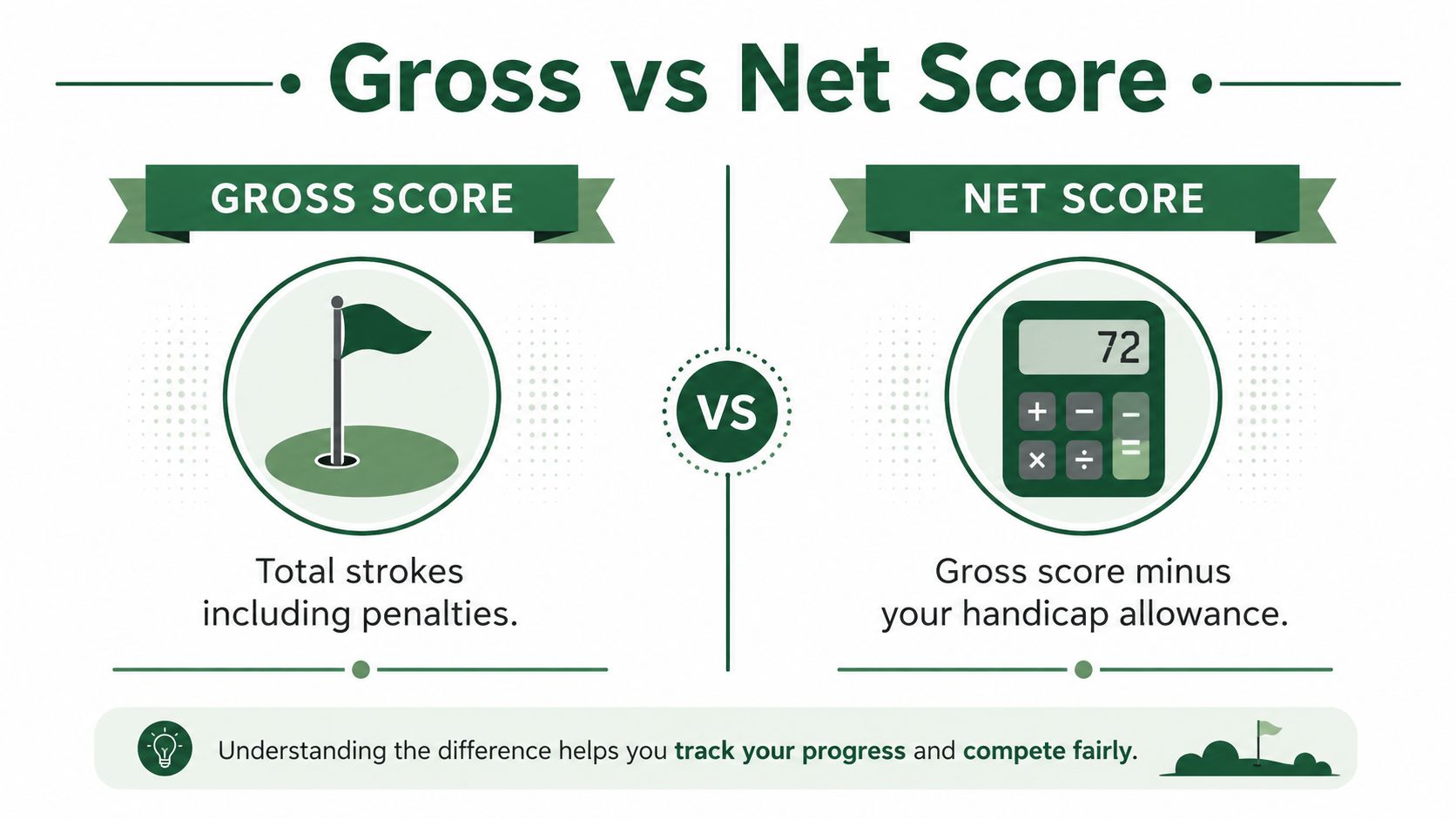
Start every tournament scoring document by separating gross score from net score. Gross score is the player's total number of strokes, including penalty strokes. Net score is that gross total adjusted by the player's handicap strokes. The distinction matters because a leaderboard can be perfectly calculated and still be wrong if staff enter gross results where the competition requires net results.
The R&A definition of gross and net score provides the foundation. Organizers should then make the calculation visible:
Record the player's actual strokes and penalties.
Confirm the handicap information used for the event.
Apply the approved handicap allowance for the format.
Rank players using the event's stated result and tie-break procedure.
Why the allowance changes by format
Handicap allowances aren't interchangeable. The USGA recommends 95% of Course Handicap for individual stroke-play formats, 85% for four-ball, and 90% for four-ball Par/Bogey. Those recommendations come from the USGA's Appendix C guidance on handicap allowances, which also explains that field size affects the recommendation and uses medium-sized net events of 30 to 100 players as the basis for the individual stroke-play allowance.
That adjustment exists to make the competition more equitable, not to make the scoring table harder to understand. A player's Course Handicap is not automatically the number you subtract in every competition. The format determines how much of it counts, and the committee must configure that before score entry begins.
For practical setup, write the allowance directly on the player information sheet. “Net stroke play, 95% of Course Handicap” is much safer than “net scoring,” which leaves players and staff guessing.
Build tie-breaks around the right score
Tie-break logic must use the same scoring basis as the event. If the competition is net, rank net scores first. If it's gross, don't let a handicap-adjusted column decide the result. For team formats, identify whether the committee compares a specified set of holes, a countback method, or another published procedure.
A useful golf tournament scoring guide can help staff structure scorecards and leaderboards, but the event sheet still needs to state the local procedure plainly. Players shouldn't discover the tie-break at the awards table.
Scoring Formats and Practical Examples
A format name only helps if players know what to do after the ball is in play. Put a short example beside each format so the scoring method is understood before the round starts.
Format | Scoring Method | Best For |
|---|---|---|
Stroke Play | Count the total score for the round, including applicable penalties | Individual competitions and broad fields |
Match Play | Compare players or sides hole by hole | Head-to-head contests |
Stableford | Award points according to the player's score relative to the target score | Faster social events and formats where one bad hole shouldn't end a round |
Scramble | Teams select a preferred shot and continue from that location under the event rules | Charity outings, corporate events, and mixed-skill groups |
Stroke play
In stroke play, every stroke matters. If a player takes six strokes on a par four and incurs a penalty, the gross score includes both the played strokes and the penalty stroke. The committee ranks the completed totals, then applies handicap adjustments if the event is net stroke play.
This format rewards consistency and makes accurate hole-by-hole recording essential. A single missing penalty can change the leaderboard.
Match play
Match play is decided by holes, not by the overall number of strokes. A player who wins a hole goes one up, while a tied hole is halved. The match ends when one side leads by more holes than remain to play, or according to the event's stated completion rule.
The operational trade-off is that match play needs a clear status display. A leaderboard showing only total strokes can confuse players, so use match status such as “1 up” or “2 and 1” when appropriate.
Stableford
Stableford gives points based on the player's result at each hole. A player who earns points must have the actual number of strokes recorded on the scorecard when the result is holed out. If the result earns zero points, the scorecard may show no score or another score that produces zero points. The USGA Stableford interpretation also specifies that penalty strokes are added to the hole where the breach occurred.
That detail matters when a player picks up. Don't let volunteers invent a score for a zero-point hole. Define the event's pickup procedure and make sure players know whether the scoring system accepts a blank, a zero-point entry, or a committee-approved notation.
Scramble
Scrambles are flexible, which is precisely why they create disputes. State how many drives each player must contribute, where the next shot is placed, and how putts are handled. A team may select the best drive, but the event must define whether the remaining players hit from the same spot and whether placement uses a club-length or another stated measure.
Team identity also affects the experience. Organizers planning a couples' or themed outing may find a useful visual reference in matching polos and game format, especially when team presentation is part of the event atmosphere. Keep that separate from the rules sheet, but make the format and team requirements unmistakable.
Common Penalties and Pace of Play Rules
The committee should brief players on penalties before play begins, not improvise after a complaint. The common situations are straightforward in principle, but players need to know which option the event and local rules permit.
Out of bounds generally uses stroke and distance, meaning the player adds a penalty stroke and plays again from the previous spot. A penalty area offers relief options under the Rules of Golf, usually with a one-stroke penalty. An unplayable lie also carries a one-stroke penalty, with relief selected under the applicable rule. The exact drop location depends on the situation, so the cheat sheet should direct players to the committee or official rule sheet when the position is unclear.
The most damaging mistake is allowing players to negotiate different remedies in different groups. A starter's briefing should identify whether the event permits any local rule designed to keep play moving and where players can obtain a ruling.
Pace is a scoring issue
The R&A says golf should be played at a prompt pace. Its championship guidance states that a player should make a stroke within 40 seconds once able to play without interference or distraction, with the first player in some situations allowed up to 50 seconds. The R&A pace-of-play guidance gives committees a clear standard to communicate.
Use operational habits that prevent delay:
Prepare before arrival: Players should choose clubs, read putts, and assess lies while others play, provided they remain safe.
Keep carts moving: Park near the route to the next tee rather than leaving the cart behind the green.
Use ready golf safely: The player who's ready may play when doing so won't interfere with another player.
Record scores away from the green: Move to the next tee or scoring area instead of creating a queue beside the hole.
Apply sanctions consistently
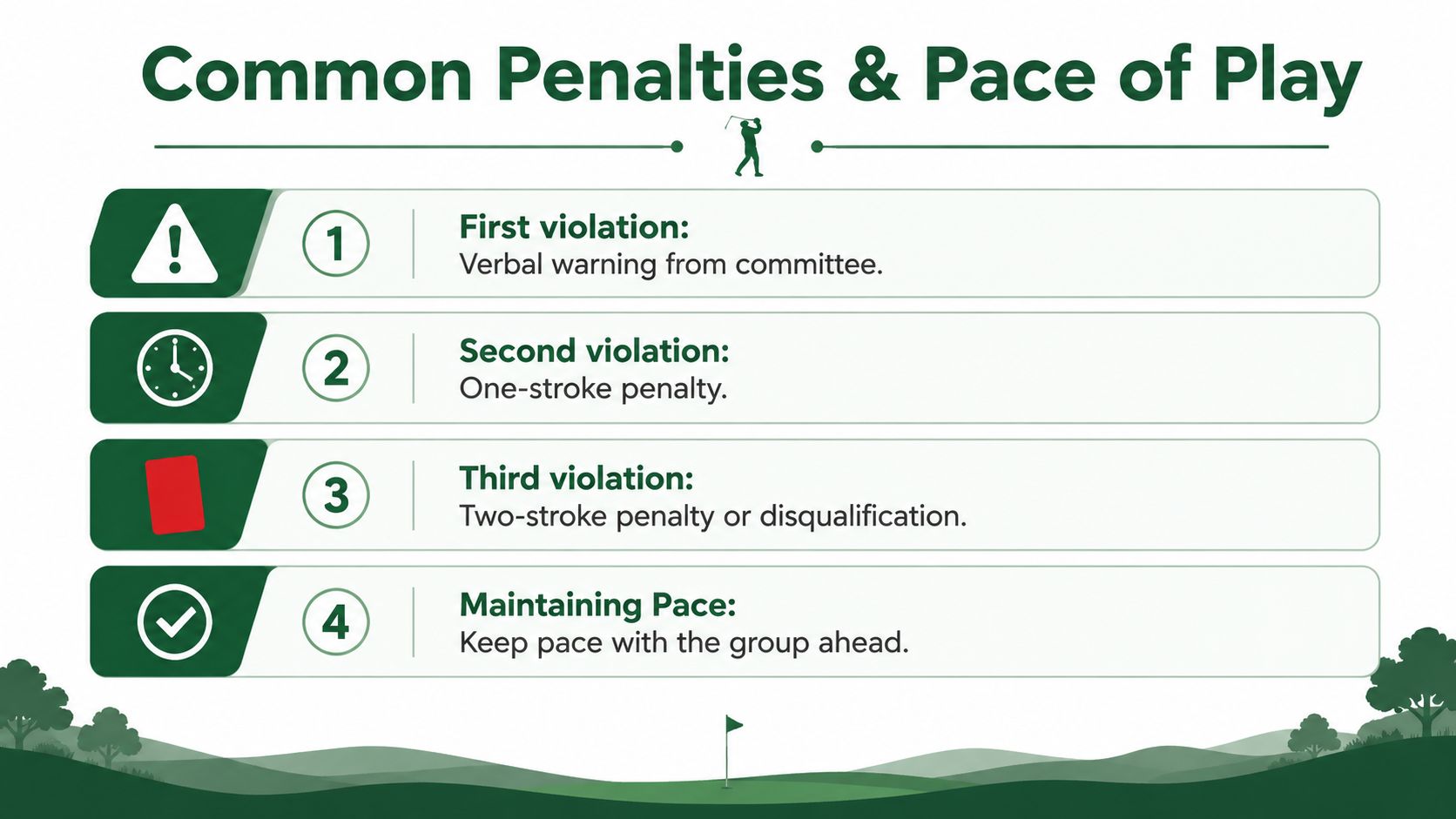
Under the R&A pace-of-play manual, escalating sanctions are clear: the first breach is a warning, the second adds one stroke, the third adds two strokes, and the fourth leads to disqualification. The R&A's pace-of-play penalty appendix provides the structure committees can include in their player briefing.
Slow play becomes a fairness problem when one group receives repeated help while another receives a penalty for the same conduct.
Tournament Setup Checklist for Organizers
A smooth event starts before the first player checks in. Work backward from the tee time and build one repeatable process that covers data, communication, course materials, and staff responsibilities.
Configure the digital event first
Create the tournament in your chosen management system, confirm the course and tees, enter the format, and set the handicap allowance. Load the roster, assign pairings, establish side games if applicable, and test the public scoring view from a phone that isn't connected to your staff account.
Print or export a test scorecard. Check that player names, tee assignments, holes, handicap strokes, and any team information appear correctly. A template that has been tested once is far safer than a new layout assembled during check-in.
Send one clear player message
The pre-event email should contain the arrival details, starting instructions, format, scoring method, pace expectations, local rules, dress guidance, and contact information. Include the score-entry link and explain whether one player per group enters scores or whether each player records independently.
Avoid sending separate corrections through different channels unless you also update the main rule sheet. Players act on the version they saw first.
Prepare the physical course materials
Make the materials match the digital setup:
Cart signs: Show group names, starting holes, event reminders, and scoring access.
Bag tags: Include player or team identification where it helps staff direct traffic.
Scorecards: Confirm the printed format, handicap information, and submission instructions.
Starter packet: Keep spare cards, pencils, local rules, and contact details together.
Brief staff before players arrive
Assign one person to scoring questions, one to rules escalations, and one to registration or roster changes. Give volunteers a short script for the starting rules meeting and identify who has authority to make a ruling.
A practical guide to running a golf tournament can support the planning process, but the event's own checklist should remain specific to the course, field, and format.
Live Scoring Best Practices Without App Downloads
Requiring players to install an app adds a decision at exactly the wrong moment. Some players won't have enough storage, some won't remember a password, and others will avoid the process because they're already managing clubs, carts, and registration. A browser-based scoring link removes that barrier.
An app-free system works best when the link is treated as part of the event infrastructure, not as an afterthought. Put it in the pre-event email, on the printed scorecard, on cart signs, and at the scoring desk. A QR code can make access faster, but the written link should still be available for players who prefer to type it.
Design the workflow around one scorer
Tell each group who enters scores and when. The simplest approach is usually one designated scorer entering hole results while the group confirms them, followed by a final review before submission. If every player enters independently, you'll need a clear process for resolving duplicate or conflicting entries.
Show the leaderboard before play starts so players understand what they'll see. A clean view should identify the player or team, format, score or points, and completion status. Don't overload the display with internal fields that players can't interpret.
Use live results to reduce, not create, staff work
Live scoring helps staff spot missing cards, incomplete holes, and unusual results while groups are still on the course. It also gives players a reason to stay engaged without asking the pro shop for repeated updates.
The platform should support the event's operational needs, including scorecards and leaderboard access. For an example of link-based tournament tracking, see free golf tracking. Live Tourney is one web-based option that provides real-time scoring and leaderboard access through a browser, with no app download required.
Adapting for Modern Golf Participation Trends
A tournament handout built only for experienced 18-hole players misses much of today's audience. In 2025, 48.1 million Americans played golf, including 37.9 million off-course participants and 29.1 million on-course participants, according to Sports Business Journal's coverage of golf participation. The same source describes strong growth among juniors, women, and people of color.
That mix changes the job of the cheat sheet. A returning golfer may need a reminder about pace and score submission, while a player moving from an off-course format onto a course needs basic explanations of penalties, teeing areas, and hole completion. A junior event may require simpler language and more visible instructions for guardians and volunteers.
Build separate lanes of guidance
Don't make one page dense enough to overwhelm beginners and still too vague for experienced players. Use a shared core with small audience-specific callouts:
True beginners: Explain the scoring vocabulary, safety expectations, course care, and what to do when a ball is lost.
Off-course players moving onto the course: Prioritize teeing procedure, pace, penalty areas, and how to use the scoring link.
Returning golfers: Emphasize format-specific rules, local rules, handicap treatment, and tie-breaks.
Juniors and families: Use plain instructions, visible contact details, and a clear escalation path for rules questions.
Treat 9-hole and short-course events as real tournaments
Alternative rounds deserve their own operating notes. The USGA reported a record 82 million scores posted in 2025, with 9-hole score posting approaching 15 million, and more than 290,000 scores posted at over 470 short courses. The USGA's 2025 score-posting report points to demand for formats beyond traditional full-round stroke play.
For a 9-hole or short-course event, state whether players post the round, how the competition handles an incomplete card, and whether the leaderboard ranks points, strokes, or net results. Never assume players will transfer an 18-hole convention automatically. The sheet should tell them exactly what counts as a completed result.
Creating Your One-Page Printable Cheat Sheet
Keep the page focused on decisions players must make during the event. Put the event name, date, starting method, format, gross or net basis, handicap allowance, pace rule, common penalty guidance, scoring link, and committee contact in that order.
Use short labels and enough white space for scanning from a cart. A small rules box can cover out of bounds, penalty areas, unplayable lies, and the event's pickup procedure. Add the live scoring QR code beside the written link, then test both before printing.
Distribute the same version everywhere. Place copies on carts, attach key details to bag tags, include the PDF in the player email, and keep spares at registration. For events with a strong course or hospitality theme, even peripheral planning materials such as a Prescott yard makeover guide can help shape the visual style, but the tournament sheet itself must stay operational and uncluttered.
Print one proof copy and ask a staff member who didn't build the event to explain the format using only that page. If they can't do it, players won't either.
Live Tourney helps courses and organizers configure tournaments, manage rosters, create scorecards and event materials, and provide app-free live scoring through a link that works on any device. Visit Live Tourney to see how you can turn this golf cheat sheet workflow into a repeatable tournament process.





