Sep 20, 2026
father and son golf, golf events, golf tournament formats, junior golf, Live Tourney
Explore 7 father and son golf event ideas, from scrambles and matches to leagues, skill challenges, prizes, and smooth Live Tourney management.

A lot of courses want a father and son golf event on the calendar because the idea is easy to sell. Families like it, members remember it, and it can bring juniors onto the property in a low-pressure way. The problem starts when the format doesn't match the players. A strict setup can overwhelm younger kids, while loose administration can turn a simple event into a scoring mess by the turn.
The better starting point is the experience. Some groups want relaxed bonding. Others want real competition, skill development, recurring league play, or a community fundraiser that feels bigger than one round. Organizers need a format that fits the age range, skill gap, available time, and staffing on hand.
That matters even more because family influence already drives golf participation. The R&A found that 65% of female golfers said family members were the main reason they took up golf, which tells you these events aren't just sentimental. They can be a real participation tool.
If you're building one now, keep the workflow as simple as the concept. Registration, pairings, scoring, leaderboards, reports, and event communication should live in one place, and players shouldn't need an app download to follow along. If weather or space pushes part of the experience indoors, it can also help to hire a golf simulator for events and keep the family format intact.
1. Father-Son Best Ball Tournaments

Best ball is the cleanest competitive answer for mixed-ability father and son golf. Both players play their own ball, and the team counts the better score on each hole. That gives the stronger player room to stabilize the card while still leaving openings for the junior to win holes for the side.
This format works especially well when the son is new to tournament golf, or when the father is a single-digit player and the child is still learning how to manage a full round. The weaker player can have a rough hole without sinking the team, which keeps the mood steady and the pace moving.
Where best ball fits best
Country clubs use best ball for annual family events because it's competitive without feeling severe. It also gives organizers flexibility on flights, gross and net prizes, and tee assignments. If you're comparing options, this guide to 2-man golf tournament formats is a useful starting point for deciding where best ball belongs.
A practical setup usually includes a few choices:
Separate by age or handicap: Flights keep a father with a beginner child from competing directly against two experienced tournament players.
Use forward junior tees when needed: That protects pace and keeps the child involved on every hole.
Show live standings: Teams stay engaged when they can see movement on the board after birdies and pars.
Practical rule: Best ball is usually stronger than alternate shot when the skill gap inside the team is large.
It also mirrors what many players already understand from member events and partner days. Staff can build pairings quickly, set a best-ball leaderboard, and avoid a lot of rules explanation before the first tee.
2. Father-Son Scramble Events

A 7-year-old who tops three drives can still help the team by knocking in a 4-foot putt. That is why scramble works so well for father-son fields with young kids, first-time golfers, and wide skill gaps inside the pairing.
The format keeps both players involved on every hole, but it also changes the organizer's job. Scrambles are easier on nerves and harder on administration if the rules are vague. Decide the basics before registration opens: 9 or 18 holes, how many drives each player must contribute if you want that rule, where juniors will tee off, and how ties will be broken. Clear setup matters more here than in best ball because families will ask those questions at check-in.
For rule language that players can follow quickly, link your event page to a plain-English guide to two-man scramble rules.
Scramble fits events where the goal is participation first and competition second. It is a strong choice for junior academies, parent-child club days, and public-course family events that need a friendly pace. It is a weaker choice if you want to identify the strongest team on pure golf ability, because better players can carry more of the load and scores can bunch up fast.
A workable setup usually looks like this:
Use age-based tees: Younger sons stay in the hole, and the round keeps moving.
Limit the day to 9 holes for junior-heavy fields: Families finish with energy left for food, prizes, or a clinic.
Spread the prize table: Team awards, putting contests, and random-draw prizes keep mid-pack groups engaged.
Collect scores hole by hole in one system: Live Tourney lets staff manage pairings, mobile scoring, standings, and event messages without chasing paper cards around the course.
One trade-off is pace at the green. New players enjoy extra chances, but scramble teams can also spend too long reading putts and marking every short attempt. Set a ready-golf expectation, cap the score if needed, and tell groups when to pick up. That keeps the experience fun for families without turning a simple event into a five-hour round.
Used well, a scramble gives organizers the easiest on-ramp into father-son golf. It asks less from beginners, gives every team a few good moments, and keeps the day simple enough to run cleanly.
3. Nine-Hole Father-Son Matches

A father gets off work at 5:30. His son can stay focused for about two hours. The club still wants golf, dinner, and a prize table to fit before dark. That is the job nine-hole father-son matches handle better than any full-day format.
This setup works best when the event goal is access, not endurance. Younger players, busy families, and first-time parent-child teams are more likely to sign up for nine holes because the commitment feels manageable. Organizers also get more options with tee times, late starts, and mixed-use club schedules.
The main decision is not whether to play nine holes. It is what kind of nine-hole experience you want to run.
For a junior-heavy field, head-to-head match play usually gives the best return. One bad hole does not sink the round, which matters with young players who can lose interest after a triple bogey. For mixed ability groups, a simple net stroke-play match can be easier to score and easier to explain in pre-event emails. If the day is more social than competitive, assign points for fairways, pars, and team spirit contests, then keep the leaderboard light.
Each version asks for a different level of administration. Match play creates more pairing logic and more small scoring updates. Stroke play is simpler to post but can feel less forgiving for beginners. Points games keep families engaged, though they need clear rules before anyone tees off.
A practical setup often includes three moving parts:
A tight tee sheet with fathers and sons grouped by age range or pace of play, not just handicap
One off-course activity, such as a putting station or dinner, so early finishers have somewhere to go
A scoring system that can handle pairings, hole-by-hole results, and event messages without staff collecting paper cards from every group
Live Tourney helps most on the admin side. Staff can build pairings, push start information, track nine-hole scores, and sort separate divisions in one workflow. That matters when the field includes both six-year-olds playing forward tees and teenage players who want a result that feels real.
The trade-off is competitive depth. Nine holes leave less time for better teams to separate themselves, and a single blow-up or lucky chip can swing the standings. That is a fair price when the priority is getting more families onto the course, finishing on time, and sending them home wanting to come back next year.
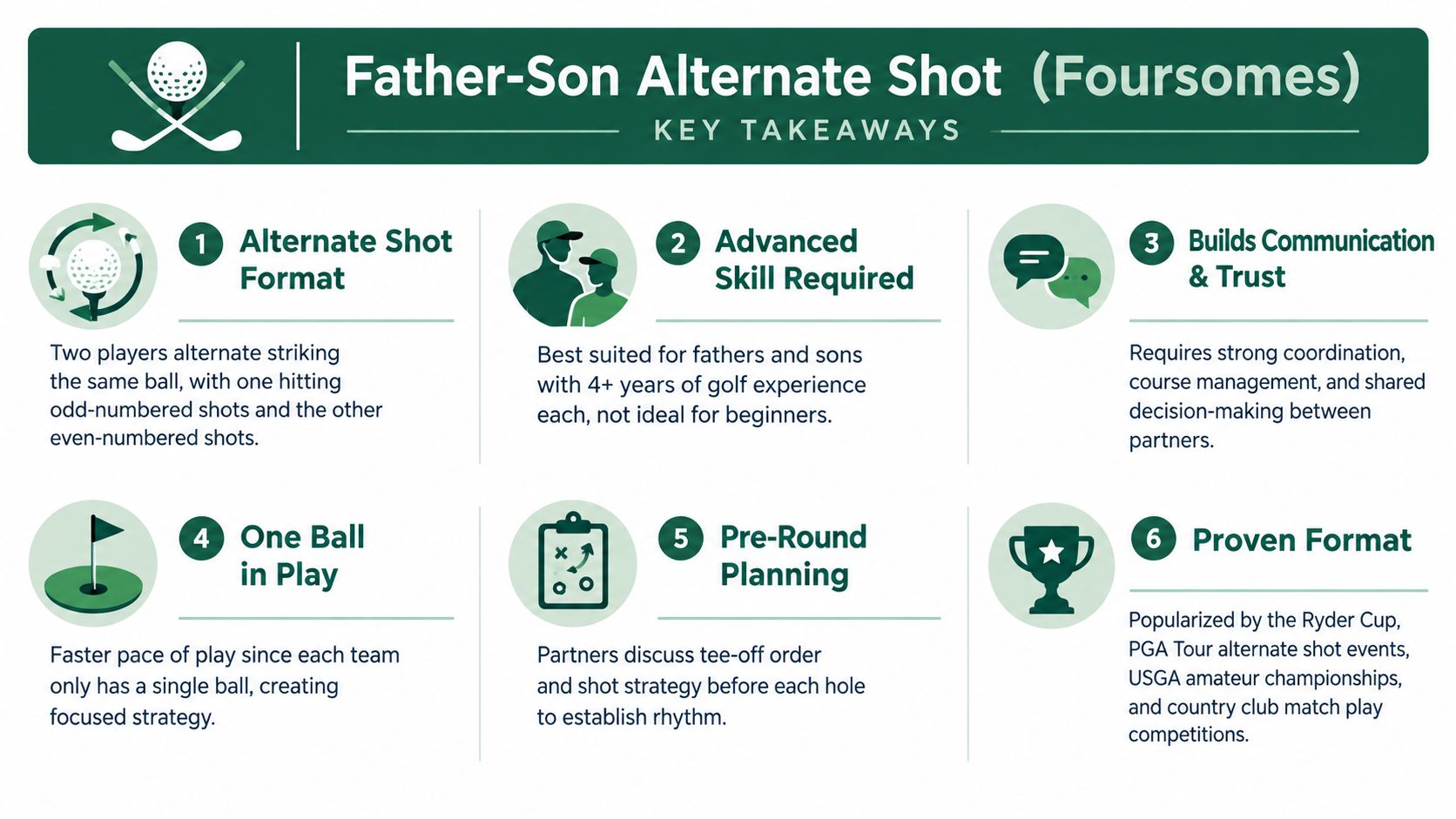
4. Father-Son Alternate Shot Foursomes
Alternate shot is where father and son golf gets more strategic. One player hits the tee shot, the other hits the next shot, and they continue switching until the ball is holed. It creates real teamwork because every decision affects your partner's next swing.
This is not the format for a wide skill gap or a child who hasn't learned basic course management yet. It's best for older sons, competitive juniors, or experienced parent-child teams who want the round to feel like a true test.
The trade-off is the point
Alternate shot rewards planning, patience, and calm reactions after bad swings. It also exposes weak communication very quickly. If one player keeps leaving awkward yardages or the team never talks through tee strategy, the format gets frustrating fast.
Some tournaments use a related version rather than pure foursomes. The NJ Golf Father & Son Championship uses a modified Pinehurst format over 18 holes, where both players hit tee shots, swap second shots, then choose one ball and continue alternate shot, while Low Net uses 40% of each team's course handicap. That's a smart middle ground for events that want strategy without making every hole feel severe from the first swing.
Don't use alternate shot just because it sounds traditional. Use it when the field actually wants a demanding partner format.
Setup details that matter
Before the round, tell teams who will tee off on odd and even holes. Encourage them to think about par-3 assignments and preferred approach distances. In live scoring, hole-by-hole match or team tracking is especially valuable because the drama lives in momentum, not just final score.
5. Father-Son Handicap-Based League Play
A Saturday event fills one tee sheet. A league fills your calendar.
Handicap-based league play fits father-son groups who want repetition more than a one-off title chase. It works especially well for clubs, munis, and practice facilities trying to serve mixed ages and uneven skill levels without turning every round into a gross-score contest. Younger sons can grow into competition, higher-handicap dads stay involved, and experienced teams still have something to play for if the net structure is set correctly.
The appeal is consistency. The risk is admin creep.
League play asks families for time, not just an entry fee, so the format only holds up if the season feels manageable. Six to eight dates usually lands better than a long schedule. A fixed weekly tee window also matters because parents are planning around school, work, and other junior sports. If the start times bounce around or makeup rules are vague, attendance slips fast.
The scoring model needs to be plain from day one. Decide whether teams use an official Handicap Index, a league-created baseline, or a simplified net adjustment for newer players. Then publish how standings work. Weekly points, season-long total net, or flighted tables all work, but only if players can understand them at a glance.
One of the better uses for Live Tourney is operational, not cosmetic. Organizers can keep recurring pairings, post weekly results, manage standings, send updates, and track side contests in one place instead of chasing texts and spreadsheet edits every week.
A few setup choices usually determine whether the first season sticks:
Keep eligibility specific: Define who qualifies as a father-son team, whether substitutes are allowed, and what happens if one player misses a week.
Match the season to the audience: Short evening rounds suit busy families. Weekend blocks fit clubs with more competitive players.
Limit side games early: One main table and one simple weekly prize are easier to sustain than multiple mini-games.
Plan for no-shows before they happen: Set forfeits, reschedules, and rain procedures in writing.
Clear eligibility rules prevent awkward signup disputes. The Texas Father-Son tournament requires male amateur Texas residents, with both father and son members of a TGA member club and holding a WHS Handicap Index of 18.0 or less, and it allows stepfather-stepson teams but not in-laws. A local league can be broader and more casual, but the lesson is the same. Spell out the rules before registration opens.
For event goals, league play is the strongest option in this roundup if retention matters more than spectacle. It gives families repeated touches with the facility, gives staff more chances to improve the format, and creates enough history that prizes, standings races, and season finales mean something.
6. Father-Son Instruction and Skill Challenge Tournaments
A 7-year-old with limited course experience and a parent who plays twice a month usually do better here than in a scored round. Instruction and skill challenge tournaments give families quick reps, visible progress, and enough competition to keep the day fun without asking them to survive 18 holes.
That makes this format a strong fit for junior clinics, academy open houses, beginner-heavy family days, and preseason events where goal is confidence. Older juniors can still compete, but the event works best when learning matters as much as placement.
The setup needs range. One family may want coaching and encouragement. Another may want a sharper contest with points and prizes. Build for both by splitting the day into teaching stations and a simple team leaderboard.
Use stations that test one skill at a time. A 20-yard pitch target, a lag putting lane, a fairway finder challenge, and a bunker escape station all tell staff more than a single aggregate score does. For a practical model, Live Tourney's guide to a skills challenge golf event shows how to score stations without creating bottlenecks.
A few operating choices make or break these events:
Keep each station short enough that groups do not stack up.
Score by points, not stroke totals, so beginners still have a path to contribute.
Put a coach or staff member at the stations where one cue can improve the next attempt.
Offer age-adjusted tees, targets, or scoring windows when the field includes young children and teens.
The trade-off is straightforward. You gain accessibility and energy, but you give up some of the prestige and rhythm of a traditional tournament round. That is usually the right trade if the event is meant to bring new families into the program or move clinic participants toward future scrambles and nine-hole events.
Administration also gets easier when pairings, station assignments, score entry, and parent communication live in one place. Live Tourney can help staff assign waves, post station rules, collect point totals, and show a live leaderboard without juggling paper cards and group texts.
Good prize structure matters here too. Closest to the target, best teamwork score, most improved junior, and parent-junior combined putting are better fits than one overall champion. Families leave talking about what they learned, not just who won.
7. Father-Son Charity and Social Golf Outings
A Saturday charity outing usually starts the same way. Grandfathers arrive with juniors, sponsors want their signs in the right places, a few teams care about winning, and many families just want an easy day together on the course. That mix changes how the event should be built.
Use this format when the goal is broad participation, fundraising, or community visibility more than pure competition. Scramble is usually the safest choice if the field includes young kids, occasional golfers, and sponsor guests. Best ball can work if the group skews older and more experienced, but it raises the pressure on pace of play and scorekeeping.
The operating trade-off is clear. Social outings create a better welcome for new families and give sponsors more room to participate, but they also create more moving parts than a standard tournament. Registration, hole assignments, contests, raffle tickets, meal counts, and post-round prizes all have to stay organized without making the day feel overproduced.
One workflow matters more here than in almost any other father and son format.
If staff are switching between spreadsheets, printed pairings, text chains, and paper scorecards, the event starts to feel disjointed for guests. Live Tourney can keep pairings, mobile scoring, announcements, and leaderboard updates in one place, which frees staff to handle sponsor setup, check-in, and family questions.
Design the day around what each group wants from it.
Families with younger players need simple rules, shorter explanations, and visible on-course fun.
Competitive father-son teams still want a leaderboard, clean scoring, and a prize worth tracking.
Sponsors want clear placement at contests, tee gifts, dinner, or activity holes.
Staff need one published schedule for arrival, start times, scoring, and awards.
Prize structure should reflect that split audience. One gross team prize is rarely enough. Add categories such as junior highlight, best dressed team, putting contest winner, and sponsor hole challenge so more families stay engaged through dinner and awards.
The father-son theme also carries real emotional weight. As noted by Golf Today, only 11 instances where both father and son won at least one tournament on major professional tours have been recorded. That rarity helps position the outing as more than a fundraiser. It gives the day a story people want to join and return to next year.
Father-Son Golf: 7 Formats Compared
Format | Implementation Complexity 🔄 | Resource Requirements 💡 | Expected Outcomes 📊 | Speed/Efficiency ⚡ | Ideal Use Cases & Key Advantages ⭐ |
|---|---|---|---|---|---|
Father-Son Best Ball Tournaments | Low–Moderate (standard scoring/pairings) | Low, basic scoring, leaderboards, optional flights/handicaps | Competitive, fair team scores; meaningful contributions from weaker player | Moderate (fewer balls than singles) | Mixed-skill pairs, mentorship-focused events; clear leaderboard competition |
Father-Son Scramble Events | Low (simple rules, easy briefing) | Low, minimal staff, simple scoring, tee setup | Inclusive, high participation, confidence-building for juniors | Very fast, continuous play and high engagement | Beginner-friendly outings, charity/club socials; maximizes fun and involvement |
Nine-Hole Father-Son Matches | Low (shorter format, same rules) | Low, standard scoring adjusted for 9 holes | Convenient bonding, frequent play opportunities, reduced fatigue | Very fast, ~90 minutes per round | Busy families, junior players, short practice/match play sessions |
Father-Son Alternate Shot (Foursomes) | High (alternate-shot rules, pre-round planning) | Moderate, experienced players, clear pairing orders, scoring | Develops strategy, trust, and advanced shot-making skills | Fast per team (one ball), but requires coordination | Skilled father-son pairs, advanced training, competitive match play |
Father-Son Handicap-Based League Play | Moderate–High (ongoing scheduling, handicap management) | High, admin, software for handicaps/standings, recurring coordination | Long-term engagement, measurable improvement, community retention | Steady, efficient with automation but recurring time commitment | Clubs seeking recurring revenue, community leagues, player development |
Father-Son Instruction & Skill Challenge Tournaments | High (multiple stations, integrated instruction) | High, PGA pros/instructors, course space, judging/staff | Skill improvement, memorable teaching moments, high engagement | Slower, longer events with instruction stops | Junior development programs, academy family events, coaching-focused outings |
Father-Son Charity & Social Golf Outings | High (logistics, sponsors, F&B, entertainment) | High, event staff, sponsors, registration systems, hospitality | Strong fundraising, community goodwill, broad participation | Moderate, play combined with social activities can slow pace | Large fundraisers, community-building events, sponsor activation |
Turn a Good Round Into a Repeatable Event
The best father and son golf event usually isn't the most complicated one. It's the one that matches the players in front of you. If the field is full of beginners or younger kids, start with a scramble. If families are busy or attention spans are short, run 9 holes. If you want balanced competition without punishing the weaker player, best ball is usually the safest choice.
For experienced pairs, alternate shot creates the deepest partnership test. For clubs that want recurring participation, league play makes more sense than a once-a-year novelty. If the property is trying to teach, recruit, or welcome new families, skill challenges are often more effective than formal stroke play. And if the broader goal is fundraising or community visibility, a social outing with simple team scoring will serve you better than a strict championship format.
History supports the appeal. Old Tom Morris and Young Tom Morris became the first father and son to finish first and second in a major, with Young Tom winning The Open in 1868 at age 17, and together they won eight of the first 12 Open Championships while Young Tom remains the youngest winner of any men's major. That legacy is part of why these events resonate. They connect family time to a format the game has recognized for generations.
Execution still decides whether families come back. Define your audience first. Publish simple rules. Choose age-appropriate tees. Set prize categories that fit the field. Build pairings that keep the pace healthy. Then communicate the schedule clearly so nobody is guessing at check-in, start times, or scoring.
If you want fewer moving parts on event day, use one system for registration, scoring, leaderboards, reports, and updates. That's where a platform like Live Tourney fits naturally. It keeps the operation cleaner while letting the day feel easy for players. If you're also building family practice spaces beyond event day, Austin putting green installation can support that long-term golf interest at home.
Live Tourney gives golf operators one web-based place to run father and son golf events, from registration and pairings to live scoring, leaderboards, reports, and player communication without requiring an app download. If you're planning a family scramble, a partner championship, or a recurring league, visit Live Tourney to see how it can simplify the admin side and keep the event moving.