
Nov 1, 2026
scoring golf games, Stableford scoring, match play, skins game, golf scorecard
Scoring golf games for stroke, match, Stableford, skins, points, and Ryder Cup, with scorecard examples, handicap rules, and live scoring tips.

The member-guest cards are coming in, someone wants the skins payout, and a team captain says the match board has the wrong winner. Your scorer has entered a net score in a gross column, and now nobody trusts the totals. You don't need another scorecard. You need a clear record of what happened on each hole, followed by a separate calculation for each game.
Scoring golf games starts with gross strokes, not the leaderboard. Keep the original hole score intact, then let the competition format determine whether that score produces strokes, points, a skin, or a hole won.
Which Result Wins in Each Golf Game
A member-guest fourball can play net stroke play, a skins pot, and a team match at the same time. The pair with the lowest aggregate result might not collect the most skins. Another pair might win the match by taking more individual holes despite losing badly on the holes they dropped.
Those aren't conflicting results. They're answers to different questions.
One gross-first record can produce three correct winners without three recording systems. Record actual strokes, including penalties, then calculate each game's result in its own column. Don't overwrite the original score when a handicap adjustment or side-game calculation changes what appears on the board.
How each golf game is scored
Format | Record each hole | Winner | When scoring stops |
|---|---|---|---|
Stroke play | Gross strokes including penalties, then net if handicapped | Lowest total gross or net | After 18 or all rounds, then the published countback or playoff |
Match play | Hole won, lost, or halved | Side whose lead exceeds holes remaining | For example, 3 and 2; otherwise after 18, then extra holes if required |
Stableford | Points against a fixed target, usually net par | Highest points total | Player may pick up once the hole can't earn a point |
Skins | Lowest unique gross or net on the hole | Player alone with the low score | Each hole; a tie carries when the committee allows it |
Points or quota | Stableford-style points versus a personal quota | Largest margin over quota | After 18 unless the committee sets an earlier cutoff |
Ryder Cup | Each match as 1 point, a half as 1/2 | Team with the most match points | After the scheduled team matches and singles |
Round robin | Win, loss, or half against each opponent | Best match-point record, then published hole-difference tiebreak | After every side has played every other side |
For skins, quota, and round-robin tiebreaks, the committee must publish the event's chosen rules. Those labels alone don't settle every scoring question.
Give markers one primary result
Before printing cards, circle the primary format row on the scorer's setup sheet. That tells staff whether the main result column holds strokes, holes, or points. Label side-game columns separately so a skins payment can't be mistaken for a championship result.
Handicap adjustments belong after gross entry. Apply them only to the allocated holes, then use the resulting net score in the relevant game. Also check that secondary games don't conflict with the primary competition's completion requirements. A match concession doesn't automatically supply a valid stroke-play score.
Keep the event budget equally clear. Custom Mark's resource on planning golf event swag budgets can help organizers separate player gifts from competition spending, rather than discovering at payout time that everyone understood the available prize money differently.
How to Score Stroke Play Hole by Hole
Stroke play supplies the base routine that other games borrow. The USGA's stroke-play guidance defines the result by total strokes and distinguishes gross scores from scores adjusted for handicap strokes. Keep penalties in gross, confirm hole entries, and only then calculate net.
The workflow should be visible to markers before they leave the shop.

Run the card through seven checks
Confirm the competition before the tee. Check tees, scheduled holes, and whether the board is gross, net, or both. Use the player's applicable playing handicap for the competition, not an unexamined Handicap Index copied into the scoring field.
Record gross after each hole. The marker enters strokes taken, including penalties, and checks the entry with the player before the next tee. A penalty discussed but never written down still changes the result.
Allocate strokes by stroke index. In this worked example, a player receiving 8 strokes gets a stroke on indexes 1 through 8. A plus player gives strokes back on the applicable allocated holes. Don't award a stroke because a hole looked difficult that day.
Calculate net without changing gross. Subtract strokes received, or add strokes given back. Keep the two values in separate fields so staff can trace every leaderboard figure to its original entry.
Four-hole excerpt of a stroke-play card
This hypothetical card shows the allocation for that player receiving eight strokes.
Hole | Par | Stroke index | Gross | Strokes received | Net |
|---|---|---|---|---|---|
1 | 4 | 7 | 5 | 1 | 4 |
2 | 5 | 2 | 6 | 1 | 5 |
3 | 3 | 15 | 3 | 0 | 3 |
4 | 4 | 9 | 5 | 0 | 5 |
The last row is the useful check. The player made bogey, but that doesn't create a handicap stroke where none was allocated.
Total only checked entries. Add the hole scores after reviewing the allocation. In a multi-round event, finalize a round only after the required player and marker certification, so a disputed entry doesn't become an accepted cumulative result.
Rank the correct column and apply the published tie procedure. Gross competitions use gross totals; handicap competitions use net totals. If the committee chooses countback, publish the sequence beforehand, for example, last 9, last 6, last 3, then the last hole. Don't invent a tiebreak after seeing who benefits.
Separate handicap posting from competition scoring. The R&A's handicap score-adjustment rule caps an established player's handicap-record hole score at net double bogey, calculated as par plus 2, plus handicap strokes received. On a par-4 receiving one stroke, that maximum is 7. Don't replace the actual competition score with that cap unless the competition's adopted format permits it.
Practical rule: Lock the card only after the player and marker have confirmed every hole. A correct total can't rescue an incorrect hole entry.
How Match Play Ryder Cup and Round Robin End
Start with the close: a side is ahead by more holes than remain, so the match is finished. The USGA's match-play guidance gives the familiar example of a 3-hole lead with 2 holes left, recorded as 3 and 2.
Don't ask those players to complete the remaining holes for the match result. They may have another reason to continue, but the match itself has ended.

Keep the lead separate from the strokes
Fewer strokes wins a hole; equal scores halve it. Update the match status from those hole results rather than comparing running stroke totals.
Be precise with dormie, meaning a side leads by the number of holes remaining. The trailing side must win every remaining hole to draw level. A halved hole therefore ends the match in favor of the leading side; a loss by the leader keeps it alive.
Concessions need their own notation. Record a conceded stroke, hole, or match as such, rather than inventing a holed-out score. A concession is final, and it doesn't automatically satisfy a separate stroke-play competition being played alongside the match.
A match result is a record of holes won and lost, not an unfinished stroke total.
Although match play doesn't require an official returned stroke-play card, a committee publishing live standings should retain the hole results. They explain the final margin and let staff resolve an incorrectly entered lead.
For a straightforward singles handicap example, Ann plays off scratch and Ben receives 8 strokes relative to Ann. Ben receives those strokes on indexes 1 through 8, not as a general deduction against par. Apply the competition's published handicap allowances before establishing that difference.
Turn matches into team standings
A Ryder Cup-style event adds completed match results to a team ledger. For a conventional worked setup, award 1 point for a win and 1/2 point to each team for a halved match; a cup offering 28 points requires 14.5 to win outright.
Session structure still matters. Foursomes, fourball, and singles produce match results, but they don't use identical player-score entry. The Ryder Cup format and scoring guide is useful when arranging those sessions and explaining them to captains.
For a round robin, schedule every side against every other side. A clear house system awards 1 for a win and 1/2 for a half, then uses net holes won as a published tiebreak. Define how final margins count before play, especially when matches finish early.
Never convert a completed 4-and-3 match into a fictional full-round stroke score. Store the match margin and award the competition points it earned.
How to Award Stableford and Quota Points
Apply handicap strokes before looking up points. In standard Stableford, the committee establishes a fixed target, and the hole's score relative to that target determines its points. The R&A's Stableford rules specify that strokes include penalties and that handicap strokes are applied before points are calculated.
Standard Stableford points against the hole target
The standard Stableford scoring scale awards points as follows, with the highest total winning.
Score versus target | Points |
|---|---|
Two or more over | 0 |
One over | 1 |
Level with target | 2 |
One under | 3 |
Two under | 4 |
Three under | 5 |
Four under | 6 |
This is why a poor hole doesn't have to end a player's competitive round. Once no points are possible, the player may pick up. Record a clear pickup status and zero points, not a blank box that staff can't distinguish from an unentered hole.
The format was developed by Frank Barney Gorton Stableford to reduce the discouragement caused by disastrous holes. That purpose still makes practical sense for mixed-skill league nights: a player can move on without carrying an unlimited stroke loss into the points total.
Calculate the hole before the quota margin
Consider a hypothetical par-4 where the player receives one stroke. A gross 5 becomes net 4, level with the target, and earns 2 points, not 1. Keep that gross entry available so the scorer can explain the conversion.
Quota adds another calculation after hole points have been totaled. The essential result is points earned minus personal quota, not just points earned. Publish both the points scale and the quota formula because quota games aren't governed by one universal house method.
For example, suppose your event deliberately adopts course handicap plus 36 as its quota formula. A player with a 12 course handicap has a quota of 48; scoring 50 points produces a result of plus 2. That's an illustration of a chosen house formula, not a standard quota rule, and I wouldn't adopt it without testing whether it creates the competition you intend.
Use a separate margin column for quota standings. Sorting raw Stableford points beside quota margins makes unlike results appear comparable.
The Stableford scoring guide can help explain the points conversion to players before the round. For handicap posting, process any pickup under the applicable handicap rules; don't manufacture a gross competition score merely to fill an empty field.
How to Score a Skins Game with Carryovers
A skin requires a low score that nobody else matches. A player can beat most of the group and still win nothing because another player tied the low score.
Use this hypothetical gross-score card with carryovers enabled. Read the holes in order, because the prize available on a hole includes anything still unclaimed.
Six-hole skins card with carryovers
Hole | Ann | Ben | Cleo | Skin result |
|---|---|---|---|---|
1 | 4 | 5 | 4 | Tie, 1 skin carries |
2 | 5 | 5 | 6 | Tie, 2 skins carry |
3 | 4 | 3 | 5 | Ben wins 3 skins |
4 | 4 | 4 | 4 | Tie, 1 skin carries |
5 | 3 | 5 | 4 | Ann wins 2 skins |
6 | 5 | 4 | 4 | Ben and Cleo tie, skin carries |
Ann and Cleo block each other on the opening hole. Ann and Ben tie the next, so Ben's lone low score on the third collects the accumulated prize.
The fourth hole starts a new carry. Ann takes that carry plus the next hole's skin, while Ben and Cleo's shared low score on the sixth refuses a payout. Being joint lowest isn't enough.
Set the money rules before play
Resolve these choices on the rules sheet rather than beside the cash drawer:
Gross or net: Name the scoring basis and the applicable handicap allocation. Don't switch to net because a gross result feels unfair afterward.
Carry or split: State whether tied holes carry forward or are settled immediately under a different house arrangement.
Unclaimed final skins: Choose a playoff or a defined split, including exactly who participates.
Separate side bets: Keep greenies and other contests in their own pots unless the published budget explicitly combines them.
The buy-in description matters as much as the scoring rule. In a hypothetical three-player game, $20 per player creates a $60 pot, while $20 total creates a much smaller pool. Spread across 18 skins, those base values are approximately $3.33 and $1.11 respectively.
Keep full precision in the ledger and round only when settling payments. Otherwise, repeated rounding can leave money unaccounted for. A three-skin win pays three times the unrounded base value.
The golf skins calculator guide is a useful companion when setting the pot and checking carryovers.
Payout check: Confirm the group's hole scores before marking a skin won. A corrected tie can reverse a payout and restore the carry.
Keep the skins ledger separate from the official championship result. Winning the side pot doesn't change who won stroke play or the team match.
Keep the Card and the Board Honest During the Round
The wrong-column mistake is easy to miss because the number looks believable. A scorer copies a net result into the gross field, the system applies another adjustment, and the board shows a score the player never made.
Catch that error at entry, not during the prize presentation. Give the scorer a clearly labeled gross field, visible handicap allocation, and separate calculated results.
Reconcile while players are still available
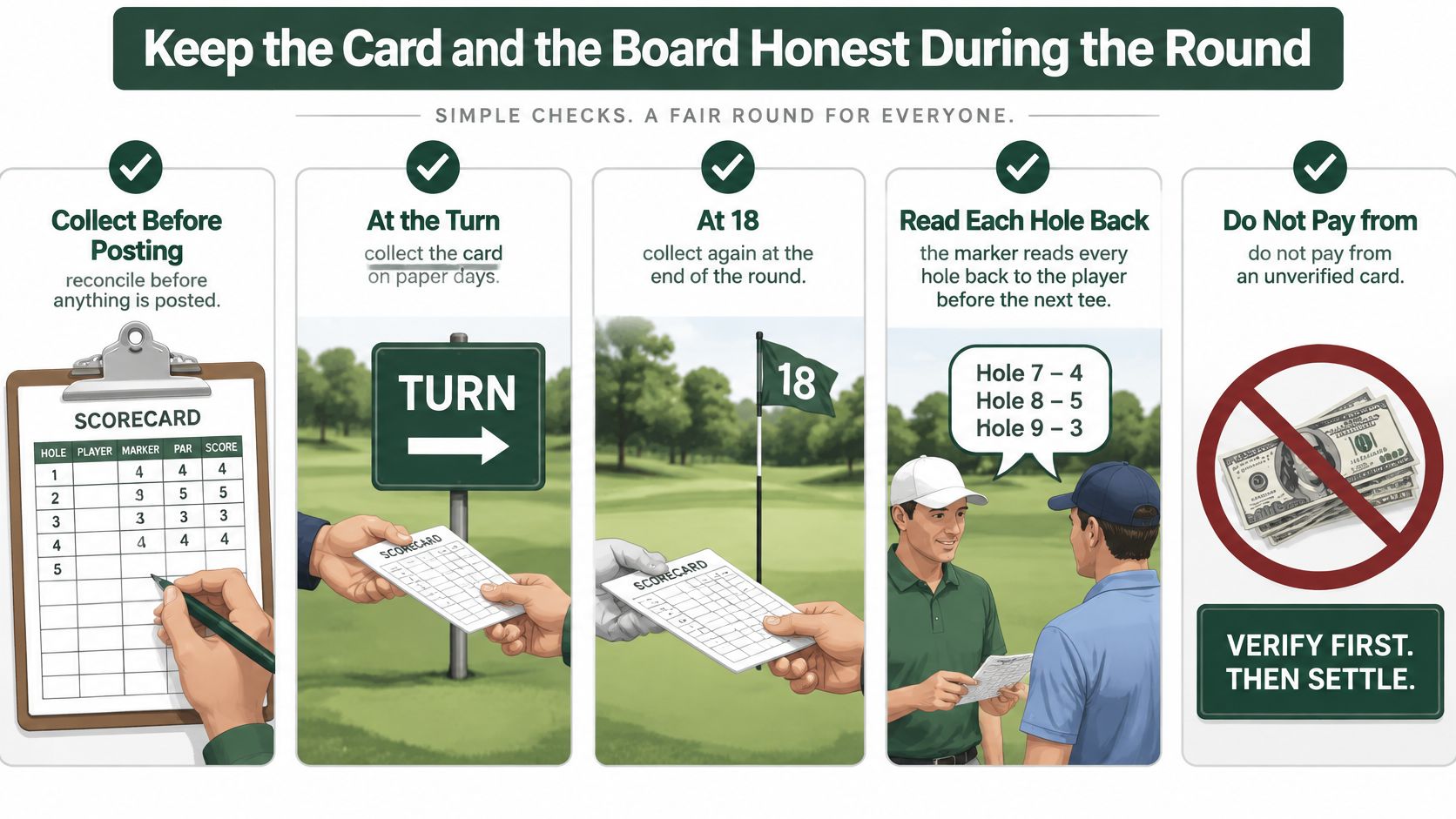
On paper days, collect or check cards at the turn, then collect them again at the finish. Have the marker read entries back to the player during the round rather than relying on a hurried reconstruction in the shop.
For live entry, submit scores promptly after leaving the green, without holding up the group behind. Players should be able to see current match leads and skins carries while those results still matter to the round.
Mark provisional standings clearly. Don't pay from an unsigned stroke-play card, and don't treat a match result as if it requires the same stroke-play paperwork. Verify each format using the record that determines its winner.
Run the final reconciliation
Hole totals: Add the recorded hole column independently and compare it with the displayed card total. Investigate a mismatch instead of typing over the total.
Handicap allocation: Check the player's assigned strokes against the hole stroke indexes. A correct round-total deduction can still conceal incorrect hole results.
Skins ledger: Reconcile awarded skins, outstanding carries, and payouts against the full pot. Keep an explicit entry for any unclaimed balance.
A spreadsheet can work for a casual group. It becomes fragile when staff copy the same score into separate tabs for different games, particularly when formulas or player rows have moved.
Use one score-entry record with separate result calculations. Preserve corrections with enough detail to identify the changed hole and the reason, then recalculate every affected game before publishing the final board.
Give one staff member responsibility for release. Other staff can check entries, but someone must know when the results are verified and ready to pay.
Set the Format Before Pairings Go Out
Choose the competition before building the tee sheet. Pairings, card layouts, handicap allowances, and finishing procedures all follow from that decision, and changing the format late forces staff to repair each of them.
Write down the primary game and name every side game. State whether matches may finish tied, whether skins carry, and which boards display gross or net. Players shouldn't be inventing a points box halfway through the round.
Make the card match the competition
Build only the columns the marker needs. Keep entry fields distinct from calculated fields, and use a concession or pickup status where the format requires it. An uncluttered card is easier to verify than a page full of unlabeled totals.
Then select the place to run that format. Live Tourney supports Single Round, Multi Round, Match Play Bracket, Ryder Cup, Round Robin, Leagues, and Outings, with real-time leaderboards and instant score updates that players access without app downloads. More than 1,000,000 holes have been scored on the platform.
That doesn't replace a committee's decisions. Staff still need to define the scoring basis, finishing rules, and payout treatment before opening live entry.
Test the event before the field arrives
Use this pre-event checklist:
Load the roster: Confirm player names, tees, teams, and applicable handicaps against the approved entry list.
Review the rules sheet: Make sure it answers the actual tie, carryover, concession, and pickup questions the format creates.
Inspect the outputs: Check scorecards and leaderboard labels against the competition, not a previous event's assumptions.
Run a practice group: Enter a sample hole, a handicap adjustment, and a tied result. Confirm that each game produces the intended outcome.
Assign the closeout: Name who verifies cards, resolves disputed entries, and authorizes payouts.
For recurring league nights, reuse a checked event structure rather than rebuilding the scoring logic from memory. Review anything that changes, especially rosters, handicaps, teams, and side-game terms.
Before the field arrives, put a practice card beside the live board and trace a hole from entry to result. If staff can't explain the number, fix the setup before players start competing for it.
Live Tourney offers live scoring, custom scorecards and reports, side games, and a payouts calculator to help run the format you've chosen. Visit Live Tourney to set up your next event and test a practice group's scores before opening the competition to the field.





