
Jun 15, 2026
bay hill scorecard, arnold palmer invitational, bay hill yardage, golf tournament software, orlando golf courses
Get the complete 2026 Bay Hill scorecard, including hole-by-hole yardages, ratings, and pro tips. A perfect reference for players and tournament organizers.
Bay Hill asks a specific question the moment you step onto the property. Are you reading the scorecard as a list of yardages, or are you using it as a working document for decisions?
That distinction matters. Players want a clean way to map tee shots, understand where par is a good number, and avoid giving shots away on holes that look simpler on paper than they play. Tournament directors need the same card for different reasons. They need accurate setup data, clean communication, proper pacing, and a format that staff and players can use without confusion.
A good Bay Hill scorecard does both jobs. It gives the player a plan and gives the organizer a framework.
Your Guide to Mastering the Bay Hill Scorecard
The first tee at Bay Hill carries a little extra weight. Players feel the history, but what usually matters more after the opening swing is whether they prepared correctly. At a course like this, the wrong read starts before the round. It starts when someone sees par 72, scans a few yardages, and assumes the card tells the full story.
It doesn't.
For a competitive player, the Bay Hill scorecard is a planning tool. It tells you how the course is presented, how long each hole is set, and where handicap allocation may shape match play or net competition decisions. For a club pro or tournament director, that same card becomes operational. It affects pairings sheets, printed materials, score-entry setup, cart signage, and the way you brief the field before the first group goes out.
Practical rule: At Bay Hill, treat the scorecard as a starting point, not the strategy itself.
That's where people get tripped up. A championship card can look straightforward and still produce ugly numbers if the player ignores angles, visuals, and carry demands. On the operations side, even a small scorecard error can ripple through scoring, hole assignments, and pace-of-play management.
Two audiences usually need this guide most:
Competitive golfers: They need the numbers, but they also need to know where Bay Hill punishes indecision.
Tournament professionals: They need a scorecard that can move from paper to event setup without introducing avoidable mistakes.
Bay Hill rewards preparation that is specific. Not generic course knowledge. Not broad “play smart” advice. Specific clubs, specific landing zones, specific admin details, and a clear understanding of what the card can and can't tell you.
Bay Hill's Championship Legacy and Design
A Bay Hill scorecard can look clean on paper and still leave good players out of position all day. That is the first design lesson the course teaches. Bay Hill was built to test judgment as much as execution, and that shows up long before a player reaches the closing stretch.
Bay Hill opened for play in 1961, with Dick Wilson shaping a course that uses bunkering and water to influence line, shape, and commitment on nearly every side of the card. A historical account of Bay Hill and the Arnold Palmer Invitational also traces the course's early development and Palmer's first competitive connection to the property in one place, which is useful context if you want the tournament history behind the layout's reputation: historical account of Bay Hill and the Arnold Palmer Invitational.

Why the design still matters
Some tournament venues get their status from the event first. Bay Hill earns it from the golf course itself.
Wilson's architecture asks for a specific kind of discipline. The hazards are not there for looks. They sit where they can narrow a preferred line, tempt a player into forcing distance, or block the best angle into the green. For anyone reading a Bay Hill scorecard, the numbers alone hide that design intent. A hole may list a modest yardage and still play as a demanding positional hole if the correct side of the fairway is only available to a committed tee shot.
That distinction matters to two groups.
For the competitive player, the scorecard is only useful if it is read alongside angles, carry windows, and miss patterns. For the tournament organizer, the same design traits affect setup choices, pace expectations, and how clearly the competition materials need to communicate the day's playing yardage and teeing grounds. A Bay Hill card is not just a record of distance. It is a map of where poor decisions get exposed.
The Palmer turning point
Arnold Palmer changed the public profile of Bay Hill early in its life, and the course never really stepped back from that standard. Once Palmer was attached to the property, Bay Hill became more than a strong Florida club course. It became a venue players, media, and organizers associated with championship golf and demanding presentation.
That legacy still shapes expectations on site. Players arrive expecting a course that rewards control under pressure. Organizers are expected to present the event with the same level of precision. If the printed card, hole information, or scoring setup is sloppy, it stands out more at a place with Bay Hill's reputation than it would at a routine member-guest.
I have always viewed Bay Hill as a course that punishes half-committed planning. The player who only checks total yardage misses the strategy. The committee that treats the scorecard as a simple admin document usually creates avoidable problems later, especially once that card has to be entered into modern scoring software and matched to the day's actual competition setup.
The Official Bay Hill Scorecard 2026
For tournament reference, the official 2026 Arnold Palmer Invitational setup is listed at par 72 and 7,114 yards, and that tournament length clears the common professional-event threshold that starts to force more demanding course management decisions, according to the Bay Hill Club & Lodge course listing. The same source notes that holes such as the 400-yard par-4 10th place a premium on 300-plus-yard carry distance when players are trying to create a real advantage.
What to look for on the card
When I review a tournament scorecard for a course like Bay Hill, I'm looking at three things first:
Tee consistency
Make sure the yardage you're using matches the setup your event is playing. “Bay Hill scorecard” can mean one thing to a visiting player and another to a tournament committee using a specific competition setup.Par and handicap alignment
Those fields affect scoring apps, printed cards, skins games, and any net competition structure. If one value is off, the scoring headache starts before the opening tee shot.Operational readability
If players can't scan the card quickly, they won't use it correctly. That's a real issue in outings and member events where pace often suffers because players are clarifying basic hole information on the tee.
Bay Hill Club and Lodge scorecard 2026
The source material provided for this article verifies the table structure and the tournament benchmark, but it does not provide a hole-by-hole yardage breakdown for each tee. Because of that, the table below is presented as an organizer-friendly template using the verified columns only.
Hole | Green (Yards) | Blue (Yards) | White (Yards) | Red (Yards) | Par | Handicap |
|---|---|---|---|---|---|---|
1 | Official hole-by-hole values should be pulled from the current club scorecard | Official hole-by-hole values should be pulled from the current club scorecard | Official hole-by-hole values should be pulled from the current club scorecard | Official hole-by-hole values should be pulled from the current club scorecard | Verify from event card | Verify from event card |
2 | Same as above | Same as above | Same as above | Same as above | Verify from event card | Verify from event card |
3 | Same as above | Same as above | Same as above | Same as above | Verify from event card | Verify from event card |
4 | Same as above | Same as above | Same as above | Same as above | Verify from event card | Verify from event card |
5 | Same as above | Same as above | Same as above | Same as above | Verify from event card | Verify from event card |
6 | Same as above | Same as above | Same as above | Same as above | Verify from event card | Verify from event card |
7 | Same as above | Same as above | Same as above | Same as above | Verify from event card | Verify from event card |
8 | Same as above | Same as above | Same as above | Same as above | Verify from event card | Verify from event card |
9 | Same as above | Same as above | Same as above | Same as above | Verify from event card | Verify from event card |
10 | Same as above | Same as above | Same as above | Same as above | Verify from event card | Verify from event card |
11 | Same as above | Same as above | Same as above | Same as above | Verify from event card | Verify from event card |
12 | Same as above | Same as above | Same as above | Same as above | Verify from event card | Verify from event card |
13 | Same as above | Same as above | Same as above | Same as above | Verify from event card | Verify from event card |
14 | Same as above | Same as above | Same as above | Same as above | Verify from event card | Verify from event card |
15 | Same as above | Same as above | Same as above | Same as above | Verify from event card | Verify from event card |
16 | Same as above | Same as above | Same as above | Same as above | Verify from event card | Verify from event card |
17 | Same as above | Same as above | Same as above | Same as above | Verify from event card | Verify from event card |
18 | Same as above | Same as above | Same as above | Same as above | Verify from event card | Verify from event card |
How players and pros should use it
Players should use the card to identify where length creates pressure and where restraint may produce a better angle. Organizers should treat it as controlled data. One verified scorecard should feed every event asset, including printed scorecards, digital score-entry pages, starter sheets, and scoreboards.
What doesn't work is copying partial information from multiple places and hoping it all matches on tournament day. At Bay Hill, details matter too much for that.
Understanding Bay Hill Course Rating and Slope
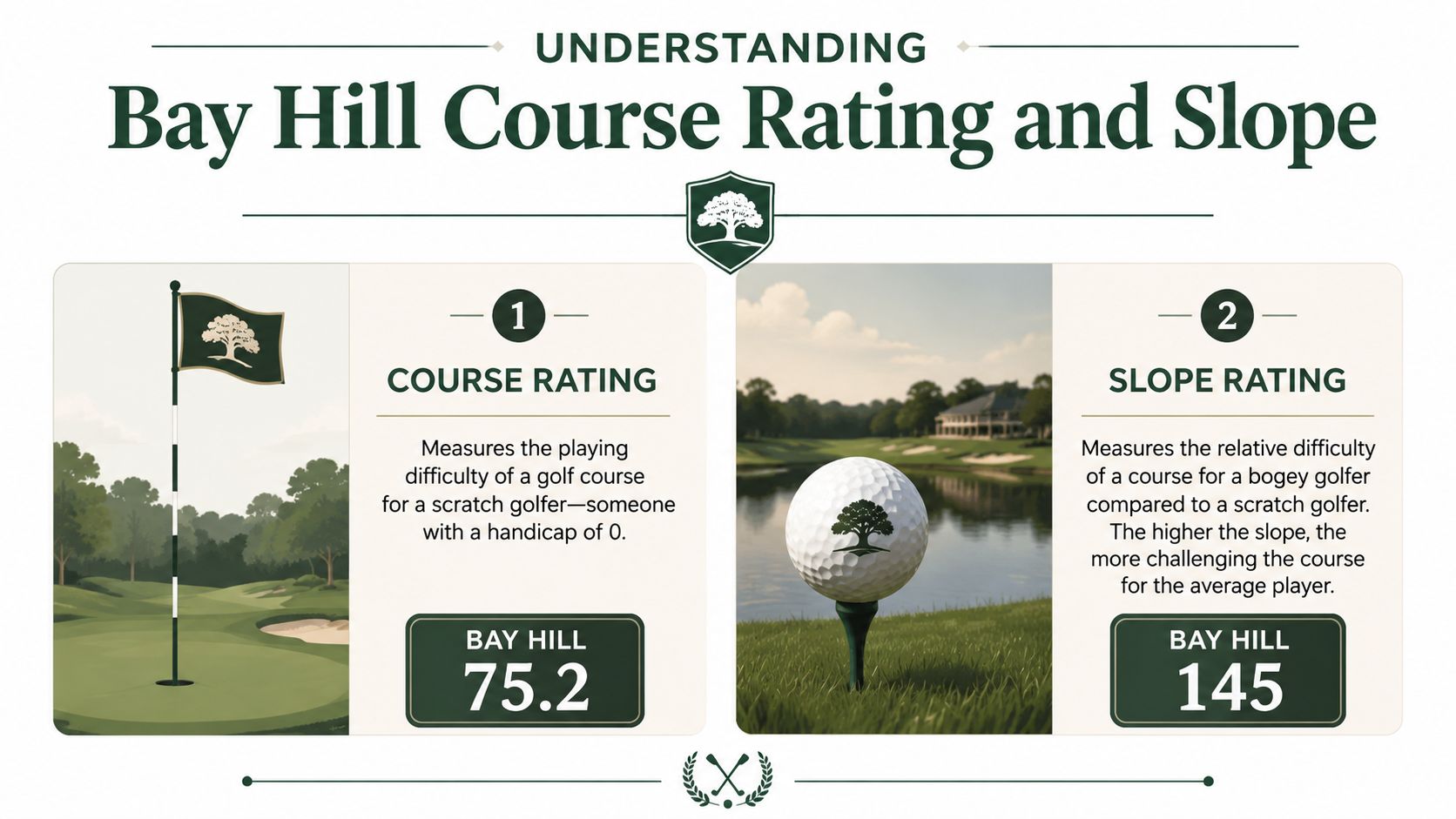
The course rating and slope tell you more about Bay Hill than the par line ever will. From the championship Green tees, Bay Hill is listed at 7,381 yards with a 75.4 course rating and 142 slope rating, while the Blue tees measure 6,895 yards with a 73.7 rating and 139 slope, according to the Bay Hill championship course details and PGA Tour difficulty analysis.
What those numbers mean in practical terms
A course rating estimates how difficult the course should play for a scratch golfer. A slope rating shows how much more difficult it becomes for a bogey golfer relative to that scratch standard. If you want a simple refresher on the underlying concept, this overview on what a course rating means is useful.
At Bay Hill, those figures tell you the challenge is structural, not cosmetic. This isn't a course that plays hard only when the wind is up or the rough gets juicy. The base setup already asks for a high level of control.
Why Bay Hill plays harder than the card suggests
The same Bay Hill analysis notes that the course ranked as the 7th-highest total scoring average among regular PGA Tour stops and had the 5th-lowest greens-in-regulation rate since 2015, at roughly 63%, in that source's review of modern tour play. A separate tour preview cited there listed Bay Hill at 7,466 yards and reported players hit only 56.7% of fairways over the previous five years versus a TOUR average of 60%.
That's the key point for players and event staff. Difficulty here shows up in the full shot chain.
Off the tee: Missing fairways happens more often than many players expect.
Into the green: Even strong players don't hit as many greens here as they do at easier tournament stops.
On the card: Par can look ordinary while the shot requirements are anything but.
If your field reads Bay Hill as “just another par 72,” the scorecard is already being misunderstood.
For tournament directors, rating and slope also shape communication. They help set expectations for pace, scoring spread, and how aggressively players should attack the course in different formats. In a gross competition, Bay Hill can expose weak ball-striking quickly. In a net event, clean handicap handling matters because the course has enough built-in stress that players will notice any scoring inconsistency.
Printable Bay Hill Scorecard and Digital Download
For preparation, a printable scorecard still has value. Players like having something they can mark up with carry numbers, conservative targets, and reminders on holes where the safe line isn't obvious. Tournament staff like it because a clean hard copy catches mistakes faster than a cluttered spreadsheet.
A digital version matters just as much. Staff can check hole details from a phone on the tee. Players can confirm setup before the round. That's especially useful when the event uses a custom competition card or adjusted tee assignments.
Best way to use a printable version
A printed Bay Hill scorecard is most useful when you annotate it before the round, not during it. Keep the notes tight.
Club decision notes: Mark where you're laying back by choice instead of default.
Trouble reminders: Flag holes where the visual doesn't tell the whole story.
Competition details: If you're running an event, note any local rules or format reminders that need to match the official card.
Best way to use a digital version
A digital copy works better for confirmation and distribution than for deep planning. That's true for players and staff.
If you're building a paperless workflow, it helps to think beyond the static PDF and review how digital golf scorecards fit into registration, live scoring, and post-round reporting. The core benefit isn't novelty. It's consistency. One clean source of scorecard data reduces the chance that the starter, the scoring table, and the players are all looking at different versions.
What doesn't work is sending multiple attachments with slightly different course information and trusting everyone to use the right one. That's how avoidable scoring disputes begin.
Hole-by-Hole Playing Strategy and Key Holes
A player standing on Bay Hill's 1st tee and a tournament director building the round sheet need the same thing from the scorecard. They need to know which holes demand restraint, which holes invite a shot, and where the printed yardage still leaves room for bad decisions.

Bay Hill is hard on players who read only the total number. It is just as hard on organizers who assume every player will interpret the card the same way. The scorecard gives the framework. Strategy comes from knowing where angle, carry, and miss pattern matter more than raw distance.
Front nine holes that shape the round
Hole 1 sets the tone. Players who force an aggressive opening tee shot often bring trouble into play before they have settled in. For event staff, this is also an early pace-of-play checkpoint because a messy start can back up the entire front side.
Hole 2 usually rewards a disciplined line more than brute force. The scorecard number matters, but the better question is which side of the fairway opens the next shot.
Hole 3 asks for control into the green. On a card, it can look straightforward. In play, the quality of the leave and the section of green you choose matter as much as the club.
Hole 4 is one of those holes where tournament players should commit early. Indecision off the tee tends to produce the worst swing of the sequence.
Hole 5 gives players a chance to settle if they have managed the opening stretch correctly. It is also a spot where organizers should expect scoring swings if tees are adjusted for a member event or multi-division field.
Hole 6 is one of the clearest examples of Bay Hill asking for a precise plan. The hole puts pressure on the tee shot shape and on where the ball finishes, not just on whether the ball stays in play. Good players work backward from the preferred approach window. Players who aim generically and accept any fairway leave often turn a manageable hole into a defensive par attempt. That same principle matters for tournament setup. If the card, tee sheet, and player notice do not reflect the intended setup, competitors can misread the hole before they even swing.
Holes 7 through 9 close the outward nine with no room for autopilot. There are birdie looks available, but Bay Hill rarely gives them away. If a player has been chasing positions instead of angles, the score usually shows it by the turn.
Back nine holes that decide scores
The inward nine is where the Bay Hill scorecard becomes more than a reference sheet. Competitive players start using it as a decision map. Organizers start seeing where the course can separate the field quickly.
Hole 10 demands a clean restart after the turn. A lot of players lose momentum here by trying to get a shot back too early.
Hole 11 tends to reward patience. On difficult setups, par has real value, and tournament officials should treat it that way in player briefings rather than presenting every hole as an attack hole.
Hole 12 can shift between opportunity and damage depending on tee position and hole location. That is exactly why scorecard data has to be paired with the day's setup.
Hole 13 is a planning hole. The first shot dictates whether the next one is aggressive or merely hopeful.
Hole 14 often gets overshadowed by what comes after it, but it matters. Players who leave this hole in control can play the closing stretch with options.
Hole 15 is one of Bay Hill's better examples of a hole that can fool players who trust the number without studying the shape of the shot. Landing area nuance and visual framing matter here. The smart play is often the one that leaves a full view and a predictable bounce, even if it gives up a few yards. I see players make the same mistake on this hole during events. They choose the club for maximum distance instead of the club that keeps the next decision simple.
Holes 16 through 18 finish the job. They test nerve, discipline, and score awareness. By that point, players are not just executing shots. They are managing context, leaderboard pressure, and pace. For organizers, those closing holes are also where scoring workflows need to be sharp, especially if the competition uses live updates or multiple formats. A clean setup for scoring in a golf tournament matters most when the finish creates movement across gross, net, skins, or team results.
How to use the scorecard strategically
At Bay Hill, the best use of the scorecard is practical.
Start with the preferred approach angle. Then choose the tee shot that produces it.
Separate playable from ideal. A ball in the fairway is not always in the right part of the fairway.
Treat par as a planned score on the right holes. Forced aggression is expensive here.
Match the card to the setup. Players need the day's tees and competition rules. Organizers need that same information carried accurately into pairings, live scoring, and reports.
That is the split in how this scorecard gets used. A player studies it to save shots. A tournament organizer uses the same information to prevent confusion, protect scoring accuracy, and make sure the event runs the way the course demands.
For Tournament Organizers Using the Bay Hill Scorecard
Running an event at a course like Bay Hill isn't hard because the scorecard is complicated. It's hard because the scorecard touches everything.

The yardages and pars have to match your printed cards. The printed cards have to match your live scoring setup. The live scoring setup has to match your formats, your handicap allocations, and the way your staff explains the competition to players on the first tee. If one piece drifts, players notice immediately.
Where manual setup usually breaks down
Most event problems show up in familiar places:
Data re-entry: Staff types the same course information into multiple systems and introduces avoidable errors.
Version confusion: The shop, the starter, and the scoring table end up using different scorecard versions.
Format mismatch: Gross, net, skins, and team games don't align cleanly with the underlying scorecard setup.
Late changes: A tee adjustment or competition tweak creates a scramble because the event materials aren't connected.
I've found that the practical fix is simple in theory and easy to miss in execution. Build one verified course setup, then let every event output flow from it.
What modern tournament software should handle
If you're evaluating software for an event built around a championship card, it should handle the scorecard as structured event data, not as a static image attachment. That means the system should support scorecards, pairings, printable outputs, and live scoring from the same core setup.
One option in that category is Live Tourney's guide to scoring in a golf tournament, which reflects the broader workflow tournament staff need. In practical use, a web-based platform should let staff upload rosters, configure formats, generate scorecards and tee sheets, and keep players on one scoring standard without requiring them to install anything.
Operational advice: If your event team has to maintain separate “paper truth” and “digital truth,” you're carrying unnecessary risk.
What works and what doesn't
What works at Bay Hill is tight operational alignment. Use one official course setup. Confirm tee assignments early. Test the score-entry view before players arrive. Make sure the pace expectation and scorecard format are clear to starters and scoring staff.
What doesn't work is stitching together a tournament from PDFs, spreadsheets, and text messages. That approach can survive a small weekday outing. It doesn't hold up as well when the course, the players, and the expectations are all more demanding.
For a serious event, the Bay Hill scorecard shouldn't live in isolation. It should sit inside the same system that runs the competition.
Frequently Asked Questions About Bay Hill
Is the Bay Hill scorecard enough to plan a good round
No. It's necessary, but it isn't enough by itself. The card gives you distance, par, and structure. It doesn't show how visuals, contour, and landing-zone shape affect club and line choices. At Bay Hill, those details matter.
Should tournament directors rely on a public scorecard listing alone
Not if accuracy matters. Use a current, verified version that matches the setup your event is playing. Public listings are useful for reference, but event materials should come from one confirmed source so that the printed card, player briefing, and scoring setup all align.
Are yardage markers important at Bay Hill or mostly cosmetic
They're important. Bay Hill uses a marker system with 100-yard red markers and 150-yard white markers, and that kind of on-course reference becomes more useful on a demanding setup where guessing can turn a routine approach into a scrambling hole. Players who use the markers well tend to make cleaner decisions.
What should an organizer communicate before the round
Keep it practical. Confirm the tees in play, the scorecard version, any competition-specific instructions, and pace expectations. Bay Hill's posted pace guidance is clear, so the field should know from the start that steady movement is part of the day, not an afterthought.
A good pre-round note should answer the questions that usually create confusion on the first three holes. If players know the format, know the card, and know how scores are being entered, the rest of the day gets much easier.
If you run tournaments, leagues, or outings and want the scorecard, pairings, and live scoring to stay aligned from setup through final results, Live Tourney is worth a look. It's a web-based way to manage golf events with digital scorecards, live leaderboards, and back-office tools for the staff who have to make tournament day run cleanly.





