
Jun 10, 2026
scga team play, golf tournament guide, nassau format, live scoring golf, team golf events
Your complete guide to SCGA Team Play for 2026. Learn the rules, format, schedule, and how to easily manage your team with modern live scoring tools.
If you're the head pro, tournament chair, or team captain handling SCGA Team Play this season, you already know the hard part isn't explaining that the event matters. It's getting everything organized without drowning in texts, spreadsheets, scorecards, lineup changes, and Sunday-night score verification.
SCGA Team Play carries real club pride. It also creates very real operational friction. The clubs that run it smoothly usually aren't doing anything magical. They just treat it like a repeatable system instead of a weekly scramble.
An Introduction to SCGA Team Play
SCGA Team Play has lasted because it gives club golf a structure people care about. It isn't a one-off member event or a loose interclub game. It's a season-long competition with fixed teams, scheduled matches, and a pathway that rewards clubs that stay organized for the full run.
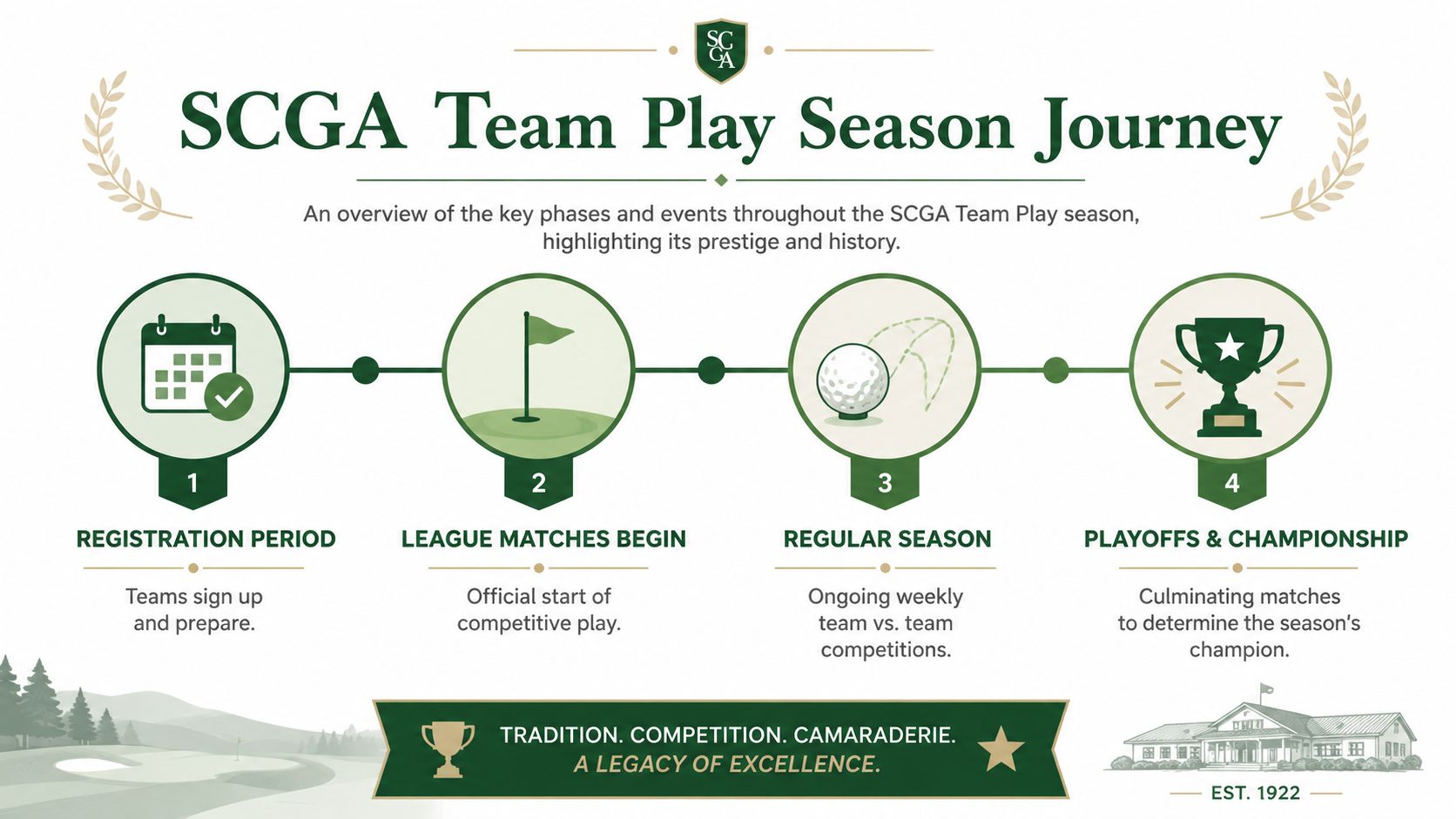
That history matters. The first informal events were held in 1900, and the first formal championship came 27 years later. Since then, the program has grown to more than 230 clubs and 8,000 participants each year, with clubs entering one 16-person team in a weekday league, a weekend league, or both for each qualifying course they maintain. Clubs are grouped in fours and play six home-and-away matches using single and four-ball match play, according to the SCGA Team Play history page.
Why clubs take it seriously
A lot of club competitions feel important only to the people playing that week. SCGA Team Play is different. It builds identity over a season. Players talk about away matches, home-course advantage, lineup strength, and whether the club can survive group play and advance.
For staff, that means the event can't be managed casually. Every weak process gets exposed fast.
Roster mistakes create eligibility headaches.
Loose communication leads to late scratches and confused pairings.
Paper-based scoring slows down match reporting.
Unclear responsibilities put pressure on the golf shop on match day.
Practical rule: Run SCGA Team Play like a league operation, not like a member-guest side game.
What the format demands from organizers
The structure is standardized, which helps. It also means your team administration has to be disciplined. You aren't improvising a field size each week. You're managing a defined roster, a fixed team competition, recurring opponents, and a season that rewards consistency.
That's why the best organizers keep three things tight from the start:
Eligibility control
Verify who can play before you need them.Scheduling discipline
Treat every match date like a production deadline.Scoring clarity
Make sure players and captains know exactly how points are won and recorded.
When those pieces are set early, SCGA Team Play becomes enjoyable to run. When they aren't, even a strong roster can lose points before the first tee shot.
Building Your 16-Person Roster
Most team problems start before the season starts. Not on the course. In the roster file, the handicap list, or the group text where someone says, "I thought he was eligible."
The cleanest way to avoid that mess is to build your roster in layers. Start with compliance. Then build for availability. Only then worry about pairings and chemistry.
Start with an eligibility checklist
Before you discuss who should play anchor, who travels well, or who fits a certain format, confirm your pool is usable.
Use a checklist like this:
Club membership status
Confirm every player is a current member in good standing through your club's records.Handicap verification
Make sure each player's handicap information is current and visible where your staff can confirm it quickly.Availability across the season
A talented player who misses multiple match dates often causes more disruption than help.Professional status and restrictions
Review the current SCGA materials carefully before finalizing anyone whose status could raise questions.Backup depth
Don't think only in terms of the starting 16. Think in terms of who can step in without forcing a last-minute scramble.
A simple league workflow makes this easier. If you need a clean model for organizing recurring competition, this league setup guide for golf organizers is useful for thinking through roster structure, communication, and repeat scheduling.
Build for reliability, not just talent
A common mistake is stacking a roster with the lowest handicaps available and assuming that solves the problem. It doesn't. SCGA Team Play is recurring. Reliability matters every week.
The following usually works better in practice:
Roster priority | What to look for | What usually goes wrong |
|---|---|---|
Core starters | Players who commit early and respond fast | Captains wait on vague maybes |
Mid-roster depth | Players comfortable in team formats | Strong individual players dislike partner dynamics |
Travel stability | Members who can handle away days consistently | Away-match attendance falls apart late |
Administrative fit | Players who submit info promptly | Staff chase missing confirmations |
A better captain mindset
Captains often ask who the "best 16" are. The better question is who the most usable 16 are.
Your strongest roster isn't the one with the flashiest names. It's the one you can field cleanly every match without drama.
That means you should lock in expectations early:
Response deadlines for availability
Substitution protocol if someone withdraws
A reserve list that isn't theoretical
One communication channel instead of scattered texts
If you've run interclub events with old methods, you know this already. The hardest part isn't selecting players. It's maintaining a roster that still functions in the middle of the season when injuries, travel, work conflicts, and silence start showing up all at once.
Decoding the Four-Ball Nassau Match Format
This is the part players nod at until you ask them to explain the points. Then half the room starts mixing up side games, overall match value, and what happens after a bad front nine.
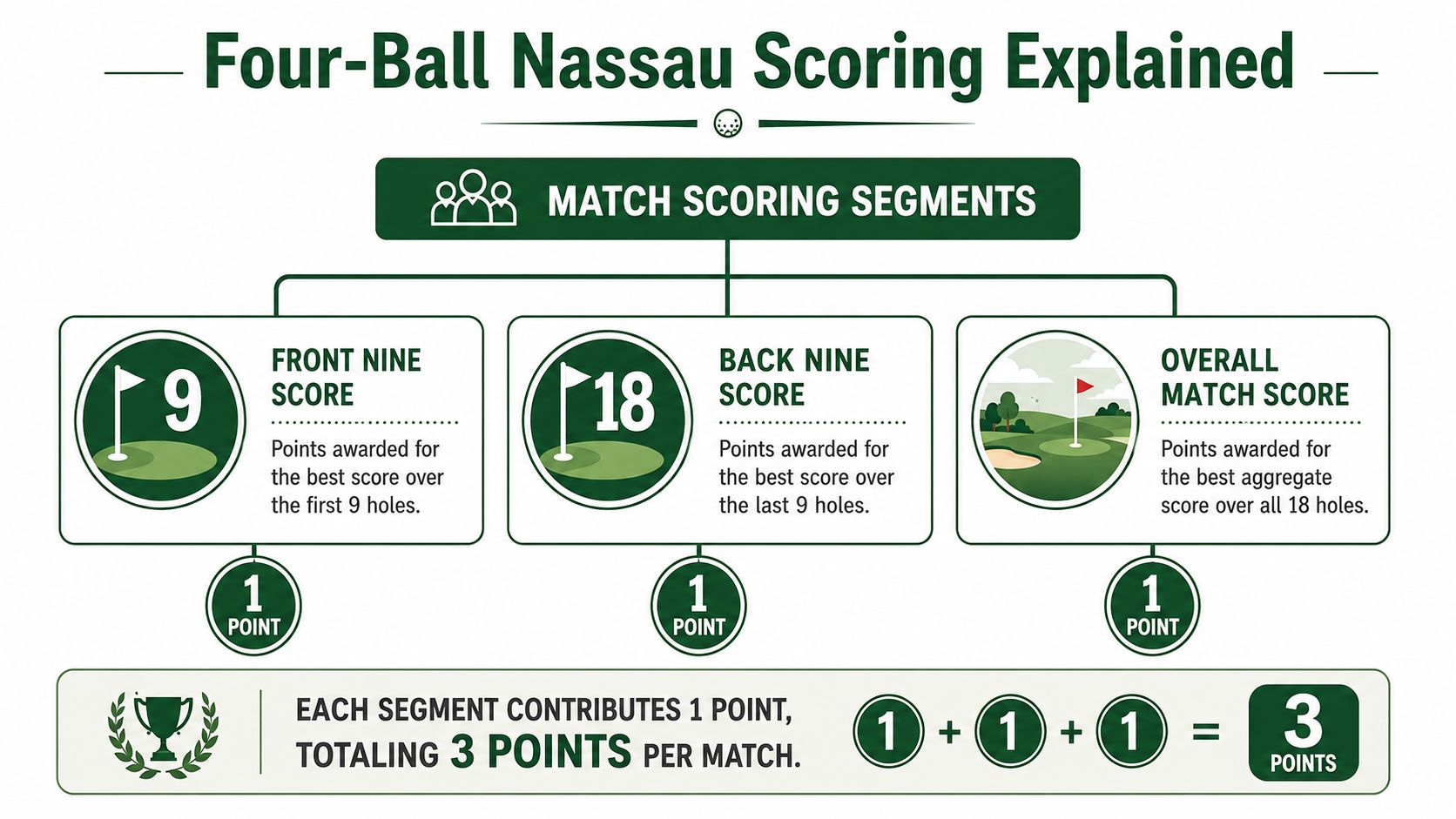
SCGA Team Play uses a four-person, four-ball Nassau format. In practical terms, that means each match contains several scoring opportunities inside one round, which is why the format stays competitive longer than winner-take-all structures.
How the points are actually awarded
According to the current manual, teams compete for two points on the front nine, two points on the back nine, and four points for the overall 18-hole match in the four-person, four-ball Nassau structure, as outlined in the SCGA Team Play manual.
That means one match isn't just one result. It has multiple pressure points.
Front nine carries its own value
Back nine is separate
Overall 18 holes matters most
If you want a quick refresher on how partner-based formats work more broadly, this guide to four-player golf games helps clarify the underlying logic.
Why players stay in matches longer
This scoring design changes behavior. A team can lose the front and still take points on the back or over the full 18. That's one reason captains like the format once they understand it. Early mistakes don't automatically kill the day.
Here's a simple way to explain it to your players:
Think of the round as three contests The front matters, the back matters, and the full round matters most.
Keep every hole live Even if one segment slips away, another is still in play.
Don't overreact to a rough start Nassau rewards teams that settle in instead of chasing hero shots.
Tell players this before every season opener: the match often looks different on the 13th tee than it did on the 4th.
Where captains get tripped up
The confusion usually isn't the format itself. It's communication. Players need to know who is recording what, when points are confirmed, and how disputes are handled before the round ends.
The old bad version looks like this:
one player keeps notes on a paper card
another tracks a separate hole-by-hole result
somebody in the parking lot tries to reconstruct the match outcome later
The better version is simpler. Agree before the first tee who enters scores, who verifies them, and how the captain gets the result immediately after the round. In SCGA Team Play, scoring confusion isn't a minor annoyance. It can become a reporting problem.
Navigating the Season Schedule and Playoffs
A Team Play season feels manageable in January. It feels tighter once availability starts colliding with home events, outside tournaments, travel, and regular member play. The clubs that handle the season well don't just know the schedule. They build around it.
Think of one club's path through the season. The team opens with an away match, hosts the next opponent, then starts realizing that every date affects more than that week. A weak response rate in one early match can ripple through the rest of the group stage because now the captain is protecting points and preserving depth at the same time.
What the season asks from a club
SCGA's current structure gives each club's 16-person team a group stage of six home-and-away matches. Group winners advance to single-elimination playoffs, and the final teams play an 18-hole championship. SCGA also notes that the World Handicap System is used in league competition, which helps make matches more competitive across clubs and skill levels, as described on the SCGA Team Play overview.
That setup creates a very specific management challenge. You aren't scheduling isolated contests. You're managing a short season where every lineup choice affects the standings.
A practical season rhythm
Most clubs benefit from treating the season in three phases:
Season phase | Captain focus | Common risk |
|---|---|---|
Early matches | Establish dependable attendance | Assuming the roster will "settle itself" |
Middle stretch | Balance form, availability, and home advantage | Burning out the same players |
Playoff push | Tighten communication and confirmation timing | Late confusion on who is actually available |
One thing I've seen repeatedly is this: clubs usually don't fall out because they lack talent. They fall out because they mishandle logistics in the middle of the season.
Good teams prepare for the playoff path early. Smart clubs prepare for the regular season grind first.
Home and away don't run the same
Home matches give you more control. Away matches test your process. Transportation, arrival timing, lineup communication, score collection, and pace expectations all become more sensitive when you're not at your own facility.
That means a captain should operate with two different checklists:
Home-match checklist for hosting, setup, and internal staff coordination
Away-match checklist for player confirmation, travel timing, and result capture
The playoff picture takes care of itself when the weekly operation stays clean. That's the unglamorous truth of SCGA Team Play. Clubs that look "organized" in the standings usually started by being organized in the golf shop.
A Modern Playbook for Running Your Matches
The old workflow for team matches is still hanging around in too many shops. Pairings live in a spreadsheet. Players get details in a text chain that nobody can search. Scores come back on paper. Someone rekeys everything later. If a captain has a question, staff dig through email and screenshots trying to confirm what happened.
That system works until it doesn't. And with SCGA Team Play, it usually breaks at the worst moment.

What a cleaner match operation looks like
A modern match-day process should do four things well:
Roster control
One current player list, not several versions.Pairings distribution
Players get their match information in one place and on time.Live score collection
Results come in during the round or immediately after, without re-entry.Fast reporting
Captains and staff can verify outcomes before anyone leaves the property.
The point isn't to add software for the sake of it. The point is to remove failure points.
Where software helps and where it doesn't
Software won't fix a captain who confirms availability too late. It won't make an unresponsive player answer messages. It also won't rescue a club that treats rules and reporting as an afterthought.
What it can do is eliminate avoidable admin work.
A practical setup might look like this:
Before the week starts
Finalize the active pool and lock your likely lineup.A few days before the match
Publish pairings and match details to players in a format they can open quickly on any device.During play
Let players or captains update scores in real time instead of waiting for staff to collect cards and reconstruct the result.After the round
Review one live record, confirm it, and report from a clean source of truth.
If you're evaluating tools for this part of the operation, golf score tracking software for tournaments and leagues gives a useful overview of what to look for in live scoring and reporting workflows. One web-based option is Live Tourney, which supports roster setup, pairings, match play scoring, and live leaderboards without requiring players to download an app.
The biggest operational win
The primary advantage of modern tools isn't flash. It's fewer handoffs.
Every handoff is a chance for a score, pairing, or player status to get lost.
When one system handles player communication, pairings, and score entry, the pro shop stops acting like a cleanup crew. That's the difference between barely surviving a match day and running one that feels professional to players and staff alike.
Handling Tiebreakers and Common Issues
Most stressful Team Play moments don't come from birdies and bogeys. They come from uncertainty. A match ends in a way two groups interpret differently. A player withdraws late. The home captain says one thing, the away captain says another, and suddenly everyone is standing by a cart trying to remember what the rule was.
That's why a written operating procedure matters more than confidence.

Resolve the issue before players leave
For tiebreakers and any disputed match result, the first principle is simple. Don't rely on memory after the parking lot clears.
Use this order of operations:
Confirm the segment results
Verify the front, back, and overall outcomes before talking about the full team result.Check the recorded hole-by-hole status
If there was confusion during the round, this is usually where the disagreement starts.Get both captains aligned on the submitted result
Don't let one side report while the other is still questioning the card.Escalate to the official SCGA materials when needed
If the issue isn't obvious, stop guessing and use the manual and league procedures.
Common problems that cause avoidable drama
Some issues show up every season.
Problem | What usually caused it | Better response |
|---|---|---|
Late no-show | Weak confirmation process | Require early attendance lock-in |
Substitution scramble | No ready reserve list | Keep alternates informed all week |
Score mismatch | Two unofficial records | Use one agreed scoring channel |
Reporting delay | Staff reconstructing results later | Verify before groups disperse |
The captain's job under pressure
The best captains don't argue louder. They slow the situation down. They ask who recorded the score, who verified it, and what was agreed on at the hole where the dispute started.
If you're managing volunteers or junior staff around these matches, broader team conduct and supervision principles matter too. This guide for sports club directors is useful because it addresses how leaders should handle conflict, behavior, and accountability in organized sports settings.
Calm administration wins more disputes than rules knowledge alone.
One more practical point. Substitutions and score reporting shouldn't live only in the captain's head. Put them in writing before the season. Players don't need the full manual memorized, but they do need to know what happens if someone is late, absent, injured, or unclear on a result. That single step prevents a lot of match-day noise.
SCGA Team Play FAQs and Final Tips
A few questions tend to come up every year, especially from clubs that are solid on golf operations but newer to the rhythm of team competition.
Quick answers that save time
Can a player's handicap change during the season?
Handicap administration is part of normal competitive golf operations, so captains should monitor current information throughout the season and use the applicable SCGA procedures when lineup questions come up.
What should the home club control on match day?
Hosting responsibilities usually include clear start information, organized player flow, score collection discipline, and making sure both sides know how results will be confirmed before anyone leaves.
How should weather issues be handled?
Don't improvise. Pause, document the situation, and follow the governing competition procedures in place for postponements, delays, or incomplete matches.
Final habits that separate smooth teams from chaotic ones
The clubs that make SCGA Team Play enjoyable usually share the same habits:
They decide early
Pairings and attendance aren't left unresolved until the last minute.They communicate in one place
Players know where to look for updates.They make score reporting boring
That's a compliment. Boring means reliable.They treat team culture as part of competition
Players come back when the experience feels organized and social, not just competitive.
That last point matters more now than some clubs realize. The National Golf Foundation reported in 2024 that women and girls accounted for 28% of on-course golfers in the U.S., up from 25% in 2019, while junior participation also remained strong, as noted in this SCGA Junior article on team play and player development. For club leaders, that suggests organized team formats can play a meaningful role in recruitment and retention.
The bigger takeaway
SCGA Team Play works because it gives golfers recurring competition with a club identity attached to it. That's powerful. It also means administration isn't optional. If the logistics are sloppy, players feel it immediately.
Run the season with a real system. Confirm early. Communicate clearly. Record scores in one place. Resolve disputes before they linger. Do that, and SCGA Team Play stops feeling like weekly chaos and starts feeling like the flagship club competition it's supposed to be.
If you're tired of running team matches through scattered texts, paper cards, and manual score entry, Live Tourney is worth a look. It's a web-based option for organizing rosters, pairings, and live scoring in one place, which makes SCGA Team Play much easier to manage for staff, captains, and players.





