
Sep 8, 2026
league management, golf league software, tournament management, golf course operations, live scoring
Streamline your golf league management in 2026 with this practical guide for course operators. Get tips on scheduling, scoring, and player engagement.

A league night rarely falls apart because players can't hit a golf ball. It falls apart because one player arrives late, a partner needs replacing, a handicap looks wrong, two groups record different results, and nobody knows which spreadsheet contains the current standings. By the time the last score is posted, the head pro is still reconciling numbers while players wait for answers.
That experience is avoidable. Good league management gives players a clean check-in, dependable pairings, visible results, and a reason to return next week. It also gives staff a reliable operating system for schedules, handicaps, payments, communications, and exceptions. The league becomes part of the course experience, not a recurring administrative emergency.
Why League Nights Make or Break Your Course
A chaotic league night has a familiar rhythm. The first tee is backed up because the pairing sheet changed after printing. A substitute has been added by phone, but the scorekeeper has the old roster. Someone leaves a paper scorecard in a cart. Players gather around the counter asking who won, while an employee compares handwritten totals with a handicap spreadsheet that was updated earlier in the day.
The damage isn't limited to staff workload. Players notice uncertainty immediately. They wonder whether their score counted, whether the handicap adjustment was fair, and whether the standings are accurate. A league that feels disorganized teaches members to treat participation as optional.

A well-run evening looks different. Players check in against a current roster, groups know where to go, and last-minute changes reach everyone who needs them. Scores move into a shared record, standings become available without a late-night calculation session, and the professional staff can spend time greeting members rather than typing results.
Practical rule: If staff must reconcile the same information in multiple places, the league is carrying avoidable risk.
The business effect is direct. A dependable weekly experience supports repeat participation, better member communication, and stronger confidence in the club. The National Golf Foundation's discussion of golf leagues frames leagues as a way to manage demand, create appointment golf, and encourage loyal golfers to play more often. That only works when the operational experience keeps its promise.
The history of league administration shows why this matters. Organized professional sport required centralized rules, schedules, standings, eligibility, and financial oversight long before digital platforms existed. The National Association of Professional Base Ball Players, created in 1871, is widely cited as the first professional league structure in modern team sports, while Ohio University launched the first master's degree program in sport management in 1966. The sport-management history reference shows how club organization developed into a formal discipline.
Golf leagues still depend on those same fundamentals. Players want a fair contest, the course wants predictable operations, and staff need one dependable record from registration through final results.
The Core Components of Golf League Management
Effective league management starts with a simple model: participants, fixtures, and outcomes. Participants are the people, teams, and eligibility records. Fixtures are the scheduled rounds, tee times, pairings, and locations. Outcomes are scores, approvals, standings, payouts, and season history. Keep those objects connected, and a change to one part can flow through the rest of the operation.
Build the operating foundation
Start with the roster. Record player names, contact details, team assignments, status, handicap information, dues, and approved substitutes. A roster isn't just a registration list. It determines who may play, who receives communications, and whose result belongs in the standings.
Scheduling then turns the roster into fixtures. Set the season calendar, play windows, tee-time blocks, blackout dates, makeup procedures, and rules for late changes. A schedule that exists only as an email attachment will drift as soon as a captain requests a change.
Format selection affects every later decision. Stroke play, match play, four-ball, team contests, and season-long points races require different pairing, handicap, scoring, and reporting logic. Decide the format before building scorecards or publishing rules.
Connect scoring to the season record
Handicap tracking needs a defined source and an approval process. Staff should know who can update a handicap, when the change takes effect, and how a disputed value is reviewed. The same discipline applies to pairings and groupings. Random draws may feel neutral, while skill-balanced groups may produce a more competitive evening. Either approach can work if the rule is visible and applied consistently.
Scoring should feed results, standings, statistics, and payments from the same record. Modern golf league systems commonly handle pairings, schedules, handicaps, quotas, points, standings, results, statistics, and automatic reports to a league website, as described by Golf LeagueSync's management platform. That breadth reflects the workload. Score entry is only one part of the job.
Make communication and reporting operational
Players need timely messages about pairings, weather, reschedules, rules, results, and payment status. Captains may need different information from individual players. Sponsors and club leadership may need polished reports rather than raw data.
A useful system preserves each season's history and makes recent activity easy to review. Research on sports league management software architecture emphasizes the value of linking rosters, fixtures, and outcomes so standings, eligibility checks, and playoff progression can update from a traceable record. That structure is more valuable than a collection of attractive screens.
Formats, Pairings, and Handicap Mechanics
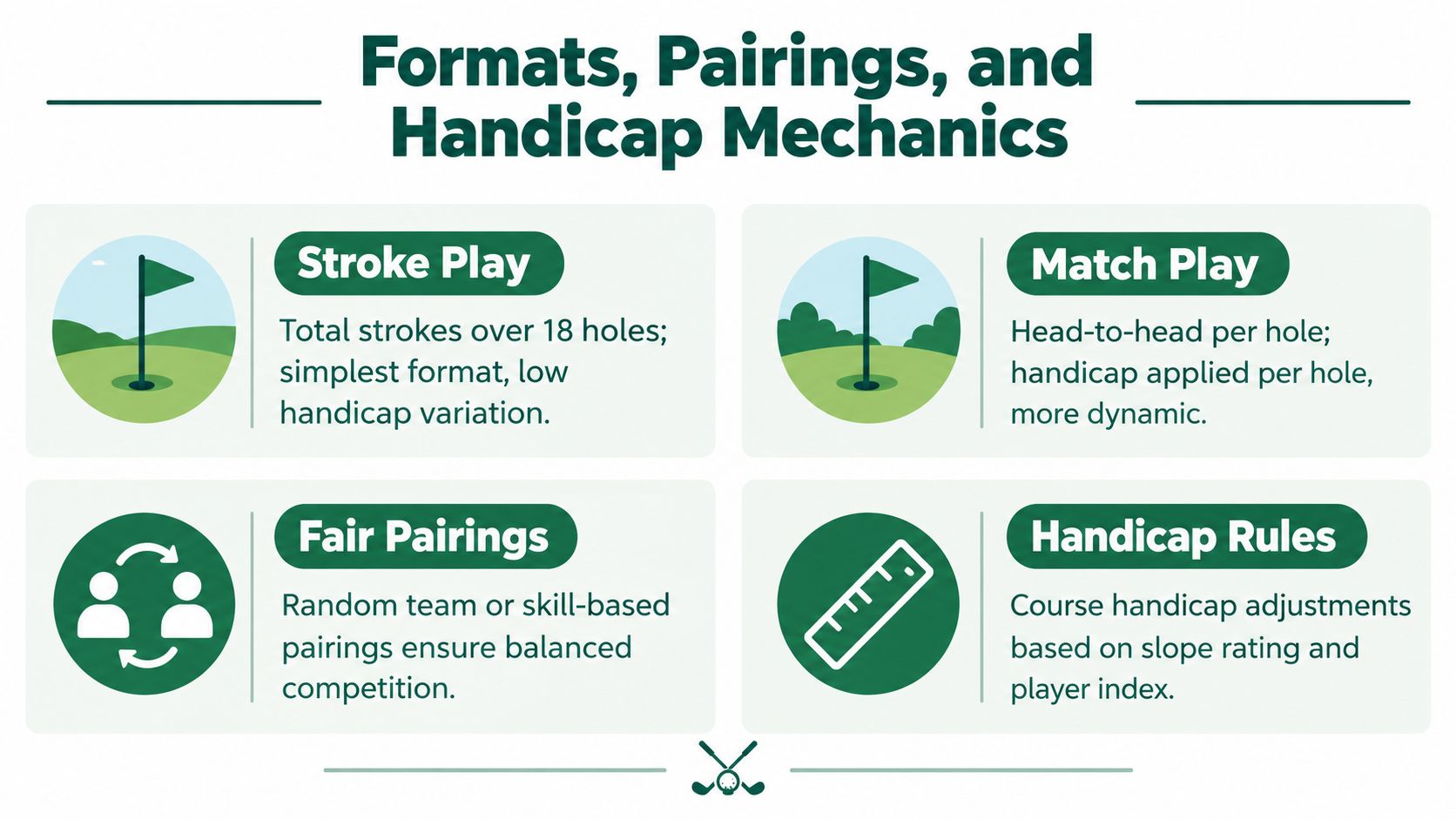
Format selection should serve the players and the course, not the other way around. Stroke play is straightforward when the aim is to compare total scores. Match play creates a hole-by-hole contest and can keep players engaged even after a poor opening stretch. Four-ball gives teams room for individual recovery because each side uses its better ball. Ryder Cup-style team events suit social competition, while a round robin can create repeated matchups across a season.
The trade-off is administrative complexity. A simple format is easier to explain and audit. A richer format can create more energy, but it needs clearer rules, better score capture, and stronger exception handling. Before publishing a schedule, confirm how the format treats ties, substitutes, incomplete rounds, handicap allowances, and postponed matches. For a round-robin structure, this round-robin schedule guide can help organizers think through the fixture logic before assigning dates.
Pairings need a defensible method
Pairings can be random, captain-selected, skill-balanced, or based on a qualifying result. The best choice depends on the league's purpose. A social league may value variety and equal exposure, while a competitive league may need flights or seeded brackets.
USGA guidance allows match-play flights to be organized by Handicap Index or Playing Handicap. If a flight contains 16 players or teams, the lowest 16 handicaps form the Championship Flight, the next 16 form the First Flight, and so on. When flights come from qualifying, the USGA recommends a General Numerical Draw, with the lowest qualifier assigned No. 1, the next lowest No. 2, and pairings made by number. The USGA flight and draw guidance gives committees a clear reference when players question a bracket.
Apply handicap rules consistently
In match play, a tied match continues one hole at a time until someone wins, unless the competition terms state otherwise. For handicap match play, the Committee's stroke-index allocation applies on extra holes, and the tie shouldn't be settled through a stroke-play playoff. The USGA guidance on tied match play should be included in the league's published terms.
Four-ball has its own mechanics. Each player plays their own ball, and teammates compare their better ball against the opposing side's better ball. After Course Handicaps are determined, the lowest value plays from scratch, and a 90% handicap allowance is applied to the difference for the other players, with results rounded to establish Playing Handicaps. USGA four-ball guidance provides the governing detail.
The practical point is simple. After allowances are applied in match play, the player with the lowest Playing Handicap plays from zero relative to the others, as explained in USGA handicap allowance guidance. Publish the calculation method before the first match, and keep an audit trail for every adjustment.
Leagues as a Retention and Revenue Strategy
A league shouldn't be judged only by whether the standings are correct. It should be judged by whether it creates repeatable demand that the course can serve profitably.
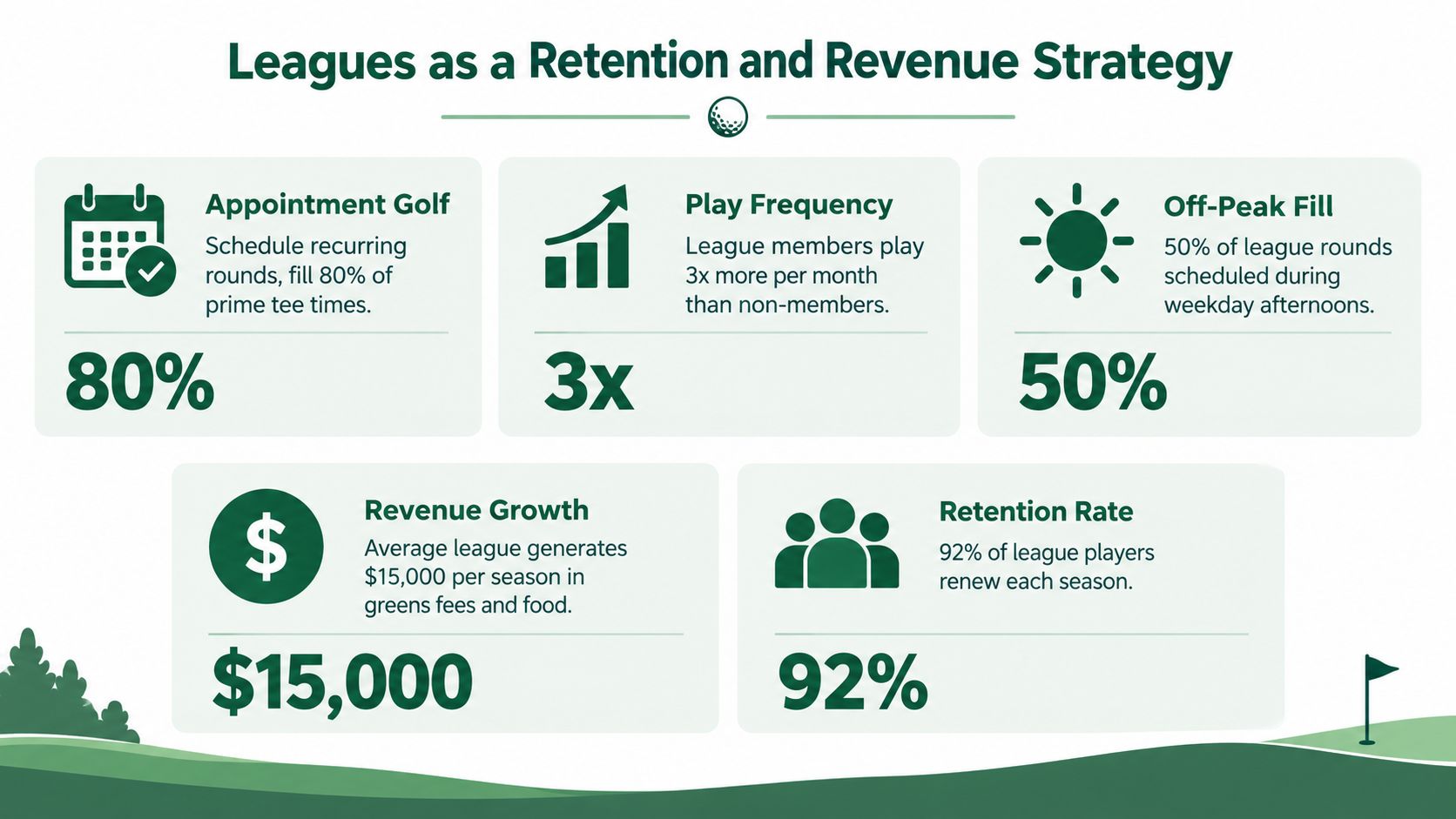
The National Golf Foundation describes leagues as a tool for managing demand, building appointment golf into routines, and cultivating more frequent, higher-value play from loyal golfers. That changes the manager's question. Instead of asking, “How much work does this league create?” ask, “Which playing habits does this league create, and are those habits valuable to the course?”
Match the format to the available demand
A weekday evening league can give golfers a dependable reason to use twilight capacity that might otherwise remain unsold. A season-long points race can keep members returning because each round affects a broader goal. A short match-play series may suit a club with limited recurring tee-time availability, while a larger team league may work better when the course can support consistent blocks and food-and-beverage traffic.
The right format depends on local economics:
Off-peak capacity: Use recurring play to support periods that need demand, without displacing stronger regular bookings.
Player behavior: Choose formats that encourage members to return after an ordinary or disappointing round.
Ancillary spend: Coordinate food, beverages, practice facilities, and pro-shop activity with the league schedule.
Staff capacity: Avoid promising a complex format that requires more manual reconciliation than the operation can sustain.

The risk is cannibalization. A league may occupy tee times that would have sold at a stronger rate, or it may shift existing regulars into a discounted structure without creating additional visits. That doesn't make leagues a bad idea. It means the course should compare the league's schedule, pricing, food-and-beverage pattern, and member behavior with the demand it replaces.
Track the business outcome
Keep the analysis practical. Monitor registrations, attendance, completed rounds, renewals, cancellations, payment collection, tee-time utilization by period, and related spending. These records help distinguish incremental demand from activity that changed labels.
Retention also depends on fairness and belonging. Players return when they understand the rules, see accurate results, receive useful communication, and feel that the league gives them a place in the club. Administrative quality supports the commercial result because members rarely separate the two experiences.
Manual Processes Versus Digital League Management
A small league can start with paper cards and a spreadsheet. That setup works while one person controls the roster, schedule, scores, and messages. Pressure arrives when substitutes join midseason, several staff members edit the same file, or handwritten scores must become standings, payouts, reports, and player emails.
Manual administration creates specific operational risks:
Transcription errors: A score can change when copied from a card into a spreadsheet.
Delayed visibility: Players wait for calculations before seeing results.
Reconciliation work: Staff compare rosters, schedules, handicaps, and results stored in separate places.
Communication gaps: A captain receives a pairing change while an affected player misses it.
Weak history: A correction can overwrite the original entry, leaving no record of what changed.
Digital platforms connect registration, scheduling, scoring, standings, and communication. Results become visible sooner, reports use current records, and staff can review changes without searching through email threads. Independent evaluations of league-management workflows identify result approval, standings traceability, reporting depth, and consolidated dashboards as useful areas to assess.
Where software earns its place
A suitable system should remove repetitive handling while leaving judgment with the people who know the course. Evaluate capabilities against the work your staff performs.
Operational need | Manual approach | Digital approach |
|---|---|---|
Pairings | Rebuild sheets after changes | Update the fixture record and notify affected players |
Scoring | Collect, read, and retype cards | Capture results in the event record |
Standings | Recalculate formulas | Update standings from approved outcomes |
Reporting | Format each document separately | Generate scorecards, signs, and season reports |
Communication | Calls, texts, and forwarded emails | Send targeted updates from current league data |
Live Tourney demonstrates this workflow through app-free scoring by link, event setup, customizable scorecards and cart signs, email communications, league schedules, and season standings in one system. The practical gain is fewer repeated touches to the same record, not automation for its own sake.
Use the same scrutiny for league software as for any operational vendor. Check implementation support, data ownership, permissions, reporting flexibility, and how the provider handles support requests. See this guide to golf league management software for a platform comparison. Local Google Ads agency evaluation tips also offer a useful vendor-selection principle: assess fit, transparency, and evidence of service rather than polished promises.
Software still cannot decide whether a weather exception is reasonable or whether a disputed rule warrants committee review. It can record the decision, show who approved it, and apply the outcome consistently. That audit trail reduces governance friction and protects the player experience that drives repeat league participation.
Governance and Decision Rights in League Operations
Many league problems are blamed on software when the issue is unclear authority. A board member changes the rules, a volunteer captain changes pairings, the head pro promises a refund, and the general manager expects official results to come from the club office. Each person may be acting in good faith, but the league still ends up with conflicting instructions.
Golf-club governance research exposes the scale of the problem. In Australian golf club research, 75% of directors and 63% of general managers said directors clearly understood how their role differed from management. Only 68% of directors and 57% of general managers felt the board worked constructively as a team. The golf-governance research suggests that role confusion isn't a minor committee inconvenience. It can shape how decisions move through the organization.
Define authority before configuring software
Write the decision rights in plain language. Players and staff should know:
Pairing overrides: Who may change a pairing, and what reason must be recorded?
Refund approval: Who authorizes refunds, credits, or prize adjustments?
Rule changes: Who can modify handicap, scoring, or eligibility terms after publication?
Result approval: Who turns a submitted score into an official result?
Communications: Who can send league-wide messages, and who handles sensitive disputes?
Exceptions: Who decides on weather, late arrivals, substitutions, and incomplete matches?
A system can't resolve a disagreement that the organization hasn't assigned to anyone.
The head pro may own day-to-day competition operations, while the board approves policy and the general manager controls commercial commitments. A volunteer captain may manage team communication without having authority to alter official standings. Those boundaries should appear in the league rules and in the platform's permissions.
Create an approval trail
Every exception needs a visible path. A pairing change should identify the approver, the affected fixture, and the communication sent to players. A result correction should preserve the original submission and record the reason for the change. A refund should connect to the relevant participant and payment record.
This discipline reduces political friction because staff can discuss a process rather than argue from memory. It also protects volunteers, who shouldn't be left personally responsible for decisions that belong to the club.
Building Your League Management Implementation Plan
Improvement starts with an operational audit, not a software demo. Follow the information from registration to final standings and mark every handoff, duplicate entry, delay, and approval. Ask staff where they spend time, then ask players where they experience uncertainty. The gap between those answers often reveals the priority.
Phase one, audit the current operation
Document the roster, schedule, scoring, handicap, payment, communication, and reporting workflows. Identify which records are authoritative and which are copies. Keep the first target narrow. A league with frequent substitutions or complicated standings usually exposes more process weakness than a simple weekly game.
Phase two, assign decision rights
Name the person responsible for pairings, rule interpretation, refunds, result approval, and player communication. Publish escalation rules before the season starts. Don't configure permissions until those responsibilities are agreed.
Phase three, select and configure the platform
Use a league management system framework to compare the functions your operation needs. Test roster imports, fixture changes, score approval, standings history, reports, payment records, and communication controls. Confirm that players can participate without unnecessary technical barriers.
Phase four, pilot one league
Run the platform with one group before changing every program. Choose a season with a manageable schedule, train staff and captains, and record every question. A pilot should test bad-weather changes, substitutes, disputed scores, late entries, and end-of-season reporting, not just a routine round.
Phase five, measure and refine
Review participation, completed rounds, renewals, cancellations, payment collection, staff workload, dispute resolution, and tee-time use. Compare the results with the operating goal you set at the start. Keep the features that remove friction, revise the rules that create confusion, and avoid adding complexity because a platform makes it available.
A league becomes a durable course asset when the business strategy, competition rules, technology, and authority structure agree. Start with one accountable workflow, make every result traceable, and give players a weekly experience they can trust.
Live Tourney provides web-based league scheduling, season standings, real-time scoring, registrations, payments, reports, and player communications without requiring app downloads. Visit Live Tourney to review the platform, test it with your next league, and give your staff a cleaner way to run every round.





