May 20, 2026
golf tournament napa valley, napa valley golf, tournament planning, live tourney, charity golf outing
Golf tournament napa valley - Plan a stellar golf tournament napa valley experience. Our guide covers premier courses, sponsorships, wine-country hospitality,
You're probably staring at the same set of questions most organizers hit early. Which course fits the event you want to run. How premium does it need to feel. How do you make a golf tournament Napa Valley experience stand out when the region already has no shortage of events, wineries, and hospitality options competing for attention.
That's the right place to start.
A Napa event works when the golf and the setting support the same promise. If you're hosting a charity outing, the day has to feel easy, polished, and social. If you're running a serious competitive tournament, the format, pairings, pace, and scoring all need to hold up. If you're trying to do both, that tension needs to be managed on purpose instead of patched over later.
The good news is that Napa gives you real advantages. The market already understands premium leisure experiences. The bad news is that players, sponsors, and guests arrive with higher expectations. Generic planning gets exposed fast here. Tight check-in tables, weak sponsor placement, sloppy pairings, and paper scorecards that nobody trusts all feel worse in a destination setting.
Laying the Groundwork for Your Napa Event
The first decision isn't the menu, the tee gift, or even the sponsor list. It's what kind of day you're building.
In Napa, that answer drives almost every operational choice after it. A corporate retreat wants relaxed pace, strong hospitality, and networking-friendly pairings. A charity event needs sponsor visibility, easy registration, and enough entertainment that non-golfers still feel included. A competitive local championship needs structure, rules clarity, and a course setup that players will respect.
Start with the event identity
If you can't define the event in one sentence, you're not ready to book a course.
Use a simple test:
Corporate outing: You're selling relationship time, not difficulty.
Charity fundraiser: You're selling atmosphere, cause alignment, and sponsor exposure.
Competitive tournament: You're selling fairness, challenge, and credibility.
Hybrid event: You're selling a polished experience, but you'll need strict boundaries between fun elements and competition.
A lot of organizers try to keep every option open. That usually creates a day that feels muddled. The players who want a relaxed scramble don't want a rules-heavy briefing. The low handicaps who expect a proper competition don't want gimmicks on every other hole.
Practical rule: Pick the primary purpose first, then let everything else support it.
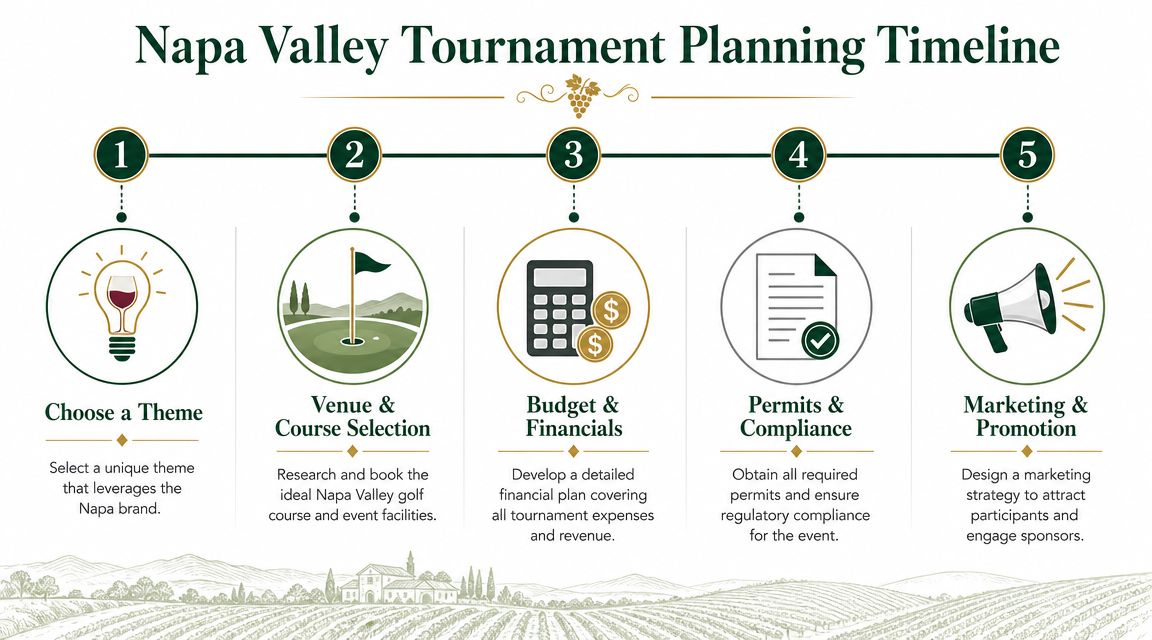
Here's the planning view I use with clients and staff when an event is still taking shape.
Use Silverado as the benchmark, not the template
The best-known major tournament in the region is the Procore Championship, held at Silverado Resort's North Course since 2014 on a par-72, 7,166-yard course with annual PGA Tour status, which makes Napa a proven tournament market rather than a novelty stop, as noted in GolfWRX's tournament preview.
That matters because it gives local organizers a clear benchmark. Not every event belongs at a tour-level venue, but every organizer should ask the same questions the strong events answer well:
Decision area | What works in Napa | What usually fails |
|---|---|---|
Course choice | Match the course to your audience and budget | Booking for prestige alone |
Event tone | Align hospitality with the level of play | Mixing luxury branding with bare-bones operations |
Venue access | Confirm parking flow, arrival points, banquet logistics | Assuming golf and hospitality logistics will sort themselves out |
Date selection | Choose a date that supports lodging, staffing, and guest energy | Picking a day based only on course availability |
If you're still evaluating properties, broad local recommendations for Northern California golf can help you compare the wider market before narrowing in on Napa-specific fit.
Date selection is a hospitality decision
In Napa, date selection isn't just a golf calendar issue. It's a destination-management issue.
A popular mistake is choosing a date because the course is open and the room rental looks acceptable, then discovering later that lodging is tight, key vendors are booked, or sponsors can't activate the way they planned. That's why I like locking the course and off-course event pieces together instead of treating them as separate workstreams.
A simple sequence works best:
Define the event type
Shortlist only courses that fit that format
Check banquet, parking, and sponsor space at the same time
Pressure-test guest travel and lodging realities
Build the budget around the actual guest experience
If you need a stronger planning framework before you start sending deposits, this golf tournament planning guide is a useful operational checklist.
Securing Sponsors and Crafting the Napa Experience
A sponsor doesn't buy a Napa event because you have tee signs available. They buy because the setting gives them a better stage.
That's a distinct advantage in this market. Napa isn't just another place to hold a tournament. It's a hospitality brand with built-in expectations around food, wine, scenery, and service. If your sponsorship package ignores that, you leave value on the table and force sponsors into generic placements that could exist anywhere.
Sell access to the audience, not just signage
Visit Napa Valley reports that 2023 tourism brought 3.7 million visitors, generated $2.5 billion in visitor spending, supported about 16,000 local jobs, and that the average visitor spent $281 per day, with direct visitor spending up 13% since 2018, according to the PGA Tour's Procore Championship overview.
For sponsors, that's the argument. A well-run Napa tournament sits inside a high-value leisure economy, not outside it. Your job is to translate that into sponsor inventory that feels visible and useful.
Build packages around experiences
The most effective sponsorship menus in Napa usually layer brand presence into the day instead of isolating it to one sign and a logo on the flyer.
Consider packages built around touchpoints like these:
Arrival sponsorship: Valet area branding, welcome gift placement, branded coffee service.
Course experience sponsorship: Wine tasting hole, chef-led bite station, contest hole with staffed activation.
Hospitality sponsorship: Hosted reception feature, branded lounge area, tasting flight integration.
Storytelling sponsorship: Sponsor mention during awards, post-event photo recap inclusion, leaderboard visibility.
A sponsor remembers whether guests actually engaged with them. They don't remember how many logos were printed on a rule sheet.
That's why I push organizers to remove weak inventory. If a sponsor placement won't get seen, photographed, or talked about, it shouldn't be premium inventory.
Make the premium feel intentional
The “Napa experience” doesn't require excess. It requires consistency.
A strong event usually has a few traits in common:
Touchpoint | Better choice | Weaker choice |
|---|---|---|
Welcome gift | Curated local item or useful golf-day kit | Random merch with no regional tie |
On-course F&B | Small, high-quality stations at logical stops | Too many tables with uneven execution |
Reception | Clear transition from golf to social time | Long dead period after the round |
Sponsor integration | Staffed, interactive, tasteful | Passive banners with no engagement plan |
The same goes for branded items. If you're trying to create real event buzz, the products should match the audience and the setting. In Napa, that usually means fewer throwaways and more pieces that guests will carry, wear, or keep through the day.
For organizers building sponsor packages from scratch, this roundup of golf outing sponsorship ideas is a practical starting point.
Designing Your Tournament Format and Pairings
Format is where a lot of events go sideways.
Organizers often choose the game structure based on habit. “We always do a scramble” isn't a strategy. It might still be the right answer, but only if the day's goals support it.
Match the format to the event purpose
The Procore Championship provides the clean competitive benchmark. The event uses a standard 72-hole, stroke-play format for a 144-player field, showing how a classic competitive structure is used for elite tournament play in Napa, as described in the PGA Tour first-look preview.
That does not mean your event should copy it.
Most Napa outings work better when the format supports the guest list:
Scramble works for charity events, corporate groups, and mixed-skill fields. Pace is steadier, players contribute, and the mood stays social.
Best ball fits events that want some competition without making high handicaps miserable.
Stroke play works when the field expects a serious test and the committee is prepared to handle rules, scoring, and disputes properly.
Modified team formats can work well for member events or sponsor days, but only if the rules are explained clearly before anyone tees off.
Pairings decide the player experience
Pairings are not clerical work. They shape the day.
If the outing is relationship-driven, stack foursomes to help conversations and sponsor contact. If it's competitive, protect the integrity of the field and avoid pairings that create obvious advantages or social distractions. If it's a charity event with corporate buyers, keep the team purchaser's preferences in view without letting one loud request distort the whole tee sheet.
A quick pairing framework helps:
Protect sponsors and hosts first
Place known beginners where the pace will stay stable
Avoid loading one group with all the strongest players unless that's intentional
Separate personalities who can slow the day or create friction
Review every foursome from the player's perspective, not just the spreadsheet's
Good pairings feel invisible. Bad pairings become the story of the day.
Side games should follow the same logic. Use a few that fit the audience and the sponsor plan. Longest drive, closest to the pin, and putting contests usually work because players understand them immediately. Too many side games create delay, confusion, and rule disputes.
Streamlining Operations with Modern Tournament Software
Spreadsheets feel manageable right up until the week of the event.
Then the sponsor names change. Two foursomes haven't paid. One team wants a handicap correction. Someone needs dietary notes for the reception. The cart signs are outdated. The leaderboard is delayed because scores are coming in on paper from different holes. None of that is unusual. It's what old workflows produce.
The old system breaks at handoff points
Most tournament problems don't come from one big failure. They come from repeated handoff errors between registration, pairings, communications, scoring, and reporting.
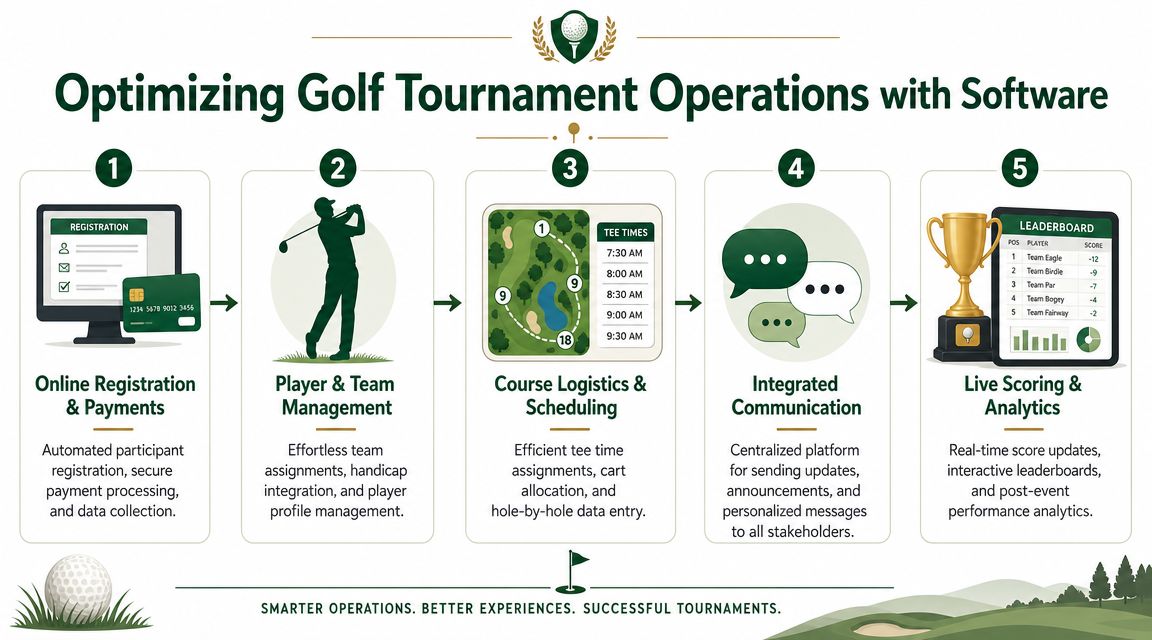
That's why the move toward dedicated tournament software matters. There is a clear shift toward optimized tools, with platforms like Live Tourney reporting 10,000+ events, 1M+ holes scored, a 40% increase in live scoring participation, and 3x faster setup, indicating demand for app-free, real-time scoring and simpler back-office management, as cited on the Mentis tournament page.
That doesn't mean every tool is the same. It means the manual model is getting harder to justify.
What to automate first
If you're modernizing your process, don't start with the prettiest feature. Start with the tasks that create the most staff friction.
Workflow | Manual method problem | Better software outcome |
|---|---|---|
Registration | Incomplete forms, scattered emails, unclear roster status | One intake point for players and teams |
Payments | Staff chasing balances and reconciling by hand | Cleaner tracking and fewer surprises |
Pairings | Version control errors and late edits | Centralized updates |
Scoring | Delays, unreadable cards, manual leaderboard posting | Real-time scoring and instant visibility |
Communication | Mixed messages across email and text | Consistent updates from one system |
A web-based tool such as Live Tourney can handle registration, payments, pairings, live scoring, and reporting in one place, with app-free scoring links and real-time leaderboards. That matters in Napa because guests expect a polished event, and staff usually don't have time to babysit five disconnected systems.
Keep the player side simple
The biggest mistake I see with tournament tech is overcomplication. Organizers choose a platform with plenty of features, then force players through too many steps on the day.
The better approach is simpler:
Send one clear registration path
Collect the data you need
Deliver one scoring link or access point
Post one live leaderboard everyone can follow
Use one communication channel for updates
If a guest has to ask how to enter a score after the opening announcements, the workflow is too complicated.
If you're evaluating systems, this guide to golf tournament management software covers the operational features worth checking before you commit.
The Ultimate Day-Of-Tournament Checklist
Tournament day doesn't reward creativity. It rewards sequencing.
By the time players arrive, every important decision should already be made. The staff needs a run-of-show, sponsors need placement instructions, volunteers need simple assignments, and the course needs to know exactly how your event will move from arrival to awards. The smoothest golf tournament Napa Valley events feel relaxed because someone did the hard operational work before sunrise.
Build the morning around flow
A practical benchmark comes from the Procore Championship's fan operations. The 2025 event opens gates at 7:00 AM, starts first tee times at 7:00 AM, uses $25 per day parking, includes digital ticket distribution, and offers public amenities like fan zones, grandstands, a fan village near the 1st green, LED screens, wine bars, concessions, and sponsor activations, with free admission for youth 15 and under with a ticketed adult, as outlined in the Procore Championship event guide.
You're not running a PGA Tour stop, but the lesson holds. Flow starts early. If parking, check-in, and first movement onto property feel messy, the rest of the day starts behind.
Use a real checklist, not a mental one
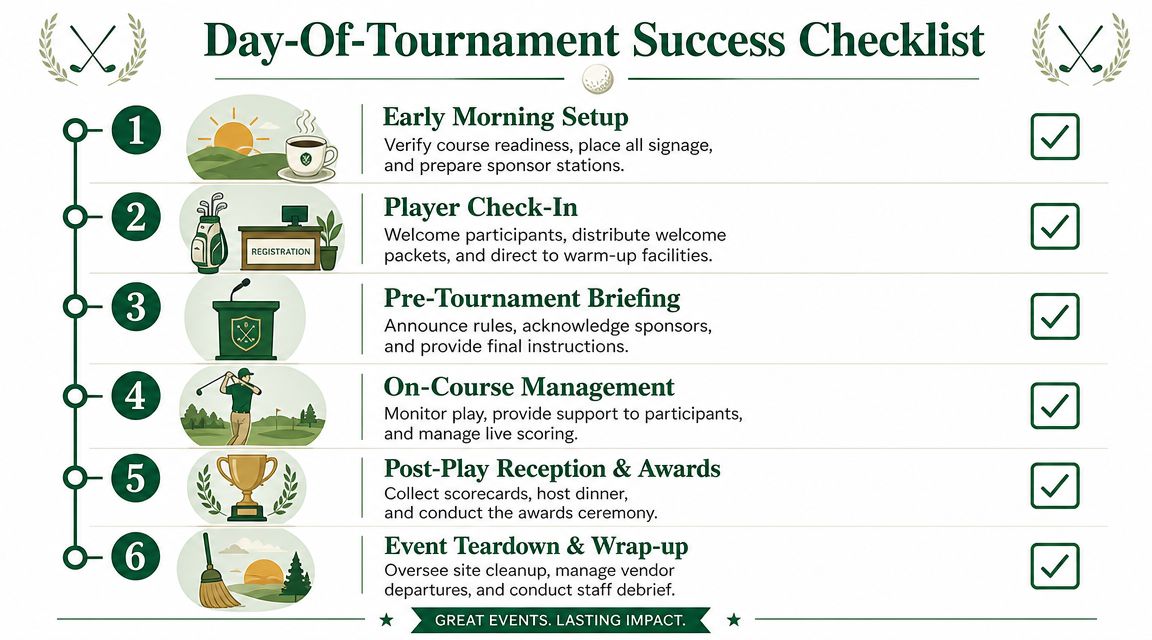
This is the minimum operational checklist I'd expect for a polished event day:
Pre-dawn course sweep: Confirm signage, sponsor tables, contest setups, scoring instructions, carts, range access, and registration materials.
Arrival control: Separate parking, bag drop, and check-in so one bottleneck doesn't choke the whole entry sequence.
Volunteer briefing: Give every volunteer one owner, one task, one location, and one escalation contact.
Opening announcements: Keep them short. Cover rules, format, contest holes, scoring method, safety, and sponsor thanks.
On-course monitoring: Have one person checking pace, one handling sponsor needs, and one watching scoring flow.
Reception reset: While players finish, another team should already be preparing the post-round area, awards staging, and score confirmation process.
Watch the transition points
Most day-of problems happen in transition zones:
Transition point | Common problem | Better fix |
|---|---|---|
Parking to check-in | Guests don't know where to go | Station greeters and directional signs |
Check-in to carts | Players linger and delay start | Announce cart assignments clearly |
Round to scoring | Scorecards arrive late or incomplete | Define who enters and verifies scores |
Golf to reception | Dead time drains energy | Open food and drinks before awards begin |
One operational habit always pays off. Put your strongest staff member where uncertainty is highest, not where the task is easiest. The charismatic volunteer can greet people. The experienced tournament lead should be where pairings, player questions, and schedule pressure intersect.
Smooth events don't happen because nobody hit a snag. They happen because the right person solved the snag before guests felt it.
Post-Event Reporting and Building for Next Year
The event isn't finished when the trophies go out.
Repeat business is earned through these actions. Sponsors decide whether they felt visible. Players decide whether they'd come back. The host committee decides whether the stress was worth it. If you disappear after the round, you waste the value you just created.
Turn the event into a reportable asset
Most golf tournament Napa Valley content online stops at logistics. It tells people the date, the venue, and maybe the sponsorship levels. It rarely answers the harder question organizers care about, which is how a premium outing proves its value and becomes worth repeating. The gap matters because many searches for “golf tournament napa valley” are really about finding a unique charity outing, while most event pages only cover basic details, as discussed in the ACIS event announcement.
That's why post-event reporting has to be deliberate.
A useful report usually includes:
Final results: Team standings, contest winners, and any flight outcomes.
Sponsor proof: Photos of activations, attendance context, and where each sponsor appeared.
Player follow-up: Thank-you email, photo gallery, and save-the-date if the event will return.
Internal notes: What broke, what ran late, which sponsors need a different setup next time.
Debrief while details are fresh
Run a short internal debrief within a day or two. Don't wait until next season.
Use prompts like these:
Where did guests look confused
Which sponsor placements got actual traffic
Did the format fit the field
Where did staff scramble unnecessarily
What should be removed, not just improved
This matters more than people think. Strong events aren't built by adding more each year. They get better because organizers remove friction, simplify weak spots, and keep the touches that guests remember.
The fastest way to improve next year's tournament is to document this year's annoyances before everyone forgets them.
Keep the relationship warm
The final step is personal. Send the thank-yous promptly. Not generic blasts if you can avoid them. Players, volunteers, and sponsors each gave you something different, so the follow-up should reflect that.
Sponsors should hear how they were integrated. Team captains should get results and next-step information. Volunteers should be thanked like insiders, because they often become the most reliable advocates when you launch the next event.
That's the essential playbook for a repeatable Napa tournament. Strong concept, clean operations, disciplined day-of flow, and a wrap-up process that turns one event into a stronger one next year.
If you want a simpler way to run registration, pairings, live scoring, and post-event reporting without relying on disconnected spreadsheets and paper processes, Live Tourney is a practical option for golf courses and event organizers managing tournaments, outings, and leagues.