
Sep 2, 2026
corporate golf outing ideas, golf tournament ideas, corporate team building, golf event planning, golf tournament software
Explore 10 corporate golf outing ideas, from scrambles and leagues to charity events, with formats, budgets, agendas, logistics, and execution tips.

Your company outing has to do more than put people on a golf course. It may need to entertain clients, reconnect employees across departments, raise money for a cause, or give a leadership group a relaxed setting for conversation. Choose the wrong format, though, and beginners disengage, strong players feel underchallenged, pairings create awkwardness, or the schedule collapses under slow play.
The strongest corporate golf outing ideas start with the event's purpose, then match the format to the group's size, skill range, available time, and budget. A client event needs a different structure from an employee league. A charity tournament needs transparent sponsorship and donation mechanics. A mixed-skill group needs a format that protects pace without making experienced golfers irrelevant.
The options below compare those trade-offs in practical terms, including scoring, side games, agendas, awards, pairings, and course logistics. If transportation is part of the experience, planners can also plan a luxury corporate outing in Chicago with arrival and departure flow in mind. For organizers who want app-free live scoring, registrations, pairings, side games, payments, reports, and live leaderboards, Live Tourney can keep those details in one web-based system.
1. Scramble Tournament with Live Leaderboard
A scramble remains the safest starting point for a company group with uneven golf experience. Each player hits a shot, the team selects the best position, and everyone plays from there. That structure gives beginners useful team contributions without making one poor shot define the hole, while experienced players still have opportunities to shape strategy and attack scoring opportunities.
A four-person scramble works particularly well for employee appreciation, client introductions, and fundraising because players spend the round making decisions together. Pairing a confident golfer with less experienced participants can improve both pace and comfort, but don't stack every strong player on one team. A little balance makes the leaderboard more credible and gives more groups a reason to follow the results.
Make the leaderboard part of the event
Live scoring works best when participants see it in several places, not only after they finish. Put a display near the clubhouse and another near the turn, then give players a phone-friendly link so they can follow standings while they wait. Live Tourney's golf tournament live scoring supports that shared view without requiring players to download an app.
Add side contests that create individual moments inside the team format:
Closest to the pin: Give players a target that rewards precision rather than raw distance.
Longest drive: Keep the eligibility rules clear and separate divisions when that supports fairness.
Remote participation: Email the leaderboard link to executives, sponsors, or guests who can't attend.
Course reminders: Use cart signs to show the format, scoring instructions, and current standings.
The trade-off is simplicity versus challenge. A pure scramble may feel too forgiving for advanced golfers, so add one or two meaningful side games rather than piling on complicated rules. For a charity event, pair the scramble with an auction or sponsorship program. For a client event, use breakfast, a turn stop, and an awards reception to create conversation beyond the scorecard.

2. Captain's Choice Modified Scramble Format
Captain's Choice adds a leadership layer to the familiar scramble. The team still benefits from selecting strong shots, but a designated captain makes the official decision about which ball to use. That small change creates a visible connection to business leadership, judgment, and communication without turning the day into a formal executive exercise.
This format suits management outings, sales contests, or board events where participants want a little more strategy. A regional sales leader might captain a team that includes colleagues from different territories. A director-led group can use shot selection as a lighthearted way to reveal decision-making styles. The captain shouldn't dominate every conversation, though. Ask the captain to explain choices and invite input from the whole group.
Give captains enough structure
Brief captains before the first tee. Explain how selections work, how scores are entered, and whether any restrictions apply to the number of shots each player must contribute. Use a scorecard that gives captains room to mark notable decisions, especially if leadership awards will recognize thoughtful risk management or team communication.
A useful operating plan includes:
Captain briefing: Cover rules, pace expectations, and how disputes will be resolved.
Decision markers: Record notable selections so the awards presentation has specific moments to reference.
Leadership recognition: Add a captain award for communication, strategy, or team inclusion.
Instant updates: Let captains see standings after each submitted hole instead of waiting for final scoring.
Balanced rosters: Mix handicaps, departments, and personalities rather than grouping senior leaders together.
The main risk is overemphasizing the captain and making other players feel like spectators. Keep the captain accountable for decisions, not responsible for every shot. A live leaderboard can highlight team performance, but it shouldn't become a leaderboard of individual executives. The event still succeeds when every participant contributes, talks, and feels noticed.
3. Ryder Cup Format Team Competition
A Ryder Cup-style event creates more emotional momentum than a standard team tournament because participants represent a side, not only a foursome. Divide the field into two teams and use match-play components such as foursomes, four-ball, and singles. Each match produces a clear result, so players understand what their performance means to the team even when they aren't near the top of an overall stroke-play leaderboard.
This is a strong choice for a division rivalry, an annual sales-versus-operations event, or a client experience built around professional-style competition. It also gives organizers several ways to involve people with different abilities. Stronger players can take on singles or demanding pairings, while newer golfers can compete in supportive team matches.
Build drama without creating confusion
The format needs careful communication. Seed pairings using available handicap information, publish match cards before arrival, and make the point system visible at the clubhouse. Give each side a clear identity with shirts, hats, or pins, but don't let the branding become more important than the golf.
A workable event plan should include:
Pairing strategy: Create competitive matches instead of placing every top player on one side.
Team captaincy: Give captains responsibility for pairings, communication, and morale.
Live match board: Display completed matches and the current team point total.
Midday reset: Schedule a team gathering where captains can discuss the next phase.
Participant updates: Send results to nonplaying employees or remote supporters so the rivalry extends beyond the course.
The trade-off is energy versus administration. Ryder Cup formats require more preparation than a scramble because the organizer must manage match assignments and results. If staff capacity is limited, simplify the number of match types and use one consistent scoring interface. The 2018 tournament service-quality research found that facility access, aesthetics, and atmosphere can shape satisfaction, so directional signs, visible team areas, and smooth movement between matches deserve as much attention as the competition itself. The tournament service-quality study provides useful context for those design decisions.
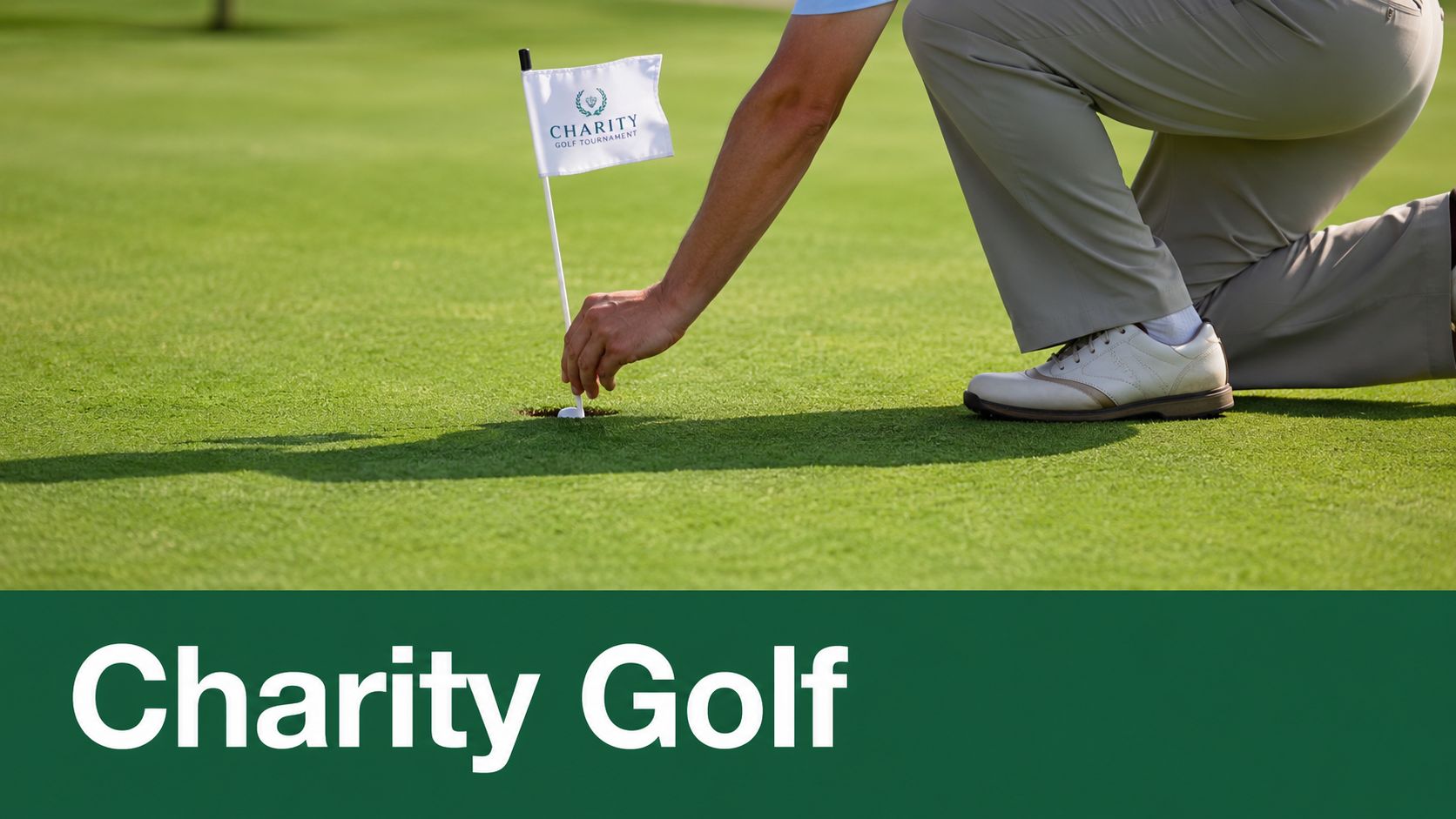
4. Charity Outing with Hole Sponsorships
A charity outing should make the cause visible without turning every hole into a sales pitch. Build the tournament around a team format that welcomes mixed abilities, then use hole sponsorships, participant donations, pledge-per-birdie mechanics, raffles, mulligans, or auctions to create fundraising opportunities. Sponsors should receive clear recognition, while players should understand exactly how their participation supports the mission.
The financial history of charitable golf explains why this model remains durable. The National Golf Foundation has estimated about 140,000 charitable golf events, involving more than 15 million participants and raising almost $3 billion collectively each year. The same National Golf Foundation charity golf research notes that community-based outings often average roughly $10,000 per event, while larger national tournaments can raise several hundred thousand dollars. These figures are evidence of the format's fundraising potential, not a promise for any individual event.
Connect sponsorship to the player experience
Start sponsor outreach early enough for businesses to approve budgets and prepare artwork. Give each sponsor a defined benefit, such as branded signage, recognition during awards, inclusion in email updates, or a sponsored contest. A donation thermometer near registration or the clubhouse can show progress without requiring players to check a spreadsheet.
Use the event software to make the cause visible during play. Charity golf tournament sponsorship packages can help planners structure sponsor benefits, while live updates can show birdies, donations, and progress toward the event's target. Follow up with sponsors and donors using receipts, tax documentation where applicable, photos, and an impact report.
A hole-in-one prize can attract attention, but protect the budget before advertising it. Industry insurance guidance identifies the hole length, prize value, and participant count as inputs used to price coverage, as explained by hole-in-one prize insurance. Don't promise a prize until the coverage, rules, and eligibility are confirmed.
5. Corporate League Play Multi-Round Series
A single outing creates one memorable day. A corporate league creates a recurring reason for employees to play, meet colleagues, and build friendly competition over time. Use a consistent day and tee-time pattern, then rotate the scoring format so the league rewards different strengths. One week might use match play, another stroke play, and another a team game.
The league model fits companies that want sustained employee engagement rather than a one-off reward. It can also connect offices that rarely interact. A cumulative leaderboard gives participants a reason to return, while a mid-season social gathering prevents the event from feeling like a spreadsheet with golf attached.
Keep the season accessible
Set rules for late entrants before the first round. You might use adjusted points or place new players into a separate eligibility track, but publish the approach clearly so existing participants don't feel disadvantaged. Tiered prizes can recognize the top finishers, while random drawings or weekly recognition keep the league engaging for players who aren't leading.
Operationally, prepare:
A fixed rhythm: Keep the day and tee-time window consistent wherever possible.
Season scoring: Track cumulative points in one system rather than combining separate spreadsheets.
Weekly communication: Send standings, upcoming pairings, and reminders through email or a shared dashboard.
Format variety: Change the competition type while preserving familiar registration and scoring procedures.
Final reporting: Produce season rankings and award records that organizers can reuse for the next cycle.
A league also needs a clear definition of success. Is the priority participation, cross-department interaction, improvement, or competition? The answer should determine whether you emphasize attendance, points, team outcomes, or social events. For organizers building a recurring program, golf league programs can provide a framework for managing registrations, standings, and season communications.
6. Client Entertainment Tournament with Networking
A client tournament should never rely on golf alone to create a relationship. The pairing plan, meal schedule, welcome experience, and follow-up determine whether guests have useful conversations or spend the day beside people they already know. Treat the round as one part of a hosted experience.
Pair clients with company representatives who can listen, introduce people, and keep the conversation comfortable. Don't place every senior executive in the same group if the event's purpose is relationship development. A thoughtful foursome can include a client, a relevant account leader, a subject-matter expert, and another guest whose interests create natural conversation.
Build networking into the agenda
Use breakfast for introductions, the turn for a short refreshment stop, and the post-round reception for deeper conversations. VIP treatment doesn't have to mean extravagance. Reserved carts, bag assistance, preferred arrival instructions, premium scorecards, and a well-organized check-in can communicate care without adding unnecessary entertainment.
The scorekeeping experience should support the relationship, not interrupt it. A live leaderboard can celebrate client achievements on clubhouse screens, while a post-event email can share results and photos. Staff should still know when to put the phone away. Players who spend the whole round entering data or checking ranks may miss the conversations the event was designed to create.
End with a reception that recognizes more than the winning team. Mention memorable shots, client contributions, and sponsor support. Then send personalized notes that refer to a genuine moment from the round. That follow-up turns a pleasant event into an ongoing business touchpoint.

7. Gross vs. Net Dual Scoring Format
Dual scoring lets an outing recognize two different kinds of performance. The gross competition rewards the player or team with the lowest actual score. The net competition adjusts results using handicaps, giving participants with different playing abilities another path to a competitive finish.
This format works for employee groups that include serious golfers and occasional players, as well as member-guest events where handicaps vary widely. It can also reduce the resentment that appears when experienced golfers believe handicaps hide performance, while newer players feel they can never win a gross contest.
Explain both leaderboards before the first tee
Confusion is the biggest threat. Label gross and net columns in large type on the scorecard, show both leaderboards side by side, and explain the difference during registration and the opening welcome. Don't wait until the awards ceremony to reveal that players were competing in two categories.
For an individual handicap event, confirm the handicap method and eligibility rules before pairings are finalized. For a team event, state whether the handicap applies to each player's score, the team total, or another defined calculation. The USGA provides recommended scramble handicap allowances, including 25%/20%/15%/10% for four players, 30%/20%/10% for three players, and 35% for the low handicap plus 15% for the high handicap in a two-player scramble. Those recommendations are available in the USGA scramble handicap guidance.
Use separate announcements for gross and net winners, and consider modest recognition in both categories rather than making one leaderboard feel secondary. Live updates are valuable here because players can see where they stand without trying to calculate adjusted results on the course. The trade-off is administrative complexity, so test the scoring setup with sample players before invitations go out.
8. Best Ball Format with Skins Game Overlay
Best ball and skins combine team security with individual pressure. In a four-person best-ball competition, the lowest score on the hole counts for the team. The skins overlay then gives players an individual reason to stay engaged, because a strong hole can matter even when the team isn't leading overall.
This works well for a group that includes experienced golfers who want more personal competition than a scramble provides. It can also suit a charity event if the skins mechanic is designed as a clearly explained fundraising or prize feature. The format isn't ideal for a field dominated by beginners unless the rules are simplified and the buy-in is handled carefully.
Publish the skins rules before registration
Players need to know whether the skins game is optional, what the buy-in covers, how ties carry forward, and when payouts occur. Don't introduce a pot at check-in without a written explanation. The organizer should also decide whether skins are individual or team-based, then use scorecards and digital screens that reflect that choice.
A clean setup includes:
Two score views: Show team best-ball standings and individual skins results separately.
Dedicated tracking: Give each hole a clear place for skin results and ties.
Carryover rules: Explain what happens when no player wins a hole outright.
Prize communication: Publish the payout schedule before play begins.
Side-game limits: Avoid adding several contests that compete for attention with skins.
Live scoring can show current skin winners and the growing value of unresolved holes, but excitement should never replace clarity. If participants can't tell whether a result is official, the overlay becomes a source of disputes. Use a final verification process before awards, especially when money or sponsor-funded prizes are involved.
9. Mixed Scramble Team Format
A mixed scramble requiring two men and two women per four-person team can support an inclusion objective while preserving the approachable nature of team golf. The format creates a deliberate reason to recruit women golfers, welcome newer players, and make golf participation part of a broader company culture conversation.
The composition rule must be communicated early. If organizers wait until the week of the event to find participants, they may create pressure for employees who don't want to represent a demographic category or for teams that lose a player. Invite participation broadly, explain the format plainly, and offer beginner-friendly support so the event doesn't assume every participant already knows golf etiquette or scoring.
Make inclusion operational
Recruit women golfers early, then build pairings around skill balance rather than using the format as a symbolic gesture. A team with two strong players and two beginners can work, but only if the scramble rules allow every player to contribute. Consider a pre-outing meetup, a short clinic, or a practice-area welcome session for participants who want extra confidence.
Recognition should reflect the event's purpose without isolating participants. Feature team achievements, standout shots, and individual contributions in live scoring and post-event communications. Women-specific awards can be appropriate when they reinforce participation and achievement, but they shouldn't replace clear access to the main team prizes.
The wider participation context supports this approach. The National Golf Foundation reported that U.S. golf participation reached 48.1 million in 2025, a record level, and rose 2% from 2024, 41% from 2019, and 55% from 2015. Its reporting also placed off-course golf participation at 37.9 million players, compared with 29.1 million on-course players, as detailed in this National Golf Foundation participation report. Corporate planners can respond by designing events that welcome a broader range of relationships with the game.
10. Round Robin Rotation Play
Round Robin makes the social structure as important as the score. Players rotate partners every six holes, face multiple opponents, and accumulate points across those matchups. That gives an executive group, association, or cross-functional company team more meaningful interaction than staying with one foursome for the entire round.
The format is particularly useful when networking is the primary purpose and the organizer wants participants to meet several people. It can also suit a group that enjoys head-to-head competition but doesn't want a full Ryder Cup administration. Every rotation should have a clear start and end, with printed cards and visible signs showing where players go next.
Design the movement before opening registration
Create the rotation schedule first, then test it against the course layout and expected pace. Use cart signs and large-format boards to identify the current rotation. Marshals should be present at transition points, because a confusing partner change can erase the goodwill built during the first six holes.
Leave a short buffer between rotations for movement, water, and questions. Mobile-friendly standings can show points against each opponent, but the display should prioritize the next assignment as much as the current rank. At the end, publish head-to-head records and cumulative points so players can understand how the final results were calculated.
The trade-off is variety versus flow. Rotation creates more introductions, but it also adds movement and administrative work. Keep the rules simple, avoid too many side games, and use one staff member as the transition owner. If the group includes non-golfers, consider a parallel networking or clinic option rather than forcing everyone into a competitive rotation.
10 Corporate Golf Outing Formats Compared
Format | 🔄 Implementation complexity | ⚡ Resource requirements | 📊 Expected outcomes | 💡 Ideal use cases | ⭐ Key advantages |
|---|---|---|---|---|---|
Scramble Tournament with Live Leaderboard | Low, simple rules; needs live-scoring setup | Moderate, scoring app, screens, marshals, carts | High engagement, faster rounds, spectator excitement | Large corporate outings (40–144), client entertainment, fundraisers | Inclusive and fun; easy to explain; strong live excitement |
Captain's Choice (Modified Scramble) | Medium, added decision rules for captains | Moderate, scoring app, captain briefings, scorecards | Leadership visibility, strategic play, moderate pace | Leadership development outings, executive/team-lead events | Promotes leadership development and strategic engagement |
Ryder Cup Format Team Competition | High, complex pairings across match types | High, experienced staff, many players (24–32+), big screens | Strong team identity, dramatic swings, longer event time | Division-level competitions, annual traditions, large rivalries | Intense team rivalry; memorable, high-drama competition |
Charity Outing with Hole Sponsorships | Medium, fundraising logistics and sponsor coordination | Moderate–High, sponsor outreach, payment processing, signage, displays | Significant fundraising, sponsor visibility, CSR impact | Nonprofit fundraisers, CSR initiatives, community events | High fundraising potential; sponsor marketing and goodwill |
Corporate League Play (Multi-Round Series) | Medium, season scheduling and cumulative tracking | Moderate, league platform, ongoing admin and communications | Sustained engagement, community building, steady revenue | Employee engagement programs, wellness initiatives, year-long leagues | Builds long-term participation and predictable planning |
Client Entertainment Tournament with Networking | Medium–High, logistics for premium services and networking | High, catering, VIP amenities, pro-shop coordination, live displays | Strong client relationships, business development, polished impression | Client retention events, high-value prospect entertainment | Premium experience that strengthens client relationships |
Gross vs. Net Dual Scoring Format | Medium, dual leaderboards and clear rule communication | Moderate, scoring platform supporting gross/net, prize budget | Inclusive competition with fair recognition for all skills | Mixed-ability corporate groups, member-guest events | Two concurrent competitions increase fairness and winners |
Best Ball Format with Skins Game Overlay | Medium–High, dual team/individual scoring and payouts | Moderate, skins administration, live tracking, payout setup | Multiple engagement layers; exciting hole-by-hole swings | Competitive corporate groups, member events, fundraising overlays | Balances team and individual play; creates high-engagement moments |
Mixed Scramble (2 Men, 2 Women) Team Format | Low–Medium, standard scramble + gender pairing logistics | Moderate, recruitment, pairing coordination, live scoring | Improved DEI outcomes; broader participation and visibility | Diversity & inclusion initiatives, inclusive company outings | Promotes authentic inclusion and celebrates diverse participation |
Round Robin Format (Rotation Play) | High, complex rotation scheduling and points tracking | High, rotation cards, signage, marshals, detailed scoring | Broad networking, consistent-performance measurement | Networking-focused events, executive peer competitions | Encourages varied pairings and deep cross-team relationships |
Turn the Best Format Into a Smooth Event
The format is only the first decision. A scramble can feel disorganized, and a match-play event can feel effortless, depending on how well the organizer handles communication, movement, scoring, and hospitality. A 2023 study of small-scale golf tournament participants found that perceived event quality affected image, trust, and satisfaction, while those factors significantly influenced loyalty. The study measured quality across four subdimensions and 13 items, with image, trust, satisfaction, and loyalty each assessed through defined item groups, as documented in the 2023 golf tournament participant study. The practical lesson is simple. Treat the outing as a service experience, not only a tee sheet.
Start by defining the outcome and audience. Decide whether the event is primarily for employee connection, client development, fundraising, leadership engagement, or recurring participation. Then choose one primary format that fits the group. Add competition layers only when they support that purpose.
Set the budget before promising prizes, premium food, transportation, or sponsorship benefits. Separate fixed course costs from optional activations, and confirm insurance for any high-value hole-in-one prize. Set participation rules in writing, including handicap treatment, team composition, buy-ins, side-game eligibility, weather procedures, and cancellation terms.
Build a timed agenda that respects the way people move through the property:
Arrival: Registration, breakfast, equipment support, and a short rules briefing.
Opening: Welcome remarks, sponsor recognition, team introductions, and starting instructions.
Round: Visible contests, refreshment points, live scoring, and staff support at decision points.
Finish: Score verification, meal or reception, awards, photographs, and next-step messaging.
Follow-up: Results, sponsor acknowledgments, receipts or reports, and a feedback request.
Confirm pairings and hole assignments with the course before arrival. Check cart staging, practice-area access, restrooms, signage, food timing, weather contingencies, and transportation. Players notice these details quickly. Facility access, aesthetics, atmosphere, signage, and staff interaction can all shape satisfaction, so a polished event doesn't require the most expensive activation. It requires fewer points of friction.
Practical rule: Use one clear primary format and only the side games that reinforce the event objective.
Before guests arrive, test registration, roster uploads, pairings, score entry, leaderboard displays, payout calculations, and printable materials. Live Tourney can manage registrations, payments, rosters, pairings, live scoring, side games, payouts, dynamic emails, scorecards, tee sheets, cart signs, and bag tags through a browser-based, app-free experience. Players can enter scores and view results from a link on any device, while staff can keep the operational work in one system.
Finish with awards that match the event's purpose. A charity event should recognize sponsors and fundraising participation. A client event should recognize guests and shared moments. An employee event can combine competitive awards with team, leadership, or participation recognition. For a memorable physical award, planners can explore designing personalized award trophies instead of relying on generic prizes.
Choose the format because it serves the people attending, not because it looks impressive on a planning sheet. The best corporate outing is usually the one that keeps the day understandable, social, and fair, then adds just enough technology and personality to make the experience worth repeating.
Use Live Tourney to manage registrations, payments, pairings, live scoring, side games, payouts, and printable event materials without requiring players to download an app. Visit Live Tourney to see how a browser-based tournament system can make your next corporate golf outing easier to run and easier for guests to enjoy.





