
Nov 14, 2026
club championship format golf, golf tournament formats, stroke play, match play, golf handicap allowances
A guide to club championship format golf: compare stroke play, match play, and qualifier-plus-bracket events, with handicap rules and a choice checklist.

3.68 million U.S. golfers maintained a Handicap Index in 2025, an 8.2% year-over-year increase, according to Golf Monthly's feature on club championship formats. More handicaps means a longer entry list, and a longer entry list breaks the format your club has run since the nineties.
The problem isn't that stroke play or match play stopped working. It's that the field changed shape around them. A bracket built for 16 single-digit players doesn't absorb a 22-handicapper who plays six times a summer, and a 72-hole stroke-play championship doesn't survive a membership that can't give up four weekend days.
Format is an operations decision. Field size, tee times, the calendar, the handicap spread and the weather forecast all constrain which format can produce a credible champion at your club. Get the decision right and the trophy means something. Get it wrong and you spend October explaining a tiebreaker to a member who has already told everyone in the bar.
Why Your Club Championship Format Matters
The pressure point is arithmetic. A 96-player entry on a course that releases foursomes every ten minutes needs eight hours of tee times just to start, before anyone has played a second round. Run that as a 54-hole stroke play event and you've committed three full days of the golf course to a field that only a dozen players can realistically win.
A championship format is the rule set that decides who wins. It fixes how many rounds count, whether strokes are added up or holes won head to head, and how a large entry gets cut down to a champion. Nothing else on the tournament calendar does as much work with as little scrutiny.
Three families cover nearly every club: multi-round stroke play, straight match play, and stroke-play qualifying feeding a match-play bracket. Flighted and one-day versions are variations on those three rather than separate species.
What the choice really asks: should your champion be the member who played the most consistent golf across 54 holes, or the member who beat five opponents head to head when it mattered?
The publication coverage of club championship format golf tends to stop at recommending stroke play or match play. The more useful framing, as Golf Monthly puts it, is that match play can be the more inclusive path for higher handicaps while extended stroke play identifies the most consistent player, and neither is automatically fairest for a given membership.
That leaves the committee with real deliverables: a comparison table, the mechanics behind each format, bracket math, handicap allowances that keep net divisions honest, real championship models cut down to club size, and a five-question checklist you can settle in one meeting.
Club Championship Formats at a Glance
Format | How the champion is decided | Typical schedule | Best for | Key trade-off |
|---|---|---|---|---|
Multi-round stroke play | Lowest total gross score over 36, 54 or 72 holes | 2 to 4 rounds, usually across two weekends | Clubs that want a true test of consistency | Long time commitment can shrink the field |
Straight match play | 18-hole knockout matches decided hole by hole | One round per stage over several weeks | Small fields that want head-to-head drama | Half the field exits after round one |
Qualifying plus match play | Stroke-play qualifier seeds an 8, 16, 32 or 64 bracket | 1 to 2 qualifier rounds plus knockout rounds | Large fields that want a decisive finish | Needs seeding, tiebreaks and bracket tracking |
Flighted match play | Separate 16-player brackets by qualifying score or handicap | Qualifier plus one bracket per flight | Clubs with a wide handicap spread | More brackets and tee times to schedule |
One-day compressed event | Morning stroke-play qualifier, afternoon match play | Single day | Clubs with limited calendar or travel | Weather risk and player fatigue |
Bracket sizes aren't guesswork. The USGA guidance on match-play flight sizes works in groups of 8, 16, 32 or 64 players or teams, which is why a 20-player entry doesn't produce a clean bracket. You either cut to 16 or build a 32 bracket padded with byes, and byes create their own complaints.
Reading the table against your entry list
Two defaults cover most clubs. Above roughly 60 committed players with a full calendar, run stroke play or the qualifier-plus-bracket hybrid, because those formats scale without adding days. Under 40 committed players, straight match play or a two-round stroke-play final keeps the tradition alive without running a bracket with empty slots.
A reader in a hurry can stop at the table and make a defensible call. Everyone else will want the mechanics and the arithmetic behind row three.
How Stroke Play and Match Play Crown a Champion
In stroke play, the lowest total over the scheduled holes wins. Every stroke stays on the card, so a double bogey early in a 36-hole championship still counts at the finish. Set the playoff or scorecard countback method before play; otherwise, a tie can become a committee dispute.
The format rewards steady scoring across the full event. One bad hole can be absorbed, while repeated big numbers are harder to overcome.
Match play is a series of sprints with a running score
Each hole is a separate contest. The player with the lower score wins the hole; in a handicap match, compare net scores. A match ends when one player leads by more holes than remain. A player who is 4 up with three holes to play has already won, because the opponent cannot catch up.
The USGA handicap manual's match-play rules allow players to concede strokes, holes or the match. Unlike stroke play, players do not exchange scorecards for the purpose of recording a total score.
That changes the risk calculation. A player can win a match despite taking more strokes overall, because the result depends on holes won, lost or tied. In stroke play, the same aggressive shot could add several strokes to the total. For practical details on seeding, halving holes and closing out a match, see this guide to the match play tournament format.
The two structures combine better than either works alone
The U.S. Amateur uses 36-hole stroke-play qualifying to reduce the field to 64 players before match play, with a 36-hole final, according to the USGA's record of championship formats. The same structure can work at club scale: stroke play determines who advances, then head-to-head matches decide the title.
This hybrid separates two tests. Qualifying rewards consistent scoring across the field; match play gives each advancing player a direct contest for the championship. It also adds scheduling demands, so set qualifying dates and match rounds before entries open.
Handicap Allowances and Gross Versus Net Divisions
Most clubs run a gross championship and one or more net divisions alongside it. The net side only stays credible if the allowance matches the format, and using one number for every event is the fastest way to manufacture a complaint.
Competition | Recommended allowance | How it is applied |
|---|---|---|
Individual stroke play | 95% | Apply to the unrounded Course Handicap, round only the final Playing Handicap |
Individual match play | 100% | Lowest Playing Handicap plays from zero, opponents receive the difference |
Four-ball stroke play | 85% | Each partner receives the allowance individually |
Four-ball match play | 90% | Strokes allocated by hole handicap index |
Those percentages come from the USGA's Appendix C handicap allowances, and the order of operations matters more than most committees expect. Apply the allowance to the unrounded Course Handicap, then round the final Playing Handicap. Round early and you create one-stroke differences that decide matches.
The allocation example worth pinning to the wall
Four players calculate Playing Handicaps of 4, 9, 14 and 18. In individual match play, the lowest player goes off zero and the others receive the difference, so the allocation is 0, 5, 10 and 14, not each player's full handicap from the course. Run the event off full handicaps and the 18-handicapper gains four strokes they shouldn't have.
If the field plays from more than one tee set, the USGA also calls for a Course Rating adjustment based on the tees played. Do the math once, document it, and use a USGA course handicap calculator that applies the allowance at the right stage rather than in a spreadsheet built at 11pm.
Lock before you publish: tee set, competition format, allowance percentage, rounding method and stroke-allocation policy. Change any one of them after registration closes and you've changed net scores, match outcomes and payouts.
Running a Qualifier That Feeds a Match-Play Bracket
The hybrid is a two-stage competition: stroke-play qualifying ranks the field by score, then match play decides advancement hole by hole. The steps below are the order that keeps the event from unravelling on the Monday after.

Publish the terms. Qualifying distance (18 or 36 holes), gross or net qualifying, bracket size, seeding method, starting times, eligibility and the tie procedure. The R&A's Committee Procedures treat match play, stroke play and stroke-play qualifying followed by match play as distinct forms the Committee must define in the terms of the competition, so ambiguity here isn't a grey area, it's an unfinished rule set.
Run the qualifier and rank the whole field. Every entrant gets a score and a position, including the members who won't reach the bracket. That ranking is the record you'll point to when someone questions a seed.
Seed the bracket. A 16-player championship flight uses a 16-position draw, with the lowest qualifier assigned No. 1 in a general numerical draw. The next 16 qualifiers can form a second bracket, the following 16 a third, so more members play for a title of their own rather than going home on Saturday night.
Play the knockout rounds. Normally 18-hole matches with a longer final. Publish the final's length in the terms, not in conversation.
Reserves matter: hold an ordered list of alternates and state how late a withdrawal can be replaced. An empty bracket slot discovered at the first tee is the one problem you can't fix with a ruling.
Two administrative rules decide whether the week runs cleanly. The R&A specifies that when qualifying leads into match play, the stroke-play portion closes when a player tees off in the first match, so qualifying ties must be resolved before anyone starts. And qualifying scores have to stay separate from bracket results in whatever system you use, with the draw seeded automatically and hole-by-hole match status recorded rather than reconstructed.
Get those right and the payoff is a decisive final played in front of a gallery, with a large field having played meaningful golf on the way there. A published match play schedule also stops the bracket from drifting across three weekends because one player had a wedding.
Choosing gross or net before stage one
The allowance and the scoring basis aren't stage-four decisions. They decide how the qualifier ranks players, which decides the seeds, which decides the bracket. Settle them first, write them into the terms, and the rest of the week is execution.
Club Championship Formats in Action
A championship format is an operations decision: field size, available tee times, calendar space, handicap spread, and weather all affect whether the winner earns a credible title. The U.S. Women's Amateur offers one example of a format changing over time. Its championship record shows that the event began in 1895 with 13 entrants and has used match play since 1896, after an initial stroke-play championship.
Qualifying structures at major amateur championships have also changed over the decades, moving between 18 and 36 holes as fields and calendars changed. The practical lesson is simple: a club can preserve its championship's identity without treating every part of its format as permanent. Stroke play gives the field a full ranking; qualifying followed by match play narrows a large field while giving more players a route into the bracket.
Three templates sized to the field
Template A, the 60-player club. Schedule 36 holes of stroke play over a weekend, with one round Saturday and one Sunday. Award a gross title and a separate net title from the same cards. This keeps administration relatively simple, but the two-round total may make the eventual winner apparent before Sunday's final holes.
Template B, the 150-player club. Run an 18-hole Saturday qualifier, then place the lowest 16 scores in the championship flight and the next 16 in a second flight. Those 32 players advance to match play on following weekends. The other 118 entrants do not advance, so make the cut and any consolation opportunities clear before registration.
Template C, the time-poor club. Hold an 18-hole morning qualifier followed by one afternoon match round, and keep an ordered reserves list for withdrawals. This fits two stages into one day, but creates a tight turn between qualifying and the first match. Publish how ties are settled, how reserves enter the bracket, and what happens if weather interrupts play; without a fallback date, a weather delay can decide whether the championship finishes at all.
Choosing the Format That Fits Your Club
Five questions, one meeting, one decision. Answer them in this order and the format picks itself.
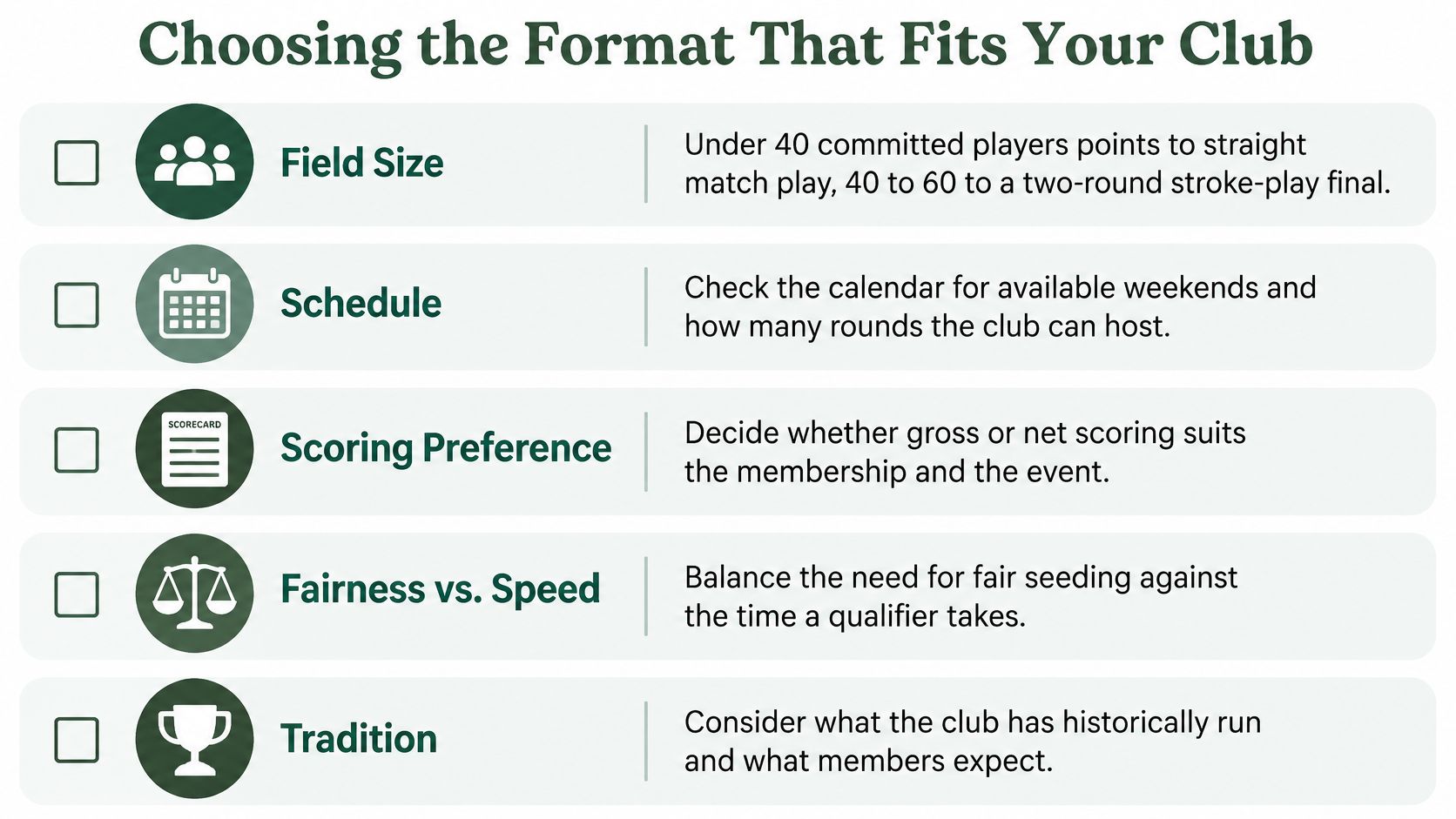
1. How many players will commit? Under 40 committed entries points to straight match play. Between 40 and 60, a two-round stroke-play final works cleanly. Above 60, run a qualifier plus a bracket, because nothing else scales without adding days.
2. How much calendar can the course give up? Count the weekend rounds the pro shop can surrender, then subtract one for a rain date. A two-weekend event without a fallback date is a scheduling gamble, not a plan.
3. How wide is the handicap spread? An index range wider than about 15 strokes is a signal to flight the field and run a separate net division. Ignore it and the same six players contest the trophy for a decade.
4. What does the weather history say? A multi-weekend championship needs rescheduling rules written into the terms. A one-day event needs an early tee-time block and a firm fallback date. Both need a rule for what happens if a qualifier is washed out.
5. What does "champion" mean at this club? The most consistent player over the longest test, or the best head-to-head competitor under pressure? That's a culture question, and the committee should answer it out loud rather than inheriting the answer.
My default: I'd rather cut a field of 70 to a clean 16-player bracket than run a 20-player knockout with four byes. Byes are unfair to nobody and irritating to everybody.
Matching the profile to the format
Traditional clubs with strong fields and a stable calendar keep Template A, the 60-player stroke-play weekend with gross and net titles. Large clubs with limited tee times run the 18-hole qualifier into a 16-player bracket, because it protects the tee sheet. Mixed-ability memberships get the most value from flighted match play with a gross champion and flight trophies down the board.
The right format isn't the fairest in the abstract. It's the one your field can finish, on the dates you can hold.
Publish Your Terms and Set Up the Event
Publish the rules before registration opens. State who is eligible, which tees players will use, qualifying distance, gross and net divisions, bracket size, seeding method, handicap allowances, tie procedures and withdrawal rules. If players cannot find an answer in the terms, expect questions once the competition starts.
Set up the event so staff can work from one roster rather than maintaining several spreadsheets. Keep qualifying scores separate from bracket results, and update match status as play progresses so players can follow the competition without confusing it with qualifying standings.
Live Tourney supports match play bracket and round robin formats, along with single-round, multi-round, Ryder Cup, league and outing events. It provides live scoring and a Customizable Report Builder for scorecards, tee sheets, cart signs, bag tags and more. These tools can help organize the event; the committee still needs to publish the draw and confirm how handicap strokes apply.
Choose the format that fits your field and calendar, then publish the terms and open registration.
For a qualifier-and-bracket championship, Live Tourney provides live scoring, supports match play bracket events and offers reports for scorecards and tee sheets. Players can follow scoring on their devices without downloading an app. See how Live Tourney fits your championship.





