Sep 24, 2026
charity golf tournament planner, golf fundraiser planning, golf outing checklist, tournament sponsorship tips, live scoring
Use this charity golf tournament planner guide to run a smooth, profitable outing with timelines, budgets, sponsorships, scoring, and day-of tips.

You've got a date penciled in, a committee asking for a sponsorship deck, and a course waiting for a deposit. The temptation is to start with flyers and registration. That's usually where the trouble starts. A charity golf tournament only performs well when every decision, from the course contract to the final payout sheet, protects the net check your organization takes home.
The scale makes that discipline worthwhile. The National Golf Foundation estimates that about 140,000 charitable golf events take place in the United States each year, involving more than 15 million participants and raising almost $3 billion annually. More recent industry reporting cited by the NGF says U.S. golf facilities hosted more than 141,000 charity events in 2022, with an average event raising about $29,500 (industry guidance on running a charity golf outing). A good charity golf tournament planner does more than fill out a checklist. The planner sequences decisions so revenue, player experience, and operations support one another.
What a Charity Golf Tournament Planner Really Does
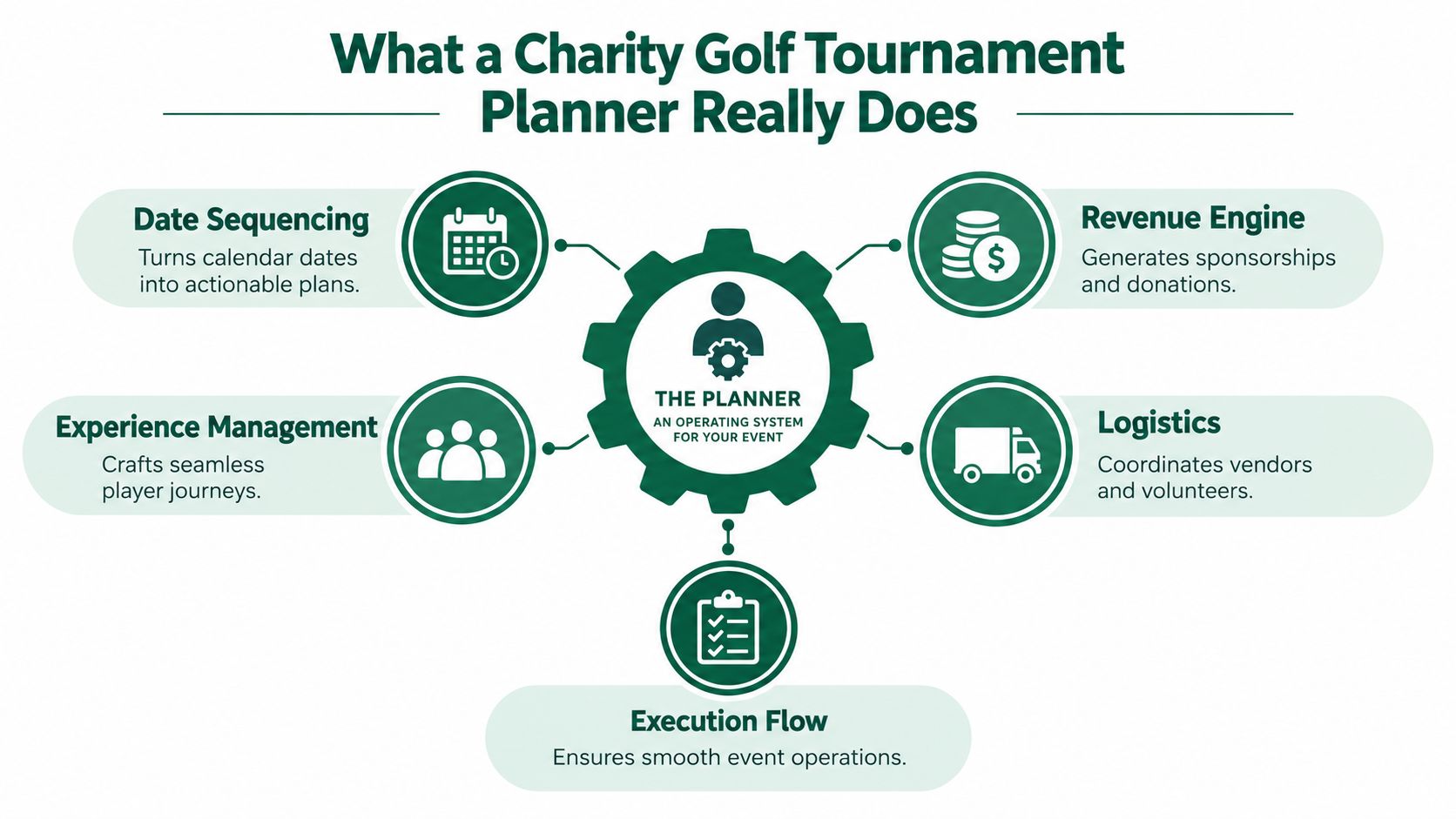
A professional planner acts as the event's operating system. The course date determines the available runway. The format affects who feels comfortable registering. The sponsorship inventory determines what businesses can buy. The prize structure influences both cost and perceived value. None of those decisions stands alone.
Start with the four outputs the outing must produce:
A clean budget: Every revenue line and cost has an owner, an assumption, and a reconciliation plan.
A sold tee sheet: Registrations arrive through a clear offer, with paid players separated from people who merely expressed interest.
A sponsor roster that feels valued: Each business knows exactly where its name appears, when recognition happens, and what it receives after the event.
A calm tournament day: Volunteers, staff, vendors, and players can follow the run sheet without repeatedly asking the planner to solve preventable problems.
The sequence matters because rework costs money. Choose the format before designing the flyer. Set the fundraising target and budget before sending the first sponsor email. Build the registration page and pricing structure before outreach begins, so a sponsor or player can commit immediately rather than wait for another round of decisions. Industry planning guidance recommends locking the course and date 6 to 9 months in advance, securing a title sponsor early, and defining the format and fundraising target before promotion begins (charity tournament planning guidance).
The planner's decision chain
A date creates a timeline. The timeline creates deadlines for sponsors, catering, signage, and player communications. Those deadlines shape the tee sheet and the day-of run sheet. If you change the format late, you may need to rewrite sponsor deliverables, adjust pricing, revise contest rules, and rebuild pairings.
Practical rule: Pick the format, set the budget, and lock the registration offer before you promote the event.
The best planner also identifies what to skip. Too many side games confuse players and slow check-in. A sponsor package with vague exposure promises creates uncomfortable follow-up. A registration form that doesn't capture dietary notes or playing information forces volunteers to retype data. The operating system works when one locked decision cascades cleanly into the next.
Working Backward From Tee Time, Your 6 to 9 Month Timeline
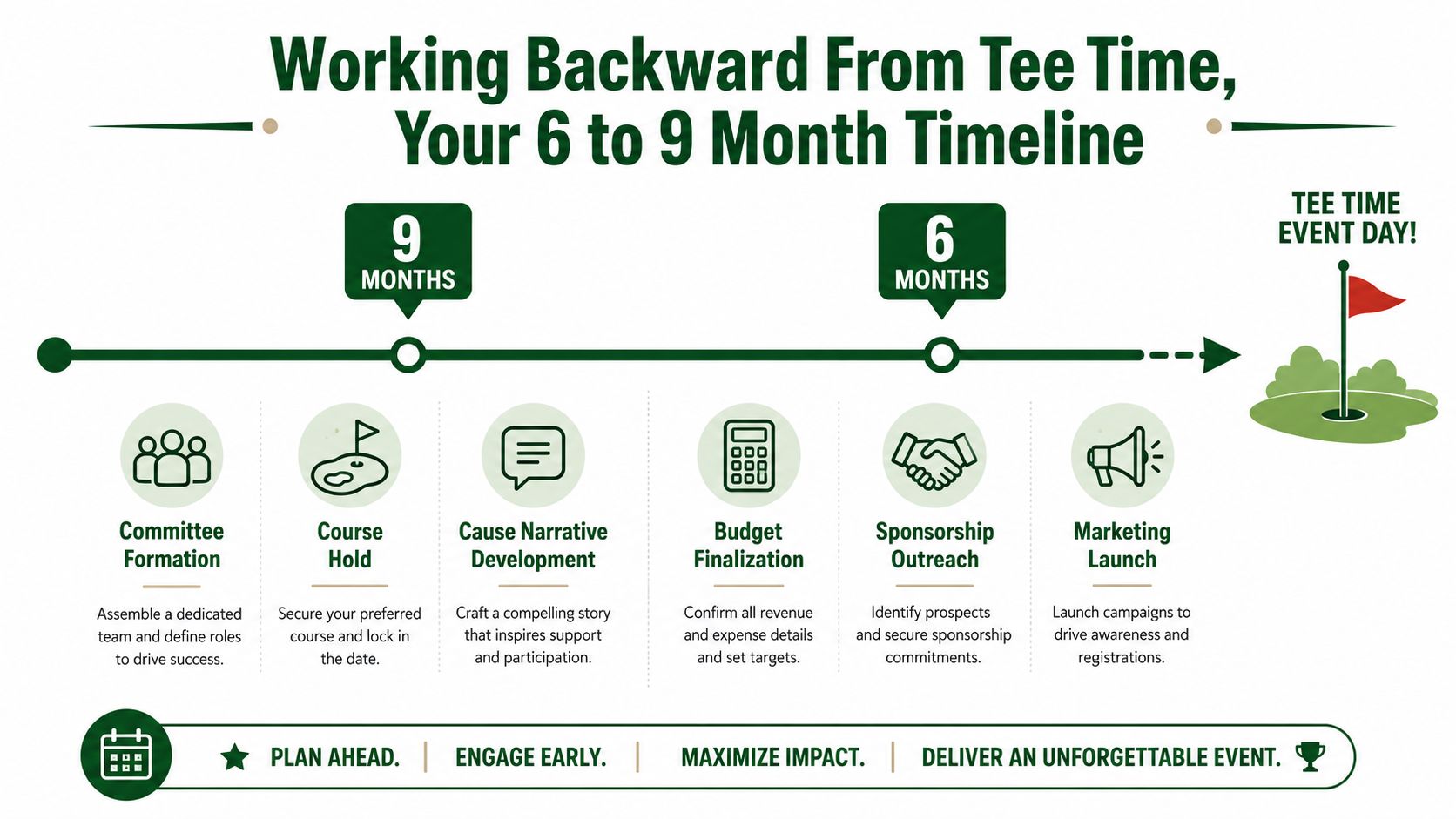
The calendar should run backward from the first tee time. A course date without milestone dates is only a reservation. The actual plan begins by asking what must be true before players, sponsors, caterers, printers, and volunteers can do their jobs.
Nine months out
Form the committee, place the course hold, and write the cause narrative. The narrative should explain who benefits, what support makes possible, and why a golf day gives donors a useful way to participate. At this point, also choose the likely format and establish the fundraising target.
Six months out
Lock the budget, finish the sponsor prospectus, and publish the registration page. Sponsors need a concrete offer, not a promise that packages are coming later. Players need a date, price, format, location, and payment path before they can share the event with their foursomes.
Organizers who want to sharpen their broader event-management habits can also review this practical resource on planning corporate events like a pro, particularly its emphasis on sequencing vendors, communications, and attendee experience.
Three months out
Push sponsor outreach, fill foursomes, and secure prize commitments. This is when the event's commercial engine should become visible. If a business wants a higher tier, you still have time to deliver the promised signage, contest, or hospitality element without improvising.
Six weeks out
Finalize pairings, hole assignments, volunteer roles, and signage proofs. The earlier registration information is clean, the less time the team spends chasing spelling corrections and missing player details.
One week out
Reconcile payments, confirm the final headcount, distribute the weather plan, and issue the day-of run sheet. A late registration cutoff can scramble pairings and kitchen counts. A late sponsor deck can cost a tier upgrade because businesses have already allocated their event budgets elsewhere.
Treat each milestone as a hard decision date. If a task slips, reduce scope rather than pretending the runway has expanded. Fewer contests, simpler signage, or a smaller awards program is better than a polished plan that arrives after the event has started.
Building the Budget Around Net Proceeds, Not Headcount
A full tee sheet can still produce a disappointing fundraiser. The number that matters is net proceeds, defined as total revenue minus total event costs (charity tournament rules and resources). Build the worksheet before announcing prices, then test whether the event can support the cause after every invoice clears.
Revenue may include player registrations, sponsorships, mulligans, contests, raffles, auctions, merchandise, meal-only tickets, and post-event gifts connected to the outing. Costs may include course and green fees, carts, catering, beverages, insurance, permits, software, signage, prizes, payment processing, and volunteer supplies.
The worksheet
Line Item | Type | Estimated Amount |
|---|---|---|
Player registrations | Revenue | To be estimated |
Sponsorships | Revenue | To be estimated |
Mulligans and contests | Revenue | To be estimated |
Raffles and auction | Revenue | To be estimated |
Merchandise and meal-only tickets | Revenue | To be estimated |
Course, green, and cart fees | Cost | To be estimated |
Catering and beverages | Cost | To be estimated |
Signage, printing, and prizes | Cost | To be estimated |
Software, insurance, permits, and processing | Cost | To be estimated |
Volunteer supplies and contingency | Cost | To be estimated |
Net proceeds | Revenue minus costs | Target amount |
Don't approve a date until the model works under a conservative 70 percent sell-through scenario. That test forces the committee to distinguish committed revenue from hopeful revenue. It also reveals whether sponsorships are carrying the event or whether player fees must do too much work.
Keep the food guarantee slightly below expected turnout when the venue permits it. Protect cash by asking sponsors to donate prizes or contest items in kind. Price add-ons so they're easy to explain at registration and check-in, rather than creating a long menu of small purchases that volunteers must reconcile manually.
Use the budget to reverse-engineer the registration price and sponsor goal. A target net is not a wish. It's the result of a gross revenue plan, a cost ceiling, and clear ownership of every assumption. For additional revenue ideas that fit naturally into this model, review golf tournament fundraising ideas.
Packaging Sponsorships That Sell and Stay Compliant
Sponsors aren't buying a logo on a banner. They're buying a defined presence in front of a particular audience, delivered at specific moments. Build each tier as a product with a name, price, inventory, deadline, and fulfillment owner.
A practical ladder can include Title, Eagle, Birdie, and Tee levels. The top package might combine naming rights, prominent course signage, cart branding, awards recognition, and web placement. Middle packages can focus on a contest, hospitality, program presence, or a cluster of signs. A Tee package should remain simple enough for a local business to understand and purchase without a meeting.
Sell the inventory, not the vague promise
List the exact deliverables:
Visibility: Tee-box signs, cart branding, program ads, and event-page presence.
Participation: A hole-in-one contest, putting activation, or staffed station.
Recognition: Verbal acknowledgment during the awards ceremony and inclusion in player communications.
Follow-through: A post-event report with photographs, results, and confirmation of delivered placements.
Price against the audience and the value of the package, not merely against your printing cost. A sponsor paying for a contest activation expects a different experience from a business buying a single sign. A charity golf tournament sponsorship package guide can help organize the tier ladder, but your inventory must reflect what the course and event can deliver.
Tier | Price | Tax-Deductible Portion | Key Deliverables |
|---|---|---|---|
Title | To be set | Donation above fair market value | Naming recognition, premium signage, awards mention, web presence |
Eagle | To be set | Donation above fair market value | Major signage, contest or activation, program recognition |
Birdie | To be set | Donation above fair market value | Hole or station signage, program listing, event recognition |
Tee | To be set | Donation above fair market value | Tee sign and sponsor listing |
Keep the accounting clean. IRS qualified sponsorship rules allow acknowledgment of a sponsor's name, logo, product line, address, phone number, or website on materials such as banners, programs, and tee signs. Advertising or other substantial benefits can change the payment's treatment and may create taxable advertising income (nonprofit fundraising event tax rules).
Separate the charitable portion from the fair-market-value benefit portion on the invoice. For non-cash gifts over $5,000, maintain the documentation needed for the donor's records and IRS Form 8283 process. A short contract should cover logo deadlines, artwork specifications, placement, acknowledgment timing, and what happens if materials arrive late. Give returning sponsors a 90-day heads-up before cold outreach begins, then track every commitment in a status sheet.
Registration, Payments, and Player Communication as One Flow
Registration should end with a paid, usable tee sheet. If the form collects names but the payment arrives by separate email, the committee creates its own reconciliation problem. If the form collects payment but not dietary notes or playing information, the clubhouse inherits the problem later.
Offer four entry paths:
Single player, for individuals who want the committee to place them.
Foursome, for groups registering together.
Sponsor-included foursome, connected to a sponsorship package.
Mulligan or add-on bundle, available during checkout rather than only at the course.
Collect the player's name, handicap or average score, email, mobile number, dietary notes, and any accommodation needs. The confirmation should generate immediately after payment, with a calendar file and receipt. Keep the registration data in one master sheet or connected event system so staff aren't retyping names into pairing sheets, cart assignments, contest lists, and scorecards.

Six touches that reduce event-day questions
Save the date: Establish the cause, date, venue, and registration link.
Early registration message: Give foursomes a reason to commit while inventory is available.
Two-week reminder: Confirm logistics and highlight remaining add-ons.
Week-of message: Send pairings, arrival instructions, parking, and check-in details.
Day-before weather call: State what will happen if conditions change and who makes the decision.
Post-event thank-you: Share results, photos, and a short survey while the experience is fresh.
The charity golf tournament registration guide is useful when you're designing the checkout flow, but the principle is operational: one source of truth from sign-up to scoring. If a player changes a dietary note or foursome member, update the central record immediately and let every downstream document draw from it.
Formats, Side Games, and Live Scoring That Keep the Day Moving
Format selection is a revenue decision, but it starts with the audience. A scramble works for casual groups and mixed abilities because players contribute to a shared team result. Best ball suits competitive foursomes that want individual shots to matter. A shamble can offer a middle ground when the committee wants pace and a little more individual responsibility.
Don't add every contest available. Choose side games that players understand quickly and that staff can resolve without delaying awards. A practical combination is closest to the pin on two par threes, longest drive, and a hole-in-one pot funded through donations at check-in. A skins game with carryovers can keep players engaged on the back nine, provided the rules and payout method are visible before play begins.
Pace is part of the product
Set a clear target of 4 hours 30 minutes for 18 holes. Use a marshal checkpoint at the turn, and intervene when a group falls two holes behind. That conversation should be courteous but direct. Slow play affects the kitchen schedule, the scoring queue, sponsor activations, and the likelihood that players stay for the reception.
Live scoring reduces the bottleneck around the clubhouse scoreboard. Players can follow the leaderboard from the course, while the scoring team checks entries as they arrive. Live Tourney is one example of a web-based option that supports app-free live scoring, real-time leaderboards, online registration, optional payment collection, roster management, and printable tournament materials such as tee sheets and cart signs.
Publish results before dinner. Players should know how scores were calculated, how ties were handled, and where side-game winners appear. Fast, visible resolution builds trust. A complicated contest that holds up the reception costs more goodwill than it raises.
Running a Calm Tournament Day From Setup to Awards
A calm tournament day starts before the first player parks. At pre-dawn setup, place registration materials, signage, mulligan packages, and carts according to a station map. Confirm radios or mobile contacts, put sponsor signs in their assigned locations, and keep a printed master roster available even if the event uses digital tools.
The morning handoff
Staff check-in with at least three volunteers per shift. One person greets and verifies the roster, one handles payments or add-ons, and one answers questions and directs players. Keep sponsor materials visible but don't let a donation table block the registration queue.
A shotgun or tee-time start should feel automatic. The head professional gives the rules briefing, marshals confirm groups have moved into position, and the start signal goes out once the course is ready. Maintain a pace window between 4 hours 15 minutes and 4 hours 45 minutes. The marshal's job isn't to patrol for its own sake. It's to prevent one delayed group from disrupting every group behind it.
At the halfway house, give the sponsor a useful activation rather than just a sign. A staffed hydration or snack point can create a natural conversation, provided it doesn't slow traffic. Meanwhile, the scoring tent should remain staffed and post leaderboards every few holes so corrections happen while groups are still on the course.
Awards should close the loop
Run the reception in under 45 minutes. Present payouts, closest-to-the-pin, longest drive, and skins without making players wait through a long speech. Then give the beneficiary a brief mission moment that connects the prizes and sponsor support to the people or program funded by the day.
Players decide whether to return based on details they notice immediately: visible volunteers, accurate scoring, short waits, clear signage, and an awards script that respects their time. For branded shirts, bags, or volunteer apparel, a basic resource on understanding direct-to-film printing can help the committee discuss artwork, production, and finish expectations with a printer.
After the last award, capture photos, verify results, and send sponsor thank-yous within 48 hours. Share the live scoring recap and event images, then record what worked, what caused delays, and which sponsors should receive an early renewal message. That follow-up turns one outing into the foundation for next year's tee sheet.
Live Tourney gives charity organizers online registration, optional payment collection, app-free live scoring, live leaderboards, tee sheets, cart signs, roster tools, side games, and payout calculations in one web-based workflow. Visit Live Tourney to see how it can connect your registration, scoring, and tournament-day operations into a cleaner charity golf event.