
Aug 20, 2026
12 team round robin, round robin schedule, tournament format, tournament scoring, golf tournament
Run a smooth 12 team round robin with fair pairings, clear scoring rules, and simple setup. Includes sample schedules and tiebreaker tips that actually work.

You've got twelve teams, one event date, and captains already asking when they'll play. The obvious answer is to find a 12 team round robin schedule online, print it, and start assigning matches. The practical answer is harder: first decide whether every team should play every other team at all.
A full round robin can be fair and satisfying, but it can also consume your venue, expose weak rest planning, and leave players waiting while the schedule falls behind. The format works best when the event has enough time, space, officials, and competitive balance to support it. When those conditions aren't present, a pool or staged format usually produces a better tournament.
When a 12 Team Round Robin Is Actually the Right Call
The awkward truth is that a full 12 team round robin is rarely the right choice for a one-day event. A true schedule requires 66 total matches across 11 rounds, and one tournament-format guide calls the complete version “completely impractical for one day,” recommending alternatives such as three groups of four for typical one-day events. See the 12-team round robin format guidance before committing your venue and officials.
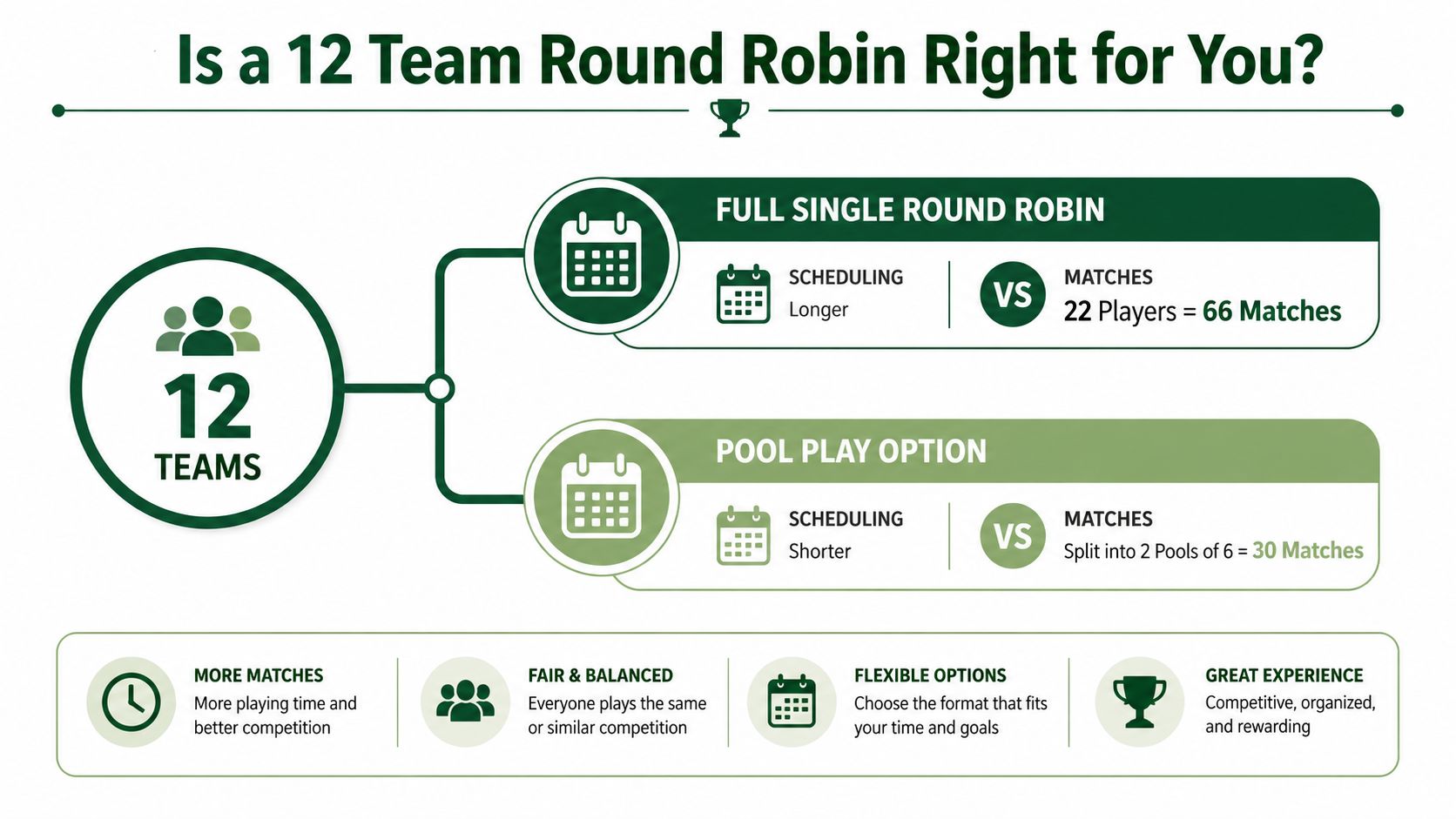
The full format makes sense when you control multiple courts, fields, or tees, or when the competition functions more like a league season spread across weeks. It also suits a field where teams are close enough in quality that standings carry genuine value. Every result contributes to the table, and no team gets eliminated because of one poor opening match.
When the full format earns its place
Choose the complete schedule when:
Time is flexible: You can run the competition across consecutive days or distribute matches throughout a season.
Facilities are plentiful: You have enough simultaneous match slots to keep rounds moving.
Officials are available: Someone can verify results, resolve disputes, and protect the schedule from drifting.
Standings matter: The event values a complete ranking, not just a single knockout champion.
The field is balanced: Each team has a credible reason to care about later matches.
The format becomes a poor choice when you have only one Saturday, limited playing areas, or a wide gap between the strongest and weakest teams. If half the field has no realistic path to the title, a long schedule can feel less like competition and more like obligation.
Director's rule: Don't ask whether the 66-match schedule is mathematically correct. Ask whether your venue and players can absorb it without sacrificing the experience.
A shorter structure is usually smarter when the winner must be decided in one day, travel time is fixed, or the facility has a hard closing window. Pool play, split groups, and hybrid brackets preserve meaningful competition while reducing the amount of dead time. The rest of the planning depends on making that choice.
The Math Behind a 12 Team Round Robin
The core calculation is simple. In a single round robin, every team meets every other team once, so the number of unique matches is the combination of twelve teams taken two at a time, C(12, 2) = 66. The round robin scheduling guide provides a practical starting point for turning that calculation into actual pairings.
Your number of simultaneous match slots determines how many rounds you need. With one match running at a time, the event requires 66 rounds. Four matches at once require 17 rounds, after rounding up. Six matches at once require 11 rounds.
Simultaneous Slots | Rounds Needed | Match Length 30 min | Match Length 45 min | Match Length 60 min |
|---|---|---|---|---|
1 | 66 | 1,980 minutes | 2,970 minutes | 3,960 minutes |
4 | 17 | 510 minutes | 765 minutes | 1,020 minutes |
6 | 11 | 330 minutes | 495 minutes | 660 minutes |
The table shows why match capacity matters more than the number printed on the schedule. Six simultaneous slots can complete the draw in 11 rounds, but that doesn't mean the event fits into a short day. Add check-in, warmups, course or court transitions, score verification, rulings, and breaks. A dispute late in one round can delay every group after it.
Test the event before publishing it
Use two rough calculations:
Total match minutes: 66 multiplied by your average match length.
Round minutes: 66 divided by your simultaneous match slots, then multiplied by the average match length.
The first number tells you the total playing load. The second tells you how long the rotation may take before buffers. Multiply rounds by simultaneous slots to estimate facility usage, then reserve extra capacity for warmups and scoring disputes.
Rest planning changes the answer. With 11 rounds and six matches per round, every team plays in every round, so there's no built-in rest between matches. If you need recovery time, increase the number of scheduling blocks and distribute byes deliberately rather than pretending the competition is continuous.
Format Options Beyond the Full 66-Match Schedule
A full round robin wins on completeness, but one-day events usually need a different balance. The right comparison isn't only match count. Look at rounds, competitive fairness, operational fit, and whether the format produces a clear champion.
Format | Total Matches | Rounds Needed | Fairness | Produces Clear Winner |
|---|---|---|---|---|
Full single round robin | 66 | 11 with six slots | Highest standings coverage | Not necessarily |
Three pools of four plus knockout | Around 45 | Fewer than full format | Strong within pools, dependent on advancement rules | Yes |
Two groups of six plus knockout | Roughly 40 | Five group rounds plus finals structure | Good group coverage | Yes |
Hybrid top-six and consolation round robins | Varies by final placement design | Lower than full format | Strong within tiers, less complete overall | Yes |
The match totals and round counts in this table reflect the structures described here, not universal tournament rules. Directors should calculate the final number again after deciding how many advancement and placement matches they'll run.
Pool play
Split the field into three pools of four. Each pool runs a six-match mini round robin, then the top teams advance to a four-team or six-team knockout. This approach keeps opponents familiar within the pool, creates a meaningful standings phase, and leaves room for semifinals and a final.
Its weakness is seeding. A strong pool can eliminate a capable team earlier than a weaker pool does, so publish the draw method and advancement rules before play begins.
Two-group split schedule
Two groups of six play a five-round internal round robin. Afterward, cross the top seeds into semifinals and finish with a final. This gives each team repeated meaningful matches while producing a champion without asking every team to face the entire field.
The trade-off is that teams in separate groups never meet unless they advance. That's acceptable when the event's purpose is a decisive championship rather than a complete ranking.
Hybrid staging
A hybrid format runs a complete round robin among the top six seeds while the bottom six play a parallel consolation round robin. Cross-bracket placement games can finish the day. This protects competitive balance and keeps more matches meaningful, though it doesn't offer the same universal fairness as a full draw.
The full round robin is fairest on paper. The hybrid format is often fairest to the actual event.
Sample Schedules You Can Copy and Tweak
A printed schedule needs to survive substitutions, late arrivals, and questions from captains. Number the teams before the draw, keep the pairing grid visible, and use a single rotation method throughout. The standard circle method is useful because it keeps opponents from repeating when the full draw is built correctly.
For a complete schedule, six pairings occupy each of 11 rounds. Every team appears once per round, so there isn't a rest team in the full six-slot version. If your venue has fewer than six simultaneous slots, keep the pairings for each round but split them into time blocks.
Full 11-round pairing grid
Round | Match 1 | Match 2 | Match 3 | Match 4 | Match 5 | Match 6 | Rest |
|---|---|---|---|---|---|---|---|
1 | 1 v 12 | 2 v 11 | 3 v 10 | 4 v 9 | 5 v 8 | 6 v 7 | None |
2 | 1 v 11 | 12 v 10 | 2 v 9 | 3 v 8 | 4 v 7 | 5 v 6 | None |
3 | 1 v 10 | 11 v 9 | 12 v 8 | 2 v 7 | 3 v 6 | 4 v 5 | None |
4 | 1 v 9 | 10 v 8 | 11 v 7 | 12 v 6 | 2 v 5 | 3 v 4 | None |
5 | 1 v 8 | 9 v 7 | 10 v 6 | 11 v 5 | 12 v 4 | 2 v 3 | None |
6 | 1 v 7 | 8 v 6 | 9 v 5 | 10 v 4 | 11 v 3 | 12 v 2 | None |
7 | 1 v 6 | 7 v 5 | 8 v 4 | 9 v 3 | 10 v 2 | 11 v 12 | None |
8 | 1 v 5 | 6 v 4 | 7 v 3 | 8 v 2 | 9 v 12 | 10 v 11 | None |
9 | 1 v 4 | 5 v 3 | 6 v 2 | 7 v 12 | 8 v 11 | 9 v 10 | None |
10 | 1 v 3 | 4 v 2 | 5 v 12 | 6 v 11 | 7 v 10 | 8 v 9 | None |
11 | 1 v 2 | 3 v 12 | 4 v 11 | 5 v 10 | 6 v 9 | 7 v 8 | None |
This grid assumes six simultaneous match slots. If you're running fewer, assign each pairing a court, field, or tee window and preserve the order within the round. Give every block a buffer, and don't schedule the next start at the exact moment the prior match is expected to finish.
Short pool-stage version
For a shorter day, divide the field into four pools of three:
Pool A: Teams 1, 2, 3
Pool B: Teams 4, 5, 6
Pool C: Teams 7, 8, 9
Pool D: Teams 10, 11, 12
Run the internal matches during rounds 1 and 2:
Round | Pool A | Pool B | Pool C | Pool D |
|---|---|---|---|---|
1 | 1 v 2 | 4 v 5 | 7 v 8 | 10 v 11 |
2 | 2 v 3 | 5 v 6 | 8 v 9 | 11 v 12 |
3 | 3 v 1 | 6 v 4 | 9 v 7 | 12 v 10 |
Use rounds 4 and 5 for crossovers based on current standings. A practical rotation is first seed from each pool against a second seed from another pool, then the remaining teams play placement matches. Rotate opponents so no team gets the shortest recovery window repeatedly.
At check-in, post the grid on a board and hand each captain a copy. Mark court or tee assignments in large type, announce the next round before the current one ends, and keep one official copy at the scoring table.
Scoring Rules and Tiebreakers That Players Understand
Players shouldn't discover the scoring system after their first result. Post the points, tiebreakers, forfeiture policy, and late-arrival rule beside registration and repeat them at the captain's briefing.
For match or team play, use straight wins with draws recorded as half points. For the full 11-round standings model, a win earns 1 point, a tie earns 0.5 points, and a loss earns 0 points. Sum the results across the scheduled rounds.

Publish the tiebreaker order
Use this hierarchy:
Head-to-head result: Apply this when exactly two teams are tied and they played each other.
Head-to-head point differential: Use the results among the tied teams when more than two teams share the same total.
Cumulative score or point differential: Compare performance across all completed rounds.
Sudden death or scorecard countback: Use this only when the event requires a final on-site decision and the rules allow it.
Suppose Teams A, B, and C finish tied at 7 points. First, isolate the matches among those three teams. If one team has the strongest head-to-head differential, it ranks first. If that still doesn't separate them, compare their cumulative differential across all rounds, then use the published playoff or countback procedure.
The exact calculation depends on your sport and scoring method, but the sequence must be visible before play begins. A useful guide to golf playoff rules can help directors turn a vague tie procedure into a posted policy.
Remove ambiguity before the first match
State what happens when a team forfeits, fails to appear, or arrives after its start window. Decide whether the opponent receives a win, whether an unplayed match receives a standard differential, and whether a late team can join after play has started. Apply the same rule every time, and record the ruling in the official results log.
Running It in Live Tourney Without Last Minute Stress
A 12 team round robin needs three working systems at once: a calendar, a scoreboard, and a tiebreaker calculator. Keeping those jobs in separate spreadsheets creates opportunities for mismatched pairings, stale standings, and arguments.
Use Live Tourney as one possible platform for importing rosters, configuring a round robin, adding rounds and matches, publishing pairings, and displaying live results. Its app-free scoring workflow lets participants enter results from a phone through a link, while organizers manage the event from the browser.
Build the event before players arrive
Start with the roster. Import all 12 teams, confirm names and captains, and lock the identifiers before generating pairings. Then choose the full 11-round structure or your selected pool format, and verify that every matchup appears in the intended round.
Add the operational details next:
Match assignments: Attach each pairing to a court, field, tee block, or start window.
Rest rotations: For a reduced-slot schedule, distribute sitting teams rather than letting the same teams absorb the longest waits.
Buffers: Leave time for warmups, travel between areas, score checks, and rulings.
Rules: Enter the scoring and tiebreaker sequence exactly as printed on the captain sheet.
The live leaderboard matters because players can see whether a result has posted and how standings are changing. That visibility reduces the number of captains walking to the scorer's table to ask for updates, but it doesn't replace an official review. Keep one director responsible for validating disputed entries before they become part of the standings.
Check the workflow from a player's phone
Before the event opens, test the participant link with someone who isn't involved in setup. Confirm that the person can find the right match, submit a result, and view the updated table without downloading an app. At check-in, provide the leaderboard QR code and explain who enters the score when both sides disagree.
The real-time golf tournament scoring workflow is useful as a reference for organizing that handoff between participants and staff. The key is not the brand of software. It's making sure the published pairings, score entry, and standings all draw from the same event record.
Day-Of Fixes and a Final Confidence Checklist
Five problems derail round robins more often than complicated mathematics: a team no-show, a disputed score, a late player, a tie at the top, and a schedule that falls behind. Handle each with a written rule and a small operational adjustment. Don't rebuild the entire bracket because one result needs attention.
Fix the problem in front of you
Team no-show: Mark the team as withdrawn, notify every affected captain, and apply the published forfeit rule consistently. If your platform supports automatic regeneration, use it to shift opponents and update records rather than editing every pairing by hand.
Disputed score: Freeze that match result, ask both captains for their written cards or scoring records, and let the director make the ruling. Keep the disputed result out of the public standings until the review is complete.
Late arrival: Apply the announced penalty or forfeiture window, then send the waiting opponent into the next available activity. Don't hold every other match for one team.
Tie at the top: Use the posted sequence. For two teams finishing 7-3, check head-to-head result, then point differential, then the next published decision such as a coin flip or sudden-death playoff if the event permits it.
Schedule slippage: Shorten the next transition, not the rule set. Announce a revised start window, move available officials to the delayed area, and preserve the match order unless safety or facility limits require a change.
A withdrawn team can create a chain reaction if you alter pairings manually. An auto-regeneration feature can shift opponents and update win-loss records in seconds, but the director still needs to review the new grid and announce it clearly before play resumes.
Tape this checklist to the scoring table
Before play
Roster lock: Confirm all 12 team names, captains, contact details, and substitutions.
Schedule posted: Display the pairing grid, start windows, locations, and rest assignments.
Scoring devices charged: Test phones, tablets, chargers, and the director's results screen.
Rules printed: Include points, forfeits, late arrivals, disputes, and tiebreakers.
Officials briefed: Give marshals and scorers the same escalation procedure.
During play
Leaderboard refresh: Check that completed matches appear before the next round.
Rule cards visible: Keep the scoring and tie sequence available at every playing area.
Marshal rotation: Put someone in charge of delays, directions, and player questions.
Score verification: Review unusual margins, missing results, and duplicate entries.
Captain updates: Announce schedule changes through the same channel every time.
At the finish
Results export: Save the final standings and match history.
Photo upload: Record the winning team and presentation moment.
Champion certificate: Confirm the name and final ranking before printing.
Payout review: If prizes are involved, verify the approved results before distribution.
Archive: Keep the schedule, rules, and final results together for the next event.
If your venue can support the full format, build it carefully and protect the rest schedule. If it can't, choose pool play or a staged championship without apologizing for it. Visit Live Tourney to configure round robin events, manage rosters and pairings, and give players app-free live scoring and standings from their phones.





