Sep 26, 2026
golf tournament tee box games, golf tournament games, golf side games, golf tournament prizes, golf event management
Explore 6 golf tournament tee box games with rules, setup, scoring, prizes, and efficient ways to run engaging events with Live Tourney.

137 seconds is the average tee-box time across 281 observations, and adding one golfer to a group increased that time by 27.5 seconds. A mulligan or re-hit added another 58.1 seconds, so the strongest golf tournament tee box games depend on your audience, desired level of competition, and operational capacity.
The right format turns a quiet stretch between registration and final results into a series of smaller competitions. Familiar team contests suit mixed corporate fields, while skins create sharper competition, blind targets reward precision, progressive leaderboards build a narrative, and a pro-versus-field challenge gives the event a headline attraction.
The practical filter is simple: every game needs clear rules, fair eligibility, an appealing prize, a quick scoring method, and an owner on the ground. Live Tourney can centralize tournament scoring, side games, live updates, registrations, payouts, and player communications through an accessible, app-free experience. Organizers can also make the event more memorable with useful details such as a personalised golf ball picker, especially when player gifts or sponsor activations need to feel practical rather than disposable.
1. Scramble with Tee Box Competitions
A scramble already gives mixed-skill teams a reason to stay involved. Add a tee-box contest, and every player gets another chance to contribute before the team chooses its best ball. A corporate charity outing might run a longest-drive fundraiser on selected holes, while a resort tournament could pair the scramble with closest-to-the-pin contests on par 3s.
The format works because the main score and the side competition serve different audiences. Beginners can enjoy the team result without needing to outdrive experienced players, while stronger golfers can pursue a measurable individual win. Keep the side game separate from the scramble score, and explain that distinction before the first group leaves the tee.
For the core format and scoring considerations, organizers can use this guide to run a golf tournament scramble.
Make the tee box easy to understand
Use clearly marked tee markers and define the eligible landing area before play begins. A longest drive should specify whether the ball must remain in the fairway, and a closest-to-the-pin contest should identify the hole and measurement method. Don't leave volunteers or players to interpret the rules differently from group to group.
Assign one person per team to record the result. A volunteer can verify standout entries, while GPS or laser measurement can settle close calls. The winning entry should include the player's name, team, hole, and measurement, not just a handwritten mark that staff must decode later.
Practical rule: If a player has to ask whether a shot qualifies after hitting it, the contest instructions weren't visible enough.
Display current leaders between holes or on a clubhouse screen. Live updates create a reason to check the leaderboard even when a team isn't near the top of the main scramble standings. Keep prize pools reasonable and communicate whether players are buying into the contest, earning entries through registration, or competing for sponsor-funded prizes. A broader golf course games collection can help organizers build related activities around the same event theme.

2. Skins Game at the Tee Box
A tee-box skins game is best for players who enjoy a defined contest on every hole. Each hole receives a stated skin value, and players compete using a tee-shot measure such as longest drive, closest to the pin on a par 3, or the best position for the next shot. The main tournament remains intact, while the skins game gives competitive players a separate result to follow.
Carryovers add tension. If no eligible shot wins a hole, the value moves forward, making later holes more important. That mechanic can be exciting, but it also creates a communication problem if players don't know the current value or the tie rule. Publish the skin value, eligibility condition, and carryover treatment before play starts, then show updates during the round with live skins game rules and scoring guidance.
Choose the right prize structure
Use cash or merchandise only when the field understands the financial rules and is comfortable with them. A point-based skins game is often cleaner for corporate, junior, senior, or charity groups that want competition without wagering. It also lets an organizer offer sponsor prizes without making participation feel compulsory.
Set the value according to the audience, not according to the most competitive player in the field. A modest, clearly explained prize can sustain attention better than an aggressive structure that makes casual players opt out. State that the skins standings are separate from the main tournament results, and keep the two score paths visibly distinct.
The tee shot itself must be judged consistently. If the contest uses longest drive, define the fairway boundary. If it uses closest to the pin, decide how measurement works when a ball is off the green or when two entries appear tied. A volunteer or designated scorer should confirm disputed results before the next group leaves.
A carryover should increase interest, not create an administrative surprise.
For a weekly club game, a simple points system may be more effective than money. For a member-guest event, an optional buy-in can work if players choose it during registration and the staff can identify participants at the tee. Live standings should show winners, unresolved holes, and carryovers without forcing players to calculate the running result themselves.
3. Blind Draw Target Game
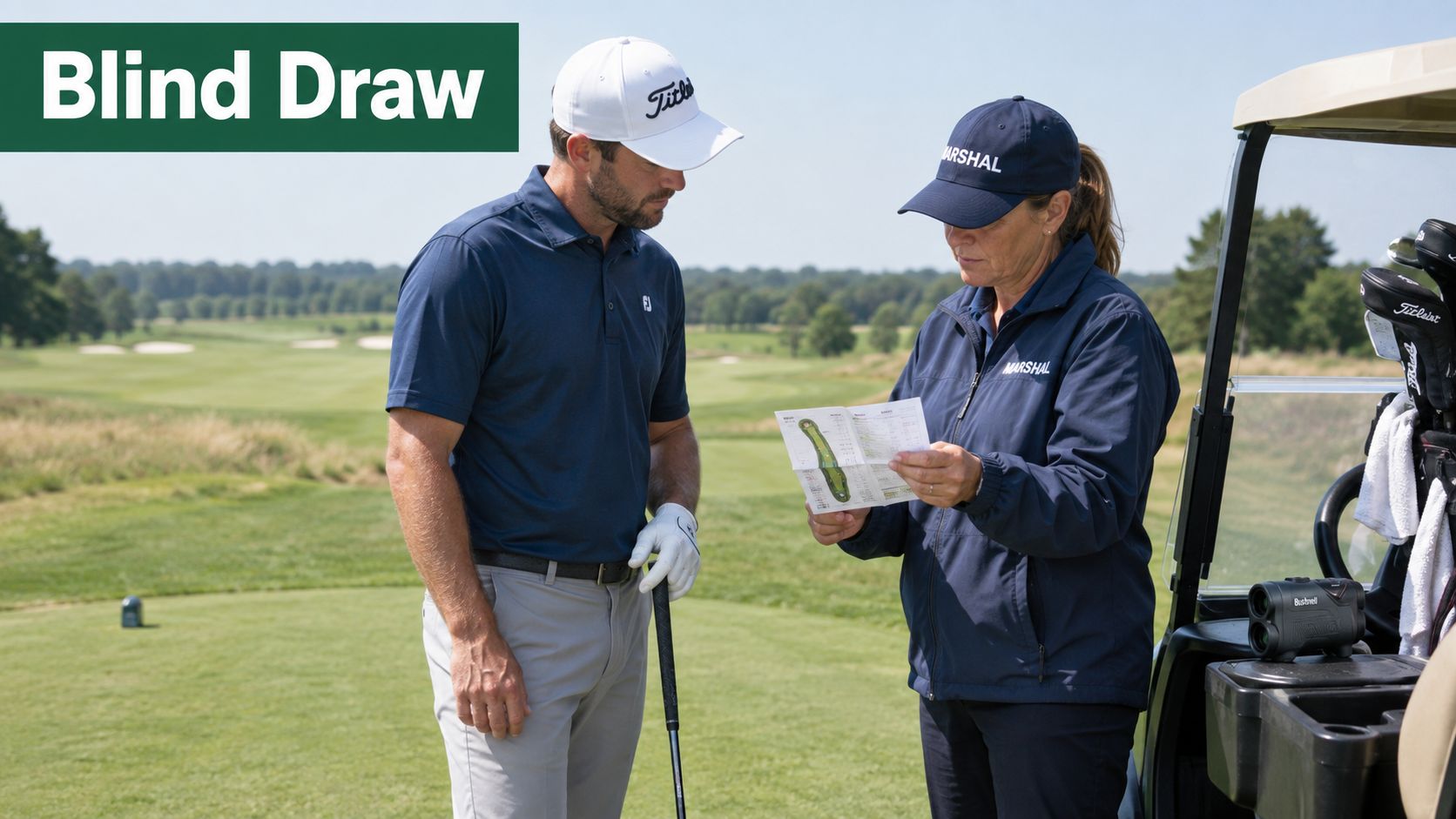
The blind draw target game replaces a familiar distance contest with a test of control. Before teeing off, a player draws an unknown yardage target. After the shot lands, staff reveal or confirm the target and compare the ball's final position with the assigned distance.
That uncertainty gives the game its appeal. Players aren't just chasing the longest drive, and a shorter but carefully controlled shot can beat a powerful one. A junior event can use the format to teach distance awareness, while a charity outing can turn every draw into a small moment of suspense.
The organizer must make the target ranges credible for the field. A target that only the strongest players can reach won't feel fair, and a target that is too easy removes the challenge. Use the course's available landing areas, the selected tee boxes, and the group's general ability when preparing the draw cards.
Keep the reveal fast
The result should be captured as soon as the group reaches the ball or as soon as a marshal can verify the position. GPS carts, rangefinders, or a clear course map can reduce arguments, but the tool matters less than using the same method for everyone. Don't rely on players estimating distances from different reference points.
Award cumulative points rather than trying to convert every result into a stroke adjustment. A simple ranking system can give the closest player the highest award, with lower awards for the next positions. Publish the points after each hole so participants can see whether a strong early result matters later in the round.
A corporate group may prefer a team total, while a junior tournament may use individual points. Either way, the rules should state whether the target measures carry from the teeing area, the fairway landing point, or another defined reference. The event staff should also decide how to handle a shot that lands outside the intended measurement area before play begins.
4. Tee Box Ladder and Leaderboard with Progressive Scoring
A progressive tee-box leaderboard gives the round a storyline. Players earn points for tee-shot wins, then receive an additional advantage for maintaining a winning streak. The structure rewards consistency while creating momentum that players can follow from hole to hole.
That momentum is also the main risk. If the scoring system gives an early leader too much influence, other players may stop believing they can catch up. Define the points, streak requirement, and multiplier before registration closes. A cap on the multiplier can preserve competition without taking away the reward for strong performance.
Separate the narrative from the official score
The ladder should never make the official tournament score harder to understand. Use a separate column or digital view for tee-box points, while the main scorecard continues to show the event's actual format. Players should know exactly what produces a ladder point and whether a tie creates shared points, a playoff, or no award.
A club championship can run the ladder alongside stroke play, while a resort event can use it as a lighter contest for players who don't expect to challenge for the overall title. A league can carry the leaderboard into later events, provided the organizer publishes the reset and eligibility rules clearly.
Live scoring is particularly useful here because staff shouldn't calculate streaks manually while managing registration, score verification, and player questions. Real-time golf tournament scoring can keep current leaders visible on player phones or clubhouse screens.
Progressive scoring works when players understand the path to winning. Complexity belongs in the system, not in the briefing.
Prepare a printable scorecard that shows both standings if players need a paper fallback. The digital leaderboard should display the current leader, streak status, and remaining opportunities. If a player withdraws or a shot is later ruled ineligible, assign one person to correct the record and communicate the change promptly.
5. Par 3 Target Zone Championship
The par 3 target zone championship shifts attention from distance to placement. Organizers mark target areas on the green, then award points according to where the tee shot finishes. A ball inside the primary zone receives the strongest result, a ball in a wider secondary zone receives a smaller result, and a shot outside both zones receives no target-zone points.
This format suits fields that value precision or need a contest that doesn't favor raw power. A senior club tournament can emphasize accuracy, a junior program can discuss club selection, and a family outing can give players with different swing speeds a more balanced competition.
Target zones must be visible without interfering with play. Use flags, discs, or other course-approved markers and coordinate placement with the golf facility before event day. The organizer should determine whether the zone is measured from the hole, the flagstick position, or a marked section of the green, then print that explanation on the contest card.
Build fairness into the setup
Tee selection affects the quality of the contest. USGA guidance connects forward tees with golfers averaging under 200 yards off the tee and under 130 yards with a 7-iron, while middle tees align with 6,000 to 6,600 total yards and drives above 225 yards. These benchmarks from tee-box selection guidance can help organizers choose starting locations that match player ability and protect the pace of play.
Mixed fields may need different target-zone arrangements or separate eligibility categories. Don't claim that one green setup is automatically equitable for every player. State whether the contest uses a common target, skill-based divisions, or a normalized scoring method, and get approval from the tournament committee before publishing the rules.
A rangefinder or smartphone can verify close positions, but the measurement process should be quick. Give the scorer a simple par 3 card with the player's name, hole, zone, and points. Publish the winner promptly after the round, and consider a small, useful prize that recognizes precision without distracting from the main awards.
6. Beat the Pro or Designated Player Challenge
The designated player challenge gives the field a human benchmark. A club professional, instructor, skilled member, local celebrity, or touring professional hits a tee shot, and participants try to beat that result using an agreed metric. On a par 3, the contest might use proximity to the hole. On a longer hole, it might use distance within the fairway or another accuracy measure.
The attraction comes from comparison, not just the prize. Players want to know whether their shot beat the professional's line, and juniors can use the contest as a practical lesson in decision-making. A member-guest tournament can feature the club pro, while a charity event can use a recognizable local player to give the tee box a fundraising focus.
Pick a benchmark the field can respect
The designated player should be skilled enough to create a real challenge, but not so far beyond the field that participation feels pointless. Publish the player's role and the contest metric before the round. If the benchmark player changes clubs, tees, or strategy, record those details so every group understands what it is comparing against.
Multiple metrics create more winning paths. A player might not beat the benchmark on distance but could win an accuracy category. On par 3s, closest-to-pin comparisons are straightforward. On drive holes, require the ball to remain within the stated fairway or target corridor if accuracy matters.
The contest also needs a neutral result owner. The benchmark shot should be recorded before participants hit, and a marshal or scorer should confirm the reference location. Displaying the results after each hole builds interest, but don't make players wait at the tee while staff manually update a board.
The pro is the attraction. The rule sheet is what keeps the attraction fair.
A special prize for beating the designated player on the most holes can work well, but explain whether ties are shared or resolved through a published tiebreaker. Keep the challenge separate from official stroke-play scoring unless the tournament committee has deliberately adopted a format that changes the score. The teeing area itself has precise boundaries, so staff must also ensure that every player starts from the correct marked location.
6-Way Tee Box Games Comparison
Item | 🔄 Implementation complexity | Resources required | ⚡ Speed/efficiency | ⭐ Effectiveness | 📊 Expected outcomes & 💡 Ideal use cases |
|---|---|---|---|---|---|
Scramble with Tee Box Competitions | Medium, team scramble plus multiple tee games; rules needed | Moderate, team coordinators, optional GPS/laser, scoring platform | ⚡ Medium, added stops for tee contests can slow play | ⭐⭐⭐⭐, high engagement across skill levels | 📊 Frequent small wins, steady excitement; Best for fundraisers, corporate outings, mixed-ability events. 💡 Designate a scorer, mark tee competition areas. |
Skins Game at the Tee Box | Low, simple per-hole skin rules with carryovers | Low, minimal staff, optional live display | ⚡ High, outcomes decided at tee, quick resolution | ⭐⭐⭐⭐, strong drama when carryovers occur | 📊 Escalating prize pools and tense moments; Best for clubs, weekly games, member events. 💡 Set carryover caps and confirm skin values pre-round. |
Blind Draw Target Game | Medium–High, blind assignment logistics and reveal rules | High, rangefinders/GPS or marshals for measurement | ⚡ Low–Medium, measuring/verification can slow play | ⭐⭐⭐⭐, very fair, tests distance control | 📊 Promotes technical skill and surprises; Best for junior programs, skill-development events, tech-forward clubs. 💡 Use rangefinders, show results immediately, define proximity rules. |
Tee Box Ladder/Leaderboard with Progressive Scoring | High, requires progressive rules and software integration | High, live-scoring platform, staff, display screens | ⚡ Medium, scoring automated but setup intensive | ⭐⭐⭐⭐⭐, excellent for narrative and sustained engagement | 📊 Builds momentum and storylines, rewards consistency; Best for leagues, multi-round tournaments, tech-enabled facilities. 💡 Cap multipliers and publish scoring rules clearly. |
Par 3 Target Zone Championship | Medium, target setup and tiered scoring per par-3 | Moderate, flags/discs, staff to place zones, measurement tools | ⚡ High, quick resolution on short holes | ⭐⭐⭐⭐, excellent for precision-focused play | 📊 Highlights short-game accuracy; Best for senior, junior, women's events, and skill-focused clubs. 💡 Pre-mark zones, scale sizes by handicap, verify with rangefinders. |
Beat the Pro/Designated Player Challenge | Low–Medium, simple concept but depends on benchmark logistics | Low–Moderate, designated player, measuring tools, publicity | ⚡ High, instant comparison at tee | ⭐⭐⭐⭐, strong spectator/marketing appeal | 📊 Creates a compelling narrative and bragging rights; Best for charity events, pro-hosted tournaments, instruction programs. 💡 Choose benchmark matched to field and use multiple metrics for fairness. |
Turn Tee-Box Ideas Into a Smoother Tournament
The best golf tournament tee box games aren't the ones with the most moving parts. They're the ones players understand quickly, staff can verify consistently, and the course can absorb without creating a queue. Choose one or two formats that fit the audience, rather than placing a contest on every tee and asking volunteers to manage a separate ruleset at each hole.
Start by defining eligibility and scoring. Decide whether the game is individual, team-based, optional, sponsor-funded, point-based, or tied to a prize. Tee selection should be explicit, particularly in mixed-skill fields. USGA teeing-area rules define the starting rectangle as two club-lengths deep behind the tee markers, with the front edge formed by the line between the markers. Playing from outside the teeing area in stroke play normally brings a two-stroke penalty, while match play can require the opponent to cancel the stroke and replay it, as explained in this overview of teeing-area rules.
Then set prize values before promoting the contest. A prize should be meaningful to the audience, but it shouldn't encourage disputes or make a casual player feel excluded. Decide how buy-ins, donations, carryovers, ties, and unclaimed prizes will be handled. If a game uses alternate tees, document which tee applies to which player and confirm that the scorecard reflects it.
Use a simple operating sequence
Prepare the course: Mark tee locations, target zones, measurement points, and sponsor signage before players arrive.
Brief the field: Explain the contest in plain language at registration, on the scorecard, and at the relevant tee.
Assign ownership: Name the person responsible for collecting results, resolving eligibility questions, and approving corrections.
Measure consistently: Use the same GPS, rangefinder, map, or visual rule for every group.
Publish quickly: Show leaders and winners while the event is still active, then verify the final payout list before the awards.
Pace of play deserves special attention. The same pace-of-play study that recorded the 137-second average tee-box time found that adding a golfer increased tee-box time by 27.5 seconds and a mulligan or re-hit added 58.1 seconds, making unnecessary tee-box activity a real scheduling concern. Its sample also included 32 mulligans and 76 par 3 tee-box observations, which reinforces why side contests need particular care on crowded holes. The pace-of-play and tee-box game analysis provides useful context for planning stations and re-hit rules.
Live Tourney can support the administration layer by keeping registrations, pairings, live scoring, side games, leaderboards, payouts, reports, and player updates in one system. Players can enter and view results through a link without downloading an app, while staff can use event data to keep scorecards, standings, and payouts aligned. The platform also supports formats including scrambles, skins, match play, Ryder Cup, and round robin, so organizers can keep the main tournament and tee-box contests distinct.
Visit Live Tourney to set up your next event with app-free scoring, live leaderboards, side-game management, registrations, and payout tools. Use the platform to give your tee-box game a clear rule set, visible results, and a smoother path from the first tee shot to the final awards.