
Jun 3, 2026
golf horse race, golf tournament formats, golf shootout, golf derby, live scoring
Learn how to run a thrilling golf horse race event. This guide covers rules, scoring variations, payout methods, and tips for a flawless tournament experience.
Most events end with a whimper. Scores are posted, a few players linger around the grill room, and everyone starts mentally moving on before the prizes are even handed out.
A golf horse race fixes that. It gives your day a real finish. Not just a result, but a scene. Players stay engaged, spectators finally have something easy to follow, and the closing stretch feels like an event instead of housekeeping. If you're running a member-guest, a charity outing, or a club championship add-on, this format can turn the last part of the day into the part people remember.
Why a Golf Horse Race Creates Unforgettable Events
The biggest reason a golf horse race works is simple. It gives everyone a focal point.
A standard tournament asks people to care about a leaderboard that may be spread all over the course. A horse race compresses the drama into one visible progression. One player goes out, the field gets smaller, and the pressure keeps rising until the final hole. Even players who were eliminated early usually stick around to watch because the format is easy to understand from the rope line.
That high-stakes feel isn't accidental. The phrase horse race comes with a long competitive history. Britannica notes that organized horse racing in medieval England included a £40 purse during the reign of Richard the Lionheart (1189–1199), and later under Charles II national racing rules required horses to win two 4-mile heats to be declared the winner, which helps explain why the term still signals an elimination-style contest with real stakes (Britannica on horse racing history).
Why the finish feels bigger than the format
The format creates a natural audience. Members can gather near the final green. Sponsors can see a climax. Staff can announce each elimination in real time. That's a very different experience from a quiet scorecard reconciliation after play.
A horse race isn't just a side game. It's your closing ceremony if you run it correctly.
Clubs that lean into presentation usually get the most out of it. Clean signage, a visible chip-off area, and a polished final green setup matter. If you're refining your short-game area or event space, it can even help to understand practical build-out decisions like how much do artificial putting greens cost, especially if your tie-break area is part of the spectator experience.
Where it fits best
A golf horse race works especially well as the capstone to:
Member-guest events where you already have an audience on property
Charity outings that need a clean, entertaining finale
Corporate tournaments where pace and spectacle matter more than pure competitive depth
Club championships when you want a separate made-for-viewing finish after the main competition
The common thread is this: the format rewards visibility. If your event ultimately needs energy, few things do that better.
Setting the Stage Core Rules and Format
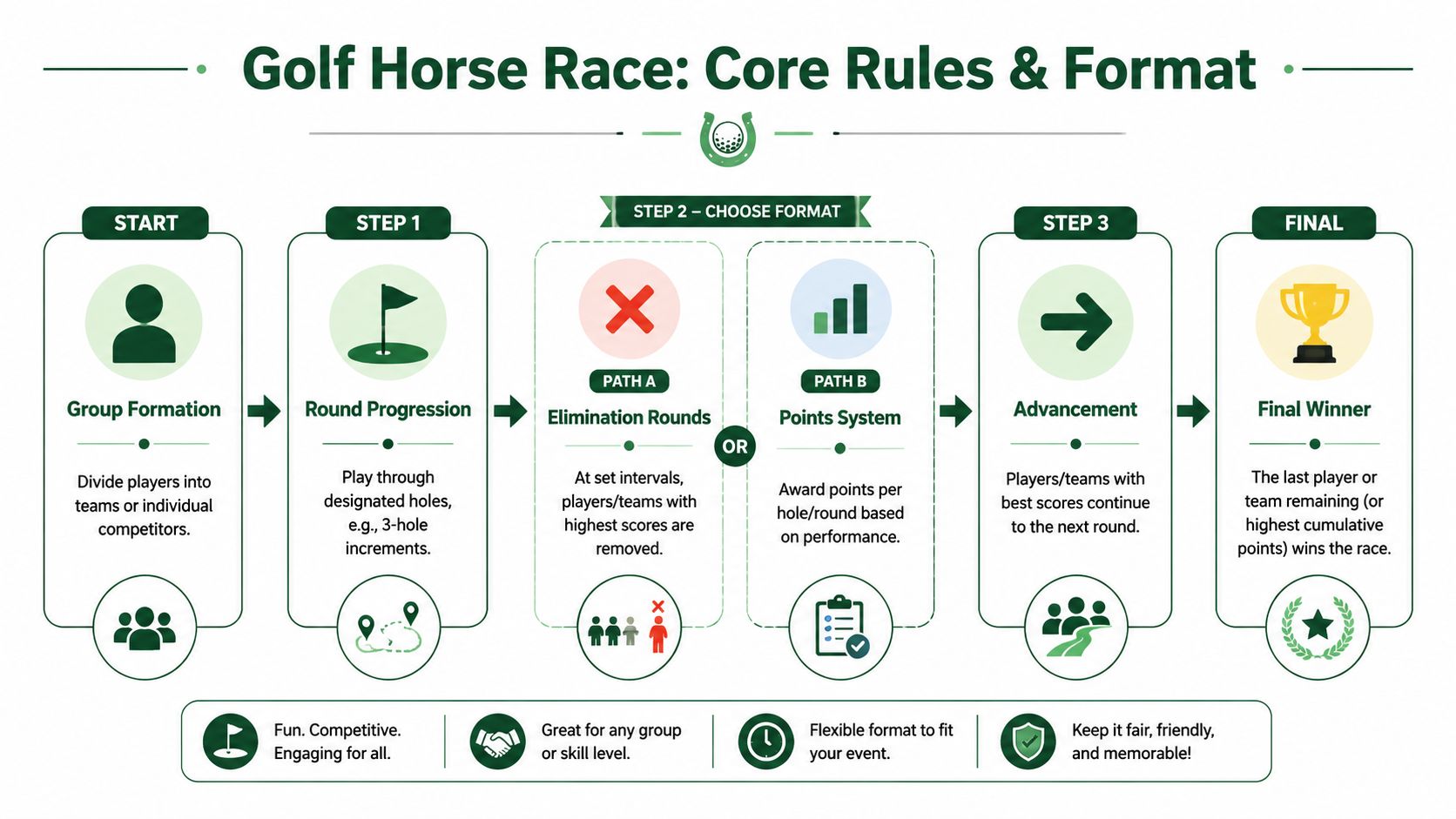
If the rules aren't clear before the first tee ball, the event gets messy fast. A golf horse race only works when players know exactly how elimination happens, how ties are broken, and whether the competition is gross or net.
The classic version is straightforward. Nineteen golfers start on the first hole, one golfer is eliminated on each hole, and the field shrinks until two players remain on the 18th hole, where the winner of that hole wins the event (Golf News on the horse race format).
A lot of operators choose the shorter version for practical reasons. Starting with 10 golfers over 9 holes reduces runtime and makes the event easier to fit into an afternoon schedule, especially when dinner, awards, or sponsor remarks are waiting.
The core rule set that keeps things moving
Most clubs use a version of this framework:
Set the field first. Decide whether the horse race is made up of qualifier winners, flight champions, sponsor picks, or buy-in entrants.
Choose gross or net scoring. Gross is cleaner for spectators. Net can widen participation if the field has a broad range of ability.
Eliminate the highest score on each hole. Keep the mechanic simple enough that players and spectators can follow it immediately.
Break ties immediately. Don't carry tied players forward unless you've written that into the format in advance.
Define the final hole clearly. Make sure everyone knows whether the final is a standard hole result, a nearest-the-pin playoff, or another stated tiebreak method.
The tie-break rule is the real rule
Most written explanations of a golf horse race spend too much time on the elimination concept and not enough on tiebreaks. Operationally, the tiebreak procedure is what determines whether the event feels sharp or sluggish.
Use one designated method and announce it before play starts. A chip-off is common because it resolves ties quickly and gives spectators something they can see. Some clubs use a putt-off if they have a consistent green-side setup and want less foot traffic in a landing area.
Practical rule: If your tiebreak method takes longer than a minute to explain, it's too complicated for a horse race.
Gross versus net
There isn't one correct answer here. There is only the answer that fits your field.
Use gross scoring when:
You want a clean spectator product. Everyone understands low score advances.
The field is elite or invitation-only. Club champions, top finishers, and low-index players usually prefer it.
You want fewer scoring discussions. Gross scoring removes handicap allocation questions.
Use net scoring when:
The event is part of a member-wide day. More players will feel they have a real chance.
You need broader participation. Net keeps mid-handicap entrants engaged.
You have confidence in your handicap setup. If the handicap work isn't clean, net can create friction.
What works and what doesn't
What works is a format card handed to every player, one starter giving the same announcement to the full field, and one official authorized to make final rulings on ties and scoring interpretation.
What doesn't work is improvising after the first dispute. Once you change a rule on the fly, every elimination feels negotiable. That's when the event loses pace and credibility at the same time.
Creative Variations and Payout Structures
Once you've run a standard horse race cleanly, you can start shaping it into a signature event. The right variation usually depends on your audience. Members may want bragging rights and tradition. Charity players may want action and entertainment. Corporate groups usually want something easy to understand with a polished presentation.
Format variations that actually translate on the ground
The strongest variations are the ones that preserve the central appeal. Elimination, visibility, and fast resolution.
A few formats tend to hold up well:
Two-player team horse race. Better for member-guest fields when you want partners involved to the end.
Alternate shot elimination. Good for stronger groups because it adds pressure without adding confusion.
Scramble team elimination. Useful in outings where the main field is already playing scramble and you want continuity.
Wildcard re-entry hole. A sponsor-friendly wrinkle if you want one extra dramatic moment and you've written the rule in advance.
The weak variations are usually the ones that get too clever. If spectators can't tell who's safe and who's out, you've lost the whole point.
Payouts shape behavior
Payout structure changes how players experience the event. Winner-take-all creates the sharpest tension, but it can also make early exits feel flat. A broader structure can keep buy-in strong and reduce complaints about variance or one bad bounce.
Payout Model | Pros | Cons |
|---|---|---|
Winner-take-all | Maximum drama, easy to explain, strongest final-hole energy | Early eliminations may feel like dead money |
Top three finishers | More players feel they have equity deeper into the event | Slightly softens the final-hole stakes |
Hole-by-hole bounties | Keeps spectators engaged throughout, creates sponsor moments | More administration during play |
Mixed model | Balances excitement with broader reward | Needs clear communication before entry |
If you need help aligning prizes with the rest of your event economics, this guide on payouts for golf tournaments is a useful planning reference.
Betting pools need structure, not guesswork
Friendly wagering can add energy, but random picks aren't very interesting. A better approach borrows from horse-racing handicapping logic. The source material on betting strategy emphasizes evaluating strength of opposition, surface or condition fit, margins, and historical performance rather than relying only on recent finishing position, which is a smart way to make side pools more thoughtful in a golf setting (horse racing betting strategy ideas).
Applied to golf, that means people shouldn't just pick the morning medalist. They should consider who fits the closing holes, who handles pressure, and who tends to avoid big mistakes.
If you're going to offer a side pool, make it interesting enough that people debate it before the first elimination.
For presentation, small details help. Branded player gifts or finalist identifiers can make the horse race feel like its own event inside the event. If you're outfitting staff or finalists, Design custom golf caps can fit naturally into that package without overcomplicating operations.
Managing Pairings and On-Course Event Flow
A golf horse race falls apart in the same way most special contests do. Not because the idea is bad, but because movement on the course isn't controlled.
You need a field that arrives together, a clear place for spectators to gather, and a plan for what happens after every elimination. The biggest operational threat is tie density. Golf Compendium notes that ties, especially early, often force repeated chip-offs and can materially slow the pace, which is one reason many organizers prefer the shorter format when time is tight (Golf Compendium on derby pace-of-play issues).
How to set the field without creating resentment
The cleanest entry methods are usually one of these:
Qualifier-based entry. Top finishers from the main event earn spots. Players accept it because the pathway is earned.
Flight winner entry. Useful in member-guest formats where multiple groups have a claim.
Optional buy-in field. Simple for social events, but only if the rules are posted early.
Invitational field. Best reserved for club traditions where everyone understands the selection logic.
If the event is tied to side action, Calcutta-style ideas, or audience wagering, it helps to think through pool mechanics in advance. This overview of pari-mutuel golf formats is a useful reference point for structuring that side of the event cleanly.
Flow control on the course
Once the field is set, logistics matter more than theory.
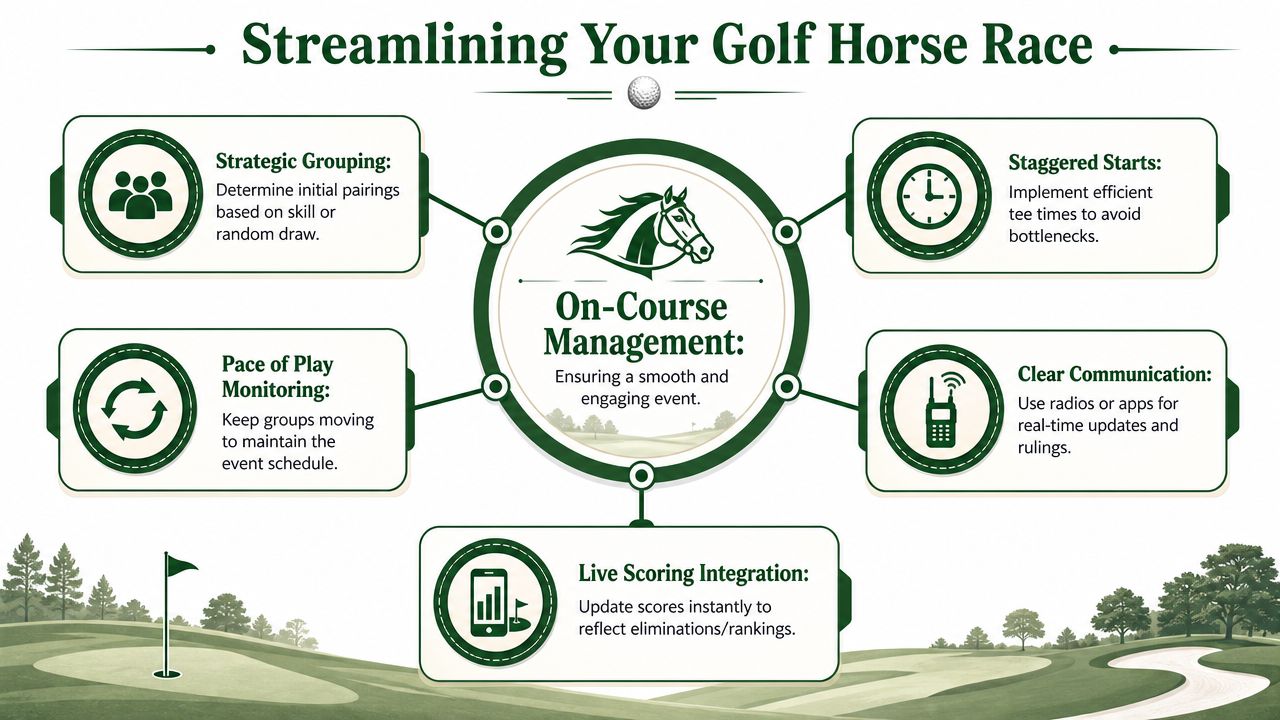
Use a dedicated starter. Put one staff member or official in charge of announcements, order of play, and tie-break instructions. Don't split that voice across the pro shop, a marshal, and a volunteer.
Then control these four areas:
Cart staging. Keep eliminated players from clogging the next movement zone.
Spectator lanes. Rope or mark where people should stand, especially near the final green and any chip-off area.
Tie-break station. Use one visible, pre-selected area. Players should know where to go without asking.
Score confirmation. Confirm scores before anyone moves to the next tee.
What polished events do differently
They reduce decisions during the event.
The more questions your staff has to answer after each hole, the slower and less professional the horse race feels.
That means pre-printed pairing sheets, one radio channel for officials, and one written script for the starter. It also means resisting the urge to keep everybody in foursomes once the field gets small. As players are eliminated, shrink groups aggressively so the remaining competitors aren't waiting on ceremonial spacing.
A horse race should feel tighter with every hole. If it feels slower as the field shrinks, the operator is losing control of the event.
Common Pitfalls and How to Troubleshoot Them
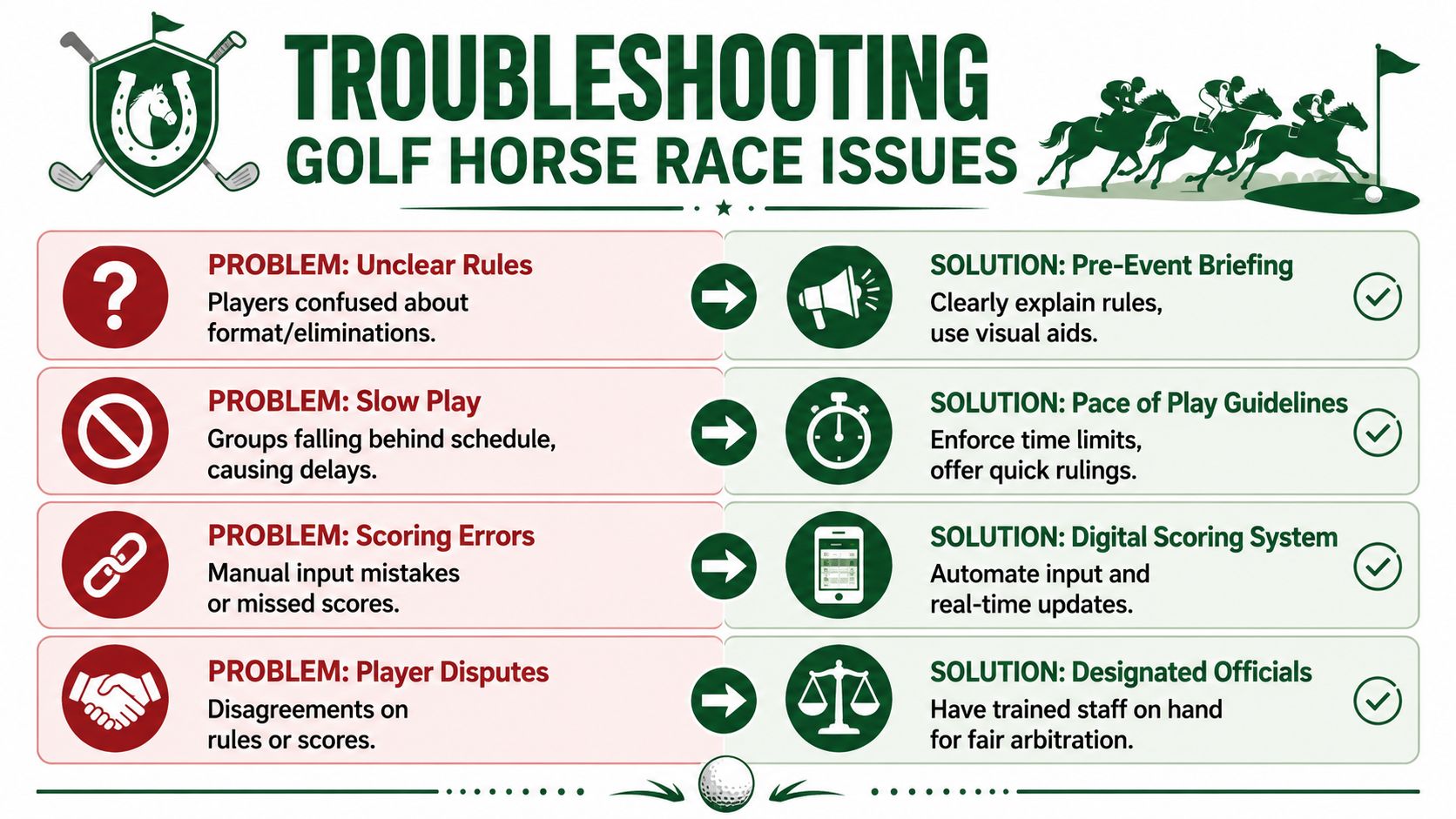
Most horse race problems are predictable. They come from unclear rules, slow tie resolution, scoring confusion, or a field that wasn't sized for the available daylight. The fix is rarely heroic. It's usually administrative.
The rules dispute problem
This usually shows up after a tied hole, a conceded putt question, or a disagreement about whether the format is gross or net. By that point, you're already late if the answer isn't written down.
Use a one-page competition sheet and read the key points aloud before the start. Then authorize one rules official or committee chair to make the final decision on-site.
If two players challenge a ruling, stop the discussion and send it to the designated official.
If a player wants to revisit the format itself, don't debate it mid-event.
If the issue affects payout, apply the posted rules and document the decision after play.
The scoring error problem
Paper score relays create lag, and lag creates arguments. In a format where one hole can end a player's day, everybody wants immediate clarity.
When a score comes in wrong, don't let the group disperse. Hold the players at the green, verify hole scores, and announce the ruling before anyone moves. If the event uses digital input, make one person responsible for confirming the official score, even if several people can see the running board.
Bad information spreads faster than corrected information. Lock the score before you announce the elimination.
The daylight problem
This is the issue that catches otherwise experienced operators. The event ran long, dinner is waiting, and ties are stacking up.
If you're losing light, use pre-authorized compression rules. That could mean a shorter closing loop, a faster tiebreak method, or a double elimination on the next hole if your posted conditions allow it. What you can't do is invent a new ending after players have already bought into one format.
The atmosphere problem
Sometimes the horse race is technically fine but feels dead. Usually that's because no one can tell what's happening.
Fix that with live announcements, visible score updates, and intentional crowd placement. If spectators can hear the ruling, see the players, and understand who's out, the event will carry itself. If they can't, the energy drains no matter how good the players are.
How to Run Your Horse Race with Live Tourney
Manual scoring struggles in a horse race because the format changes hole by hole. One elimination changes pairings, updates the audience view, and can trigger a tiebreak immediately. Paper boards and radio relays can handle that, but they require more staff attention and leave more room for delay.
A web-based scoring setup is cleaner because it keeps the event visible while staff stays focused on officiating and flow. That matters most when the field gets small and the audience gets larger.

Where digital tools help most
For a golf horse race, software doesn't need to be fancy. It needs to do a few things well:
Roster control. You need to know who's in, who's out, and who advances.
Live visibility. Spectators and staff need one current view of the event.
Fast score entry. The scorer shouldn't be walking scores back and forth.
Clear outputs. Pairings, cart signs, and player lists should already exist before the first ball is struck.
If you're comparing workflows, this overview of golf score tracking is a good starting point for thinking through how live scoring changes event operations.
A practical setup for event day
The cleanest process is usually this:
Build the horse race field in advance. If it's qualifier-based, don't wait until the crowd is standing on the tee to decide the entrants.
Assign one scoring owner. Even if players can enter scores, one staff member should monitor the official feed.
Publish the leaderboard link early. Put it in the pre-event text, the registration email, and on signage near the clubhouse.
Display it near the finish area. A monitor near the final green or clubhouse patio helps spectators follow the eliminations.
Train staff on tie scenarios. The technology should support the event, not make your team stop and troubleshoot in front of players.
Using Live Tourney for a horse race
Live Tourney is a web-based tournament platform that can handle roster setup, live scoring, and real-time leaderboard display without requiring players to download an app. For a horse race, that means staff can manage entrants, update scores as holes finish, and keep a current leaderboard visible on phones or a screen near the action.
What matters in practice is the app-free access. In a horse race, participation drops if players or guests need extra steps just to follow along. A simple scoring link keeps things moving and reduces the usual friction around adoption.
What good execution looks like
The best-run digital horse races still feel human. The starter announces the tee. The official confirms the score. The crowd reacts. The screen supports the moment instead of replacing it.
Don't over-automate the theater. Use the scoring platform to remove clerical delay, then let your staff focus on the parts guests remember:
Calling out eliminations
Moving players efficiently
Directing the crowd
Keeping the final holes visible and clean
Closing with an awards moment that starts on time
When those pieces line up, the horse race becomes easier to run and much easier to sell internally as a recurring feature of your event calendar.
If you're building a cleaner process for live scoring, pairings, and real-time leaderboard display, Live Tourney is worth a look for golf tournaments, leagues, and outings that need a simple web-based setup without app downloads.





