Jun 23, 2026
dad miller golf course tee times, dad miller golf, anaheim golf courses, book golf tee times, orange county golf
Your guide to booking Dad Miller Golf Course tee times. Learn how to book online, by phone, or walk-up, plus get insider tips on rates and best times to play.

You're probably doing one of two things right now. You're either refreshing the booking page trying to land a playable weekend slot, or you're wondering why a straightforward municipal round at Dad Miller can feel harder to pin down than it should.
That confusion usually comes from treating Dad Miller like a generic public course. It isn't. Dad Miller Golf Course tee times sit inside a very specific operating model. The course carries local history, regular public demand, junior activity, and a booking window that rewards players who understand how the tee sheet is managed. If you know the logic behind the system, getting a better time gets much easier.
Securing Your Round at Dad Miller
A common mistake is assuming Dad Miller is just another city course where you can casually decide on Thursday that you want a prime Saturday morning tee time. Sometimes that works. More often, it doesn't.
Dad Miller has the kind of reputation that keeps demand steady. The course's connection to Tiger Woods, who played there during his high school years in the early 1990s, helped cement its reputation as a credible junior-development venue in Orange County, influencing its tee sheet priorities to this day, as noted in the Dad Miller Golf app listing. That matters because a course with junior credibility doesn't manage tee times the same way a sleepy weekday muni does.

Why the course feels competitive
At Dad Miller, availability isn't just about public demand. It's also about how the course preserves flexibility for leagues, junior play, and the normal last-minute churn that every busy public operation deals with. That's why local players who book well tend to act early and stay flexible on start time.
Practical rule: If you only want one narrow tee-time band, you're making Dad Miller harder than it needs to be.
The better approach is to build a plan around your real priority. If pace matters most, aim for earlier starts. If value matters most, look later in the day. If you're just trying to get on property and play, don't dismiss less glamorous windows.
The local-player mindset
Good Dad Miller booking habits look a lot like good tournament-planning habits. You watch the window, act when it opens, and keep a second-choice time ready. That's the same discipline that helps operators manage tee sheets elsewhere, including at busy public facilities covered in pieces like this look at Big Met tee times.
Dad Miller rewards golfers who understand one simple point. The course isn't trying to frustrate you. It's trying to keep the tee sheet usable for everyone.
Your Three Paths to Booking a Tee Time
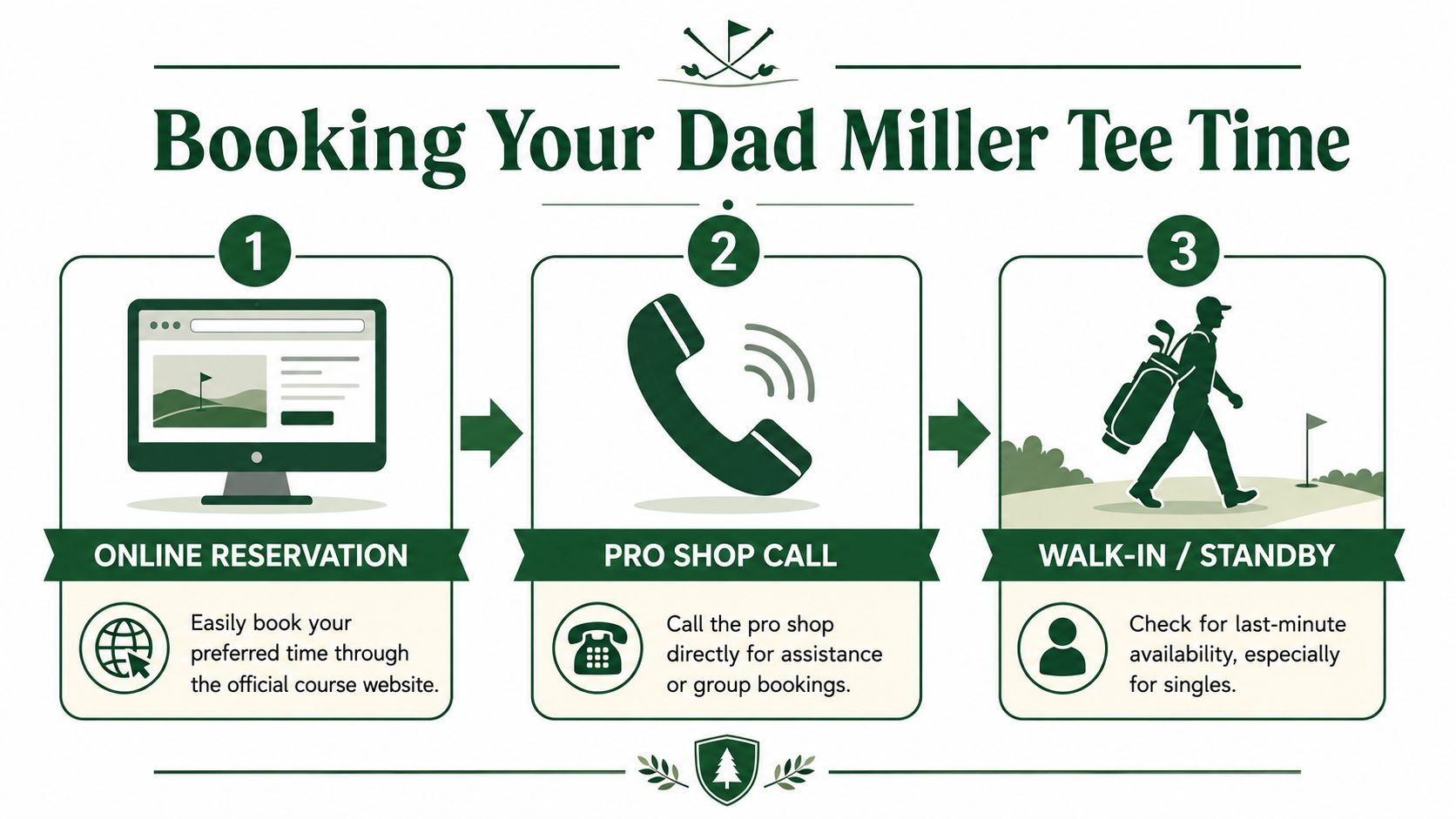
There are three realistic ways to get on the sheet at Dad Miller. Each works. Each also has a different use case.
Book online when you know what you want
The cleanest route is the course's online system. Dad Miller's standard online booking system lets players reserve up to 7 days in advance without additional fees, a setup designed to balance revenue with walk-on demand and league play in a busy Southern California market, according to the official tee-time booking page.
That tells you two things right away.
The window is short on purpose. This isn't an oversight. It protects the course's flexibility.
Speed matters inside that window. If you want a desirable slot, don't wait around once your day becomes available.
Use the online path when your group size is simple and your date is firm. It's best for singles, twosomes, and standard foursomes that don't need special handling.
Call the pro shop when your situation is messy
Online systems are good at clean transactions. They're less useful when the main question is, “Can you fit us around another commitment?” or “What's the best option if we need to stay close together but not necessarily in one exact block?”
That's where a call helps. Have your preferred day, backup day, group size, and flexible time range ready before you dial. The staff can usually guide you faster when you sound organized.
A phone call also makes sense when you're comparing formats. Golfers who travel often already know this. The same way people compare websites for booking Vilamoura golf to see which booking channel best matches their trip, local players should think about booking method as a strategic choice, not just a convenience.
Call when the request has moving parts. Click when it doesn't.
Try walk-up or standby when flexibility is your edge
Walk-up play still has a place at Dad Miller, especially for singles or golfers who don't mind waiting for an opening. This path works best when your main advantage is patience.
A few practical realities matter here:
Singles have the best chance because they can slide into gaps more easily.
Rigid foursomes have the toughest path without a reservation.
A later-day mindset helps because schedules loosen as the day unfolds.
Walk-up doesn't mean random. It means using the natural movement of a public tee sheet to your advantage.
Which path works best
Here's the simplest way to choose.
Situation | Best path |
|---|---|
You know the day and want a normal round | Online booking |
You have special timing needs or a larger party | Pro shop call |
You're solo or highly flexible | Walk-up / standby |
What doesn't work is mixing the worst parts of all three. Don't wait too long to book online, refuse to call, and then expect a walk-up miracle with a full group at a prime hour. That's how players turn a manageable process into a frustrating one.
Beating the Crowds and Finding the Best Rates
Getting a tee time is one job. Getting the right tee time is the better one.
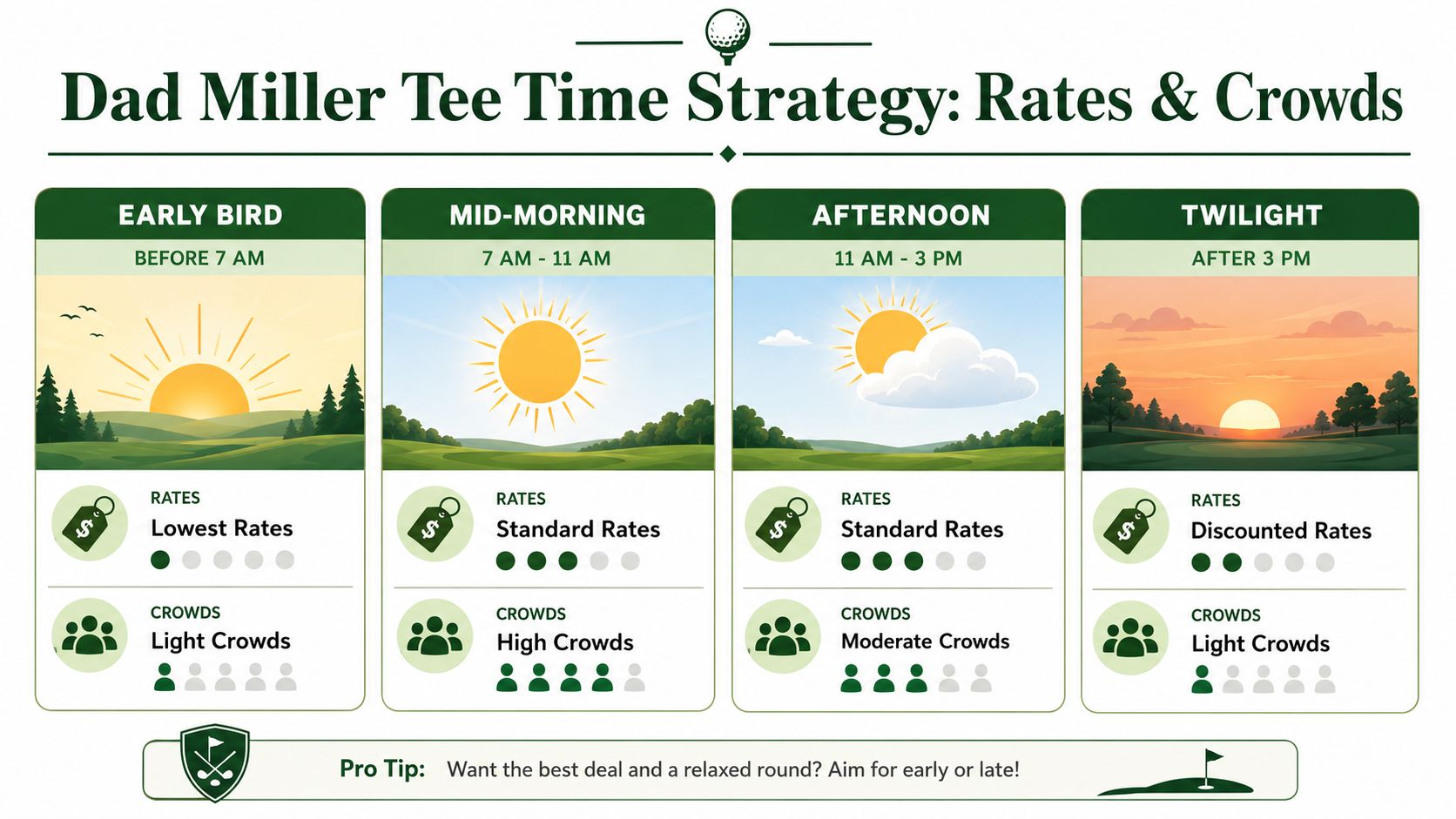
Dad Miller lists multiple daily price points ranging from $27 to $74, depending on the day and start time, and the course enforces minimum separation between groups to reduce stacking and protect pace of play, according to Fairway Finder's Dad Miller listing. For players, that means timing affects both cost and on-course experience.
What the rate spread tells you
A course doesn't post a wide price range by accident. It's using pricing to shape demand across the day. Prime windows carry the strongest demand, while later or less desirable slots become the value play.
That creates a simple trade-off:
Pay more for priority if you want the most conventional start windows.
Pay less for flexibility if you're comfortable with afternoon or twilight conditions.
Experienced public-course players gain an edge through their discerning approach. They stop asking only, “What's available?” and start asking, “Which slot gives me the best mix of pace, price, and finish conditions?”
The best plays by golfer type
Different players should attack Dad Miller differently.
The pace-first player should lean early. Earlier starts usually reduce the odds that you spend the whole round waiting on every tee.
The value hunter should watch later-day inventory. That's often where the best cost relief shows up.
The social foursome should avoid chasing only the most obvious mid-morning windows, because that's where the broadest public demand tends to bunch up.
Better value at a public course usually comes from accepting a small compromise in start time, not from hunting for a miracle discount.
A simple decision table
Your priority | Best general target |
|---|---|
Fastest rhythm | Early start |
Lowest posted rate | Late-day slot |
Easiest group coordination | Shoulder times rather than peak mid-morning |
Most predictable full-round conditions | Earlier half of the day |
The pacing piece matters more than many golfers realize. Courses create tee-time separation for a reason. When players or operators crowd the sheet too tightly, the entire day drags. At a place with steady public demand, one poor spacing decision can ripple through multiple groups.
That's why the sharp move at Dad Miller isn't always the “best” clock time on paper. Often it's the slot where demand, price, and pace line up in your favor.
Planning for Groups and Special Events
Group golf is where players run into the biggest misunderstanding. They assume the public booking system will eventually show what they need if they just wait long enough. It won't.
Any event involving tee times beyond 7 days out has to be coordinated directly with course management because the standard public booking channel won't show those slots, as noted on the Dad Miller green fees and program page. For outings, leagues, and small tournaments, that changes the process completely.
What organizers should do instead
Start with a direct conversation, not the online tee sheet. Come prepared with the basics:
Headcount clarity so staff can judge whether you need a loose cluster or a true block
Time-range flexibility instead of one rigid start demand
Format details if you're doing anything beyond a casual group round
Backup plans in case the ideal wave isn't practical
Course staff aren't just placing names into empty slots. They're fitting your event into a live operating calendar that may already include public play pressure, league considerations, or junior activity.
What usually goes wrong
The classic mistake is treating a group outing like a bigger version of a foursome booking. It isn't. Once you need multiple times held together, you're asking the course to protect inventory and manage flow across a portion of the day.
That's why organizers should think in terms of tee-sheet architecture, not just reservations. If you want a useful comparison of how another busy public facility fits event play into daily operations, this breakdown of Brookside Golf Club scheduling realities is worth a read.
Group golf works best when the organizer respects the course's scheduling limits before asking for exceptions.
Understanding Cancellation Policies and Etiquette
At a busy public course, cancellation habits are part of golf etiquette. They're not just administrative rules.
Dad Miller's tee sheet works because players either use the time they book or release it early enough for someone else to grab it. When golfers hold times they no longer need, then cancel late or do not show, they create dead space that staff often can't refill cleanly. On a high-demand course, that hurts everyone. The course loses flexibility, walk-up players lose opportunity, and the flow of the day gets harder to manage.
The standard you should follow
If your plans change, cancel as soon as you know. Don't wait until the last minute because you're “still deciding.” That habit is one of the quickest ways to make a public tee sheet less functional.
A good rule is simple:
If you can't make it, release it early
If your group size drops, update it
If weather or timing becomes uncertain, call instead of guessing
A canceled tee time is useful. A silent no-show is not.
That mindset also helps you as a player. Courses remember golfers who communicate clearly. Staff can often work with players who handle changes responsibly. They have far less patience for players who treat prime tee times like placeholders.
Dad Miller Quick Reference Guide
When you're booking Dad Miller Golf Course tee times, the easiest rounds usually come from having the key details in one place and making one clean decision instead of bouncing between tabs, aggregators, and old listings.
Dad Miller Golf Course is open for play Monday through Friday from 6:00 AM to 6:45 PM, has extended hours on Tuesdays, and opens at 6:00 AM on weekends, according to the Yelp business listing for Dad Miller Golf Course. That gives players a dependable operating window for morning, midday, and later-day planning.

The essentials at a glance
Item | Details |
|---|---|
Address | 2400 N. Harbor Blvd, Fullerton, CA 92835 |
Phone | (714) 765-3481 |
Website | |
General hours | Early morning through evening, with Tuesday extended hours and weekend openings from 6:00 AM |
On-site options | Public golf and additional facility use that can support practice-oriented visits |
How to use this information well
The practical takeaway is straightforward. Use the official site when your request is simple, call when your situation needs staff input, and treat listed hours as a planning baseline rather than an excuse to cut your arrival too close.
If you like comparing nearby public-course logistics before you commit to a round, this look at the Fullerton Golf Course scorecard and setup helps frame how local municipal options differ in rhythm and player fit.
Dad Miller is at its best when you approach it like a course with structure, not like a course with endless open inventory. Respect the booking window, choose your time based on your real priority, and you'll usually get a much better result.
If you run outings, leagues, or tournaments and want a cleaner way to manage pairings, registrations, score entry, and live leaderboards, Live Tourney is worth a look. It's built for golf operators who want a modern, app-free system that's easier for staff to run and easier for players to use on any device.