
Aug 21, 2026
32 man bracket double elimination, double elimination bracket, tournament bracket, bracket setup, live scoring
Learn how to build and run a 32 man bracket double elimination tournament with match counts, seeding rules, and live scoring tips for 2026.

The head pro is standing at the scoring table an hour before the doors open, looking at a printed 32 man bracket double elimination sheet with one hand and a stack of blank scorecards with the other. The stations are only half ready. Two teams haven't checked in. A volunteer wants to know where a first-round loser goes, and the first match hasn't even been called.
That morning is where most double-elimination events are won or lost. The bracket itself is easy to understand on paper. The difficult part is keeping player movement, match slips, court assignments, scores, and timing aligned while both sides of the bracket are moving at once. This guide treats the format as a run sheet for a real event, not just a diagram. By the end, you'll know what needs to be ready before play starts, how to label every match, how to budget for the reset final, and how live scoring can remove the manual score chase that causes late-day confusion.
What You're Actually Walking Into on Event Morning
At the venue, the first job isn't explaining double elimination to players. It's proving that the field is complete. A 32-team field is a power-of-two field, so the opening round can run without byes, but that advantage disappears if an expected team is missing and the director leaves an empty slot on the sheet.
The pre-opening checklist
Before calling the first match, confirm these items in a deliberate order:
Player count: Verify that all 32 entrants are present, assigned, and eligible to play.
Bracket display: Put the bracket where players can see it, either printed in a large format or projected where the match paths are readable.
Seed list: Make the seed order visible at the scoring table and on the working bracket.
Match materials: Stage match slips, score sheets, pencils, clips, and spare copies before the opening whistle.
Losers-bracket routing: Mark exactly where each winners-bracket loser will enter, rather than relying on memory.
Court or station plan: Assign the opening matches and identify which spaces will receive the next wave.
Scoring ownership: Name one person responsible for collecting and entering every result.
The printed bracket deserves more attention than it usually gets. A clean sheet with strong contrast, clear match identifiers, and enough room for scores gives volunteers a working document instead of a crowded poster. If you're preparing a large packet of event materials, this practical guide to artwork prep for event prints can help you avoid illegible files and last-minute print problems.
Practical rule: Never let a volunteer decide where a loser goes by looking for an open line. Give every match a destination before play begins.
The first hour should feel slightly over-organized. Keep a master bracket at the scoring table, a public bracket for players, and a queue showing matches that are ready, active, or waiting for a feed-in. That separation matters because the public display answers “where do I play?” while the master sheet answers “what must happen next?”
A clean single-day finish depends on respecting the format's workload from the start. If the director treats the losers bracket as an afterthought, the event may appear on schedule early and still collapse near the end, when tired operators are managing the most consequential matches.
How a 32-Team Double-Elimination Bracket Works
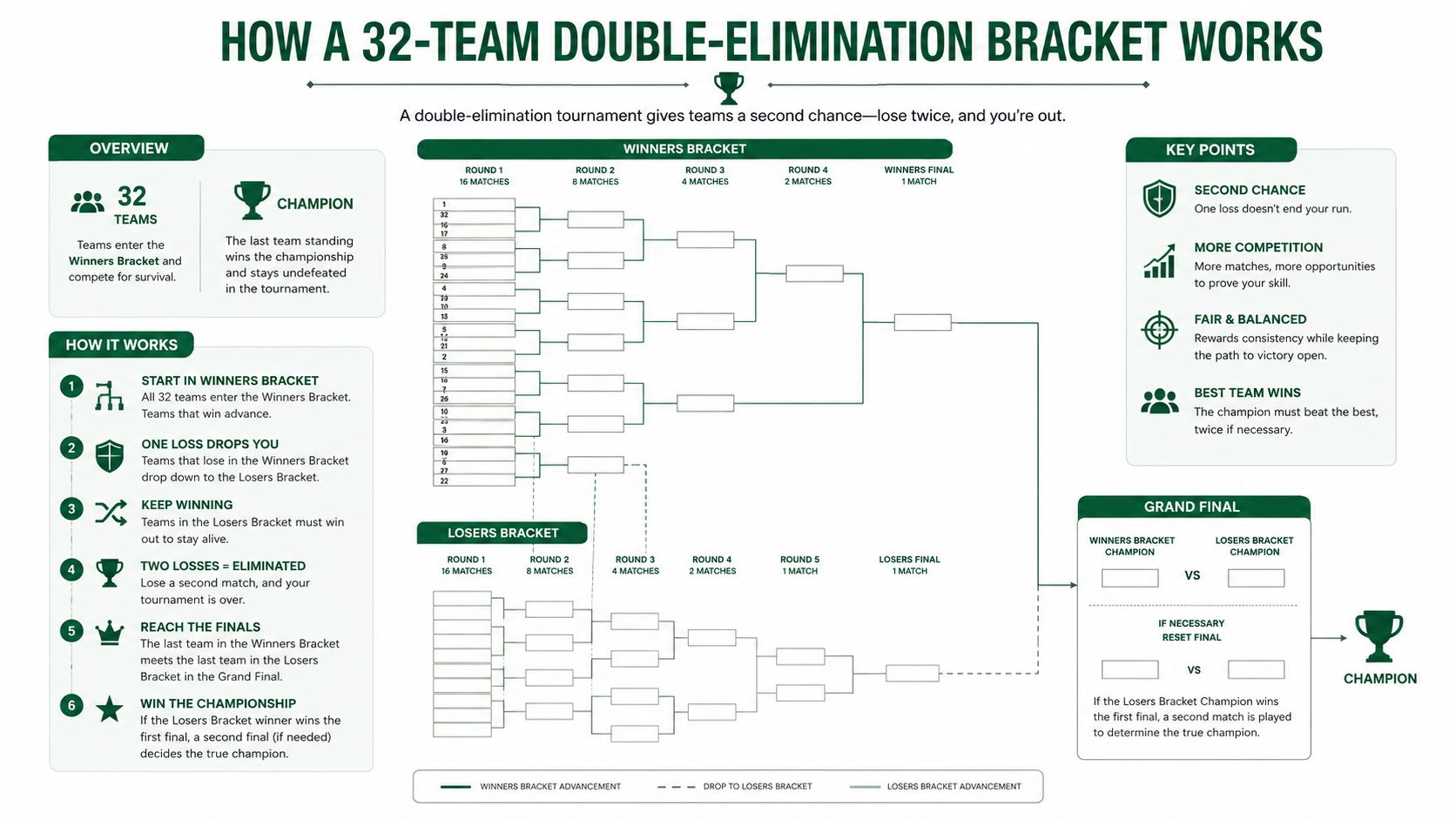
A double-elimination bracket gives each entrant two losses before elimination. Every team begins in the winners bracket. A first loss moves that team into the losers bracket, while a second loss removes it from the event. The winners-bracket champion and losers-bracket champion then meet for the title.
A field of 32 fits this structure cleanly because 32 is a power of two. The opening round contains 16 matches, followed by 8, 4, 2, and 1 in the remaining winners-bracket rounds. There are no byes in a properly filled field, so the director doesn't need to explain why one team advanced without playing or create play-in matches to repair the draw. The standardized power-of-two design is one reason these fields are common in tournament administration, as described in the double-elimination tournament overview.
The two paths
Think of the winners bracket as the clean path and the losers bracket as the recovery path.
Opening placement: Seed or place all 32 entrants in the winners bracket.
First loss: Move the defeated entrant into the correct losers-bracket slot.
Losers-bracket survival: The entrant must keep winning while carrying one loss.
Second loss: Remove the entrant from the tournament.
Championship meeting: Send both bracket champions to the grand final.
The winners side contains 31 matches before the championship round because it reduces 32 entrants to one undefeated finalist. The losers side also contains 31 matches in the standard maximum structure before the grand final, and the final itself may require one or two games depending on the reset rule. That creates the familiar 62-match baseline and 63-match maximum for a full 32-team event with a reset, as outlined in this guide to a 32-team double-elimination bracket.
Double elimination rewards consistency rather than one perfect run. A team can recover from an early mistake, but it can't survive a second one. That balance is the reason organizers choose the format when a single bad result shouldn't immediately define the entire tournament.
For the director, the key mental shift is simple: you're not running one bracket that happens to have extra lines. You're running two connected competitions with different entry points, different match loads, and a shared championship finish. A well-built digital or printable bracket should make those connections obvious. Tools that help organizers create and publish brackets can also reduce the setup burden, as shown in this tournament bracket creation guide.
Winners Bracket, Losers Bracket, and Match Numbering
Seed the 32 entrants first, then assign every opening pairing a permanent identifier. Don't rename matches because a court changes or a team withdraws. Match IDs should remain stable throughout the day so the scorekeeper, announcer, runner, and players are always referring to the same contest.
The winners-bracket map
The winners side has five rounds:
Winners Round 1: 16 matches, producing 16 winners and 16 losers.
Winners Round 2: 8 matches, producing 8 winners and sending 8 losers downward.
Winners Round 3: 4 matches.
Winners Round 4: 2 matches.
Winners Round 5: 1 winners-bracket final, producing the undefeated finalist.
Label those matches consistently, such as W1-M1 through W1-M16, then W2-M1 through W2-M8, continuing through W5-M1. A volunteer should be able to hear “W3-M2” and find the correct slip without asking which court hosted it.
The losers-bracket map
The losers bracket is eight rounds deep for a 32-player field. Its feed-ins arrive in waves, not all at once. Early winners-bracket losers enter earlier and therefore face a longer survival route. A player eliminated in winners round one must win eight straight losers-bracket matches to reach the championship match, a demanding path that affects both scheduling and fatigue.
The first losers-bracket wave combines four first-round losers, each carrying a 0-1 record, with two first-round winners from the lower-side structure carrying a 1-0 record. Later waves receive losers from the winners bracket at staggered points. That uneven flow is why a director must verify advancement logic against a round map before the event starts. The 32-team bracket progression guide describes the depth and routing that make this structure more complex than a simple knockout.
Round | Bracket | Matches | Feed-In |
|---|---|---|---|
W1 | Winners | 16 | 32 entrants |
W2 | Winners | 8 | W1 winners |
W3 | Winners | 4 | W2 winners |
W4 | Winners | 2 | W3 winners |
W5 | Winners | 1 | W4 winners |
L1 | Losers | 6 | Early W1 losers and lower-side winners |
L2 | Losers | 6 | L1 winners and next winners-bracket losers |
L3 | Losers | 4 | Prior losers-bracket winners and feed-ins |
L4 | Losers | 4 | Prior losers-bracket winners and feed-ins |
L5 | Losers | 2 | Prior losers-bracket winners and feed-ins |
L6 | Losers | 2 | Prior losers-bracket winners and feed-ins |
L7 | Losers | 1 | Remaining lower-side competitors |
L8 | Losers | 1 | Losers-bracket final |
Use the table as an operational map, not as decoration. Print the round code on every slip. For example, the volunteer packet for L4-M2 should identify the two source matches, the station assignment, and the destination match if the result is a win or loss.
A bracket isn't finished when it's printed. It's finished when a tired volunteer can advance a team correctly without asking the director.
Keep a separate feed-in list at the scoring table. When W2-M3 ends, record the loser immediately, then confirm the destination L2 match before calling the next contest. This small pause prevents the common late-day mistake where a team is technically ready but nobody knows which slot belongs to it.
Paper templates can still work well for a small crew, especially when the director has rehearsed the routing. If you want to compare that structure with a simpler consolation model, this 8-team single-elimination bracket with consolation helps clarify why consolation play isn't the same as a connected losers bracket.
The Grand Final and the Bracket Reset Rule
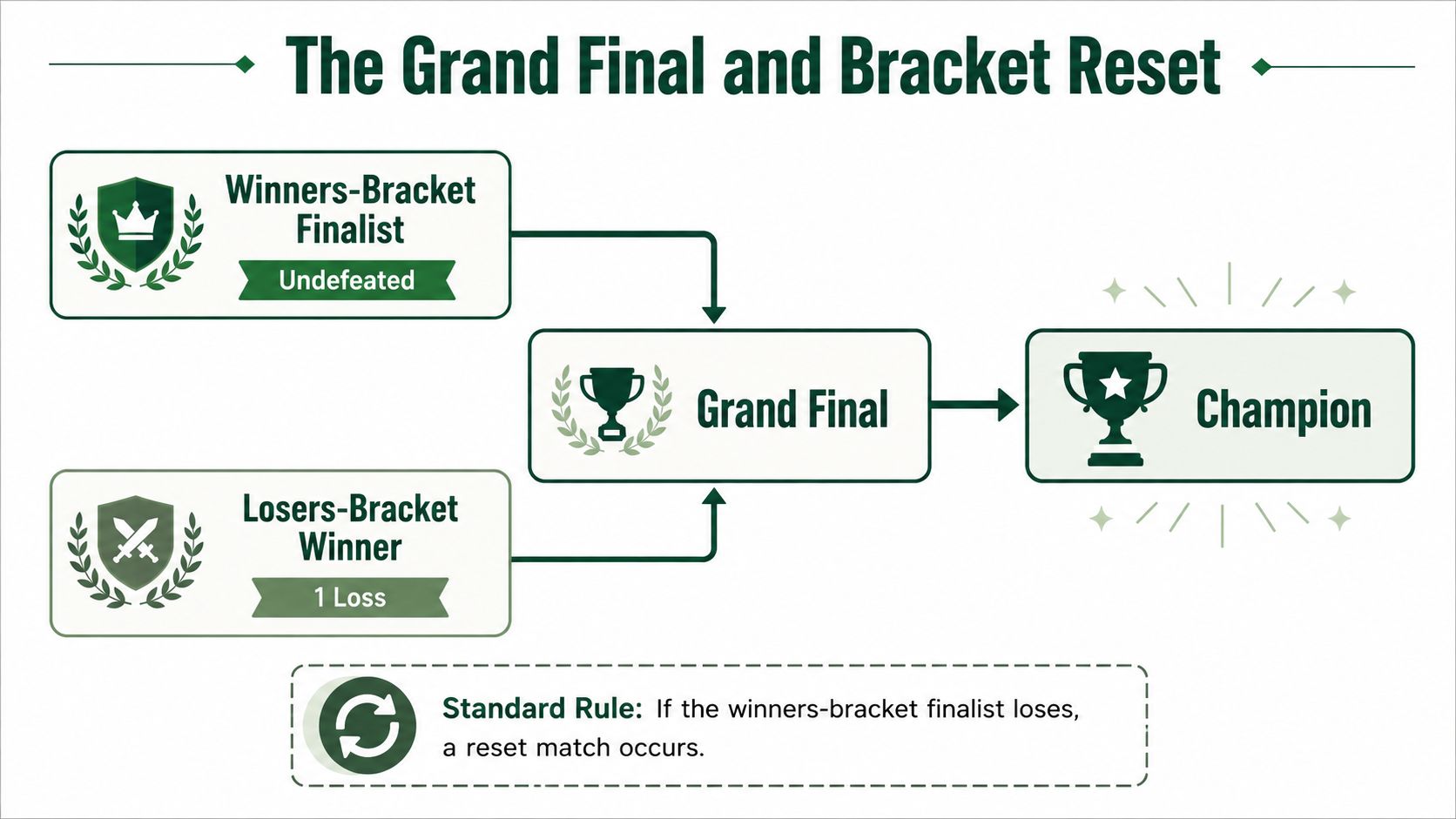
The grand final is deliberately asymmetrical. The winners-bracket finalist arrives undefeated, while the losers-bracket winner already has one loss. Under the standard rule, the winners-bracket finalist needs one victory to take the title. The losers-bracket champion must win twice because the first victory would give that player or team a first loss, not a second.
What the reset means on the clock
Write the championship slots as GF and GF Reset, sometimes abbreviated GR. The sequence works like this:
The undefeated winners-bracket finalist plays the one-loss losers-bracket champion in GF.
If the winners-bracket finalist wins, the event ends.
If the losers-bracket champion wins, that player or team has now given the other finalist a first loss.
GF Reset is played to decide the championship.
The reset isn't an administrative curiosity. It adds a full match to the end of the day, often 20 to 40 minutes depending on game length, so the crew needs a reserved station, officials, score materials, and a communication plan. The match window should remain available even if everyone hopes it won't be needed.
The no-reset alternative awards the championship after the first grand-final match, sometimes using an “if necessary” setup that doesn't provide a second title match. That approach saves time, but it weakens the logic of double elimination because the undefeated finalist can lose once and still be declared champion without a return contest.
Schedule the reset before the final begins. If you wait to decide after the first game, you're already behind.
For a competitive 32-team event, the explicit-reset format is the stronger choice. It preserves the second-chance principle all the way through the championship and is easier to defend when participants have invested a full day in the bracket. The small time cost is real, but so is the credibility cost of changing the rule when the final becomes inconvenient.
The public announcement should state the rule before play starts. Put it on the event sheet, explain it during the captain briefing, and mark the reset slot on the visible bracket. Players shouldn't learn the championship conditions only after one finalist wins the opening grand-final game.
Match Counts, Round Map, and Time Budget at a Glance
The director needs more than the headline number. A 32-team single-elimination bracket needs 31 matches to produce one champion, while a full double-elimination schedule requires 62 matches at minimum and 63 when a bracket reset is played, according to the practical bracket breakdown from PrintYourBrackets. The workload consists of 31 winners-bracket matches, 31 losers-bracket matches, and the grand final, with the reset adding the final slot when required.
A working time model
The table below applies the stated match length to the complete maximum schedule. It is a planning model, not a promise, because court changes, warmups, disputes, breaks, and delayed feed-ins can extend the day.
Match Length | Winners Bracket | Losers Bracket | Grand Final + Reset | Total Matches | Estimated Run Time | Day Feasibility |
|---|---|---|---|---|---|---|
20 minutes | 31 matches | 31 matches | 2 matches | 63 | 21 hours of single-station match time | Requires parallel stations or multiple days |
30 minutes | 31 matches | 31 matches | 2 matches | 63 | 31.5 hours of single-station match time | Requires substantial parallel capacity |
45 minutes | 31 matches | 31 matches | 2 matches | 63 | 47.25 hours of single-station match time | Not practical on one station or a short single day |
Those totals describe serial match time across one station. With a 30-minute average match, the event represents roughly 12 hours of match time when distributed across parallel courts or stations, a workload that can fit a single day only when capacity is planned rather than assumed. An independent bracket calculator estimates 8 hours on 2 fields or 4 hours on 4 fields, excluding breaks, which illustrates how strongly venue capacity changes the schedule, as shown in this 32-team double-elimination time calculator.
The director's practical question is therefore not “Can I print this bracket?” It is “How many active stations can I keep staffed, and what happens if the reset is needed?” If the answer depends on every match ending exactly on time, the schedule is too tight.
Printable Templates and a Live Scoring Workflow
A printable template gives the director control, visibility, and a dependable offline backup. Start with a blank 32-team double-elimination PDF, enter the seeds before players arrive, and keep extra copies at the scoring table. As each match finishes, write the score, circle the winner, cross out the eliminated team when appropriate, and copy the advancing team into the next slot.
That process works until the bracket starts moving faster than the paperwork. The director calls the score to a runner, the runner updates the wall sheet, a volunteer searches for the next matchup, and a player asks whether their team is in L4 or waiting for a result. Smudged ink and rewritten names make the public bracket harder to trust.
Two workflows, one backup plan
Printable workflow | Live-scoring workflow |
|---|---|
Seeds are written onto a master sheet before play. | Seeds are published once in the digital bracket. |
A scorekeeper records each result by hand. | A player or scorekeeper enters the result on a phone or tablet. |
The runner copies winners and losers to destination slots. | Downstream matches populate from the recorded result. |
Players ask staff to confirm the next match. | The current match and queue remain visible online. |
Corrections require careful erasing or rewriting. | The operator can review and correct the entered result. |
A platform such as Live Tourney can publish a match-play bracket, assign unique match identifiers, accept score entry from a phone or tablet, and update the bracket as results are recorded. Its broader scoring workflow is also described in this golf tournament scoring software guide, but the operational principle applies directly here: score entry should advance the bracket instead of forcing the director to relay every result manually.
The strongest setup uses both methods. Publish the live bracket so players can check their path and current assignment, then keep a printed summary at the scoring table for connectivity problems, disputes, or a device failure. The paper copy shouldn't be the primary engine of the tournament, but it should be ready to preserve continuity if the digital workflow stops.
Give every match a unique identifier in both systems. When a score arrives for L6-M1, the operator should know exactly which bracket slot to update and which players are waiting next. That one convention reduces the “what's next?” conversation that consumes a surprising amount of a director's attention.
Run-Day Risks and How to Stay Ahead of Them
The three risks that hurt a 32-team double-elimination event most are predictable: the reset final, late losers-bracket feed-ins, and operator fatigue from chasing paper scores. None of them comes from the diagram. They come from treating a connected schedule like a loose collection of matches.
Reset risk
Don't put “reset if needed” in tiny print at the bottom of the run sheet. Reserve it as an explicit second championship window after GF, with the same officials and station held available. If the first final decides the title, release the crew. If it doesn't, start GF Reset without rebuilding the day around a surprise.
Feed-in delays
Losers-bracket matches shouldn't be called as though every player is already available. Stagger the start windows so the next lower-bracket wave is ready when the relevant winners-bracket results arrive. A round map, visible queue, and dedicated runner will keep early losers from disappearing into the crowd while later entrants wait for their destination.
Manual score fatigue
Paper score sheets force the director to become a messenger. Replace that constant relay with live result entry where possible, then use the printed summary as a backup rather than the primary source of truth. Keep a 20-minute buffer per round, assign one runner to move slips and confirm feed-ins, and set a hard cutoff before the first match begins. The exact cutoff depends on the venue, but the decision must be made before fatigue makes it for you.
A clean event day has a visible queue, named responsibilities, and a reset plan that everyone understands. A 32-team field can finish smoothly when the staffing and station capacity match the schedule. It won't finish smoothly if the director budgets only for the bracket's logic and ignores the people who must operate it.
Live Tourney gives tournament staff a way to publish match-play brackets, collect scores from phones or tablets, and keep player assignments visible as results move through the event. Visit Live Tourney to see how its live scoring and tournament management tools can support a connected bracket workflow.





