
Oct 5, 2026
match play scoring system, golf tournament formats, golf scoring rules, match play handicaps, live golf scoring
Master the match play scoring system with this detailed guide. Learn terminology, handicap rules, formats, and scorecard management for golf events.

The first tee time is less than an hour away. Players are asking whether a conceded putt needs to be recorded, volunteers are trying to update a bracket, and the clubhouse leaderboard still shows total strokes instead of holes won. Everyone understands that the event is match play, but the scoring workflow feels more complicated than a normal tournament.
That confusion is avoidable. A match play scoring system becomes manageable when you separate three tasks: deciding the result of each hole, applying handicap strokes correctly, and recording the match state immediately. The rules are different from stroke play, so your pairing sheets, score entry process, leaderboard, and staff instructions need to reflect that difference from the start.
Why Match Play Changes the Tournament Experience
At a club championship, two players can reach the final green with completely different score totals and still have a close match. One golfer may have recovered from a poor hole by winning the next one. The other may have played steadily but failed to convert enough holes. The result isn't determined by the lowest total for the round. It comes down to who won more holes.
That format creates a different kind of pressure. A disastrous hole usually costs one hole, not a permanent addition to a cumulative total. A player who's behind can take a calculated risk because winning the next hole changes the match immediately. A tied hole doesn't create a growing stroke deficit either. It leaves the match in the same state.
The history of elite golf reflects how important this format once was. The USGA explanation of match play under Rule 3 notes that the PGA Championship used match play for its first 39 editions, from 1916 through 1957, before changing to stroke play in 1958. Modern events still use the format because head-to-head competition is easy for spectators to understand, even when the administration behind it requires careful preparation.
Where organizers feel the difference
A stroke play administrator can collect completed scores and rank players by total strokes. A match play administrator must know which hole was won, whether it was halved, whether a concession ended the hole, whether a handicap stroke applied, and whether the match has already become mathematically decided.
That affects the whole event:
Pairings must be unambiguous: Players need to know their opponent, starting hole, handicap allowance, and reporting method.
Staff need match-state language: “One up,” “all square,” and “three and two” must mean the same thing to scorers, players, and spectators.
Leaderboards need the right data: A match status such as “4 up with 3 to play” is more useful than a stroke total that doesn't determine the winner.
Software needs early-finish logic: The system must close a match when the lead is greater than the holes remaining, rather than waiting for a full round submission.
The player experience feels spontaneous, but the organizer's process shouldn't be. Match play rewards confident decisions on the course only when the committee has built a clear system behind them.
Core Concepts and Essential Scoring Terminology
The foundation is simple: the hole is the scoring unit. Golfers compare their results on each hole, not their accumulated strokes across the round. The player or side with fewer strokes wins the hole, equal scores halve it, and the match score changes by no more than one up or down increment on any hole, as described in this overview of match play scoring.
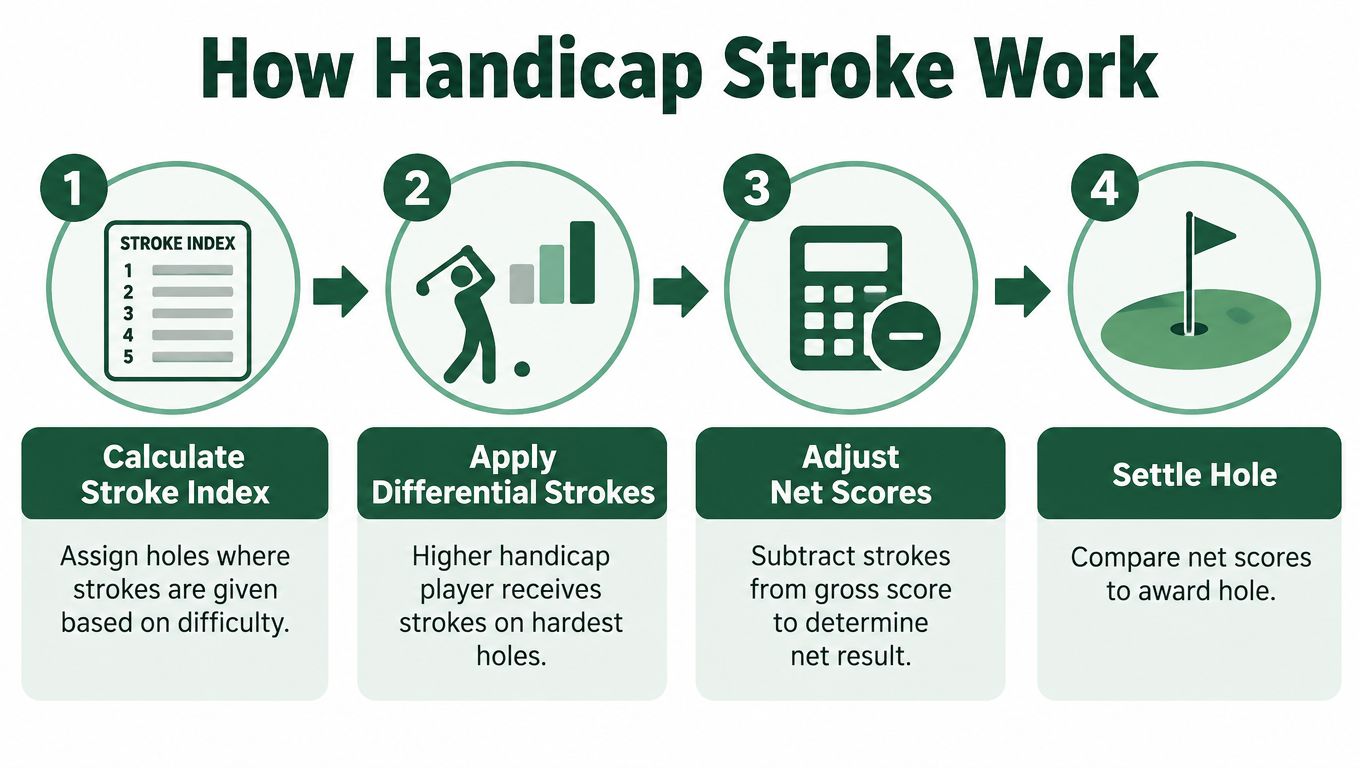
Read the match state in four steps
Compare the hole. Determine each player's gross score, or net score if handicaps apply.
Assign the result. The lower score wins the hole. Equal scores produce a halved hole.
Update the running state. A winner moves one hole up, while the loser moves one hole down. A halved hole leaves the state unchanged.
Check whether play can continue. If one side leads by more holes than remain, the match is over.
Suppose a player is 4 up with 3 to play. The trailing player can win the remaining holes, but can't erase a four-hole deficit. The match ends at that point. The same logic explains a result such as 3&2, which means the winner is three holes ahead with two holes left, so the remaining holes can't change the outcome.
Vocabulary your volunteers should use
All square means the players have won the same number of holes. It describes a tied match at any point, not necessarily the end of the round.
Up and down describe the current advantage. A player who's won more holes is “up,” while the opponent is “down.” The number refers to the hole margin, not the number of strokes saved.
Halved means neither side wins the hole. The players may have used different strategies or taken different numbers of strokes in other holes, but the hole itself produces no change in the match state.
Dormie describes a lead equal to the number of holes remaining. It signals that the leading side can't lose the match, although the match may continue if the event rules require all remaining holes to be played or if the format uses a different procedure.
A leaderboard should show both the margin and the holes remaining. “Player A, 3 up” is incomplete if spectators don't know whether the match has reached the point where it can finish. “Player A, 3&2” communicates the result clearly.
Practical rule: Train scorers to report the margin first and the remaining holes second. Never ask them to infer a winner from total strokes.
For a practical rules reference that staff can keep alongside their pairing sheets, use the match play rules guide. It should supplement, not replace, the committee's published conditions of competition.
Navigating Handicaps and Net Match Play Rules
Handicap match play uses net scores, so the lower-handicap player does not compare gross totals with the higher-handicap player. The lower-handicap player gives strokes to the higher-handicap player on the holes identified by the course's stroke index. The hole result then comes from the adjusted net scores.
The USGA Rule 3 handicap match play guidance states that the World Handicapping System recommends an allowance of 100% of the handicap difference between players for individual match play. That gives organizers a direct starting point, but the committee still needs to publish how the allowance is converted into strokes on the scorecard or digital setup.
A practical setup follows this sequence:
Establish each player's relevant course handicap under the event conditions.
Calculate the difference between the two players.
Give the full difference to the higher-handicap player when the event uses the WHS recommendation.
Assign those strokes to the appropriate stroke-index holes.
Compare net scores on each hole, then record win, loss, or halve.
Consider a lower-handicap player against a higher-handicap player. The higher-handicap player receives strokes on the hardest holes first, according to the card's stroke index. If the handicap difference extends beyond the number of holes, the committee's published handicap procedure determines how additional strokes are applied. The software should display the allocation before play begins, so players aren't trying to reconstruct it beside the green.
What organizers should verify before play
Handicap disputes usually come from configuration, not arithmetic. A tournament administrator should check that the event uses the intended handicap type, the correct course and tee, the correct stroke index sequence, and the correct allowance. Mixed formats may use different committee provisions, so don't assume that an individual match setting applies to a team event.
Players who need background on the underlying handicap calculation can review this resource on portable handicap index explained. It can help separate the player's handicap information from the event's match play allowance, which are related but not interchangeable settings.
A digital match setup should show the actual hole-level effect. Staff should be able to answer, “Does the higher-handicap player receive a stroke here?” without opening a spreadsheet or calculating from memory. If a player disputes a hole, the scorer can inspect the assigned stroke, the gross entries, and the resulting net comparison.
For additional operational guidance, see handicap scoring in golf. The key administrative principle is consistency. Once the committee publishes the allowance and applies it uniformly, every hole follows the same net-score decision process.
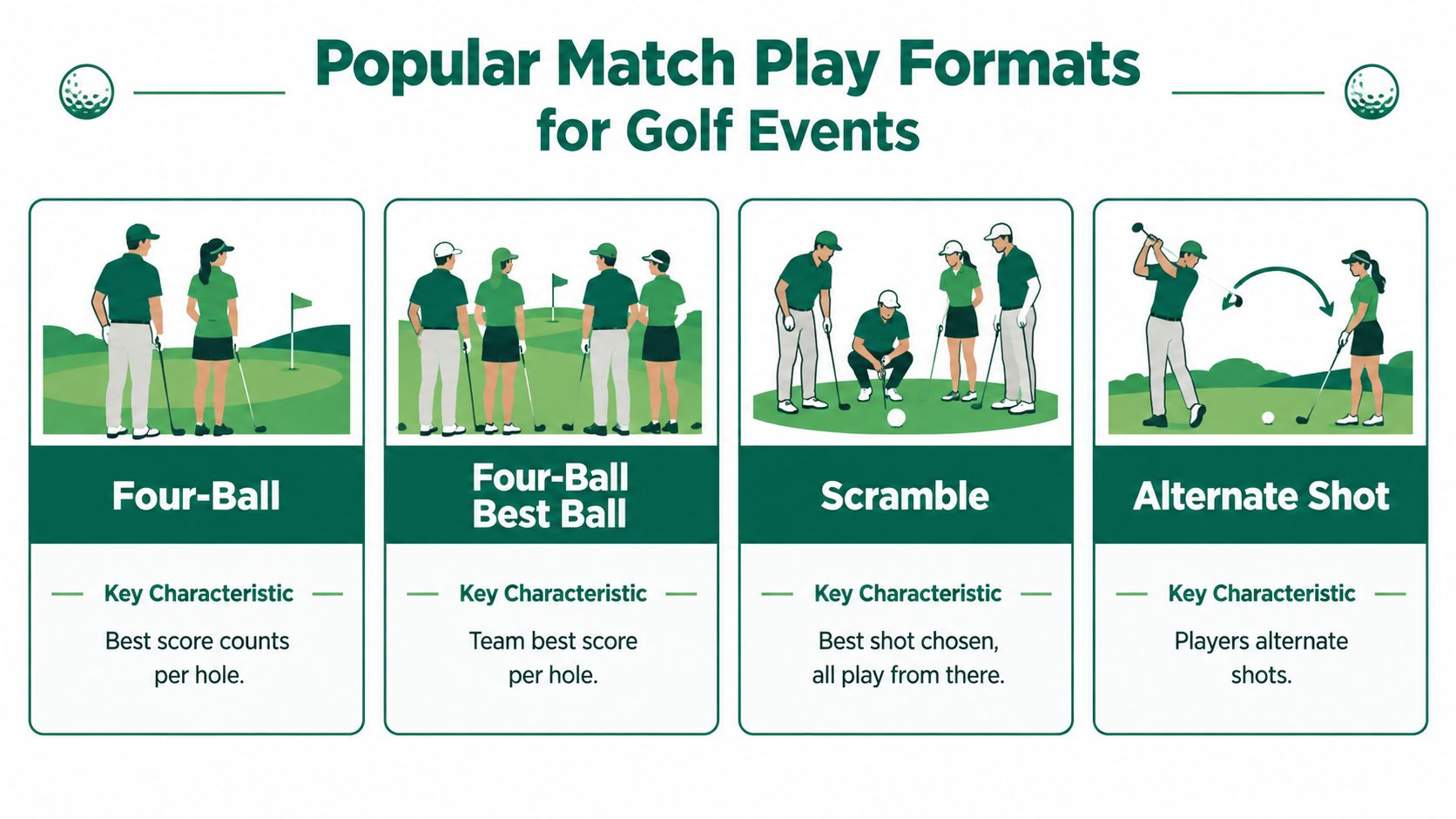
Popular Match Play Formats for Golf Events
Singles match play is the easiest format to administer because one player competes directly against one opponent. Each player records a score on every hole, the lower applicable score wins, and the running status belongs to that single pairing. Club championships often favor this structure because the bracket is easy to explain and the result is easy to verify.
Team formats add another layer. The committee must define how partners contribute to the hole result, how handicaps are applied, and who enters the final team score. The match play scoring system still produces only a hole result, but the path to that result changes.

Four-ball and better-ball structures
In four-ball, each partner plays their own ball. The side's result on a hole comes from the better score designated by the event rules, whether that is gross or net. The administrator needs separate player entries because a team's best result may come from either partner on different holes.
That creates a useful software requirement: the system should capture both individual scores while displaying the team result. If one partner records a lower net score, the other player's score still matters for verification and may matter in a different side game, report, or tie situation.
Foursomes and alternate shot
In foursomes, partners share one ball and alternate strokes. The team doesn't have two independent scores to compare. Staff must know which partner tees off on the relevant holes, because the starting order affects the sequence of shots and the score entry workflow.
Foursomes can suit events that want stronger team identity and a distinct pace dynamic. Four-ball gives each golfer an independent ball and more recovery options, while alternate shot makes every decision shared. A committee choosing between them should consider player familiarity, pace expectations, and whether its scoring tool can represent the format without forcing volunteers to improvise.
Team match play and Ryder Cup-style events
A Ryder Cup-style event may combine singles, four-ball, and foursomes across a larger competition. Each individual match needs its own state, while the overall event may award a point or other result for the team competition. A halved match or halved hole must be handled according to the published event conditions, not assumed from a standard singles setup.
Use a format matrix before opening registration:
Format | Ball responsibility | Hole result source | Main setup risk |
|---|---|---|---|
Singles | One ball per player | Individual gross or net score | Incorrect opponent or handicap |
Four-ball | One ball per partner | Better designated score | Team result not tied to player entries |
Foursomes | One shared ball per side | Team alternate-shot score | Wrong starting order |
Team match play | Depends on the event | Match-level or team-level condition | Confusing match points with hole status |
The format determines what the scorer must enter. Don't ask a four-ball team to submit only a single unexplained number, and don't configure foursomes as if two independent scores decide the hole.
Managing Concessions and Tie-Breaker Scenarios
A match can become final before every ball reaches the hole. A player may concede the opponent's next stroke, the hole, or the entire match. Under the Rules of Golf, that decision is final and can't be declined or withdrawn, as explained in this PGA guide to match play.
For scoring, a conceded stroke counts as completed. The player does not need to hole the ball, so the scorer must be able to close the hole without waiting for another physical score entry. Treat the concession like a status change in a match ledger, not like a missing score.
Build concession handling into the workflow
Publish the reporting process before the first tee time. A practical sequence is:
The player states the concession clearly to the opponent.
The opponent confirms whether it ends the stroke, hole, or match.
The scorer records the concession as the event that ended the hole or match.
The system updates the match state immediately.
Staff retain an audit trail if someone later questions the result.
Do not replace a conceded stroke with an estimated score. The concession is the match play event that determines the result. A platform that accepts only completed hole scores may leave the hole open, show the wrong margin, or require players to enter a score that never occurred. The software should identify the concession type and preserve who recorded it and when.
Set the procedure for tied matches
A match that is all square after the scheduled holes needs a published committee procedure. The conditions of competition should specify whether play continues hole by hole, which hole begins the extension, whether handicap strokes carry forward under the format, and how the final result appears in the bracket.
The USGA explanation of how tied matches are extended hole by hole supports the operational choice to continue until one side wins. The tournament system therefore needs an “extra holes” state. A tied match should not be forced into either completed or cancelled status.
Set up test cases before registration closes:
A match ends early because the lead is unreachable.
A hole is halved while the match remains tied.
A player concedes a stroke.
A player concedes the hole.
The scheduled holes end with the match all square.
The next hole produces the winning result.
For each case, verify the displayed match status, bracket result, player notification, and audit record. That check catches configuration errors before volunteers face them on the course.
A committee does not need a complicated player experience. It needs a precise internal record of what ended each hole and when the match became final.
Real-World Scorecard Walkthroughs and Examples
A paper scorecard can help players follow a round, but the administrator needs a hole-result ledger that reflects how the match is decided. Each record should contain the hole number, each side's gross or net result, the hole outcome, and the match state after that hole. In practice, this ledger works like a running account: every hole changes the balance, while total strokes do not determine the winner.
Consider a singles match between Player A and Player B. Player A wins the opening hole, so the match becomes one up. The second hole is halved, leaving Player A one up. Player B wins the third, returning the match to all square. The scoring workflow records those outcomes in sequence rather than comparing cumulative stroke totals.
Hole result | Match state after the hole |
|---|---|
Player A wins | Player A, 1 up |
Halved | Player A, 1 up |
Player B wins | All square |
Player A wins | Player A, 1 up |
Player A wins | Player A, 2 up |
Player B wins | Player A, 1 up |
A handicap stroke changes the comparison for that hole. The scorer must compare the net results, not only the gross scores. If Player B receives a stroke and both players record the same gross score, Player B may win the hole on net score. The event system should display the stroke adjustment beside the hole result, so an administrator can explain why the match state changed.
How an early finish appears
Suppose Player A leads 3 up with 2 holes to play. The result is recorded as 3&2, because Player B cannot draw or win the match with only two holes remaining. The remaining holes do not receive ordinary match results. The bracket can advance Player A, while the result report retains the finishing margin for players, officials, and later review.
A conceded putt requires the same careful treatment. Record the hole outcome created by the concession, rather than entering an estimated stroke count. The audit record should identify the hole, the player who conceded, the resulting winner, and the time the entry was confirmed. If that result makes the match mathematically final, the system should close the match immediately.
Under Rule 3.2a, a scorecard is not required in match play because the result depends on the sequence of hole outcomes, not an end-of-round total. A club may still issue paper cards or provide a digital record as an administrative aid. Staff should use that record to verify each hole, confirm the current margin, and catch an incorrect gross or net entry before it affects the bracket.
Streamlining Match Play with Modern Tournament Software
Paper cards and spreadsheets can record results, but they make match play administration fragile. Staff must update each hole, apply handicap information, identify early finishes, maintain brackets, and communicate changes to the clubhouse. A missed concession or incorrectly entered halved hole can leave the displayed match state wrong even when the players completed the hole correctly.
A web-based system should let players report results through a simple link, without requiring an app download. Staff can then review the entry, update the live leaderboard, and see which matches remain active. The essential features are practical rather than flashy:
Hole-level entry: Record each hole as won, lost, or halved.
Net-score support: Apply the published handicap allowance and stroke allocation.
Concession handling: Close a hole or match without forcing a fabricated score.
Bracket updates: Move winners forward when a match ends.
Live status displays: Show margins, remaining holes, and completed matches clearly.
Extra-hole support: Keep a tied match active until the committee's playoff procedure produces a winner.
For administrators comparing options, golf club event software provides useful context on the broader event-management category. A match-specific setup should still be tested with the exact formats, handicap rules, and reporting requirements used by your club.
Golf tournament scoring software should reduce manual interpretation, not hide it. Give staff a test event, enter a conceded hole, simulate an early result, and run an all-square playoff before opening the tournament to players. That short rehearsal exposes configuration problems while there's still time to fix them.
Live Tourney provides web-based tournament management with match play bracket setup, hole-by-hole scoring, and live leaderboard updates through a player-accessible link. For a league administrator, the practical objective is simple: publish clear conditions, configure the match rules once, and give players and staff a shared view of the current result.
Live Tourney helps golf clubs set up match play brackets, capture hole-by-hole results, and display live match states without requiring players to download an app. Visit Live Tourney to see how your next league or club tournament can move from manual score chasing to a clearer, more reliable workflow.





